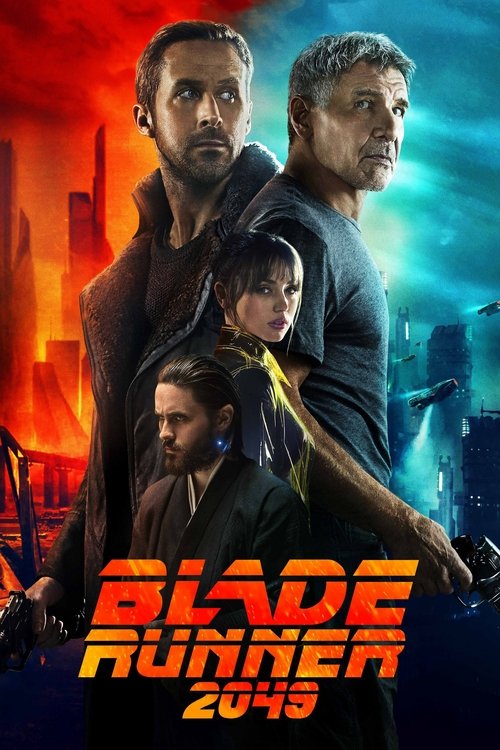
Blade Runner 2049
2017 · Denis Villeneuve
The "serious sci-fi" standard-bearer whose Dune films made slow, austere blockbusters a mainstream event, and whose hiring to direct James Bond set off a fresh round of "can an auteur save a franchise" debate. Perpetually invoked in arguments about whether spectacle can still be art.
For when you want to be swallowed by a world — a lights-off, phone-away, big-screen night. Patient viewing, but if you're craving atmosphere and images to get lost in, few films deliver more.
What it's about
Thirty years after the original, a new blade runner — Officer K, a replicant who hunts his own kind for the LAPD — turns up evidence of something long buried that could shatter the fragile line between manufactured beings and born ones. The trail leads him across a ruined, climate-wrecked California toward Rick Deckard, missing for three decades, and toward questions about his own past he may not want answered.
The experience
Slow, vast and hypnotic — a nearly three-hour mood you sink into, punctuated by bursts of violence and one of the loudest, most physical scores in modern movies. Melancholy is the dominant note; it's a detective story that aches.
Performances
Ryan Gosling carries it with a stillness that cracks in exactly the right places, Harrison Ford brings unexpected raw grief to his return as Deckard, and Ana de Armas is quietly heartbreaking as K's holographic companion.
The craft
Roger Deakins' cinematography — irradiated orange wastelands, drowned concrete, rooms of rippling light — finally won him his Oscar, and every frame earns the biggest, best screen and sound system you can access. Villeneuve directs at a deliberate, confident pace that lets the images breathe.
Why it matters
It underperformed in theaters but was immediately recognized as one of the great-looking films of its decade, proof that a legacy sequel could deepen its source rather than replay it, and it cemented Villeneuve as the premier director of serious large-scale science fiction.
Snapshot
Blade Runner 2049 is the long-delayed sequel to Ridley Scott's Blade Runner (1982), arriving thirty-five years after the original and set thirty years after it within the fiction. Directed by Denis Villeneuve from a screenplay by Hampton Fancher (co-writer of the 1982 film) and Michael Green, it follows K, a replicant LAPD officer who "retires" his own kind, as he uncovers evidence that a replicant once bore a child — a discovery that destabilizes the boundary between manufactured and born life and leads him to the vanished Rick Deckard. The film is at once a continuation, a meditation on the original's unresolved questions, and a distinct authorial work: slower, more austere, and more openly melancholic than its predecessor. It was a critical success widely praised for its craft, and it became a landmark of late-2010s effects-driven art cinema while underperforming relative to its substantial budget at the box office.
Industry & production
The project sat in development for years; a sequel had been discussed since at least the early 2010s, with Ridley Scott — director of the original — attached as a producer through his Scott Free banner alongside Andrew Kosove and Broderick Johnson of Alcon Entertainment, which financed the film. Hampton Fancher, who had written the original, developed the story and returned to script duties, later joined by Michael Green. Scott stepped back from directing, and Villeneuve, coming off Prisoners (2013), Sicario (2015), and Arrival (2016), took the chair, bringing a reputation for controlled, atmosphere-forward genre filmmaking.
Alcon co-produced and the film was distributed by Warner Bros. in North America and by Sony's Columbia Pictures internationally — an unusual split reflecting the financing structure. The budget was large, commonly reported in the rough range of $150 million or more, and the film's theatrical gross did not recoup that outlay against marketing and distribution costs, leading to public acknowledgment from the financiers that it had fallen short of commercial expectations. The exact figures circulate in trade reporting rather than audited disclosure, so precise profit-and-loss claims should be treated cautiously. The production shot primarily at Origo Film Studios in Budapest, Hungary, with additional location work, and the original Ridley Scott consulted as executive producer without day-to-day directorial involvement.
Technology
Blade Runner 2049 was shot digitally on the ARRI Alexa system, with cinematographer Roger Deakins — a long-committed advocate of digital capture by this point in his career — controlling image quality through large-format-oriented framing and meticulous lighting rather than film stock. The film's effects strategy blended large practical sets and miniatures with digital extension and CGI, an approach Villeneuve and his team favored to preserve a tactile, physically lit quality consistent with the 1982 film's model-built world.
The film's most discussed technological feat was the partial digital re-creation of a younger Sean Young as Rachael, the replicant from the original film, reprising her appearance for a brief scene. The work combined a performing double with digital facial reconstruction to render a character as she looked decades earlier — an early, prominent instance of the "digital resurrection" techniques that would become contentious across the industry. The depiction of K's holographic companion Joi also required extensive compositing and effects work to convey a projected, non-corporeal presence interacting with physical space, including a celebrated sequence in which Joi synchronizes her image with a physical woman. The visual effects, supervised by John Nelson with contributions from multiple houses, were recognized with the film's Academy Award for Visual Effects.
Technique
Cinematography
Roger Deakins's photography is the film's signature achievement and earned him his first competitive Academy Award after a long history of nominations. Deakins built the look around bold, saturated color fields — the sodium-orange dust of a ruined Las Vegas, the sickly green and amber of corporate interiors, the cold blue-gray of Los Angeles rain — each environment given a distinct, almost monochromatic palette. He favored stark, often top-down or single-source lighting, vast negative space, and architecture that dwarfs the human figure, extending the original's neo-noir vocabulary into something more abstract and minimalist. Where Jordan Cronenweth's 1982 cinematography was dense, smoky, and cluttered with light, Deakins's is clarified and sculptural, trading density for scale. Slow, deliberate camera moves and symmetrical compositions reinforce the film's contemplative register.
Editing
Joe Walker, Villeneuve's editor on Sicario and Arrival, cut the film at a deliberately unhurried pace; at roughly 163 minutes it is considerably longer than the original. The editing favors duration and held shots over montage, letting scenes breathe to the point of stillness — a strategy that drew some criticism for length but is integral to the film's meditative mode. Walker's cutting builds the mystery procedurally, doling out information slowly as K follows the trail, and uses elliptical transitions between the film's distinct color-coded environments to structure the journey.
Mise-en-scène / staging
Production designer Dennis Gassner, working with Villeneuve, constructed a future that extends the original's retrofitted decay into new registers of scale and emptiness. The 2049 Los Angeles is colder and more brutalist than the rain-soaked 2019 of the first film; the Wallace Corporation interiors are vast, water-rippled chambers of shadow and gold; the irradiated ruin of Las Vegas is a depopulated orange void studded with monumental statuary. Staging emphasizes isolation: characters are repeatedly placed as small figures within overwhelming spaces, dramatizing the film's concern with loneliness and the search for connection. Costume and set detail maintain continuity with the original's worn, lived-in textures while pushing toward greater austerity.
Sound
The sound design constructs a dense, oppressive sonic environment — low drones, mechanical hums, the roar of rain and wind — that often verges on the physically overwhelming, matched to Hans Zimmer and Benjamin Wallfisch's score. The score deliberately invokes Vangelis's analog-synthesizer work for the original through massive, distorted synthetic tones, while pushing them to abrasive, sub-bass extremes that are more confrontational than the 1982 film's romantic electronica. Sound functions less as accompaniment than as an enveloping presence, central to the film's immersive, dread-laden atmosphere.
Performance
Ryan Gosling anchors the film as K with a restrained, internalized performance suited to a character who is himself uncertain whether his feelings and memories are authentic. His minimalism — long stretches of near-silent watchfulness — places the emotional weight on micro-expression and physical bearing. Harrison Ford returns as Deckard, appearing in the final act with a weathered gravity that contrasts the younger replicant's controlled affect. Ana de Armas as the hologram Joi gives the film much of its warmth and pathos; Sylvia Hoeks plays the replicant enforcer Luv with brittle menace; Robin Wright is the steely Lieutenant Joshi; and Jared Leto plies the blind industrialist Niander Wallace with mannered grandiosity. Dave Bautista appears briefly but memorably in the opening as the replicant Sapper Morton.
Narrative & dramatic mode
The film operates as a slow-burning detective story in the noir tradition inherited from the original, but reorganizes that structure around questions of identity and origin. K's investigation is also a quest for self: the central mystery — whether a replicant child exists, and whether K might be it — externalizes his interior uncertainty about whether he is special, born, or merely manufactured and given implanted memories. The narrative repeatedly raises and withdraws the possibility of K's uniqueness, culminating in his recognition that he is not the chosen child but can nonetheless choose a meaningful act. This is a dramatic mode of melancholy and interiority rather than action, structured around revelation, disappointment, and a quietly redemptive sacrifice. The film withholds resolution on several threads — Deckard's nature, the coming replicant uprising — preserving the original's commitment to ambiguity.
Genre & cycle
Blade Runner 2049 belongs to science fiction's cyberpunk lineage and to the specific cycle of "tech-noir" the original helped found — the fusion of hardboiled detective narrative with a dystopian, corporate-dominated future. As a legacy sequel it participates in the 2010s wave of long-delayed continuations of canonical 1980s properties, but it distinguishes itself by treating that inheritance as material for art cinema rather than nostalgia spectacle. Within Villeneuve's filmography it sits between Arrival and Dune (2021) as part of his cycle of cerebral, large-canvas science fiction. It also belongs to a broader contemporary preoccupation in the genre with artificial consciousness, synthetic companionship, and the question of what constitutes authentic personhood.
Authorship & method
The film is most usefully understood as a convergence of strong authorial voices. Villeneuve directs with a recognizable signature — patient pacing, monumental scale, atmospheric dread, and a willingness to subordinate plot to mood — that he carried from Sicario and Arrival and would extend into Dune. He worked, as is his practice, with a tight company of collaborators. Roger Deakins's cinematography is so central that authorship is genuinely shared between director and DP. Editor Joe Walker and the Zimmer/Wallfisch scoring partnership were likewise drawn from Villeneuve's recent work or installed to serve his methods.
The writing reflects a different kind of continuity: Hampton Fancher's return links the sequel directly to the original's literary DNA and to Philip K. Dick's source novel Do Androids Dream of Electric Sheep? (1968), while Michael Green shaped the script into producible form. Ridley Scott's involvement as executive producer provided sanction and continuity without directorial control; reporting indicates creative differences over aspects of the story, though the specifics are best treated as trade rumor rather than established fact. The result is an unusual authorship in which an original creator hands a property to a younger director who reinterprets it through his own sensibility while honoring its foundational questions.
Movement / national cinema
The film resists tidy placement in a national cinema. Villeneuve is a Québécois (French-Canadian) director who emerged from Canadian cinema before moving into English-language Hollywood production; Blade Runner 2049 is an American studio film, financed and distributed through US companies, but physically produced in Hungary with an international crew. It is best situated within a transnational mode of prestige genre filmmaking — large-budget, auteur-driven spectacle made for global release — rather than any single national tradition. Its aesthetic lineage runs through the European-inflected art-cinema sensibility Villeneuve brings to Hollywood material.
Era / period
Blade Runner 2049 is a product of the mid-2010s studio landscape, when established intellectual property dominated tentpole production and studios increasingly entrusted major franchises to distinctive auteurs as a strategy for differentiation. It reflects the period's technical state of the art — mature digital cinematography, sophisticated photoreal effects, and the early normalization of digital de-aging and resurrection. It also captures a cultural moment increasingly preoccupied with artificial intelligence, virtual companionship, and the erosion of boundaries between the real and the synthetic — anxieties that the film's holographic Joi and its child-of-a-replicant premise render with unusual seriousness for a blockbuster.
Themes
The film's governing theme is the question that animated the original: what makes a being authentically human or alive, and whether memory, feeling, choice, and the capacity to love can be "real" if their bearer was manufactured. Where the 1982 film posed this through the replicants' desire for more life, the sequel extends it to reproduction — the idea that a replicant could be born rather than made collapses the last firm distinction between the categories. Around this center cluster several concerns: the authenticity of implanted memory and the longing for a meaningful origin story; loneliness and the substitution of artificial companionship for human connection, dramatized through K and Joi; the commodification of life under corporate power, embodied by Wallace's quasi-religious ambitions; and the possibility of dignity and meaning in choosing a selfless act even after one's hoped-for specialness is denied. The film is finally less about answers than about the persistence of yearning in beings told they cannot truly feel.
Reception, canon & influence
Critically, Blade Runner 2049 was strongly received, with particular acclaim for Deakins's cinematography, the production design, the score, and the ambition of mounting a contemplative art film at blockbuster scale; the most common reservations concerned its considerable length, deliberate pace, and the question of whether it added to or merely elaborated the original's ideas. It won Academy Awards for Cinematography and Visual Effects and was nominated in several other technical categories, finally delivering Deakins a long-overdue Oscar. Commercially it underperformed against its budget, a result its financiers publicly acknowledged.
Its influences run backward through the original Blade Runner and, behind it, Philip K. Dick's novel; through the noir and detective traditions the first film absorbed; and through Villeneuve's own prior science fiction. Looking forward, the film consolidated Villeneuve's standing as the era's foremost director of intellectually serious large-scale science fiction, directly enabling his subsequent Dune films. It influenced a wave of visual and atmospheric imitation across film, television, advertising, and games — the brutalist scale, monochromatic color fields, and sub-bass synthetic dread of "the 2049 look" became widely recognizable shorthand. It also intensified industry and cultural debate over digital recreation of performers, given its de-aged Rachael. Within the broader culture, it stands as a rare instance of a legacy sequel that earned genuine critical respect as a work in its own right, and its canonical status as one of the more substantial science-fiction films of its decade has solidified in the years since release.
A Deleuzian reading
The image that stays is a man made small.
The full Deleuzian reading of Blade Runner 2049 →
Reception
A box-office disappointment in 2017 despite rapturous reviews — 'too long, too slow' was the refrain — it's since been fully canonized as one of the great modern sci-fi films and the rare sequel argued to rival its original.
How Blade Runner 2049 was received, from release to now →
Influences: the films it descends from and the films it influenced
- Blade Runner (1982) — Establishes the tech-noir grammar 2049 inherits wholesale — atmospheric haze pierced by hard moving shafts of light, the rain-soaked neon megacity, and the detective-hunts-replicants frame that returning writer Hampton Fancher directly continues.
- Metropolis (1927) — Originates the figure-dwarfing monumental architecture that shrinks humans to specks, the compositional template for 2049's brutalist megastructures and the cavernous, near-empty halls of the Wallace Corporation.
- 2001: A Space Odyssey (1968) — Models the slow, deliberate pacing that subordinates plot to mood, holding shots long enough that scale and score make duration itself the expressive instrument.
- Solaris (1972) — Pioneers the meditative SF treatment of artificially recreated beings and the question of authentic personhood, privileging contemplative tempo over genre incident — the emotional register 2049 chases.
- Stalker (1979) — Supplies the atmospheric dread of the desolate, depopulated zone traversed in long takes through ruined landscapes, the sensibility behind 2049's irradiated Las Vegas and trash-mesa wastes.
- The Conformist (1970) — Vittorio Storaro's bold monochromatic color-field cinematography and expressionist single-source lighting that Deakins consciously channels in the amber Vegas interiors and saturated, color-blocked rooms.
- Children of Men (2006) — Demonstrates the seamless blending of practical sets with restrained CGI to build a grimy, wholly plausible near-future, the world-building realism 2049 adopts over clean spectacle.
- Her (2013) — The artificial companion rendered as genuine intimacy — Joi descends directly from Samantha — extending the question of whether love for a synthetic being is authentic.
- Ex Machina (2014) — A chamber-piece interrogation of artificial personhood built on clean single-source lighting, glass-and-concrete minimalism, and deliberately restrained performance, sharing 2049's formal vocabulary.
- Sicario (2015) — Forges the Deakins–Villeneuve working method 2049 runs on: figures dwarfed in vast hostile landscapes, dread accreted through restraint, and sub-bass sound design as a threat instrument.
- Arrival (2016) — The immediate stylistic precursor — restrained minimalist performance and slow, mournful SF that elevates emotional interiority and atmosphere over exposition and action.
- Drive (2011) — Inherits Drive's slow-cutting rhythms, digital neon palette (Roger Deakins extending Sigel's expressionist approach), and synthesizer-dominant score (Zimmer and Wallfisch) while extending the lone-protagonist-as-function motif into science fiction; the film consolidates and scales the aesthetic template Drive codified into prestige studio cinema.
- Dune (2021) — Directly enabled by 2049's prestige; carries forward the brutalist figure-dwarfing scale, monochromatic color fields, Joe Walker's patient editing, and the Zimmer sub-bass score architecture.
- Dune: Part Two (2024) — Extends the monumental staging and the proof that a contemplative, mood-first epic can hold blockbuster scale, refining the dwarf-the-human compositions 2049 standardized.
- The Creator (2023) — Adopts 'the 2049 look' explicitly — monochromatic atmospheric SF vistas, figure-dwarfing scale, and sub-bass dread — proving the aesthetic could be reproduced on a fraction of the budget.
- Rogue One: A Star Wars Story (2016) — Sets the immediate technical and ethical precedent for the digital recreation of a performer — Tarkin's CGI resurrection one year before 2049's de-aged Rachael.
- Annihilation (2018) — Contemporaneous dread-soaked art-house SF that prioritizes eerie, ambiguous mood and unhurried image-making over explanation, the same contemplative-blockbuster wager.
- Ghost in the Shell (2017) — Same-year live-action cyberpunk reconstructing the dense holographic neon megacity, drawing on the identical Blade Runner-derived production-design lineage of stacked vertical urbanism.
- 1917 (2019) — Deakins's immediately prior major work, where he developed the practical-source lighting philosophy and extended camera-subject choreography—particularly the low-angle tracking in enclosed spaces—that he and Mendes then carried directly into 1917's pre-production design.
- Star Wars: The Last Jedi (2017) — Sibling in large-format expressive color-blocking and negative-space isolation, placing single figures against vast monochrome fields as compositional argument.
- Alien: Romulus (2024) — Extends Scott's used-future synthetic-personhood inquiry with low-key source lighting and analog-textured world-building, the same Scott-derived visual and thematic grammar Romulus's divided synthetic Andy inhabits.
- Mars Express (2023) — A detective procedural in which manufactured beings confront implanted memory and the grief of not being unique — the copies-and-consciousness core Mars Express shares and updates.
- TRON: Legacy (2010) — Reunites cinematographer Roger Deakins with the same legacy-sequel brief — vast monastic-modernist volumes, high-contrast colored light and a synth-dominant score expanding a 1982 world decades on.
- Doctor Sleep (2019) — A legacy sequel that negotiates a beloved original by meticulously rebuilding its production design and visual grammar decades on while grafting a new authorial sensibility over it.
- Twisters (2024) — Composer Benjamin Wallfisch's Zimmer-adjacent sub-bass, low-frequency sound-design-as-score approach — physically felt tectonic rumble — is the sonic method he ports into the storm mix here.
- Enemy (2013) — An entire act keyed to a single amber wash, monolithic rectilinear Vermette sets, and Zimmer/Wallfisch low-frequency drone used as architecture — Enemy's amber-and-drone system scaled to blockbuster budget with the same author and designer.
Similar films
- Blade Runner (1982) — influence & lineage · often watched together
- Sicario (2015) — influence & lineage · often watched together
- Metropolis (1927) — influence & lineage
- Dune: Part Two (2024) — influence & lineage
- Solaris (1972) — influence & lineage
- Dune (2021) — influence & lineage
- Arrival (2016) — influence & lineage
- Stalker (1979) — influence & lineage · often watched together
All the films related to Blade Runner 2049 →