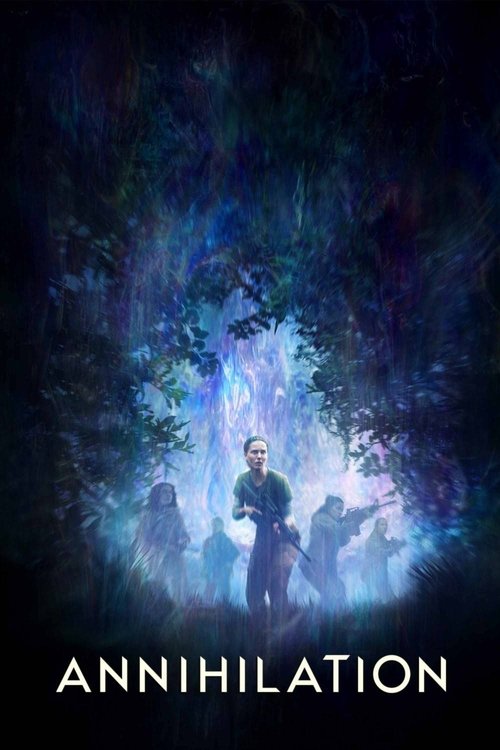
Annihilation
2018 · Alex Garland
Civil War's refusal to name its politics made it 2024's most argued-about film, and his "war is bad, both sides" interviews poured fuel on it; Warfare continued the provocation. The name attached to "is apolitical centrism a stance" discourse.
For when you want smart, ambitious science fiction that's willing to get weird — a challenge, not comfort food, best on a night you're ready to be haunted and then argue about what it meant.
What it's about
A biologist and former soldier volunteers for an expedition into the Shimmer, an iridescent zone spreading along the Gulf coast where biology and physics have stopped following the rules — and from which almost no one returns. She goes in with an all-women team of scientists, each carrying her own reason for walking into something that looks like a one-way door, while she wrestles with grief and a marriage in ruins.
The experience
Gorgeous and deeply unsettling in the same breath — a slow-building trance that alternates lush wonder with sudden, genuinely frightening horror. It gets stranger and more wordless as it goes, and it leaves you rattled in a way that's hard to shake.
Performances
Natalie Portman anchors it with a guarded, grief-locked performance that keeps the wildest imagery grounded, and Jennifer Jason Leigh's eerily flat team leader gives the expedition its uncanny pulse.
The craft
The Shimmer is one of the great modern movie environments — mutated flowers, refracted light, creature design that's beautiful and wrong at once — scored with a throbbing electronic soundtrack that does half the frightening. The final stretch is nearly dialogue-free, pure image and sound; it demands the biggest screen and best speakers you can find.
Why it matters
Its studio-mandated detour to Netflix in most of the world became a flashpoint in the debate over bold original films and streaming, while the film itself grew into a modern cult touchstone for cerebral, biological horror.
Snapshot
Annihilation is Alex Garland's second feature as director, a science-fiction horror film adapted from Jeff VanderMeer's 2014 novel, the first volume of his Southern Reach trilogy. It follows Lena (Natalie Portman), a cellular biologist and former soldier, who joins an all-women expedition into "the Shimmer," an expanding, iridescent zone of refracted physics and mutating biology that has formed around a lighthouse on the American Gulf coast after an apparent meteor strike. The film braids a journey-into-the-interior structure with a study of self-destruction, grief, and the cellular logic of transformation. It is best remembered for its uncanny final act — a hypnotic, near-wordless confrontation inside the lighthouse — and for the production saga that sent it to Netflix in most of the world after a US theatrical release. Critically admired and commercially modest, it has become a touchstone for a strain of cerebral, body-horror-inflected studio science fiction.
Industry & production
The film was produced by DNA Films (Andrew Macdonald and Allon Reich), Garland's long-standing partners, together with Scott Rudin Productions, and financed and distributed by Paramount Pictures, with Skydance Media participating. It is a direct continuation of the working relationship that produced Ex Machina (2015): same director, same producers, and several of the same key craftspeople.
The defining industry story concerns its release. During post-production, a financier reportedly objected that the film was too "intellectual" and too "complicated," and pushed for changes — among them softening the protagonist and clarifying the ending. Garland and Rudin held final cut, and the film was released as made. The widely reported resolution was that Paramount, wary of the film's commercial prospects, sold international distribution rights to Netflix; Annihilation received a conventional theatrical run in the United States, Canada, and China and streamed elsewhere shortly after. The episode became a frequently cited example of studios' diminishing appetite for mid-budget, non-franchise, original genre cinema for adults — and of streaming absorbing exactly that kind of risk. I would treat the specific quotations attributed to executives as press accounts rather than documented fact; the broad outline is well established, the verbatim phrasing less so.
Technology
Annihilation was shot digitally and finished as a visual-effects-forward production, with the studio house DNEG (Double Negative) handling the bulk of the imagery, including the Shimmer itself. The film's signature problem was rendering a zone where "the laws of nature don't apply" without lapsing into either cartoon spectacle or vague abstraction. The solution was a governing visual idea — the Shimmer as a prism that refracts not only light but DNA — which let the effects, production design, and biology share a single logic: doubled flowers grown in human shapes, a crystalline tree, hybridized animals, a deer pair moving in mirrored unison.
Two set pieces anchor the film's technical reputation. The first is the bear-like creature whose call carries the human scream of a dead expedition member — a layered sound-and-creature design that fuses prosthetic/digital animal horror with an acousmatic human voice. The second is the lighthouse's humanoid figure, a shifting, mercurial double performed in part by the dancer and actor Sonoya Mizuno (a Garland regular, also in Ex Machina and the later Devs), realized through choreography combined with digital manipulation so that the "alien" reads as mimicry rather than monster. The achievement is less any single innovation than the disciplined subordination of effects to a thematic premise.
Technique
Cinematography
Rob Hardy, who shot Ex Machina, returns as cinematographer. His work here moves from the controlled, glassed-in interiors of the earlier film to a humid, overgrown exterior palette: greens pushed toward the toxic, skies and water given an oily refraction, and the Shimmer rendered as a soap-bubble membrane that tints everything inside it. Hardy favors a clean, slightly clinical frame — appropriate to a protagonist who sees the world cellularly — punctured by bursts of saturated unreality. The film alternates wide, painterly landscapes of the contaminated wilderness with tight, anxious close-ups during the creature attacks, and reserves its most formally radical imaging for the lighthouse interior, where light, color, and motion become the substance of the drama.
Editing
Barney Pilling edited the film. Its most distinctive structural choice is a framing device: Lena is interrogated in quarantine after the expedition, so the journey is told in retrospect, the outcome partly foreknown. This lets the cutting hold dread in suspension rather than rely on surprise. The interior sequences accelerate toward the climax, then deliberately decelerate inside the lighthouse, surrendering narrative momentum to a sustained, rhythmic, almost musical passage that many viewers experience as the film's true argument. The editing's willingness to slow down precisely where a conventional thriller would tighten is central to the film's identity — and to the studio's reported anxiety about it.
Mise-en-scène / staging
The production design organizes the Shimmer as a graded descent: a recognizable evacuated landscape gives way to baroque mutation and finally to the wholly alien geometry of the lighthouse and the chamber beneath it. The all-women team is staged as a set of differing relations to self-harm — each carrying a wound (grief, illness, addiction, loss) that the Shimmer will literalize. Recurring motifs — the ouroboros tattoo, cellular division, doubling and mirroring — are seeded across décor, costume, and blocking, so that the climax's logic of replication feels prepared rather than imposed.
Sound
The score and sound design are among the film's most discussed elements. Composers Ben Salisbury and Geoff Barrow (Barrow of Portishead), who also scored Ex Machina, supply music that ranges from spare, plaintive acoustic guitar to a swelling synthetic-organic mass in the finale. The lighthouse sequence in particular fuses score and sound effect into a single throbbing texture that drives the wordless action. The bear creature's appropriation of a human scream is a sound-design conceit as much as a creature design, exploiting the horror of a familiar voice issuing from the wrong body.
Performance
Natalie Portman plays Lena with a guarded interiority suited to a character who is both griever and dissembler. Jennifer Jason Leigh's psychologist, Dr. Ventress, is deliberately affectless, a woman already partway out of life. Tessa Thompson (Josie, a physicist), Gina Rodriguez (Anya, a paramedic), and Tuva Novotny (Cass, a geologist/anthropologist) fill out the team, each performance pitched to a specific mode of dissolution. Oscar Isaac, as Lena's soldier husband Kane, is used sparingly and increasingly uncannily, his blankness in the framing scenes seeding the film's question about who, exactly, returned.
Narrative & dramatic mode
The film operates in the mode of the expedition-into-the-unknown — a descent narrative in the lineage of Heart of Darkness and Apocalypse Now, here turned inward and biological. Its dramatic engine is not plot mechanics but a sustained metaphor: the Shimmer does to bodies and genomes what depression, grief, and self-destruction do to a life, refracting and recombining the self until the original is unrecoverable. The retrospective frame converts the journey into a confession of uncertain reliability. The ending is calculatedly ambiguous — Lena's account, Kane's identity, and the final embrace all withhold resolution — which is the point: the film dramatizes annihilation not as death but as transformation past the threshold of selfhood.
Genre & cycle
Annihilation sits at the intersection of science fiction and body horror, with strong currents of cosmic/weird horror in the Lovecraftian sense — an encounter with an intelligence whose indifference and strangeness exceed human categories. It belongs to a 2010s cycle of "elevated" or auteurist genre cinema produced and marketed for adults — alongside films like Arrival, Under the Skin, and Garland's own Ex Machina — that treats science-fiction premises as vehicles for philosophical and emotional inquiry. Its specific subgenre is the contamination-zone narrative, in which a bounded anomaly rewrites the rules within its perimeter.
Authorship & method
Garland's authorship is unusually continuous across writing and directing. He began as a novelist (The Beach) and screenwriter (28 Days Later, Sunshine, Never Let Me Go, Dredd) before directing, and his films share a cool, idea-driven sensibility, a fascination with consciousness and the boundaries of the human, and a willingness to end on irresolution. His adaptation method here is itself notable and well attested: Garland has said he wrote the screenplay from his memory of a single reading of VanderMeer's novel rather than working closely from the text, producing a film that is faithful in atmosphere and theme but substantially its own object — the characters, the back-story of Lena and Kane, and the climax all diverge from the book.
His key collaborators form a repertory company: cinematographer Rob Hardy, composers Ben Salisbury and Geoff Barrow, and performer Sonoya Mizuno all carry over from Ex Machina and continue into the television series Devs (2020). Editor Barney Pilling joined for this film. This stability of collaborators is a meaningful part of the authorship: the consistent visual coolness, the organic-synthetic scores, and the recurring interest in doubles and artificial selves are products of a stable team as much as a single director.
Movement / national cinema
The film is a British-American production — a DNA Films picture financed by a Hollywood studio — and reflects a particular strand of British-rooted, internationally financed genre filmmaking that runs through Garland and Macdonald's careers. It is not part of a formal movement, but it is legible within the broader 2010s ecosystem of English-language auteur science fiction made just below blockbuster scale. Its source material connects it to the literary "New Weird," and its sensibility owes as much to European art cinema — Tarkovsky above all — as to Hollywood.
Era / period
Released in February 2018, Annihilation is very much a film of its moment. It arrived as the economics of original, mid-budget studio cinema were collapsing into a franchise-or-streaming binary, and its release pattern became a case study in that shift. Its all-women expedition and its concern with depression, illness, and self-erasure also place it within late-2010s cultural conversations, though the film resists topical literalism. Technologically, it sits in the mature digital-VFX era, when a studio could plausibly render genuinely strange imagery without a tentpole budget.
Themes
The film's governing theme is self-destruction as a biological and psychological constant: an early line frames suicide as distinct from the near-universal human drive toward self-sabotage, and the Shimmer literalizes that drive at the level of the cell. Closely related are transformation and identity — the dread and possibility of becoming something other than oneself — figured through doubling, mutation, and the climactic mirror-figure. Grief and trauma run beneath the surface, each team member entering the zone already damaged. There is also a Lovecraftian theme of the radically alien: an intelligence that neither attacks nor communicates but refracts, indifferent to human meaning. Finally, the film meditates on the porous boundary between creation and obliteration — annihilation, in its etymology, as a reduction to nothing that is simultaneously a making-new.
Reception, canon & influence
Critical reception was strongly positive, with particular praise for its ambition, its score and sound, and its astonishing final act; reservations tended to concern pacing and opacity. Commercially it was modest — the international Netflix arrangement and a soft domestic run meant it never performed as a theatrical event — but it found a large and durable audience on streaming and has grown in stature since. I would avoid citing precise box-office figures here, as they are easily distorted by the unusual split release; the reliable summary is "theatrically modest, culturally outsized."
Its backward influences are explicit and frequently noted. The deepest debt is to Andrei Tarkovsky — Stalker (1979), with its forbidden, rule-breaking "Zone" reached by a small expedition, and Solaris, with its unknowable alien intelligence that reflects human interiority. Behind Stalker stands the Strugatsky brothers' Roadside Picnic. The descent structure echoes Conrad's Heart of Darkness and Apocalypse Now; the cosmic indifference and biological wrongness draw on H. P. Lovecraft (often compared to "The Colour Out of Space") and on VanderMeer's New Weird fiction; the bodily transformation and isolation-under-siege owe something to John Carpenter's The Thing and to 2001: A Space Odyssey's closing passage into abstraction.
Its forward influence is still consolidating but visible. Annihilation helped legitimize a continuing strain of cerebral, horror-tinged studio and streaming science fiction, and its "Shimmer" aesthetic — refracted color, beautiful-toxic mutation, the alien as prism rather than predator — has been widely imitated and referenced. Within Garland's own filmography it connects forward to Devs (2020) and Men (2022), which extend its interests in doubling, dissolution, and irresolution. Among 2010s science-fiction films it is now routinely listed alongside Arrival and Under the Skin as evidence that demanding, original genre cinema could still be made at scale — and, in its release history, as a marker of how the industry was changing around it.
A Deleuzian reading
Two deer step out of the brush moving in perfect mirrored unison.
The full Deleuzian reading of Annihilation →
Reception
Dumped by a nervous Paramount in 2018 — modest box office at home, sold straight to Netflix everywhere else after test audiences found it 'too intellectual' — it's since climbed into the modern sci-fi canon, routinely named alongside Arrival and Under the Skin as the decade's smart-sci-fi high-water mark.
How Annihilation was received, from release to now →
Influences: the films it descends from and the films it influenced
- Stalker (1979) — The forbidden, rule-governed 'Zone' entered by a small expedition is the direct structural template for the Shimmer — a contaminated interior space whose logic warps as you penetrate it, traversed by long, decelerating takes rather than action beats.
- Solaris (1972) — Garland borrows Tarkovsky's unknowable alien intelligence that materializes human interiority back at the protagonists — the alien as mirror of grief and self rather than antagonist, motivating the doubling/refraction motif.
- 2001: A Space Odyssey (1968) — The lighthouse climax's surrender of narrative to pure abstract image-and-sound — the human dissolving into shifting form — is a deliberate echo of the Star Gate passage into non-representational cinema.
- The Thing (1982) — The isolation-under-siege body horror — organisms reorganized into wrong anatomies, identity contaminated from within so you can't trust who's still human — supplies Annihilation's practical-effect creature grammar (the screaming bear that wears a victim's voice).
- Apocalypse Now (1979) — The Heart of Darkness river-journey architecture — an expedition moving upstream toward a deranged precursor at the source — is reused as the graded descent toward the lighthouse and Kane's predecessor team.
- Under the Skin (2013) — Shares the alien-as-prism approach and the marriage of an organic-synthetic, dread-inducing score to clinical, beautiful-toxic abstraction at the moment of bodily transformation.
- Arrival (2016) — Co-defines the 'elevated sci-fi' studio strain — somber, idea-driven, retrospective-framed (a narrator recounting a transformation already complete), trusting opacity and emotional interiority over spectacle.
- Ex Machina (2014) — Garland's prior film with the same repertory company (DP Rob Hardy, composers Salisbury & Barrow, Sonoya Mizuno) established the cool clinical frame, organic-synthetic score, and doubling/artificial-self obsession carried directly into Annihilation.
- Sunshine (2007) — Garland's own screenplay — a doomed expedition toward an overwhelming light-source where crew psychology fractures and the climax tips into sensory abstraction — prefigures Annihilation's structure and its deceleration-into-light finale.
- 28 Days Later (2002) — Garland's contamination-zone screenplay debut: a depopulated quarantine landscape and infection-as-transformation, the contaminated-territory template he later authors as director.
- Color Out of Space (Lovecraft, source) (1927) — The cosmic-indifferent contamination that warps flora, fauna and minds via an unnameable color is the literary engine behind the Shimmer's prismatic, indifferent alien-as-environment.
- The Fly (1986) — The defining body-horror grammar of gradual cellular fusion — a protagonist documenting their own transformation into something else with clinical fascination — underlies Lena's video-log study of mutating bodies.
- Devs (2020) — Continues the same repertory team and the irresolution/determinism/doubling concerns, with the identical hum-and-drone organic-synthetic scoring and clinical-frame visual coolness extended to television.
- Men (2022) — Pushes Annihilation's body-horror doubling to its extreme — a single replicating male figure, transformation rendered as grotesque practical-effect birth-loop — and shares the acousmatic-scream sound design.
- The Colour Out of Space (2019) — Directly inherits the Shimmer's refracted-color contamination aesthetic — an alien hue that mutates biology into beautiful-toxic growths — drawing on the same Lovecraft 'Colour Out of Space' wellspring.
- Aniara (2018) — A contemporaneous elevated-sci-fi entry sharing the deceleration-at-climax and descent-into-the-interior arc, ending in cosmic surrender and dissolution rather than rescue.
- 28 Years Later: The Bone Temple (2026) — Garland-authored sibling whose painterly, uncanny landscapes and bodily transformation-as-spectacle rhyme with the film's death-memorialization and painterly-landscape facets.
- The Revenant (2015) — Landscape as a quasi-metaphysical devouring entity that physically rewrites the protagonist's body and identity, with sparse electronic score submerged in dense environmental sound texture—the landscape-as-antagonist-with-lyric-vision structure transposed into a science-fiction register.
- Tenet (2020) — Garland and Rob Hardy's practical staging of the doppelgänger pool sequence—a mirrored figure mimicking then diverging from the protagonist's movements in a sustained single take—is the closest sibling to Tenet's inverted-combat choreography: temporal doubling solved as a practical photography problem rather than a CGI composite.
- Nope (2022) — Garland, Salisbury, and Barrow construct the alien entity's acoustic presence from biological and environmental sources rather than conventional sci-fi synthesis — the creature as organism, not machine — a parallel approach to Nope's sound team building the creature's audio signature from organic material.
- Blade Runner 2049 (2017) — Contemporaneous dread-soaked art-house SF that prioritizes eerie, ambiguous mood and unhurried image-making over explanation, the same contemplative-blockbuster wager.
- Civil War (2024) — Extends the identical uncanny-Americana staging and perceptual unease into a continuous, recognizable house style applied across genres.
Similar films
- Stalker (1979) — influence & lineage · same viewing thread · often watched together
- Arrival (2016) — influence & lineage
- The Thing (1982) — influence & lineage
- Alien (1979) — same viewing thread
- Alien: Romulus (2024) — same viewing thread
- Apocalypse Now (1979) — influence & lineage · often watched together
- On the Silver Globe (1989) — often watched together
- Mandy (2018) — often watched together
All the films related to Annihilation →
Watch it with: curated runs of related films
- Crossing Into the Zone — A run of crews and expeditions that step across a threshold into a hostile unknown — a derelict, a shimmer, a forbidden Zone — that rewrites biology, sanity, and who comes back; watch them in sequence to feel the same dread deepen from pulp to the sublime.