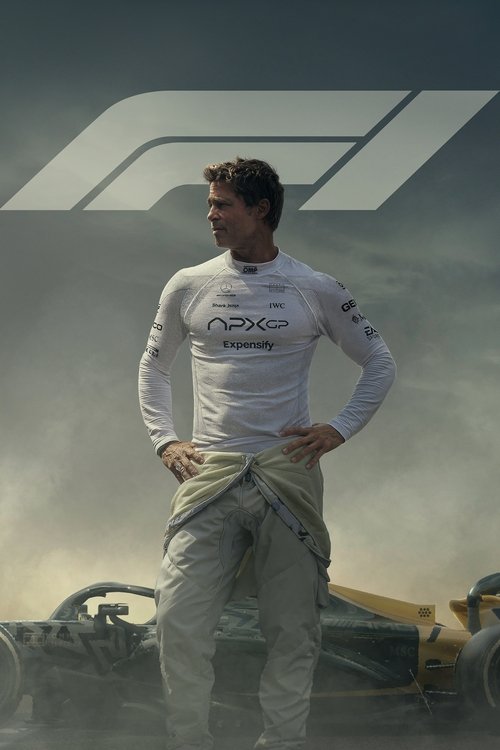
F1
2025 · Joseph Kosinski
For when you want a big, satisfying Friday-night movie that just works — turn the volume up, feel your pulse climb, and let a movie star do movie-star things. Comfort viewing with a racing heart.
What it's about
Sonny Hayes was a Formula 1 prodigy until a crash ended his career; decades later he's a racing drifter coaxed back by an old teammate to save a failing F1 team. He's paired with Joshua Pearce, a brash rookie who sees him as a relic, and the two have to stop fighting each other long enough to fight the rest of the grid. One last shot at glory, chased at 200 miles an hour.
The experience
Pure propulsion — the racing sequences pin you to your seat, and between them it's a slick, confident crowd-pleaser about pride, age, and second chances. You know roughly where it's going, and it's a blast getting there.
Performances
Brad Pitt does effortless veteran-cool as well as anyone alive, and Damson Idris matches him with a cocky, wounded turn that keeps the mentor-rookie friction honest.
The craft
Kosinski shot it during actual Grand Prix weekends with Formula 1's full cooperation, mounting cameras in real cars on real circuits, and the in-camera authenticity shows — the speed feels physical, not digital. It's a film built for the biggest screen and best sound system you can get to.
Why it matters
A global box-office hit that brought the immersive, shot-for-real blockbuster approach of Top Gun: Maverick to motorsport, riding and feeding Formula 1's surging popularity.
Snapshot
F1 is a big-budget sports drama built around a veteran-and-protégé structure familiar from decades of racing pictures, executed with an in-camera, location-shot spectacle apparatus refined by its director on Top Gun: Maverick. Brad Pitt plays Sonny Hayes, a onetime Formula 1 prodigy whose career was cut short by a crash and who is drawn back into the sport by an old teammate to steer a failing team, the fictional APXGP, and to mentor a brash young driver, Joshua Pearce (Damson Idris). The film's central ambition is legitimacy: it was shot during actual Grand Prix weekends, with the cooperation of Formula 1 and its constructors, and staged its fictional team inside the real 2023–2024 competitive calendar. The result sits at the intersection of the underdog sports formula and a hardware-driven spectacle tradition, and it became a conspicuous commercial success for Apple's theatrical ambitions, distributed in partnership with Warner Bros. Its interest for an atlas of influence lies less in narrative innovation than in method — how a genre older than sound cinema was re-mounted with 21st-century camera engineering.
Industry & production
F1 is a landmark in Apple Original Films' pivot toward event theatrical releasing rather than streaming-first distribution. Apple financed the picture at a scale reported in the industry press as among the largest for any of its productions, and partnered with Warner Bros. Pictures for a wide global theatrical release in June 2025, with an IMAX and premium large-format rollout. Jerry Bruckheimer produced, extending a decades-long association with high-velocity studio spectacle, alongside Brad Pitt's Plan B Entertainment and Kosinski's own producing team. Seven-time World Champion Lewis Hamilton served as a producer and technical consultant, a credit that was central to the production's access strategy: his involvement, together with Formula 1's commercial arm and the Fédération Internationale de l'Automobile's cooperation, allowed the crew to embed at genuine race weekends, place a fictional team's cars and garages within the paddock, and film against real crowds and competitors.
That access defined the production's logistics. Rather than build races on closed sets, the unit shot around live events across a full competitive season, integrating purpose-built cars modeled on Formula 2 chassis dressed to read as F1 machinery. The undertaking required coordination with circuits, teams, and broadcast partners on a scale unusual for a narrative feature. The exact budget and final box-office figures reported in the trade press vary, and I will not cite specific numbers here; what is well established is that the film was positioned as, and widely described as, one of Apple's most successful theatrical releases to date.
Technology
The film's defining technical achievement is its camera system. Building directly on the workflow Kosinski and cinematographer Claudio Miranda developed for Top Gun: Maverick — where miniaturized cameras were mounted inside fighter cockpits — the F1 team worked with Sony to engineer highly compact camera units derived from the Sony Venice sensor architecture, small and light enough to be mounted on and around a moving racing car without destroying its aerodynamics or adding prohibitive weight. These bodies were designed to resemble and integrate with the broadcast cameras F1 cars already carry, allowing them to sit within the real racing environment. The engineering problem was severe: cinema-grade image capture under extreme g-forces, vibration, heat, and speed, controlled remotely so that a cast member could pilot the car while the camera rolled.
This is a continuation of a lineage in which spectacle is generated by putting a professional-quality sensor physically inside a real fast-moving vehicle rather than simulating the motion in post. The approach trades the flexibility of CGI and process work for the authenticity of genuine speed, real light, and real environments, and it commits the production to the constraints of the physical world. Post-production still involved substantial digital work — compositing, cleanup, and the seamless insertion of the fictional team into real footage — but the governing philosophy is in-camera capture, consistent with Kosinski and Miranda's practical-first sensibility.
Technique
Cinematography
Miranda, an Academy Award winner for Life of Pi and a longtime Kosinski collaborator, shoots for scale and clarity. The racing sequences favor mounted, on-car perspectives that place the viewer at the driver's eye line and wheel level, exploiting the miniaturized cameras to generate a sense of velocity that conventional trackside or helicopter coverage cannot. Against this, the film uses the real light of actual circuits — the specific quality of sun, dusk, and floodlit night races — as a production-design asset that could not be fabricated economically. The photography's aim is immersion and legibility: rendering the geography of a race, the relative positions of cars, and the physical stakes of speed in a way that a lay audience can follow, while retaining the documentary texture of the genuine paddock.
Editing
Cutting a coherent race from footage gathered across real, uncontrolled events is the film's central editorial challenge, and the sport's spatial confusion — many cars, long circuits, events unfolding simultaneously — is precisely what the editing must tame. The picture's construction depends on assembling comprehensible dramatic geography from disparate captures: on-car views, pit-lane action, and competition footage stitched into a continuous fiction. The task is analogous to the aerial-combat editing of Top Gun: Maverick, where orientation and momentum had to be manufactured in the cut. The editing also carries the film's rhythmic contract with the sports genre — the alternation between the compressed intensity of the race and the slower interpersonal beats of the team drama.
Mise-en-scène / staging
The production's signal decision was to stage its fiction inside a real institution. The APXGP team — garage, livery, pit crew, hospitality — was built to occupy the actual F1 paddock and to appear within the frame alongside genuine teams. This is mise-en-scène as embedding rather than construction: the "set" is the real world of Formula 1, dressed with one additional, invented competitor. The staging of the races themselves had to negotiate the reality of events the production did not control, choreographing the fictional cars into plausible relationships with real ones.
Sound
The engine is the sport's signature, and the film's sound design foregrounds the physical acoustics of Formula 1 machinery — the pitch of the power unit, the doppler of passing cars, the ambient roar of a live crowd captured at real venues. Detailed authoritative accounts of the specific sound-design and mixing workflow are not something I can document precisely here, and I will not invent them; what is evident from the film's design premise is a commitment to the recorded reality of the sport's sonic environment, married to Hans Zimmer's score.
Performance
Pitt anchors the film on movie-star gravity and physical credibility, having undergone the driver training the production's realism demanded; his Sonny Hayes is a weathered, wry veteran, a register Pitt has cultivated across his late career. Idris, as the ambitious younger driver, supplies the generational counterweight the mentor structure requires. Kerry Condon and Javier Bardem fill out the team's technical and managerial leadership, and Tobias Menzies appears among the supporting figures. The performances are calibrated to the genre's archetypes — the redemption-seeking elder, the talented hothead, the pragmatic engineer — with the actors' real proximity to the cars lending the driving scenes a bodily conviction that doubling and simulation typically dilute.
Narrative & dramatic mode
The screenplay, by Ehren Kruger, operates in the classical sports-redemption mode: a fallen champion returns for a final campaign, rehabilitates a struggling team, and reconciles his own past through the tutelage of a successor. The dramatic engine is dual — the external contest (can the team win?) and the internal one (can Sonny outrun the crash that ended him, and can the mentor-protégé pair resolve their friction into partnership?). This is the structure of the underdog picture, with the season standing in for the tournament arc. The mode is broadly earnest and populist, prioritizing momentum, emotional clarity, and spectacle set-pieces over ambiguity. Its innovations are textural rather than structural: the familiar beats are delivered through unprecedented access to a real sport.
Genre & cycle
F1 belongs to the racing film, a genre nearly as old as narrative cinema and periodically renewed by advances in capturing speed — from John Frankenheimer's Grand Prix (1966), which pioneered on-car mounts and immersive race photography, to Steve McQueen's Le Mans (1971), Ron Howard's Rush (2013), a dramatization of the Hunt–Lauda rivalry, and James Mangold's Ford v Ferrari (2019). Frankenheimer is the deepest ancestor here: Grand Prix established the ambition of putting the audience in the car, and F1 pursues the same goal with modern miniaturized sensors. Within Kosinski's own filmography and the contemporary studio landscape, the picture also belongs to a cycle of practical-spectacle event films that sell theatrical exhibition on the promise of real, large-format sensation — the tradition Top Gun: Maverick revitalized. It is at once a racing movie and a demonstration of the case for the big screen.
Authorship & method
Joseph Kosinski trained in architecture before moving through commercials into features (Tron: Legacy, Oblivion, Only the Brave, Spiderhead), and his method is consistently engineering-forward: he approaches spectacle as a technical problem to be solved with real hardware and real environments, minimizing simulation. Top Gun: Maverick was the proof of concept — practical aerial capture with actors genuinely in the aircraft — and F1 transposes that philosophy to motorsport. His authorship is less a matter of thematic signature than of a repeatable production doctrine: identify a domain of real, dangerous speed; engineer cameras to live inside it; and build the drama around footage the audience knows could not be faked.
His key collaborators reinforce that doctrine. Cinematographer Claudio Miranda is the visual architect of the in-camera approach across their films together. Composer Hans Zimmer supplies the score, extending a long career defining the sound of large-scale contemporary spectacle and a working relationship with this producing milieu. Editor Stephen Mirrione — an Oscar winner for Traffic and a frequent collaborator of directors including Alejandro G. Iñárritu and Steven Soderbergh — brings a pedigree in structuring complex, multi-strand material to the problem of assembling coherent races. Writer Ehren Kruger provides the genre scaffolding. Producer Jerry Bruckheimer connects the film to a long tradition of kinetic studio entertainment, and Lewis Hamilton's consulting role is inseparable from the film's authorship of authenticity.
Movement / national cinema
F1 is not the product of a film movement in the art-historical sense; it is mainstream American studio filmmaking, financed by a technology company (Apple) and released through a Hollywood major (Warner Bros.). Its most meaningful "movement" affiliation is industrial rather than aesthetic: it is a flagship of the post-pandemic argument for premium theatrical exhibition — the position that certain films justify the big screen through scale and sensation that home viewing cannot replicate. Its subject and settings are transnational, following a globe-spanning sport across international circuits, but its production grammar and financing are firmly within the American studio system's spectacle tradition.
Era / period
The film is a document of the mid-2020s in two respects. First, it registers the streaming-era realignment in which a technology giant with a streaming service nonetheless invests heavily in a wide theatrical release, treating cinemas as a marketing and prestige engine rather than bypassing them. Second, it reflects the era's fascination with Formula 1 itself, whose global popularity surged in these years, amplified by the docuseries Formula 1: Drive to Survive and expanded audiences. F1 arrives on that wave, converting a moment of heightened cultural attention to the sport into a mainstream feature. Its technological moment — miniaturized cinema cameras enabling in-situ capture at extreme speed — is likewise specific to the present.
Themes
The film's thematic spine is redemption and legacy: the return of a diminished champion seeking to reconcile a defining failure, and the transmission of hard-won wisdom from one generation to the next. Around that core it works familiar sports-drama concerns — teamwork against institutional dysfunction, the tension between individual glory and collective success, and the cost of speed on the body and the psyche. The mentor-protégé relationship dramatizes continuity and rivalry at once. Underneath runs a meta-theme consonant with Kosinski's whole method: the valorization of the real — real speed, real risk, real skill — as both moral value within the story and organizing principle of the production. The picture argues, in form as much as content, that authenticity is worth its enormous cost.
Reception, canon & influence
Critically, F1 was received as a highly effective piece of large-scale entertainment, praised in particular for the visceral immediacy of its racing sequences and its in-camera spectacle, with the more familiar and formulaic dimensions of its screenplay drawing the predictable reservations that attend genre pictures. Commercially it performed strongly and was widely reported as a major success for Apple's theatrical strategy; I decline to cite exact grosses, as reported figures vary, but its status as one of Apple's most successful theatrical releases is well established.
Its influences run backward to the racing-film canon — Frankenheimer's Grand Prix above all for the in-car ambition, and the recent prestige-racing cycle of Rush and Ford v Ferrari for the model of dramatizing motorsport for a broad audience — and, within its own production family, to Top Gun: Maverick, whose practical-capture doctrine it directly extends. Looking forward, its most likely legacy is technical and industrial: a further validation of engineered, miniaturized in-camera capture as the premium alternative to CGI-driven action, and a continued argument for event theatrical releasing by streaming-era financiers. Whether it reshapes the racing genre or chiefly stands as the definitive Formula 1 feature of its moment is a judgment the historical record is still too close to settle, and it would be premature to claim more.
A Deleuzian reading
Take the shot from the wheel.
The full Deleuzian reading of F1 →
Reception
Opened summer 2025 as the movie that finally cracked Apple's theatrical curse — critics called it formulaic but irresistible, audiences made it a word-of-mouth juggernaut, and within months it settled into 'best big-screen experience of the year' status rather than any real reappraisal arc.
How F1 was received, from release to now →
How to watch F1: what to notice on a first viewing
- Watch the shots taken from inside the car, at wheel height. Kosinski and Miranda mount miniaturized cameras on the moving car itself, putting you at the driver's eye line instead of trackside or aerial coverage. This puts you inside the machine's speed rather than watching it from outside.
- Notice the light changes: full sun, dusk, floodlit night races. The film shoots at real circuits during actual Grand Prix weekends, using whatever light each session produced rather than staged lighting. That real light is a production asset no studio rig could fake economically.
- Listen for the engine pitch rising and falling as cars pass. Sound design foregrounds the physical acoustics of the power unit, the doppler of passing cars, and crowd roar recorded live at real venues. Speed here becomes something heard as much as seen, since a helmeted face can't carry emotion.
- Look for the fictional APXGP garage sitting among real F1 teams. The production built and dressed an invented team to physically occupy the actual paddock, appearing in frame beside genuine competitors. Staging inside a real institution gives the fiction the weight of an actual competitive world.
The whole guide to watching F1, with the keys for a rewatch →
Influences: the films it descends from and the films it influenced
- Grand Prix (1966) — Pioneered the in-car mounted camera and periscope rigs bolted to actual Formula 1 machinery, establishing the driver's-eye immediacy that F1's miniaturized on-car cameras directly modernize.
- Le Mans (1971) — Filmed camera-equipped race cars running in an actual 24-hour endurance event with minimal dialogue, pioneering the doctrine of building drama from footage that could not be staged — F1's exact authenticity thesis.
- Top Gun: Maverick (2022) — Kosinski's own proof-of-concept for engineering IMAX-certified miniature cameras inside real cockpits with actors genuinely enduring the g-forces, the production doctrine F1 transposes wholesale from jet to race car.
- Days of Thunder (1990) — Established the Bruckheimer racing template of intercutting real on-track footage with in-car cameras and a driver-mentor arc, the commercial DNA producer Jerry Bruckheimer carries straight into F1.
- Ford v Ferrari (2019) — Modeled the prestige-racing cycle's foregrounding of diegetic engine acoustics and gear-shift mechanics as dramatic sound, the sonic realism F1 extends with its diegetic engine-acoustic design.
- Rush (2013) — Demonstrated how to dramatize Formula 1's rivalry-and-redemption structure for a mass non-fan audience, the narrative scaffolding Ehren Kruger's script for F1 inherits.
- Ronin (1998) — Frankenheimer's late-career insistence on real stunt drivers and car-mounted cameras through actual streets, refusing process shots — the practical-capture lineage F1 explicitly invokes as its heritage.
- Bullitt (1968) — Its bumper- and hood-mounted camera rigs during real high-speed driving created the ground-level velocity grammar that F1's on-car mounts descend from directly.
- Oblivion (2013) — Kosinski and Claudio Miranda's collaboration on natural-light capture using real environments and front-projected skies, establishing the Miranda naturalistic-light method reused across F1's on-location shooting.
- Tron: Legacy (2010) — Kosinski's architecture-trained approach of treating spectacle as an engineering problem solved with built hardware, the authorship method he refines through to F1.
- Only the Brave (2017) — Kosinski's embedding of a professional ensemble into real, dangerous locations to earn documentary authenticity, the real-location-embedding technique F1 applies to actual grand-prix weekends.
- Life of Pi (2012) — Claudio Miranda's Oscar-winning cinematography honing the naturalistic light and immersive spatial framing he brings to Kosinski's practical projects including F1.
- Mad Max: Fury Road (2015) — The defining modern argument for practical vehicular spectacle — real vehicles, real desert, minimized CGI — that legitimized F1's in-camera-over-simulation premium-action strategy.
- Gran Turismo (2023) — A concurrent motorsport feature dramatizing real racing with driver-training authenticity and on-track capture, extending the same practical racing-film craft F1 competes within.
- Senna (2010) — Its immersion in genuine Formula 1 cockpit and paddock footage set the authenticity benchmark and consulting-driver ethos (Hamilton's role in F1 echoing the sport's own voice) that F1's valorization-of-the-real answers to.
- Traffic (2000) — Editor Stephen Mirrione's Oscar-winning structuring of complex multi-strand action, the assembly craft he brings to cutting F1's simultaneous cars into a coherent, legible race.
Similar films
- Top Gun: Maverick (2022) — influence & lineage · same viewing thread
- Rush (2013) — influence & lineage
- Ford v Ferrari (2019) — influence & lineage
- Mad Max: Fury Road (2015) — influence & lineage
- Days of Thunder (1990) — influence & lineage
- Furiosa: A Mad Max Saga (2024) — same viewing thread
- The Fall Guy (2024) — same viewing thread
- Marty Supreme (2025) — shared sensibility
Watch it with: curated runs of related films
- Real Machines, Real Stunts — A run of blockbusters that strap the camera to actual jets, cars, rigs and bodies — watch them together for the vertigo of action done for real.