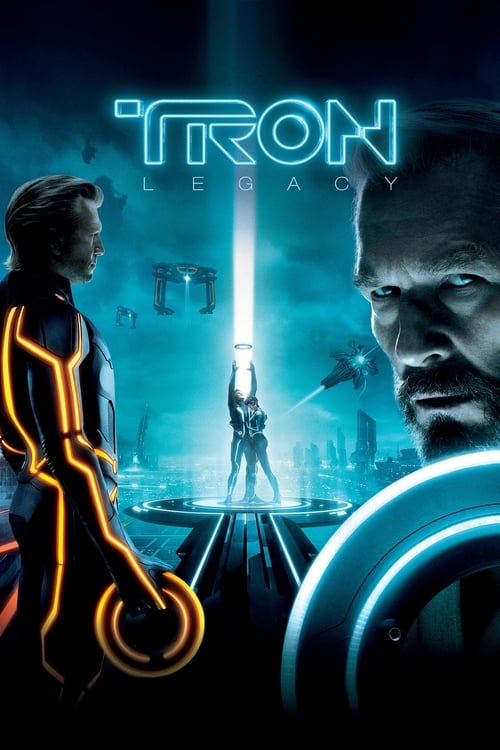
TRON: Legacy
2010 · Joseph Kosinski
For when you want to turn the lights off, turn the sound up, and just bathe in neon and bass — a vibe watch more than a plot watch, and comfort viewing for anyone who loves gorgeous machines.
What it's about
Sam Flynn has spent twenty years angry at a father who vanished — Kevin Flynn, the game-designer legend who walked out of his son's life and into thin air. Chasing a signal from his dad's old arcade, Sam gets pulled into the Grid, a digital world his father built, now ruled by Clu, a program with Kevin's face and none of his mercy. With a fearless warrior named Quorra at his side, Sam races light cycles and gladiator discs to find his father and get them both out before Clu forces his way into the real world.
The experience
It washes over you: sleek, gliding, almost hypnotic, with Daft Punk's score doing half the storytelling. The pace is stately between action beats, but when the light cycles rev up it's pure electric spectacle.
Performances
Jeff Bridges plays a double role — the aging, zen-drifted Kevin Flynn and his cold digital creation Clu — and gives the film its soul and its menace at once.
The craft
Joseph Kosinski, an architect before he was a director, designs the Grid like a building: black lacquer, glowing circuit lines, light that behaves like liquid. Daft Punk's orchestral-electronic score is one of the most celebrated of its era and fuses so completely with the images that the film plays almost like a feature-length music piece. This one genuinely demands the biggest screen and best speakers you can find.
Why it matters
It became the template case for the legacy sequel — reviving a decades-old property through a child of the original hero — and its score changed expectations for what electronic musicians could do in blockbusters. It also launched Kosinski's career as Hollywood's premier craftsman of sleek, machine-loving spectacle.
Snapshot
TRON: Legacy is a legacy sequel arriving twenty-eight years after Steven Lisberger's TRON (1982), produced by Walt Disney Pictures and released in December 2010. It marked the feature directorial debut of Joseph Kosinski, an architect-turned-commercials-director, and is best remembered less for its narrative than for its total sensory design: a lacquered black-and-neon vision of cyberspace scored by the French electronic duo Daft Punk. The film's premise is a father-son myth grafted onto the original's man-inside-the-machine conceit — Sam Flynn (Garrett Hedlund) is pulled into the digital "Grid" while searching for his vanished father Kevin (Jeff Bridges), and finds him exiled by his own creation, the tyrannical program Clu. Critically it was received as a triumph of surface over story; culturally, its fusion of image and sound became one of the most durably influential aesthetic statements of its decade.
Industry & production
The film sits squarely inside the late-2000s Hollywood turn toward reviving dormant intellectual property, and toward the post-Avatar (2009) premium of stereoscopic 3D. Disney had let the TRON brand lie fallow for a generation; the project was reactivated in part by a proof-of-concept sequence shown at San Diego Comic-Con in 2008, which demonstrated the "identity disc" arena and a de-aged Bridges as Clu. Kosinski, then known chiefly for striking video-game commercials, was an unconventional choice to steward a nine-figure tentpole. The reported production budget was in the region of $170 million, and the film became a substantial worldwide commercial success — grossing in the vicinity of $400 million globally — though these figures are the widely reported industry estimates rather than audited totals and should be treated as such.
Principal photography took place largely in Vancouver. The producers included original TRON creator Steven Lisberger alongside Sean Bailey and Jeffrey Silver, a lineage the film foregrounds as a matter of brand continuity. Visual effects were led by Digital Domain. The production is also notable as a case study in the difficulty of digital de-aging circa 2010: the effort to render a youthful Clu from Bridges's 2010 performance produced results many viewers found uncannily synthetic, and this became the film's most-discussed technical liability.
Technology
TRON: Legacy is a landmark of its moment in several overlapping technologies. It was conceived and finished as a stereoscopic 3D release, and adopted a deliberate structural device: the "real world" sequences were rendered flat while the Grid was presented in 3D, an homage to the color/monochrome split of The Wizard of Oz and a way of marking the passage into the digital realm. The film was among the higher-profile productions to build its world extensively from computer graphics while attempting to integrate them with photographed actors under practical lighting.
Two technological ambitions define its reputation. The first is the illuminated costume work: the programs' suits carried functioning electroluminescent lighting integrated into the garments, a demanding wardrobe-and-effects problem that gave the Grid its signature glowing linework. The second is the digital creation of Clu — a full CG facial performance mapped to reference of Bridges — which represents an early, high-visibility attempt at a photoreal de-aged human. Its shortfalls, rather than its successes, made it a reference point in subsequent debates about the "uncanny valley" and about whether audiences would accept synthetic humans in leading roles.
Technique
Cinematography
The film was photographed by Claudio Miranda, who would win the Academy Award for Cinematography two years later for Life of Pi (2012) and who became one of Kosinski's recurring collaborators. His images here are defined by extreme contrast and controlled color: fields of near-total black punctuated by hard-edged neon — the Grid's signature cyan and orange — with reflective floors that double every light source. The look is glossy, architectural, and deliberately artificial, closer to industrial design rendering than naturalism, a sensibility consistent with Kosinski's background. The stereoscopic capture and the flat-versus-3D structural split were integral to how the cinematography was conceived rather than incidental to it.
Editing
The film was cut by James Haygood, an editor associated with David Fincher (notably The Game and Fight Club). The editing is at its most kinetic in the Grid's gladiatorial set pieces — the disc-battle arena and the light-cycle "derby" — where geometry, speed, and shattering "derezzed" programs are the primary material. Elsewhere the pacing has been widely described as measured to the point of slackness, a rhythm that privileges spectacle and atmosphere over narrative propulsion; this is one axis on which contemporary criticism found the film wanting.
Mise-en-scène / staging
Production design by Darren Gilford, with costumes by Michael Wilkinson and Christine Bieselin Clark, gives the film a unified, almost monastic modernism. The Grid is a world of black glass, cantilevered platforms, and light-lines, and Kevin Flynn's safe-house retreat is staged as a spare, minimalist sanctuary — a knowing nod to 2001: A Space Odyssey's white rooms and to the idea of the aging creator as a kind of exiled monk. Michael Sheen's turn as the club-owner program Zuse/Castor introduces a burst of glam-cabaret excess (the "End of Line Club") that deliberately breaks the otherwise austere palette. The staging consistently reads as designed rather than found space, in keeping with the film's overall thesis that this is an authored, coded world.
Sound
Sound is arguably the film's most fully realized craft dimension. The sonic design of the Grid — the hum of light-cycles, the crack of the identity discs, the crystalline shatter of derezzing programs — is built to interlock with Daft Punk's score, and the film's sound mix and design were among the most praised elements in its reception. The overall effect is of a world whose audio and music are a single continuous fabric.
Performance
Jeff Bridges anchors the film in a dual role: the older, weary Kevin Flynn, played with a spacey, quasi-Zen affect that Bridges has elsewhere connected to his "Dude" register, and the digital Clu, a colder mirror-image antagonist. Garrett Hedlund carries the audience-surrogate lead as Sam with earnest physicality if limited nuance, and Olivia Wilde's Quorra — the last surviving "isomorphic algorithm," or ISO — supplies the film's note of wonder and its emotional bridge between worlds. Bruce Boxleitner returns from the 1982 film as Alan Bradley and his program counterpart Tron. The performances are generally regarded as serviceable within a film whose priorities lay elsewhere; the script gives its actors archetypes more than characters.
Narrative & dramatic mode
The dramatic mode is myth-quest crossed with tech-noir. Structurally the film is a portal fantasy: Sam crosses a threshold into a coded otherworld, undergoes trials (the arena, the light-cycle grid), locates the lost father-king, and must escape back through the closing "portal" before it seals. Onto this the writers layer a creation-myth theology — Kevin Flynn as flawed god, Clu as the created being who rebels against his maker for failing to deliver "the perfect system," and the ISOs as spontaneously emergent life that Clu exterminates in a digital genocide. The climax turns on Flynn reabsorbing Clu (the two are, in a sense, the same being) in a self-sacrificing act of "reintegration," freeing Sam and Quorra. The mode is earnest and mythic rather than ironic, and its thematic reach — fatherhood, creation, the ethics of perfection — is broader than its screenplay's ability to dramatize it.
Genre & cycle
The film belongs simultaneously to several cycles. As science fiction it descends from the cyberpunk lineage of the digital-frontier narrative. As an industry object it is a paradigmatic "legacy sequel" — a sub-cycle of the 2010s (alongside films such as later Star Wars, Blade Runner, and Mad Max continuations) that revives a decades-old property by pairing a returning original star with a younger inheritor. And in its look and sound it is a foundational text of the neon-retro / "synthwave" and "outrun" revival, a cross-media aesthetic movement built on 1980s-coded neon grids and analog-synth textures. Few films sit so precisely at the intersection of the corporate legacy-sequel and a genuine underground aesthetic movement.
Authorship & method
The controlling sensibility is Kosinski's, and it is legible: trained as an architect (he studied at Columbia's graduate architecture program) and seasoned in commercials, he brings a designer's eye — clean geometry, immaculate surfaces, world-as-object — that would recur across his later films (Oblivion, Top Gun: Maverick). His method here is world-first: the film's identity was fixed at the level of production design, costume, and score before, and arguably at the expense of, screenplay.
His key collaborators shape the result decisively. Cinematographer Claudio Miranda established the high-contrast neon idiom. Editor James Haygood brought a Fincher-schooled precision to the action. The screenplay was written by Edward Kitsis and Adam Horowitz — then known for the television series Lost — from a story they developed with Brian Klugman and Lee Sternthal, and its mythic-television DNA is visible in the emphasis on lore, prophecy, and serialized world-building. Above all, Daft Punk (Thomas Bangalter and Guy-Manuel de Homem-Christo) composed the score, working with orchestrator Joseph Trapanese to marry an 85-piece orchestra with the duo's electronic signature. The resulting soundtrack album, released on Disney's label, became a cultural artifact in its own right — for many listeners more consequential than the film. The convergence of an architect-director, an award-caliber cinematographer, television mythmakers, and a landmark electronic act is the film's authorial signature.
Movement / national cinema
This is a Hollywood studio production in the fullest sense — American, corporate, franchise-driven — and does not belong to a national art-cinema movement. Its more meaningful affiliations are transnational and cross-medium: the involvement of a French electronic duo, and the film's participation in a globally networked, internet-native synthwave aesthetic, place it within a distributed digital-culture movement more than any geographic school. If it has a "movement," it is the design-and-music-led branch of the 2010s effects blockbuster, in which spectacle is conceived as an integrated audiovisual environment.
Era / period
TRON: Legacy is an artifact of a specific commercial moment: the post-Avatar stereoscopic-3D gold rush, the studios' pivot toward reviving legacy IP, and the maturation of digital human effects to the point where they could be attempted for a lead character but not yet convincingly delivered. It also registers, in its retro-1980s neon romanticism, a broader early-2010s nostalgia for the analog and arcade textures of the decade that produced the original TRON — a nostalgia the film both draws on and helped to accelerate.
Themes
The film's central theme is creation and its discontents: the maker's responsibility to what he makes, and the danger of pursuing perfection. Clu is literally programd to build "the perfect system," and his tyranny is the logical endpoint of that directive — a meditation on how utopian design curdles into authoritarian control. Around this sit the film's other preoccupations: fatherhood and inheritance (Sam must reconcile with a father who chose his creation over his son, then reverse that choice); the emergence of unplanned life and wonder (the ISOs, and Quorra as their survivor, embody the idea that the most valuable things are the ones we don't engineer but that spontaneously arise); and the porous boundary between the digital and the human — the recurring anxiety, and hope, that programs might cross into the real world. Flynn's arc bends toward a near-Buddhist acceptance: the antagonist is defeated not by force but by reabsorption, the creator taking his flawed creation back into himself.
Reception, canon & influence
Contemporary critical reception was decidedly mixed and split along a consistent fault line: near-unanimous praise for the film's visual design, sound, and especially the Daft Punk score, set against widespread disappointment with a thin, slow, exposition-heavy screenplay and an emotionally inert center. The de-aged Clu was frequently singled out as a distracting failure. It was, in the common formulation, a film to be admired more than felt.
Its influences run backward through a clear genealogy: Lisberger's TRON (1982) as direct source; Blade Runner and the tech-noir tradition; the clean, ominous futurism of 2001: A Space Odyssey; and the broader cyberpunk imagination of humanity dissolving into cyberspace. Daft Punk's contribution folded the duo's own established robot-electronic mythology into the film's DNA.
Its forward legacy is disproportionate to its critical standing, and lies overwhelmingly in aesthetics and sound. The Daft Punk score became a touchstone for a generation of electronic and film composers and is routinely cited as a catalyst for the mainstreaming of the synthwave/outrun aesthetic — the neon-grid, analog-synth visual and sonic vocabulary that permeated 2010s music, video games, advertising, and design. The film's look — glowing linework, black-glass environments, the light-cycle silhouette — became instantly iconic and endlessly homaged. Within the franchise, a planned direct sequel did not materialize for many years; the TRON brand instead re-emerged much later with a further installment, TRON: Ares, extending the property into the mid-2020s. The precise reasons for the long gap between films are a matter of studio decision-making that the public record documents only partially, and are best not over-specified here. What is unambiguous is that TRON: Legacy endures less as a story than as a mood — a self-contained world of image and sound whose cultural afterlife outstripped its reception as drama.
A Deleuzian reading
A light-cycle takes a corner and leaves a wall behind it.
The full Deleuzian reading of TRON: Legacy →
Reception
Landed in 2010 to shrugging reviews — gorgeous but hollow, they said — and has since been steadily reclaimed as a high point of studio 'vibes cinema', with Kosinski's later Top Gun: Maverick glow-up retroactively boosting its stock.
How TRON: Legacy was received, from release to now →
How to watch TRON: Legacy: what to notice on a first viewing
- Watch every neon line appear twice on the black floors. Claudio Miranda shoots fields of near-total black punctuated by hard cyan and orange. The floors are reflective, so each light source doubles and you are rarely sure which line is the thing and which is its copy. The Grid is built so that everything on it has a double, and the story is built the same way.
- Watch whether a program's suit glows cyan or orange. Color assigns allegiance before anyone speaks. The costumes carry working electroluminescent light sewn into the garment, so the glow that sorts the bodies is also throwing real illumination onto the actors' faces. You read the politics of a room off the costumes, and the light on those faces was genuinely present on set.
- Listen for the score and the machine noise as one thing. Daft Punk wrote for an eighty-five piece orchestra alongside their own electronics. The hum of a light-cycle, the crack of a disc, and the shatter of a deleted program sit in the same fabric as the music. Nothing is laid on top of anything else, so you cannot hear where the Grid stops and the score begins.
- Watch the light-cycle trail harden into a wall behind the rider. Movement turns instantly into architecture. The wall a rider draws will kill whoever hits it, the rider included. The arena and derby sequences run on speed, geometry, and shattering bodies rather than on dialogue. Every move in this world leaves behind a structure nobody can unmake, which is also what the story is about.
- Watch how still Jeff Bridges sits in the white room. Bridges plays Kevin Flynn spacey and calm inside a minimalist sanctuary. He has stopped acting on his world entirely. Hedlund's Sam does all the running while the father mostly sits and watches. One man drives an adventure and the other has given up on action, and the film runs both at once.
The whole guide to watching TRON: Legacy, with the keys for a rewatch →
Influences: the films it descends from and the films it influenced
- TRON (1982) — Direct source: pioneered backlit-animation and early CGI to render a computer world as glowing vector linework on black, the exact grid-and-neon vocabulary Legacy re-skins in high-contrast digital form.
- 2001: A Space Odyssey (1968) — Model for slow, symmetrical monastic-modernist staging where clean white/black architecture and long silent holds make production design carry meaning in place of dialogue.
- Blade Runner (1982) — Established the tech-noir idiom of neon light cutting through darkness and synthesizer-driven mood (Vangelis) as world-building, the atmosphere Miranda and Daft Punk translate into black-glass environments.
- The Fifth Element (1997) — Precedent for total design-first world-building where couture costume, saturated color-blocking and production design precede and outweigh narrative logic.
- The Matrix (1999) — Codified the portal-fantasy of bodies jacked into a rule-based digital realm rendered with sleek monochrome-plus-highlight styling and electronically-scored combat set-pieces.
- Akira (1988) — Source of the light-cycle-style neon vehicle trail and the glowing-linework-in-darkness cyberpunk cityscape that Legacy's silhouettes directly echo.
- Fight Club (1999) — The Fincher precision editor James Haygood carries into Legacy — clinically motivated cuts, digital-smooth camera moves and desaturated control that shape the disc-arena and light-cycle sequences.
- The Curious Case of Benjamin Button (2008) — Eric Barba and Digital Domain reused Button's FACS-plus-Light-Stage facial pipeline to digitally youthen Jeff Bridges, the first direct reapplication of the technology.
- Oblivion (2013) — Kosinski repeats the architect's world-as-object method — immaculate white surfaces, geometric hardware and a Anthony Gonzalez/M83 electronic score standing in for emotional interiority.
- Top Gun: Maverick (2022) — Extends Kosinski/Miranda's high-contrast surface fetishism and world-first design discipline, again pairing immaculate machine-object cinematography with a driving synth-inflected score.
- Ghost in the Shell (2017) — Inherits Legacy's black-glass-and-neon holographic city design and its prioritization of a fully-rendered synthwave visual world over narrative coherence.
- Ready Player One (2018) — Builds a feature-length portal-fantasy into a gamespace whose neon-grid virtual world and light-cycle race directly quote Legacy's digital aesthetic.
- Tron: Ares (2025) — Direct franchise continuation extending the electroluminescent-costume, grid-world and Nine Inch Nails electronic-score template into the property's mid-2020s installment.
- Life of Pi (2012) — Miranda's high-contrast, source-in-frame illumination and comfort shooting whole environments as controlled digital light, feeding Pi's treatment of light as a spiritual medium.
- The Amazing Spider-Man 2 (2014) — Motivated electric/neon light treated as a character and an electronic score fused to the environment prefigure Electro's Times Square palette and synth-vocal soundworld.
- Drive (2011) — Shares the synthwave/outrun turn Legacy catalyzed — neon-on-night compositions scored by analog synths (Cliff Martinez) treated as an integrated audiovisual mood rather than underscore.
- Enter the Void (2009) — Parallel experiment in electroluminescent neon-grid cityscapes and light-as-subject cinematography where glowing geometry and pulsing sound become the film's primary content.
- Blade Runner 2049 (2017) — Reunites cinematographer Roger Deakins with the same legacy-sequel brief — vast monastic-modernist volumes, high-contrast colored light and a synth-dominant score expanding a 1982 world decades on.
- The Social Network (2010) — Contemporary demonstration of the Fincher-Trent Reznor model — precise digital editing married to a foregrounded electronic score as narrative engine — the same schooling Haygood and Daft Punk bring to Legacy.
- Mandy (2018) — Full inheritor of the outrun mood Legacy mainstreamed: saturated neon-and-black frames and a synth score (Jóhannsson) deployed as immersive audiovisual atmosphere over plot.
- Iron Man 2 (2010) — Shares the same-year retrofuturist holographic-interface and glowing-machine design language drawn from the World's Fair futurist tradition.
- The Irishman (2019) — Early sustained CG de-aging of a lead (Bridges as CLU) that exposed the uncanny-valley problem in digital youth which Irishman's markerless rig was designed to overcome.
- F1 (2025) — Kosinski's architecture-trained approach of treating spectacle as an engineering problem solved with built hardware, the authorship method he refines through to F1.
Similar films
- Tron (1982) — influence & lineage
- Blade Runner 2049 (2017) — influence & lineage
- Blade Runner (1982) — influence & lineage
- Oblivion (2013) — influence & lineage
- The Matrix (1999) — influence & lineage
- Top Gun: Maverick (2022) — influence & lineage
- 2001: A Space Odyssey (1968) — influence & lineage
- Ready Player One (2018) — influence & lineage
All the films related to TRON: Legacy →
Watch it with: curated runs of related films
- Rogue Heroes, Rigged Systems — A run of slick, propulsive 21st-century spectacle — spies, super-soldiers, sci-fi survivors, and dystopian rebels all squaring off against some vast machine or shadowy apparatus — best watched back-to-back when you want momentum, style, and a lone figure taking on the whole board.