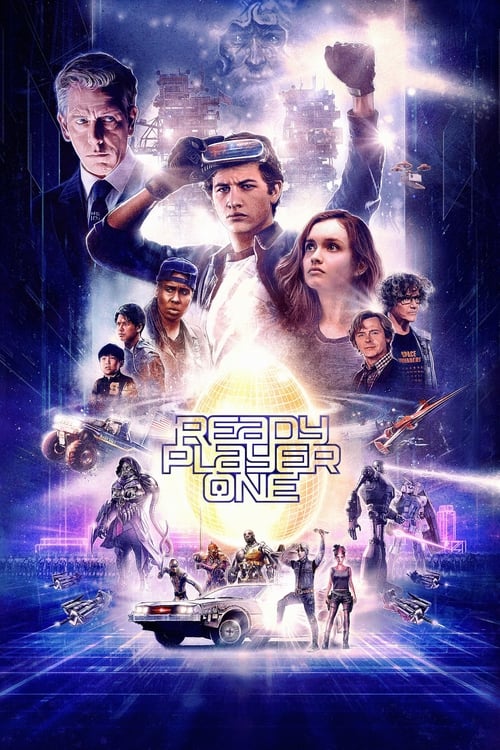
Ready Player One
2018 · Steven Spielberg
For a big, loud, switch-your-brain-to-fun night — pizza, couch, maybe friends who'll pause to point at the screen. Comfort viewing, especially if the 1980s live somewhere in your heart.
What it's about
In a run-down 2045, most of humanity escapes into the OASIS, a limitless virtual world. When its reclusive creator dies, he leaves his fortune and control of the OASIS to whoever can solve his hidden riddles — kicking off a global treasure hunt built from his beloved 1980s pop culture. Wade Watts, a teenager from the vertical trailer parks of Columbus, Ohio, joins the hunt with a crew of fellow gamers against a corporation with an army of contracted players.
The experience
A sugar rush — fast, dense with sight gags and references, and staged with the clean, kinetic action instincts of a director who invented half this playbook. It's pure ride, with just enough melancholy about hiding from the real world to give it an aftertaste.
Performances
Mark Rylance is the quiet surprise: as the mumbling, socially broken creator Halliday, he gives a cartoon-scaled movie its one genuinely tender human being.
The craft
Spielberg orchestrates enormous digital set pieces — a demolition-derby race through a shape-shifting city, a battle with thousands of avatars — with a clarity most effects films can't manage, and one extended homage sequence to a horror classic is worth the ticket alone. This is emphatically a big-screen, loud-speakers movie.
Why it matters
A late-career Spielberg spectacle in which the man who built 1980s blockbuster culture turned around to examine the nostalgia industry it spawned — and it landed right as that nostalgia dominated pop culture.
Snapshot
Ready Player One is Steven Spielberg's adaptation of Ernest Cline's 2011 bestseller, a maximalist pop-culture spectacle that doubles as one of the strangest objects in the director's late career: a blockbuster about the very 1980s blockbuster culture that Spielberg himself did more than anyone to create. Set in a depressed, climate-strained 2045, it follows Wade Watts (Tye Sheridan), a teenager from the slum "stacks" of Columbus, Ohio, who — like most of humanity — escapes a broken reality by living inside the OASIS, a sprawling virtual universe. When its reclusive creator, James Halliday (Mark Rylance), dies, he bequeaths control of the OASIS and his fortune to whoever can solve a series of riddles and find a hidden Easter egg, triggering a global treasure hunt that pits Wade and a band of fellow "gunters" against the predatory corporation IOI and its executive Nolan Sorrento (Ben Mendelsohn). The film is at once a breathless action-adventure, a love letter to the gaming and movie ephemera of the late twentieth century, and — more ambivalently — a fable about escapism that warns against the very immersion it so lavishly sells. It stands as Spielberg's most technologically forward film of the decade and, simultaneously, his most backward-looking, an exercise in nostalgia engineering executed at the absolute frontier of digital production.
Industry & production
Ready Player One was a major studio tentpole, produced for Warner Bros. with Amblin Entertainment and the Indian conglomerate Reliance Entertainment among the financing and producing partners; Donald De Line, Kristie Macosko Krieger, Dan Farah, and Spielberg himself are credited producers. The project had a notable gestation: Warner Bros. acquired Cline's novel before its publication, and the adaptation passed through development before Spielberg committed to direct — a coup for the studio, since the book's reverent invocation of his era made him the most logical and most loaded choice imaginable.
The single largest production challenge was legal rather than technical: the film's entire conceit depends on densely layering copyrighted characters, vehicles, and imagery from across decades of games, films, comics, and toys, each requiring rights clearance. The result was one of the most complex licensing operations in modern Hollywood, and the final film teems with cleared references — the Back to the Future DeLorean, the Akira motorcycle, the Iron Giant, Chucky, the King Kong and Jurassic Park iconography, characters from Overwatch, Halo, Street Fighter, Gundam, and Godzilla, among many others. Some sought-after properties could not be secured, and the film's roster reflects the negotiated reality of what was obtainable. Crucially, Warner Bros.' own ownership of The Shining enabled the film's most celebrated sequence, a sustained excursion into a digital recreation of Kubrick's 1980 film — a set-piece that would have been impossible without the studio's control of the rights.
Spielberg shot principally in Birmingham, England, with the live-action "real world" scenes grounded in a tactile, grimy physical production, while the OASIS material was generated through performance capture and animation (see Technology). The film premiered at SXSW in March 2018 and opened to strong commercial performance, particularly internationally and notably in China, where it became one of the year's larger Hollywood successes; it ranks among the higher-grossing films of Spielberg's later career. Precise final figures vary by source, and I will not assign numbers I cannot verify here.
Technology
Technologically, Ready Player One is the most significant film of Spielberg's later period and a landmark in his own practice. Roughly half the picture takes place inside the OASIS, realized not as traditional live-action but through performance capture and full computer animation, executed chiefly by Industrial Light & Magic under visual-effects supervisor Roger Guyett. The production used a motion-capture volume in which actors performed, with their movements driving digital avatars, and Spielberg directed the virtual scenes using a real-time virtual camera system — a rig that let him "shoot" the animated world as though operating a physical camera within it, framing, panning, and choosing angles inside a space that did not yet fully exist.
This represented a genuine methodological departure for a director long associated with classical, photochemically grounded craft. By his own account Spielberg approached the virtual-production apparatus as a new and initially disorienting instrument, learning to stage and shoot in a game-engine-adjacent environment that anticipated the real-time virtual-production techniques that would proliferate across the industry in subsequent years. The film thus occupies an important transitional position: it is a major-auteur, big-budget demonstration of virtual cinematography arriving just before such pipelines became standardized. Its technical achievement lies less in inventing any single tool than in the scale and fluency with which an established master integrated emerging virtual-production methods with ILM's photorealistic animation and the dense compositing demanded by its citation-heavy design.
Technique
Cinematography
The cinematography is credited to Janusz Kamiński, Spielberg's near-exclusive director of photography since Schindler's List (1993). The film presents Kamiński with a bifurcated assignment, and the division is its defining visual logic. The real-world 2045 scenes are shot in his characteristic register — diffused, often desaturated light, smoke and atmosphere, a melancholy naturalism that lends the stacks and IOI's corporate interiors a lived-in heaviness. The OASIS sequences, by contrast, are "photographed" virtually, with Kamiński and Spielberg translating cinematographic instinct into the animated volume: saturated color, weightless camera movement, and a hyperkinetic legibility impossible in physical space. The contrast is thematic as much as formal — the drab, grounded reality against the limitless, candy-bright virtual — and the seamlessness with which Kamiński's sensibility carries across the two domains is part of the film's accomplishment.
Editing
The film was cut by Michael Kahn — Spielberg's editor across nearly his entire career — together with Sarah Broshar, marking a generational handoff in the director's editing room. The editorial task is formidable: the action set-pieces (the opening reverse-race through a hazard-strewn Manhattan, the climactic mass battle) are extraordinarily dense with simultaneous incident and embedded references, and the cutting must sustain spatial coherence amid near-total visual saturation. The film moves at high velocity yet remains, for the most part, readable — a function of editing that prioritizes the geography of action over fragmentation. The Shining sequence is a particular showcase, a sustained set-piece whose comic and horror beats depend on precise rhythmic control.
Mise-en-scène / staging
Production design by Adam Stockhausen anchors the film's two worlds. The real 2045 — the vertical shantytown of stacked trailers, the worn domestic interiors — is rendered with grounded, plausible decay, a near-future built from extrapolated present-day precarity. The OASIS, by contrast, is a designed plenitude, an environment whose every surface can hold a citation. Spielberg's staging organizes this overwhelming density around clear lines of action and character, using the contrast between the two registers as the film's central visual argument: the impoverishment of the physical against the seductive abundance of the simulated. The recreation of the Overlook Hotel is the most virtuosic act of staging, a knowing reconstruction that depends on the audience's memory of Kubrick's spaces for its effect.
Sound
The score is by Alan Silvestri — a conspicuous and meaningful departure, since Spielberg's films are overwhelmingly scored by John Williams, who was occupied with The Post during the same period. Silvestri, indelibly associated with the Back to the Future trilogy, is an apt substitute given the film's 1980s fixation, and his music both supplies propulsive adventure scoring and participates in the film's nostalgic texture. The soundtrack is further saturated with licensed period pop music, deployed as another layer of cultural citation. The sound design must render two acoustically distinct worlds — the muffled reality and the hyperreal OASIS — and the film's aural identity is, like its imagery, built substantially out of recognition and reference.
Performance
The performances are split between physical and capture-based work. Tye Sheridan carries the film as Wade/Parzival with earnest, unshowy conviction, and Olivia Cooke gives Samantha/Art3mis the most grounded interiority among the young leads, her real-world arc (including a facial birthmark she conceals in the OASIS) supplying the film's clearest statement of its reality-over-avatar theme. Ben Mendelsohn plays Sorrento as a recognizably contemporary corporate villain, smoothly menacing rather than cartoonish. The film's emotional center, however, is Mark Rylance — the Oscar-winning star of Spielberg's Bridge of Spies — whose halting, gentle, socially withdrawn Halliday gives the picture its melancholy soul; his performance reframes the entire treasure hunt as the testament of a lonely man who mistook retreat for living. Simon Pegg as Halliday's estranged partner Ogden Morrow, Lena Waithe as Aech, and T.J. Miller as the bounty hunter i-R0k round out a cast performing across the live-action/capture divide.
Narrative & dramatic mode
The narrative mode is the quest-adventure, structured as a sequence of escalating challenges — three keys, three gates — adapted (and substantially altered) from Cline's novel. Spielberg and the screenwriters notably reinvented the specific puzzles: where the book's first trial is a head-to-head game of Joust and a recreation of WarGames, the film opens instead with a spectacular vehicular race, and its middle challenge becomes the Shining excursion. The dramatic engine is a race-against-the-corporation, with Wade's ragtag "High Five" against IOI's industrialized army of paid players. Beneath the adventure plot runs a coming-of-age and first-love story, and beneath that a mournful, almost elegiac strand carried by Halliday's posthumous riddles — a structure in which solving the game means, ultimately, understanding the regrets of the man who built it. The mode is fundamentally optimistic and youth-centered in the Amblin tradition, even as its resolution turns on a sober lesson about the limits of the virtual.
Genre & cycle
The film sits at the intersection of the science-fiction adventure, the dystopian young-adult adaptation, and the nostalgia-driven franchise spectacle. It belongs squarely to the 2010s cycle of intellectual-property-saturated blockbusters — films built on recognition, cross-referencing, and the monetization of cultural memory — and is in some sense that cycle's apotheosis and its self-portrait, a blockbuster whose subject is blockbuster culture. It also descends from the cyberpunk lineage of virtual-reality fiction (the genealogy that runs through Tron, The Matrix, and the "jacked-in" tradition), and from the YA dystopia wave then prominent in Hollywood. Within Spielberg's own filmography it connects to his strain of effects-driven adventure (Jurassic Park, Minority Report) while standing apart for its self-referential, meta-nostalgic premise.
Authorship & method
Ready Player One is unusually charged as an authorial object because its source material is, in large part, a tribute to Spielberg's era and Spielberg's own work. The director's method here was one of partial self-effacement: by multiple accounts he was reluctant to foreground references to his own films, wary of self-aggrandizement, and steered the citation toward the broader culture rather than the Amblin canon — though the presence of the Back to the Future DeLorean (from a film he produced) and the unavoidable resonance of the whole project complicate any clean separation. The screenplay is credited to Zak Penn and Ernest Cline, adapting Cline's novel, with significant restructuring of the book's set-pieces for the screen.
The key collaborators are, strikingly, Spielberg's long-standing inner circle deployed on radically new terrain: cinematographer Janusz Kamiński and editor Michael Kahn, the two craftspeople most identified with his classical style, here working in virtual production and high-density VFX, with Sarah Broshar co-editing and Alan Silvestri standing in for the absent John Williams. Production designer Adam Stockhausen and ILM's Roger Guyett complete the core authorial team. The film is thus a case study in a veteran auteur extending an established collaborative signature into an unfamiliar technological idiom.
Movement / national cinema
The film is a product of the globalized Hollywood studio system at its most internationally calibrated — an American tentpole financed and distributed for a worldwide audience, with substantial international (and especially Chinese) box-office success integral to its economics. It belongs to the Amblin tradition of mainstream American popular cinema, the very sensibility — suburban-mythic, technologically wondrous, emotionally accessible — that Spielberg pioneered and that the film both extends and historicizes. It is, in that sense, a piece of American commercial cinema reflecting on its own global cultural reach.
Era / period
Ready Player One is profoundly a film of the late 2010s. It arrives at the peak of IP-driven franchise filmmaking and the "nostalgia economy," amid a wave of cultural recycling (the contemporaneous success of properties like Stranger Things shares its appetite for 1980s memory). It reflects the era's anxieties about virtual reality and immersive technology — landing during the consumer-VR hype cycle and anticipating later "metaverse" discourse — as well as gathering fears about corporate control of digital spaces, surveillance, and economic precarity. Its diegetic 2045 projects present-day worries about inequality, climate stress, and screen-mediated escape into a near future. The film captures, with unusual precision, a cultural moment caught between reverence for the analog past and apprehension about a fully virtualized future.
Themes
The film's governing theme is the tension between reality and escape. It stages an immense, seductive argument for the pleasures of the virtual only to insist, in its resolution, that "reality is the only thing that's real" — a message complicated by the fact that the film's own appeal lies overwhelmingly in its virtual spectacle. Closely related is the theme of nostalgia itself: the narrative literalizes the proposition that cultural memory has become both a treasure and a trap, a body of shared reference that binds people together yet can also imprison them in the past, as it did Halliday. Other strands include the critique of corporate predation (IOI's commodification of play and its indentured "loyalty centers"), the value of authentic human connection over curated avatars (embodied in Art3mis's birthmark and the friends' eventual face-to-face meeting), and the melancholy of creation — Halliday's hunt revealed, finally, as the confession of a man who built infinite worlds because he could not live fully in his own.
Reception, canon & influence
Critical reception was mixed-to-positive. Reviewers widely praised the film's technical bravura, the kinetic command of its action set-pieces, and the Shining sequence in particular as a virtuoso act of homage; many singled out Mark Rylance's performance and the unexpected poignancy of the Halliday material as the film's most genuine achievements. The recurring criticism concerned substance beneath spectacle: detractors faulted thin characterization, and several critics noted the film's central irony — that a work cautioning against escapist immersion and the hollow accumulation of pop-culture references is itself an exercise in exactly that, a nostalgia object critiquing nostalgia. The discourse around the film became, to an unusual degree, a debate about the cultural value of "reference" as a mode of storytelling.
The influences on the film are layered. Most directly it adapts Cline's novel and its encyclopedic 1980s sensibility; behind that stand the cyberpunk and virtual-reality traditions of science fiction, the arcade and early-gaming culture of the era, and — inescapably — the Amblin-Spielberg cinema of the 1980s itself, which the film treats as both source and subject. Kubrick's The Shining is invoked as explicit text. Its legacy forward is bound up with the technologies it helped popularize: as a high-profile, big-budget demonstration of virtual production and real-time virtual cinematography, it is part of the lineage leading toward the now-standard game-engine-driven production methods of subsequent years. Culturally, it became a touchstone — and frequently a punching bag — in debates about the "metaverse," about IP-saturated filmmaking, and about the limits of nostalgia as a creative engine. Its longer standing in the Spielberg canon remains unsettled; it is generally regarded as a minor but fascinating late work, valued less as a story than as a document of its director, and its era, reckoning with the culture they had made.
A Deleuzian reading
The reverse-race opens in a city eating itself.
The full Deleuzian reading of Ready Player One →
Reception
A solid box-office hit in 2018 (over half a billion worldwide) with mixed-to-decent reviews, but the online backlash to its wall-to-wall pop-culture referencing was instant and brutal — and since the 'metaverse' hype cycle, it's been reappraised less as a movie than as an accidental prophecy people love to cite.
How Ready Player One was received, from release to now →
Influences: the films it descends from and the films it influenced
- The Shining (1980) — The Jurassic-jungle 'Distracted Globe'/Overlook sequence reconstructs Kubrick's hotel sets and Steadicam corridor glides near shot-for-shot, an explicit staging recreation rather than allusion.
- Tron (1982) — First feature to render a navigable luminous game-grid interior; the OASIS inherits its convention of dropping live actors into a fully synthetic, gravity-bending digital arena.
- Back to the Future (1985) — Spielberg-produced source of the DeLorean licensed-prop citation, and the home of Alan Silvestri's brass-fanfare idiom that he transplants here to cover John Williams's absence.
- Who Framed Roger Rabbit (1988) — Spielberg-produced template for cross-studio IP cohabitation in a single frame, pioneering live-action/animated integration that the OASIS's mascot-crowd compositing scales up.
- Jurassic Park (1993) — Establishes Kahn's action-spatial-coherence cutting that interleaves ILM CG bodies with live plates while preserving legible geography — the editorial method RPO reuses at higher VFX density.
- The Matrix (1999) — Codified the VR-action grammar in which avatars obey game-physics and the virtual camera detaches from real optics (bullet-time), the formal vocabulary RPO's combat assumes.
- Minority Report (2002) — Kamiński's bleach-bypassed, desaturated future register and pre-vis-heavy gestural-interface staging seed the bifurcated real/virtual look split he deploys across RPO.
- Speed Racer (2008) — Hyperkinetic, fully-synthetic race choreography with impossible camera carries is the direct stylistic forebear of the King Kong / New York race set-piece.
- Avatar (2009) — Built the performance-capture-plus-virtual-camera pipeline — directors framing CG worlds through a tracked handheld monitor in real time — that RPO's OASIS shoot adopts wholesale.
- The Polar Express (2004) — Pioneered full-body performance capture driving photoreal animated avatars, the capture-live-divide technique behind Rylance/Halliday's Anorak and the players' OASIS bodies.
- The Adventures of Tintin (2011) — Spielberg returns to virtual-camera previsualization and a fully digital animated act, again migrating his live-action crew into the synthetic realm Tintin proved he could direct.
- Pacific Rim: Uprising (2018) — Stages a climactic CGI mecha battle (Gundam vs. Mechagodzilla) using the identical photoreal giant-robot-vs-kaiju brawl vocabulary, treating the mecha/kaiju canon as remixable spectacle Uprising had just franchised.
- The Lion King (2019) — Extends RPO's real-time methods by staging the entire film inside a game-engine VR set where operators frame virtual cameras in headsets — virtual production as total method.
- The Mandalorian (2019) — Industrializes the game-engine virtual cinematography RPO demonstrated into the StageCraft LED volume, making real-time rendered backgrounds a standard production tool.
- Free Guy (2021) — Builds its diegesis from an open-world video-game with player avatars and brand cameos, directly extending OASIS's conceit of a playable world as narrative space.
- Space Jam: A New Legacy (2021) — Takes RPO's licensed-IP cameo logic to its endpoint, structuring an entire film around a corporate-property crossover crowd inside a server-verse.
- Alita: Battle Angel (2019) — Centers a fully performance-captured protagonist acting opposite a live cast, pushing the same capture-live-divide integration RPO uses for its avatar/operator boundary.
- Avengers: Endgame (2019) — Fuses a performance-captured digital antagonist (Thanos) with a nostalgia-IP crossover spectacle, sharing RPO's reliance on accumulated franchise reference as emotional payoff.
- Jurassic World (2015) — Spielberg's own reflexive blockbuster about the commodification of nostalgia and spectacle-fatigue, narrating the same self-aware franchise economics Jurassic World embeds in its 'Verizon Indominus' satire.
- A Minecraft Movie (2025) — Deploys virtual-production and volumetric stagecraft to shoot actors inside a digital game-world mashup, the toolchain Minecraft's virtual production descends from.
Similar films
- Tron (1982) — influence & lineage
- The Matrix (1999) — influence & lineage
- Jurassic Park (1993) — influence & lineage
- Avatar (2009) — influence & lineage
- Avengers: Endgame (2019) — influence & lineage
- Star Wars: The Last Jedi (2017) — shared sensibility
- The Maze Runner (2014) — shared sensibility
- Star Wars: The Force Awakens (2015) — shared sensibility
All the films related to Ready Player One →
Watch it with: curated runs of related films
- Worlds Worth Getting Lost In — A run of maximalist, effects-driven pictures that each conjure a whole world from scratch — watch them when you want to be swept somewhere on the biggest screen you can find.