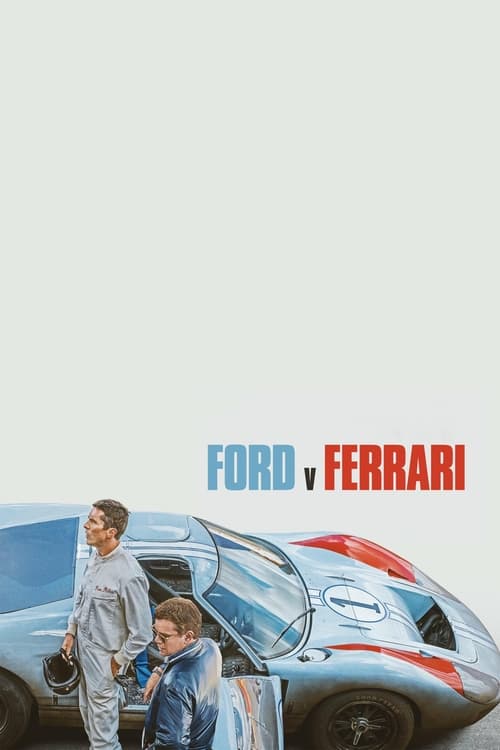
Ford v Ferrari
2019 · James Mangold
For when you want an old-fashioned great time at the movies — underdogs, friendship, engines, and stakes you can feel in your chest. Comfort viewing with real craft behind it; perfect with company.
What it's about
In the mid-1960s, Ford decides to humiliate Ferrari at the 24 Hours of Le Mans, and hands the job to two men who can actually do it: Carroll Shelby, a charming Texan car designer, and Ken Miles, a brilliant, prickly British driver nobody at corporate can stand. Together they fight physics, the clock, and Ford's own suits to build a race car that can survive twenty-four hours at full throttle.
The experience
A total crowd-pleaser — funny, fast, and surprisingly moving, with racing sequences that put you in the driver's seat at 200 mph. It roars along for two and a half hours and somehow leaves you wishing for more.
Performances
Christian Bale is the engine of the film — his Ken Miles is spiky, hilarious, and unexpectedly tender — and Matt Damon's easy-charm Shelby gives him the perfect sparring partner; their scenes together are the movie.
The craft
The racing is shot low, close, and largely for real, so speed registers in your body — and the sound design of engines screaming through the night at Le Mans practically demands good speakers. James Mangold builds it like classic Hollywood: character first, spectacle earned.
Why it matters
Proof that the mid-budget, adult crowd-pleaser could still thrive in the blockbuster era — a hit with audiences and awards voters alike, and now the modern benchmark for racing on film.
Snapshot
A late-Hollywood epic in the classical mold: two men against a corporation, against physics, against each other's stubbornness, against time itself. James Mangold's Ford v Ferrari recounts the true story of the 1966 24 Hours of Le Mans, where Carroll Shelby (Matt Damon) and Ken Miles (Christian Bale) built the Ford GT40 Mk II that finally broke Ferrari's stranglehold on endurance racing — only for Ford's own bureaucracy to snatch a clean victory away at the finish line. The film is simultaneously a celebration of individual craftsmanship and a skeptical anatomy of corporate power, grounding its thesis in the sensory extremity of racing: the body at the edge of its limits, the machine at the edge of dissolution. At 152 minutes it earns its length through accumulation of character detail rather than spectacle alone.
Industry & production
The project had a protracted development. The script, credited to Jez Butterworth, John-Henry Butterworth, and Jason Keller, circulated for years — Keller's original draft attracted significant early interest before the Butterworths substantially reworked it. Ridley Scott was at one point attached; the property eventually reached Mangold, whose track record with character-centred genre films made him a natural fit. Production company Chernin Entertainment brought it to 20th Century Fox, which was in the final stages before its acquisition by Disney — Ford v Ferrari became one of Fox's last prestige theatrical bets under the old regime and one of its most commercially vindicated ones. The film shot primarily in California, using Willow Springs International Raceway and other circuit facilities to stand in for Le Mans and the other tracks depicted. CGI augmented but did not replace practical on-location and on-track photography; Mangold made clear from early production materials that the film's racing sequences would prioritize physical reality over digital synthesis, a decision with significant logistical consequences for scheduling and safety management. The production also navigated significant period-vehicle logistics, sourcing and maintaining era-correct GT40s and Ferrari P3s, some functional and some cosmetically dressed.
The film was released in November 2019 and performed strongly at the domestic box office, outperforming many comparable mid-budget adult dramas of its period. It was nominated for four Academy Awards and won two: Best Film Editing (Michael McCusker and Andrew Buckland) and Best Sound Editing (Donald Sylvester), the latter recognition pointing to the centrality of sound design in the film's experiential argument.
Technology
Cinematographer Phedon Papamichael's approach to the racing sequences required sustained invention. Rather than relying on the static GoPro grammar that had become common in motorsport coverage, the production mounted cameras in unconventional positions — on the cars themselves but also close to track level, inside cockpits in ways that emphasized the spatial claustrophobia of the GT40's driving position, and in configurations that could follow motion without sacrificing optical coherence. The goal was immersion without the detachment of pure documentary footage: the camera always implicitly argues a point of view, whether it belongs to Miles or to the watching Shelby.
Sound design by Sylvester and his team treated the GT40's engine signature as an almost musical instrument, distinct in character from the Ferrari P3 — a decision that functions dramatically rather than merely authentically, since audiences need to aurally distinguish the cars as protagonists. The design occupies a studied middle ground between recorded accuracy and expressionist amplification: the sounds are real in origin but shaped in the mix to carry dramatic weight. This is perhaps the most technically ambitious aspect of the production and the one most directly responsible for the film's visceral effectiveness.
Post-production used digital intermediate workflow standard for major studio releases of its period, though the photography was designed with a naturalistic texture — wider latitude, warmer in period flashbacks and California sequences, with a particular attention to the dusty heat of California testing grounds — that evokes analog grain without replicating it precisely.
Technique
Cinematography
Papamichael and Mangold have collaborated across multiple films, and their shared visual language emphasizes spatial clarity over stylistic restlessness. Ford v Ferrari is shot with a strong sense of horizontality — the wide frame used to accommodate both car and landscape in single shots, rarely fragmenting what can be shown whole. In quieter scenes — the Miles kitchen, Shelby's garage, the Ford boardrooms — the camera holds position longer than contemporary Hollywood defaults, trusting performance to animate the frame. The Le Mans night sequences are among the film's finest work: blue-cool and slightly underexposed, they create genuine disorientation without abandoning legibility, using practical light sources (headlamps, pit-lane fluorescence) to sculpt faces and machines in the dark.
Lensing opts for moderate focal lengths in dramatic scenes and longer glass during racing, compressing the cars against the landscape and implying speed through the relationship of moving foreground to static background. The cockpit photography, necessarily achieved through tight rigging, maintains surprising spatial integrity — the viewer always knows where Miles's hands are relative to the wheel, where the road is relative to the car. This refusal to lose orientation in action sequences is a deliberate formal argument: Mangold wants you to understand what is happening, not merely to feel stimulation.
Editing
McCusker and Buckland's Oscar-winning cut is a work of tonal management as much as structural assembly. The film's three major racing sequences — Daytona, the press and testing montages, and Le Mans itself — differ sharply in rhythm from each other, reflecting their different dramatic functions. The Daytona sequence establishes grammar. The Le Mans sequence deploys that grammar at maximum extension across what is effectively a 40-minute sustained climax, alternating between cockpit immediacy and the longer view of pit strategy, keeping Shelby's perspective as emotional anchor. The editing observes a discipline rare in contemporary action filmmaking: the cuts serve continuity of space and causation rather than sensation alone. When the film does accelerate — corner entries, near-misses — the burst is short and the return to stable continuity is swift, which paradoxically makes the danger feel more rather than less acute.
The dramatic scenes use longer takes than the racing sequences, and the cut frequently comes on action or on a character's moment of decision rather than at the end of a line of dialogue. This gives Damon and Bale room to layer reactions across full exchanges without being interrupted by coverage.
Mise-en-scène / staging
Mangold is a director formed partly in theater (his collaborations with strong dramatic writers are consistent across his career), and it shows in how he stages confrontation in interior spaces. The scenes between Shelby and Leo Beebe (Josh Lucas), the Ford executive whose corporate conservatism functions as the film's principal antagonist, are blocked as spatial negotiations — who controls the center of a room, where Ford II (Tracy Letts) sits in relation to the arguers, how a body turned away from someone constitutes an argument. The Miles kitchen — the domestic world the racing threatens — is staged with careful routinisation, the family's physical ease in the space contrasting with Miles's inability to be still anywhere except behind a wheel.
The film's most celebrated staging set-piece is not in a car: it is the fight between Miles and Shelby in Miles's front yard, a slapstick brawl that functions as a pressure valve for their sustained emotional tension and that arrives at exactly the dramatic moment when their relationship needs to be tested and confirmed simultaneously. Mangold choreographs it as farce with an undertow of feeling, and the scene's tonal precision — funny and real and slightly sad — encapsulates the film's overall register.
Sound
As noted under Technology, the sound design is among the film's most significant contributions. Marco Beltrami and Buck Sanders's score takes an interesting position relative to the sound design, frequently pulling back or disappearing entirely during racing sequences to cede the field to engine sound. When the score enters during racing, it does so as emotional underscoring rather than as accompaniment — signaling shifts in Miles's interior experience (the approach to "the perfect lap," the passage through the night) rather than amplifying external action. The score's primary register is intimate and slightly elegiac, consistent with the film's awareness that this is a story with a tragic ending that the narrative declines to rush toward.
Performance
Bale's preparation is known to have included mechanical training and racing work — he is persuasive in the cockpit in ways that are physically difficult to fake. More importantly, he constructs Miles as a man whose body thinks faster than his mouth, whose intelligence manifests as physical intuition rather than verbal fluency. The performance is technically showy in the gear-shift of emotion Miles displays in his final race, but Bale subordinates the technique to the character's grain: you never catch the acting. Damon plays Shelby as the mediating intelligence, a man who translates between Miles's uncompromising instinct and the institutional world that must be managed. It is a less flamboyant performance and often the more difficult one — Shelby must be simultaneously the audience surrogate and a figure of his own interiority, which Damon achieves through economy. Tracy Letts's Henry Ford II is a small masterpiece of authority and vulnerability in a few scenes.
Narrative & dramatic mode
The film works in the tradition of the American underdog-professional story — a tradition that has its literary roots in the craftsman's narrative (the obsessive artisan struggling to do the thing right against forces that want it done merely adequately), and its cinematic roots in the sports biopic. The dramatic mode is realist with genre inflection: the racing sequences tip toward genre spectacle, the boardroom scenes toward drama, the domestic scenes toward quiet character study. Mangold moves between modes without tonal rupture, which is the film's central structural achievement.
The narrative's sharpest choice is where it places the tragedy. The historical record is devastating: Miles, having driven what Shelby calls the perfect race, is denied a clean victory by a bureaucratic decision in the pit lane — Ford orders a formation finish for publicity purposes, and the lap-counting rules give the win on distance to Bruce McLaren and Chris Amon, who started behind Miles. The film dramatizes this exactly, allowing the injustice to land fully, and then moves quickly to Miles's death in a testing accident weeks later. The ending is elegiac rather than cathartic, which is the honest structural choice: there is no narrative redemption available that the facts support.
Genre & cycle
Ford v Ferrari belongs to the prestige racing film, a genre with a sporadic but coherent history: Le Mans (1971), Grand Prix (1966), Rush (2013) are the most direct antecedents. It also sits within the American corporate-individual biopic cycle prominent in the 2010s — films like The Social Network (2010), Moneyball (2011), and Steve Jobs (2015) that use professional and commercial arenas to examine American mythology about genius, institutions, and the cost of excellence. Ford v Ferrari is less formally ambitious than any of those films but more assured in its classical execution, and its generic double allegiance — it is simultaneously an action film and a character drama — gives it a broader register.
The film is also a rare mainstream Hollywood production centered on blue-collar and artisanal expertise rather than executive or entrepreneurial intelligence. Miles and Shelby are builders and drivers, not dealmakers; the film's genuine admiration runs toward the mechanical knowledge that cannot be faked, the physical courage that cannot be delegated.
Authorship & method
James Mangold came to notice with Cop Land (1997), a tightly controlled low-budget crime drama that demonstrated both his genre facility and his instinct for performance. His subsequent career has been characterized by the prestige genre film in which character depth and genre mechanics are treated as reinforcing rather than competing obligations: Walk the Line (2005), 3:10 to Yuma (2007), Logan (2017). Ford v Ferrari is continuous with this method. Mangold is not a formalist director — his camera rarely calls attention to its choices — but he is a precise one. His films tend to be handsomely but not showily shot, to use classical coverage deployed with care, and to arrive at emotional effectiveness through patience rather than intensity.
His long collaboration with Papamichael is part of this method: the cinematographer's naturalistic but controlled visual sensibility extends Mangold's own preference for transparent craft. Similarly, McCusker has cut most of Mangold's recent work, and the Beltrami/Sanders composing partnership is a consistent presence. This is auteurism expressed through ensemble stability rather than singular visual signature — the authorial personality is legible but distributed across a committed collaborative unit.
Jez Butterworth's involvement in the screenplay is notable and somewhat anomalous. His stage work — particularly Jerusalem (2009) — is interested in the English outsider against institutional forces, a thematic strain that maps coherently onto Ken Miles's position in the film: the idiosyncratic British craftsman who cannot or will not sand down his edges for corporate palatability. How much of this thematic architecture is Butterworth's, how much Keller's earlier material, and how much emerged in production is impossible to establish from external record.
Movement / national cinema
Firmly within Hollywood commercial cinema of its period, though the film's subject is inherently transnational. The central conflict — Ford versus Ferrari, American industrial capitalism versus Italian artisanal racing tradition — is written as a clash of national industrial cultures, and the film treats it as such. Ferrari functions in the film almost entirely as myth: Enzo Ferrari (Remo Girone) appears only briefly, his presence established through absence and reputation. This is historically somewhat abstracted; the film is less interested in Italian cinema or culture than in what "Ferrari" means as a signifier of European excellence against which American ambition must prove itself.
Ken Miles's Britishness is handled thoughtfully. He is outside both the American corporate world and the Italian tradition — a craftsman without institutional home, which is the source of both his excellence and his vulnerability. The film never sentimentalizes his foreignness but it does use it structurally: Miles is the man who cannot be managed because he has no stake in any of the national mythologies being contested.
Era / period
Ford v Ferrari arrived in November 2019, a moment of unusual density in prestige Hollywood cinema — Once Upon a Time in Hollywood, The Irishman, Marriage Story, 1917, and Parasite were all competing for attention and awards. Its commercial and critical success in this environment is evidence of how effectively it triangulated between adult-drama seriousness and genre accessibility. It is a product of the late studio period in which mid-budget films for adult audiences were becoming increasingly difficult to produce within the major-studio system; its commercial performance did not reverse this trend but offered a counterexample of what the model could still achieve.
The film's visual and narrative conservatism is appropriate to its subject and its moment: it does not attempt the formal experiments that characterized some of its 2019 prestige contemporaries, and it does not need to. Its mode of excellence is classical rather than innovative.
Themes
The film's dominant thematic argument is about the irreducibility of expertise and the institutional hostility it reliably encounters. Miles can feel things in a car that cannot be communicated in terms the Ford marketing department can process; this is presented not as mysticism but as the product of thousands of hours of embodied practice. The antagonism between this kind of knowledge and the knowledge that circulates in boardrooms — legible, quantifiable, photographable — drives every major dramatic confrontation.
Alongside this runs a secondary argument about friendship and loyalty as forms of practical commitment rather than sentiment. Shelby's repeated efforts to protect Miles from institutional consequences are not idealized; they cost him, and the film is honest about what they cost. The Shelby-Miles relationship is the film's emotional core and it is handled with unusual restraint: the two men rarely speak directly about what they mean to each other, and the film trusts the action sequences to carry the emotional argument.
The tragic conclusion opens onto a third theme: the gap between historical achievement and personal reward. Miles wins the race by every measure that matters to him and loses it by the only measure the institution recognizes. The film declines to resolve this ironically — it does not suggest the institution was right, nor does it offer the consolation of posthumous vindication. The final scene is quiet and small and correct.
Reception, canon & influence
Critical reception was strongly positive, with consensus praising the performances, the racing sequences, and the film's tonal range. The Best Picture nomination confirmed its standing in the prestige tier of its year, though it did not seriously threaten the awards frontrunners. Its durability since release has been solid; the film performs well in replay conditions, partly because the racing sequences genuinely improve on IMAX-scale home exhibition and partly because the character work accrues rather than diminishes.
The primary influences on the film run through the racing-film tradition: John Frankenheimer's Grand Prix (1966) is the obvious structural predecessor for the extended competition sequence; Steve McQueen's Le Mans (1971) looms over any Le Mans film as the radical limit-case of the experiential approach, stripped of conventional narrative. Ron Howard's Rush (2013) is a more immediate precedent — a sophisticated, well-crafted racing biopic that demonstrated market appetite for the form. Mangold has also cited the influence of American character-driven sports films of the 1970s; the film's interest in working-class competence and institutional friction is continuous with that tradition.
Its forward influence is necessarily provisional given its recency, but it has clearly refreshed industry confidence in the prestige racing film as a commercially viable form. The attention to practical stunt work and on-camera racing has reinforced arguments — audible in production discourse around several subsequent projects — for physical rather than digital approaches to vehicle-based action. As a template for the adult studio genre film that takes its subject and its audience seriously without sacrificing entertainment, it is likely to remain a reference point.
A Deleuzian reading
Watch Ken Miles's hands.
The full Deleuzian reading of Ford v Ferrari →
Reception
A hit on arrival — six Oscar nominations including Best Picture, wins for editing and sound editing — it has since hardened into the poster child for 'the mid-budget adult drama Hollywood doesn't make anymore,' cited constantly in that discourse.
How Ford v Ferrari was received, from release to now →
Influences: the films it descends from and the films it influenced
- Grand Prix (1966) — Frankenheimer pioneered mounting cameras inside, on, and beneath the cars themselves — multi-axis in-vehicle coverage at race speed — inventing the spatial grammar that Mangold's sustained Le Mans sequences directly reproduce, including the low-angle wheel-level framing and the driver's-eye shot that anchors spectator orientation mid-race.
- Le Mans (1971) — The radical choice to withdraw score almost entirely during racing and let engine sound carry the film's emotional register as its sole expressive instrument is the direct philosophical and practical model for Ford v Ferrari's sound design, which applies the same principle with a larger, more controlled production apparatus.
- Bullitt (1968) — Lalo Schifrin's score drops out during the chase and William Fraker's telephoto lens work collapses street depth through long-lens compression — the specific cinematographic technique Phedon Papamichael applies to the racetrack, making the GT40's speed legible through background-foreground spatial collapse rather than cutting rate.
- The Right Stuff (1983) — The structural model for Ford v Ferrari's craftsman's tragedy: Chuck Yeager as instinctual airman-artisan whose refusal to sand down his edges for institutional palatability results in bureaucratic ejection from the very program his skill made possible — the exact arc Jez Butterworth maps onto Ken Miles within the Ford corporate machine.
- Ronin (1998) — Frankenheimer hired rally drivers and deployed practical long-lens photography for Paris and Nice chase sequences with no process shots or CGI vehicles — the specific production methodology Ford v Ferrari's second-unit team applied to Le Mans, where real cars at speed were photographed with telephoto lenses from helicopter and chase vehicles.
- Senna (2010) — Kapadia established the F1 engine's harmonic range — its pitch-shifting under acceleration and braking — as an orchestral texture capable of carrying emotional register without underscore, a sound-design discovery that Ford v Ferrari extends to the GT40's V8, treating engine acoustics as musical instrument rather than background noise.
- Rush (2013) — The immediate structural predecessor: a prestige racing biopic built around dual-protagonist rivalry, sophisticated multi-camera race coverage, and adult genre seriousness, which demonstrated commercial market appetite for the form and provided Mangold's production a concrete template to measure against and refine.
- Apollo 13 (1995) — The practical-over-CGI approach to period technical drama — building and filming the actual spacecraft interiors, using real equipment — and the narrative of craftsmen defeating institutional skepticism through competence under deadline are the template for Ford v Ferrari's production philosophy and its corporate-individual conflict structure.
- Cop Land (1997) — Mangold's methodological origin: a performance-led genre film with transparent craft and the individual-against-institutional-corruption engine that recurs throughout his work; the casting of physically specific actors against type and the patience of classical coverage deployed for emotional accumulation rather than sensation are habits fully formed here.
- Top Gun: Maverick (2022) — Ford v Ferrari's demonstrated commercial and critical return on practical in-vehicle camera work directly emboldened Maverick's production to mount IMAX cameras inside operational F/A-18s at flight speed; the aircraft cockpit sequences are the aviation translation of Mangold's racing-car camera methodology, and the production discourse explicitly cites FvF as proof-of-concept.
- Ferrari (2023) — Mann's entry into the prestige racing film genre Ford v Ferrari revived; his ambient engine-sound design and long-lens race photography at Mille Miglia are in direct formal dialogue with FvF's acoustic and visual approach, and the corporate-individual structure — Enzo Ferrari as craftsman-proprietor against institutional and personal dissolution — occupies the same biopic architecture.
- F1 (2025) — Modeled the prestige-racing cycle's foregrounding of diegetic engine acoustics and gear-shift mechanics as dramatic sound, the sonic realism F1 extends with its diegetic engine-acoustic design.
- Walk the Line (2005) — The same Mangold–Papamichael–McCusker collaborative unit producing the same economy-of-means prestige biopic, with performance-as-craft at the center — Joaquin Phoenix's physical embodiment of Cash mirrors Bale's embodiment of Miles — and the same preference for transparent classical coverage over stylistic signature.
- 3:10 to Yuma (2007) — Papamichael's naturalistic horizontal wide-frame cinematography — the anamorphic landscape framing that positions characters against open space without compositional flourish — is directly continuous with his Ford v Ferrari visual approach, and the working-class protagonist defending competence against institutional pressure is the same dramatic engine in Western register.
- Logan (2017) — The elegiac craftsman's tragedy close — in which the protagonist's death resolves rather than undermines the film's emotional argument about a life spent in service of an exacting physical discipline — is the same structural and tonal choice Mangold makes for Ken Miles; the same collaborative unit executes it in both cases.
- Days of Thunder (1990) — Builds its racing sequences on practical car-mounted cameras and motor-centric sound design — the real-speed, real-crash methodology Days of Thunder championed against CGI.
- Soorarai Pottru (2020) — An underdog engineering-and-machines drama pitting hands-on builders against corporate gatekeeping, using the physical craft of the vehicle as the emotional stakes.
- Hidden Figures (2016) — Extends the engineering-procedural aesthetic of Hidden Figures: physical calculation instruments (stopwatches, slide rules, chalked telemetry) shot as loving inserts, with the antagonist rendered as corporate process rather than a villain, and cross-cutting between the shop floor and the executive suite.
Similar films
- Rush (2013) — influence & lineage · same viewing thread
- 3:10 to Yuma (2007) — influence & lineage
- Bullitt (1968) — influence & lineage
- Ronin (1998) — influence & lineage
- The Right Stuff (1983) — influence & lineage · same viewing thread
- F1 (2025) — shared sensibility
- Drive My Car (2021) — shared sensibility
- Ben-Hur (1959) — shared sensibility
All the films related to Ford v Ferrari →
Watch it with: curated runs of related films
- Great Men, Grand Reckonings — A run of prestige true stories about singular, obsessive men chasing an epochal achievement — the bomb, the moon, the checkered flag, a nation — and reckoning with what it cost them and everyone around them.