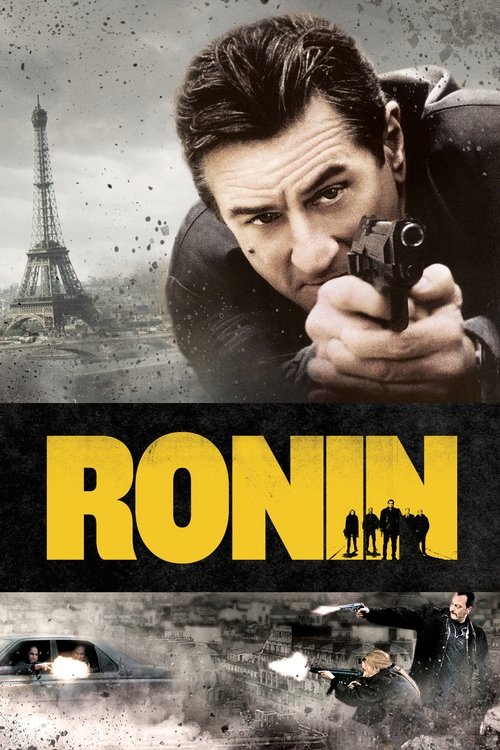
Ronin
1998 · John Frankenheimer
For when you want a grown-up thriller — real cars, real stakes, competent people doing dangerous work — without a single wink at the camera. Perfect for a night when you want to lean forward, not switch off.
What it's about
A metal briefcase — contents never explained — is wanted by Irish operatives and Russian interests alike, and a freelance crew of ex-intelligence professionals is hired to steal it. De Niro's Sam, an American with an apparent CIA past, joins mercenaries left masterless by the end of the Cold War: men with lethal skills, no flags, and no idea what they're actually fighting for. The job takes them through Paris and the south of France, where nobody on the team can fully trust anybody else.
The experience
Tense, terse, and ruthlessly professional — the film moves like its characters, all economy and watchfulness, then erupts into some of the most heart-in-throat chases ever filmed. It respects your intelligence and never wastes a word.
Performances
Robert De Niro is at his most quietly commanding, doing more with a raised eyebrow than most action heroes manage with a monologue, and Jean Reno gives the film its soul as the one man Sam might actually trust.
The craft
The car chases are the stuff of legend: shot practically at genuinely terrifying speeds through the streets of Paris and Nice, often against oncoming traffic, with the actors visibly inside the cars — no digital trickery, no cheating. Frankenheimer stages every ambush and shootout with the geographic clarity of a master, so you always know exactly where everyone is. See it big and loud.
Why it matters
It capped John Frankenheimer's late-career comeback and set the modern benchmark for practical, in-camera vehicle action — the standard every subsequent chase scene gets compared to.
Snapshot
Ronin is a post–Cold War espionage thriller built around a deliberate void: a metal briefcase, sought by Irish republican operatives and Russian interests alike, whose contents the film never discloses. John Frankenheimer, then in his late sixties and enjoying a hard-won career renaissance, used that hollow center to make a film about professionals — ex-intelligence operatives and mercenaries left masterless by the end of the Cold War — who do skilled, dangerous work without knowing, or caring, what it ultimately serves. Robert De Niro anchors an international ensemble (Jean Reno, Natascha McElhone, Stellan Skarsgård, Sean Bean, Jonathan Pryce, Skipp Sudduth, Michael Lonsdale) as Sam, an American with an apparent CIA past, hired into a freelance crew assembled by an IRA liaison. The film's lasting reputation rests less on its labyrinthine, double-crossing plot than on its craft: a procedural attention to tradecraft and, above all, two extended car chases through southern France and Paris that remain benchmarks for analog, location-shot vehicular action. Ronin is at once a genre exercise of unusual rigor and an elegiac character study about men whose code outlives the cause it was meant to serve.
Industry & production
Ronin was produced and distributed by Metro-Goldwyn-Mayer/United Artists, a major-studio action picture made largely on European locations. It arrived at a particular juncture in Frankenheimer's career: after a difficult stretch in the 1980s and a troubled experience on The Island of Dr. Moreau (1996), he had restored his standing through acclaimed cable television work — Against the Wall, The Burning Season, Andersonville, and George Wallace — and Ronin functioned as his return to large-scale theatrical filmmaking. The shoot ranged across France, with major sequences staged in Paris, Nice, and Arles, exploiting real streets, tunnels, and highways rather than backlot reconstructions.
The most cited production fact concerns authorship of the screenplay. The credited writers are J.D. Zeik, who originated the story and script, and "Richard Weisz" — a pseudonym for the playwright and screenwriter David Mamet, who substantially reworked the dialogue and structure but elected not to take credit under his own name. The Mamet involvement is well documented and audible in the film's clipped, elliptical exchanges and its preoccupation with confidence, deception, and the rules of a closed professional world; the unusual credit arrangement reflects Writers Guild arbitration norms and Mamet's own choice rather than any dispute over the quality of the work.
Beyond that, the granular financial record — exact budget and box-office figures — is the sort of detail I will not assert precisely from memory; the film performed respectably as a fall release and was generally received as a commercial and critical success that consolidated Frankenheimer's late renaissance, but I will not attach numbers I cannot verify.
Technology
Ronin is, technologically, a defiantly pre-digital action film, and that is central to its meaning and its legacy. Made at the threshold of the era when computer-generated imagery was beginning to transform spectacle, it commits almost entirely to practical, in-camera methods. The car chases were executed with real vehicles driven at high speed by professional stunt drivers on actual roads, including sequences staged against the flow of traffic and through tunnels. Cameras were mounted on and inside the cars and on tracking vehicles to capture genuine velocity and proximity, and the production favored authentic motion over the optical trickery of undercranking or speed-ramping. Frankenheimer's resistance to digital augmentation was both temperamental and aesthetic: the danger had to read as real because the cars and the spaces were real.
The film's tradecraft texture likewise depends on physical, period-appropriate technology — surveillance, handheld weapons, vehicles, and improvised hardware — rather than the screen-bound hacking and digital omniscience that would soon dominate the genre. This grounding in tangible machinery is inseparable from the film's late-1990s moment, when the analog action film was about to be eclipsed.
Technique
Cinematography
Robert Fraisse photographed Ronin with a cool, naturalistic European palette — overcast skies, slate-gray water, the muted stone of Arles and the wintry Riviera — that strips the action thriller of glamour. The lighting tends toward available-light realism, lending interiors a documentary plainness that complements the screenplay's distrust of surfaces. In the action sequences the camera is mobile and embedded, prioritizing legibility of geography: the viewer almost always understands where the pursuing and pursued cars are in relation to each other, a clarity achieved through disciplined coverage and vantage rather than fragmentation. Fraisse's framing keeps faces and hands in view during dialogue scenes, reinforcing the film's interest in watching professionals read and mislead one another.
Editing
The editing, by the veteran Antony "Tony" Gibbs, is the film's quiet technical triumph. The car chases are cut for spatial coherence and rising tension rather than for the staccato disorientation that would later become fashionable: shots are held long enough to register speed and risk, and cuts respect screen direction so that the chase remains readable across long stretches of road. In the dialogue and planning scenes the cutting is patient, allowing the actors' calibrations of trust and suspicion to play out. The contrast — measured restraint in the procedural passages, propulsive but coherent assembly in the chases — gives the film its distinctive rhythm.
Mise-en-scène / staging
Frankenheimer stages Ronin with the eye of a director schooled in live television and widescreen composition. Meetings unfold in cafés, safehouses, and rendezvous points chosen for their ordinariness; the staging emphasizes sightlines, exits, and angles of fire, so that even a conversation feels like a tactical situation. The exchanges of the briefcase are blocked as set pieces of spatial mistrust — who stands where, who can see whom, who controls the high ground. The recurrent motif of men watching and being watched is built into the physical arrangement of bodies in space.
Sound
Elia Cmiral's score is propulsive but restrained, leaning on percussion and tension-building textures rather than melodic grandstanding, and it withdraws entirely during the chases, where engine noise, tire squeal, and the absence of music heighten realism. Sound design generally favors the concrete and diegetic — gunfire, vehicles, the acoustics of stone streets — consistent with the film's analog ethos.
Performance
Performance in Ronin is studiously underplayed, a deliberate counter to action-genre bombast. De Niro's Sam is watchful, economical, and competent; the film withholds backstory and lets behavior — how he checks a room, dresses a wound, anticipates betrayal — substitute for biography. Jean Reno's Vincent provides warmth and a rooted, almost domestic counterpoint, and the rapport between the two carries much of the film's emotional weight. Stellan Skarsgård, Sean Bean, Natascha McElhone, and Jonathan Pryce flesh out a gallery of operatives whose loyalties are provisional, while Michael Lonsdale, as the model-maker and former intelligence hand Jean-Pierre, lends gravity to the film's thematic core. The ensemble's restraint reinforces the picture's premise: these are people trained to reveal nothing.
Narrative & dramatic mode
The film's organizing device is its MacGuffin in the purest, most self-conscious sense — the briefcase whose contents are never revealed. Borrowing openly from the Hitchcockian principle that the object of pursuit matters only insofar as it sets people in motion, Ronin makes the emptiness thematic: the characters fight, betray, and die over a thing whose value they cannot verify, mirroring their post–Cold War condition of serving causes they no longer understand. Narratively the film is a procedural laced with reversals; allegiances invert, identities prove false, and the plot's espionage machinery (Irish factions, Russian interests, the entanglements of intelligence services) is intentionally hard to map. The dramatic mode is cool and behavioral rather than psychological — character is disclosed through action and craft, and exposition is doled out sparingly, often obliquely, in keeping with the Mamet-inflected dialogue.
Genre & cycle
Ronin sits at the confluence of several traditions: the heist/caper film, the espionage thriller, and the European-flavored crime picture. It belongs to a late-1990s cycle of adult, professionally minded thrillers — films interested in the competence and codes of criminals and operatives — and it consciously reaches back to the location-shot car-chase pictures of the late 1960s and 1970s. Within Frankenheimer's own filmography it extends his long preoccupation with conspiracy, institutions, and men trapped inside systems. Against the prevailing direction of the action genre, which was tilting toward digital spectacle and comic-book scale, Ronin reads as a deliberate throwback to a grittier, more grounded model.
Authorship & method
Frankenheimer's signature is everywhere in Ronin, and the car chases are its clearest expression. His authority over high-speed vehicular sequences traces directly to Grand Prix (1966) and to his own life as a serious amateur racing driver; few directors have understood the cinematic rendering of speed as intimately. His method privileged realism, location shooting, and the legibility of physical space — values formed in his apprenticeship in live television drama in the 1950s, which trained him in precise blocking and the management of complex action in real time. Ronin fuses that craft with his enduring thematic interests in paranoia, betrayal, and institutional disillusionment that run through The Manchurian Candidate (1962), Seven Days in May (1964), and Seconds (1966).
Among collaborators, cinematographer Robert Fraisse supplied the muted European naturalism; editor Antony Gibbs — a major figure whose career stretched back to the British New Wave — provided the coherent, tension-forward cutting; composer Elia Cmiral contributed a spare, percussive score. The screenplay, originated by J.D. Zeik and reworked by David Mamet under the pseudonym Richard Weisz, gives the film its terse, allusive verbal register. The result is a strongly authored film in which directorial sensibility and a handful of expert collaborators pull in the same direction.
Movement / national cinema
Ronin is an American studio production, but it is in significant respects a European film: shot in France with a multinational cast, steeped in Continental locations, and engaged with the geopolitics of a Europe reconfigured after the Cold War. It does not belong to a national-cinema movement so much as to an internationalist strain of Hollywood filmmaking that draws on European settings and a transatlantic sensibility. Its lineage as American genre cinema — the conspiracy thriller, the location chase film — is filtered through a distinctly European austerity of mood and place.
Era / period
The film is profoundly of its moment: 1998, a decade after the fall of the Berlin Wall, in a Europe still metabolizing the collapse of the old bipolar order. Its central metaphor — the ronin, the masterless samurai — is explicitly the predicament of intelligence professionals whose states and ideologies have dissolved beneath them, leaving skill without sanction. The film is also a period artifact in its technology and craft, made on the cusp of the digital transformation of action cinema; its commitment to practical stuntwork marks it as one of the last major films of the analog action era, and part of its retrospective appeal is precisely that historical position.
Themes
The dominant theme is the masterless warrior. The title invokes the Japanese ronin — samurai left without a lord — and Michael Lonsdale's Jean-Pierre articulates the parallel directly through the legend of the forty-seven ronin, the retainers who avenged their master and then accepted death. Frankenheimer maps this onto his ex-operatives: men defined by loyalty and code who have outlived the masters those virtues were meant to serve. Allied themes follow: the obsolescence of Cold War professionals; loyalty and betrayal among people for whom trust is a tactical luxury; identity and concealment, since nearly everyone is pretending to be something other than what they are; and the unknowability of purpose, dramatized by the empty briefcase over which men kill and die. Professionalism itself becomes a value system — competence as the last available form of integrity when ideology has failed. The film's coolness is not nihilism so much as elegy for a vanished framework of meaning.
Reception, canon & influence
Ronin was generally well received on release and is widely regarded as a high point of Frankenheimer's late career and a vindication of his return to theatrical filmmaking. Critics singled out the car chases as among the finest ever filmed and praised the film's craft, restraint, and intelligence, even where they found the espionage plot deliberately or excessively convoluted. The character of Sam consolidated the late-career persona De Niro had been developing in films of measured, professional menace.
Looking backward, the film's influences are clear: the Hitchcockian MacGuffin as structuring absence; the location-shot car-chase tradition of films such as Bullitt (1968) and The French Connection (1971); the European crime cinema associated with figures like Jean-Pierre Melville, whose cool, code-bound criminals are kin to Frankenheimer's mercenaries; and Frankenheimer's own Grand Prix as the technical foundation for its driving sequences. The samurai framework draws on the broader Western fascination with bushido and the ronin myth long mediated through Japanese cinema and its Hollywood adaptations.
Looking forward, Ronin became a touchstone for practical, grounded action filmmaking. Its insistence on real cars, real speed, and spatially coherent editing is frequently cited as an influence on the geographically legible, stunt-driven action of the 2000s — most often invoked in discussions of the Bourne films and later vehicular thrillers that sought to recover analog authenticity against the rise of CGI. Among filmmakers and stunt professionals it is routinely held up as a model of how to shoot a car chase, and its reputation has, if anything, grown as digital spectacle has made its analog rigor seem rarer and more valuable. Within Frankenheimer's body of work it stands as one of his last major statements, a culminating demonstration of the craft and the thematic preoccupations — conspiracy, institutions, men adrift inside failing systems — that defined his career.
A Deleuzian reading
Watch the briefcase.
The full Deleuzian reading of Ronin →
Reception
A solid mid-tier hit in 1998, praised mostly for its chases, Ronin has since been canonized as John Frankenheimer's late-career triumph and the gold standard of practical, no-CGI car action — the film people reach for whenever someone says 'they don't make them like this anymore.'
How Ronin was received, from release to now →
Influences: the films it descends from and the films it influenced
- Grand Prix (1966) — Frankenheimer's own template for shooting speed: cars rigged with mounted cameras at bumper and cockpit height, real vehicles at real velocity, and editing that keeps the driver's spatial relationship to the road legible — the direct technical foundation Ronin reuses.
- Bullitt (1968) — Established the unscored, location-shot car chase carried entirely by diegetic engine roar and tire squeal — the sound design and music-free tension Frankenheimer adopts for Ronin's Paris and Nice pursuits.
- The French Connection (1971) — Pioneered the documentary-grade, ground-level chase shot through real traffic with handheld immediacy and rigorous geographic continuity, the editing grammar of spatial coherence Ronin extends.
- Le Samouraï (1967) — Codified the laconic, code-bound professional whose competence is shown through ritualized procedure and behavioral underplaying rather than dialogue — the Melvillian register De Niro's Sam and the whole mercenary ensemble inherit.
- The Manchurian Candidate (1962) — Frankenheimer's foundational study of paranoia and institutional betrayal staged in deep-focus blocking learned from live TV, supplying Ronin's atmosphere of men adrift inside failing, untrustworthy systems.
- North by Northwest (1959) — The pure Hitchcockian MacGuffin — a contents-irrelevant object (the case) that structures the chase by its absence — is the narrative engine Ronin runs on, foregrounding the briefcase nobody opens.
- Rififi (1955) — Defined the procedural assembled-crew heist built on near-wordless, real-time technical execution and the certainty of internal betrayal, the structural blueprint for Ronin's ambush-and-double-cross plotting.
- The Killing (1956) — The specialist-crew caper undone from within, where each professional is defined by function and the operation collapses through treachery — the assembled-mercenaries-betrayed shape Ronin reproduces.
- Le Cercle Rouge (1970) — Melville's masterless professionals converging for one tactical job under a fatalistic code of honor and silence — the bushido-inflected criminal ethos and cool restraint Ronin transplants to post-Cold-War mercenaries.
- The Day of the Jackal (1973) — Built suspense from the dispassionate, step-by-step tradecraft of a professional operative — weapons prep, surveillance, fallback — the procedural espionage texture Mamet's terse rewrite sharpens in Ronin.
- The Train (1964) — Frankenheimer late-career reaffirmed his own practical-action doctrine with real high-speed car chases shot on actual European roads using multiple synchronized cameras and minimal fakery, the method he forged on The Train.
- The Bourne Supremacy (2004) — Its grounded, practical car chases through real European streets — real cars, real impacts, geographically tracked cutting against the CGI tide — are routinely traced directly to Ronin's analog rigor.
- Drive (2011) — Centers a near-silent, code-bound wheelman whose character is conveyed through driving precision and behavioral minimalism, extending the Melville-via-Ronin synthesis of laconic professional and practical vehicular craft.
- Sicario (2015) — Stages its convoy ambush and border crossings through tactical sightlines, vehicle positioning, and underplayed operator competence — the legible spatial tension and professional-procedure staging inherited from Ronin.
- Mad Max: Fury Road (2015) — A feature-length argument for practical vehicular stunt work and real physical speed over digital spectacle, the analog-authenticity ethos for which Ronin is the standing reference point.
- Baby Driver (2017) — Returns to real stunt driving and spatially coherent chase geography with diegetic engine emphasis, consciously recovering the practical car-chase craft Ronin is held up to exemplify.
- The Bourne Identity (2002) — The Paris car chase sequences in Bourne directly inherit Ronin's practical-stunt methodology: cameras mounted on vehicles, real Paris streets driven at speed, zero CGI augmentation, and a philosophy that danger must be photographed rather than constructed digitally.
- The Bourne Ultimatum (2007) — Robert Fraisse's location-based car chase photography through actual European city streets — no process shots, no CGI inserts, spatial geography preserved — established the grounded-in-place kinetic action standard that the Bourne franchise institutionalized and exported globally.
- Shooter (2007) — The professional-gunman ensemble thriller built on authentic weapons handling and tactical procedure rather than character interiority, with character-actor casting (De Niro, Reno, Skarsgård) supplying menace depth — a template Shooter adopts for its own ensemble of morally compromised professionals.
- Ford v Ferrari (2019) — Frankenheimer hired rally drivers and deployed practical long-lens photography for Paris and Nice chase sequences with no process shots or CGI vehicles — the specific production methodology Ford v Ferrari's second-unit team applied to Le Mans, where real cars at speed were photographed with telephoto lenses from helicopter and chase vehicles.
- F1 (2025) — Frankenheimer's late-career insistence on real stunt drivers and car-mounted cameras through actual streets, refusing process shots — the practical-capture lineage F1 explicitly invokes as its heritage.
- Heat (1995) — Contemporaneous De Niro vehicle built on the same professional-crew ethos and tactically staged action with real sightlines and weapon discipline, the underplayed-competence persona running in parallel to Sam.
- The Driver (1978) — Professionals known only by function executing procedure, anchored by practical, geographically coherent car chases — the same fusion of Melvillean code and legible action.
Similar films
- The Bourne Supremacy (2004) — influence & lineage · same viewing thread
- Heat (1995) — influence & lineage
- The French Connection (1971) — influence & lineage
- Bullitt (1968) — influence & lineage
- Le Samouraï (1967) — influence & lineage
- The Day of the Jackal (1973) — influence & lineage
- Le Cercle Rouge (1970) — influence & lineage
- Rififi (1955) — influence & lineage
All the films related to Ronin →
Watch it with: curated runs of related films
- The Silent Professional — A run of lethal loners who move through the world with monkish economy — watch them back to back for pure, terse competence under pressure and men who just want to disappear.