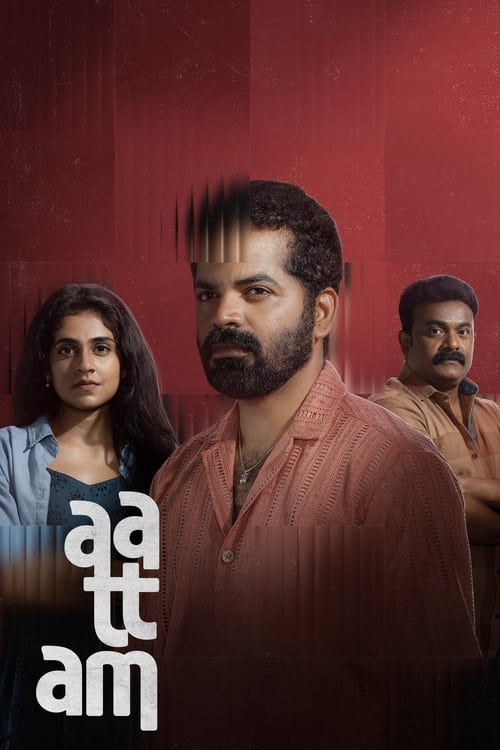
Aattam
2024 · Anand Ekarshi
For when you want a film to chew on for days and debate afterwards — a demanding, dialogue-driven watch that pays off in moral clarity and discomfort rather than easy answers.
What it's about
A Kochi theater troupe — twelve men and one woman — celebrates after a show, and by morning everything has changed: Anjali, the company's sole actress, reports that one of the men assaulted her at the party. The group convenes to decide what to do, and over one long stretch of talk, alliances shift, self-interest leaks through the principles, and every man's character is quietly put on trial. Complicating everything: the accused is the troupe's most famous member, the one their collective ambitions depend on.
The experience
Riveting in the way a great stage play is riveting — almost all talk, yet tense as a thriller, because every speech reveals someone. It leaves you unsettled and arguing with yourself about who you'd have been in that room.
Performances
The ensemble is the show: a dozen distinct men whose decency erodes at different speeds, with Zarin Shihab quietly devastating as Anjali — the one person in the room with the most at stake and the least power to steer the conversation.
The craft
Anand Ekarshi's debut script is a machine of shifting sympathies, structured so each new piece of information re-sorts the room. The direction keeps a single extended deliberation visually alive, and the editing gives the talk the momentum of an unraveling mystery.
Why it matters
One of the most acclaimed Malayalam films of its moment, sweeping India's top national honors and instantly marking Ekarshi as a major new voice — and a pointed contribution to the post-#MeToo conversation about how institutions close ranks.
Snapshot
Aattam ("dance," or more loosely "play/movement" in Malayalam) is the debut feature of writer-director Anand Ekarshi, a chamber drama built almost entirely from the deliberations of a theater troupe forced to sit in judgment on one of its own. The company — a Kochi-based amateur ensemble that in the film's telling numbers a dozen men and a single woman, the actress Anjali — gathers after a celebratory party at which Anjali reports having been molested by one of the men. What follows is not a whodunit but a what-will-we-do: a long night of talk in which the group tries, and repeatedly fails, to reach consensus about whether to believe her, whom to protect, and what the incident is worth measured against their collective ambitions. The film's central irony is economic and moral at once: the accused is the troupe's most famous member, the one whose film-industry connections have just secured the group a career-defining opportunity, so that every man's reasoning is quietly bent by self-interest. Released to Malayalam theaters in January 2024 after a festival premiere, Aattam became one of the most decorated Indian films of its moment, winning the National Film Award for Best Feature Film and for Best Screenplay. It is a talk-driven, single-location work whose formal austerity is inseparable from its subject — the way a room full of reasonable people can rationalize an injustice.
Industry & production
Aattam belongs to the wave of low-budget, script-first Malayalam cinema that has, since roughly the mid-2010s, given the industry a reputation disproportionate to its size for intelligent, socially observant work. It was made outside the star system on modest means, its economy of scale matched to its economy of setting: a production that can be mounted largely in one apartment interior with a fixed ensemble is precisely the kind of film the new Malayalam model rewards. The picture was produced under a small independent banner rather than a major studio; the exact production and financing details are less thoroughly documented than they would be for a mainstream release, and I flag that as a genuinely thin part of the public record rather than fill it with specifics I cannot verify. What is clear is that Aattam was conceived as a writer-director's vehicle — Ekarshi's own screenplay is the engine — and that its distribution followed the now-familiar path of a limited theatrical run amplified by festival recognition and, subsequently, streaming, which carried it well beyond the audience a film of its scale would once have reached.
Technology
Technically, Aattam is a study in constraint rather than spectacle. It was shot digitally, as virtually all Malayalam production now is, and the choice matters less for any headline capability than for what it quietly enables: sustained low-light interior work, long unbroken takes with many bodies in frame, and the flexibility to keep cameras running through the extended verbal exchanges the script demands. I have no verified information on the specific camera or lens package and will not invent one. The relevant technological fact is negative rather than positive — the film deliberately forgoes the tools of scale (locations, crowds, effects, coverage-heavy shooting) in favour of a near-theatrical containment, and digital capture is what makes that containment economically and logistically survivable. The picture's ambition is dramaturgical, not technological, and its craft is measured in blocking and rhythm rather than in any apparatus.
Technique
Cinematography
The camera's task in Aattam is to organize a crowd. With a dozen-plus performers in a confined space and dialogue passing rapidly between them, the cinematography must keep the geography of the group legible — who sits where, who has drifted to the margins, who commands the center — while registering the micro-shifts of alliance that the talk produces. The film favours a watchful, largely unshowy visual grammar: framings that hold several actors at once so that reactions play against speech, compositions that use the architecture of the room (doorways, the division of spaces, foreground bodies) to cluster and isolate figures. The look is naturalistic and interior, keyed to available-seeming domestic light rather than to any expressive scheme. The effect is documentary-adjacent proximity — we feel installed in the room as a silent thirteenth party. The specific below-the-line camera credit is part of the film's thinly documented technical record; I will not attach a name I cannot confirm.
Editing
Editing is where Aattam most obviously does its dramatic work, because a film that is essentially one long conversation lives or dies on the timing of cuts. The picture has to sustain tension across a talk-heavy runtime without the relief of incident, which demands an editorial ear for when to hold on a listener rather than a speaker, when to let a silence run, and when to accelerate the crosstalk into something like a scrum. The cutting has to keep a large ensemble's shifting consensus readable — tracking the drift of a majority in real time — while never letting the argument feel diagrammatic. That the film maintains suspense almost purely through the rhythm of deliberation is its central editorial achievement.
Mise-en-scène / staging
The staging is the film's signature, and it is unmistakably the work of someone from the theater. Aattam treats its single principal location as a stage on which the ensemble is continually reblocked: men rise, sit, cluster, break apart, and re-form into new factions as the argument turns, so that the physical arrangement of bodies becomes a live diagram of where the group's moral center lies at any given moment. The choice to confine the drama to essentially one space is not a limitation worked around but the whole point — the pressure-cooker geometry forces every evasion and alliance into visible, spatial terms. The troupe's identity as theater-makers is folded into the form: these are people who perform for a living, and the film watches them perform sincerity, reasonableness, and outrage for one another even as their true motives leak out through where they choose to stand.
Sound
Sound in Aattam is dominated by the human voice — overlapping speech, interruption, the rising volume of a room losing its composure. Given the material, the soundscape's job is to make a dozen people talking legible without flattening the messiness of real argument, preserving the sense that meaning is being contested in real time. Music is used sparingly; a film this committed to naturalistic deliberation cannot lean on a score to tell the audience how to feel without undercutting its own method, and Aattam largely resists that temptation, letting the texture of talk and silence carry the tension. I do not have a verified composer credit I can responsibly attach.
Performance
Performance is the film's true medium, and its ensemble is its greatest asset. Aattam asks a large cast to function as a genuine collective — no single star turn is allowed to dominate — while giving each man enough specificity that his particular flavor of rationalization registers. The acting has to thread a difficult needle: these are characters who are themselves actors, so the performances must convey people performing for one another, sincerity and self-justification blurring, without tipping into caricature. Zarin Shihab, as Anjali, carries the moral weight of a figure who is talked about more than she is talked with, her presence and absence structuring the men's evasions. The film benefits from established Malayalam character actors — Vinay Forrt and Kalabhavan Shajohn among the ensemble — deployed not as leads but as instruments in a group portrait, which is itself a statement about the film's egalitarian, anti-star design.
Narrative & dramatic mode
Aattam operates in the mode of the deliberation drama: a real-time or near-real-time collective reasoning process in which the stakes are ethical rather than physical and the "action" is the movement of opinion. The narrative withholds the certainty a thriller would supply — it is less interested in establishing exactly what happened than in dramatizing how a group decides what to do about a claim it cannot fully verify. This is a structure that turns the audience into a juror and then, crucially, implicates that judgment. The screenplay's most sophisticated move is to let sympathy migrate: the group's reasoning is made to sound plausible in the moment, so that the viewer can feel the pull of the very rationalizations the film ultimately indicts. Suspicion is distributed and redistributed; motives surface late; the ostensibly principled and the ostensibly compromised trade places. The result is a drama of consensus-formation as a corruptible process — the film's subject is not a crime but the machinery a community uses to explain a crime away.
Genre & cycle
The obvious comparison, and one the film openly invites, is Sidney Lumet's 12 Angry Men (1957): a single-room, ensemble deliberation in which the fate of a person hangs on the shifting arithmetic of a group's conscience, with the count of participants itself echoing Lumet's twelve. But Aattam inverts the older film's arc. Where Lumet's jury is moved by a lone dissenter toward justice, Ekarshi's troupe is more often moved by self-interest away from it, so that the film reads as a darker, twenty-first-century answer to the chamber-jury tradition. It also sits inside a contemporary cycle of gender-reckoning cinema — works produced in the wake of #MeToo and, in the Malayalam industry specifically, in the wake of the movements around the Women in Cinema Collective and the broader public reckoning with harassment in Kerala's film world. Aattam metabolizes that moment into fiction: it is a film about how an ostensibly progressive artistic community handles an accusation from within, which is exactly the question the industry around it was being forced to confront.
Authorship & method
Aattam is, above all, an authored screenplay, and its authorship is the least ambiguous fact about it. Anand Ekarshi wrote and directed it as his feature debut, and the film's National Award for Best Screenplay confirms that the writing is understood, even institutionally, as its defining achievement. Ekarshi's background in theater is legible in every structural choice — the confidence to stake a whole film on talk, the reblocking of an ensemble as dramaturgy, the interest in performers performing. His method here is that of the playwright-director: control the room, trust the text, subordinate visual flourish to the pressure of the situation. On his key collaborators I will be candid about the limits of the record. The below-the-line craft — cinematography, editing, score — was carried out by a crew that, like the director, was working outside the star apparatus, and the specific attributions for these roles are not as firmly or consistently documented in the sources available to me as the writing and directing credits are; rather than risk misattributing a name to a role, I flag this as a genuine gap. What can be said with confidence is that the film's authorship is unusually concentrated in its writer-director and that its collaborators served a single, coherent vision of containment and restraint.
Movement / national cinema
Aattam is a characteristic product of contemporary Malayalam cinema — the so-called new wave that has made the Kerala industry a byword, within India, for realist, socially engaged, writer-driven filmmaking done on sustainable budgets. This is a cinema defined less by a shared style than by a shared disposition: attention to ordinary milieus, distrust of spectacle, a willingness to make the small film about the large question. Aattam's theater-troupe setting also connects it to Kerala's deep and living tradition of political and amateur theater, a culture in which the stage has long been a site of social argument. The film's national significance was ratified by its Best Feature Film win, which placed a talky, single-location Malayalam debut at the very center of India's official canon for its year — a telling marker of how far the regional new wave's values had penetrated the national institution.
Era / period
The film is thoroughly of the early 2020s. Its concerns — believing women, the abuse of power inside "enlightened" creative communities, the collision of professional ambition with ethical obligation — are the concerns of the post-#MeToo decade, and in the Malayalam context specifically they arrive amid an ongoing, painful public reckoning with harassment and gender inequity in the film industry itself. The period is present formally as well as thematically: Aattam reflects an era in which low-budget, high-concept regional films could reach a national and then international audience through festivals and streaming, decoupling cultural impact from production scale. It is a film that could only have been made, and only have been rewarded, in this particular moment of Indian cinema.
Themes
At its core Aattam is about the corruptibility of collective judgment — the way a group of individually decent men can, through incremental rationalization, arrive together at an indecent conclusion. Its most pointed theme is the way patriarchy operates not as villainy but as reasonableness: the men rarely defend the act; they defend everything around it — the accused's value, the troupe's future, the ambiguity of the claim — until the woman at the center has been argued out of the room. Bound up with this is the theme of art versus interest, the discovery that a career opportunity can quietly become the measure against which a person's suffering is weighed. The film is also about performance as a way of life: a troupe of actors performing conscience for one another, sincerity and self-service indistinguishable. And it is about the isolation of the single dissenting truth inside a consensus machine — Anjali as the one perspective the majority is structurally equipped to metabolize and expel. Underlying all of it is a class and gender critique of the "progressive" artistic community's flattering image of itself.
Reception, canon & influence
Aattam was received as a major arrival — a debut that announced a serious new writer-director and won the highest institutional endorsement Indian cinema offers, the National Film Award for Best Feature Film, alongside the award for Best Screenplay. Critics singled out the audacity of sustaining a feature almost entirely on deliberation, the precision of its ensemble, and the intelligence with which it refused easy moral comfort; the 12 Angry Men comparison became a critical shorthand precisely because the film earned and then complicated it. It premiered on the festival circuit — including at the International Film Festival of Kerala in late 2023 — before its January 2024 theatrical release, and its reach was subsequently extended by streaming.
The influences on the film run backward to the chamber-jury drama epitomized by Lumet and, more broadly, to a theatrical tradition of single-room ethical argument; its DNA is that of the stage play as much as the screenplay, and Ekarshi's own theater practice is the proximate source. Its influence forward is still crystallizing — this is a very recent film — but its significance is already legible in two directions. Institutionally, its National Award win is a validation of the small, script-first Malayalam model, likely to embolden further low-budget, high-concept debuts. Culturally, it stands as one of the defining fictional treatments of how creative communities handle abuse in the #MeToo era, a reference point for a conversation the Indian film world is still, unavoidably, having with itself. Any claim about a durable "legacy" would be premature, and I say so plainly; what can be asserted is that Aattam entered the canon at once, as an award-anointed debut, and did so on the strength of its writing and its nerve rather than any of the resources usually required to command that attention.
Reception
A quiet Malayalam indie debut that premiered at IFFK 2023 and opened small in January 2024, it snowballed via streaming word-of-mouth into the year's consensus triumph — capped by the Best Feature Film prize (plus Screenplay and Editing) at India's 70th National Film Awards, a stunning result for a first film with almost no stars.
How Aattam was received, from release to now →
How to watch Aattam: what to notice on a first viewing
- Watch where each man moves to sit as the argument shifts. The group is continually reblocked. Men rise, cluster, and break into new factions as opinions turn, so the room's physical arrangement maps the argument in real time. You can read where the group's sympathy stands just by looking at who is standing near whom.
- Notice how many people the camera holds in frame at once. Wide, ensemble framings keep several faces visible together so a listener's reaction plays against whoever is speaking, using doorways and foreground bodies to cluster or isolate figures. You watch the room think, not just the person currently talking.
- Listen for how often people talk over each other. Overlapping speech and interruption dominate the soundtrack, and the film resists a score, letting the mess of real argument stay legible instead of smoothing it into clean lines. The noise itself tells you consensus is being fought over, not calmly reasoned out.
- Watch how little any single actor is allowed to dominate. A dozen men share the screen time roughly evenly, each given enough specificity that his particular reasoning registers, without one figure emerging as the story's hero. The ensemble design is itself an argument: this is a group's failure, not one villain's.
The whole guide to watching Aattam, with the keys for a rewatch →
Influences: the films it descends from and the films it influenced
- 12 Angry Men (1957) — The template Aattam explicitly reworks: a feature sustained on one room's deliberation, driven by a consensus-reversal engine in which private motive and cheap reasonableness are exposed one holdout at a time.
- Ek Ruka Hua Faisla (1986) — The Indian transposition of the jury-room single-location model, proving Lumet's talk-only chamber dramaturgy could carry an entire film in an Indian vernacular idiom before Aattam did it in Malayalam.
- Rope (1948) — Real-time confinement adapted from a stage play, where the fixed apartment becomes the drama's pressure vessel and the camera is the only mobile element — the containment discipline Aattam inherits.
- Who's Afraid of Virginia Woolf? (1966) — A playwright's text (Albee) filmed as overlapping, corrosive talk within one house, where dialogue is staged as combat and reblocking around the room does the dramaturgical work.
- My Dinner with Andre (1981) — Demonstrated a whole feature could be built from conversation alone, licensing Aattam's nerve to subordinate visual event entirely to the pressure of people talking.
- Vanya on 42nd Street (1994) — Actors playing actors rehearsing a play, deliberately blurring performer and role — the exact 'performers performing' device Aattam builds its theater-troupe ensemble around.
- Opening Night (1977) — The anti-star ensemble method in which actors dramatize their own craft, vanity and interdependence, treating the acting company itself as the film's subject.
- Dogville (2003) — A playwright-director stages an ensemble on a near-bare set so blocking reads openly as theatrical dramaturgy, and a community's collective moral reasoning curdles into self-interest under scrutiny.
- Carnage (2011) — A single-apartment adaptation of Reza's play where the veneer of civil, reasonable adults deliberating collapses into tribal self-interest and gendered posturing — Aattam's patriarchy-as-reasonableness in miniature.
- 12 (2007) — A re-nationalized remake of the jury-room engine, showing how the same single-location deliberation structure absorbs local social politics — the move Aattam makes for Kerala's theater milieu.
- The Man from Earth (2007) — A low-budget, high-concept film staked entirely on one room of talk, the script-first digital-containment economics Aattam shares with the Malayalam new-wave model.
- The Hunt (2012) — Anatomizes how a close community's consensus forms against a single accused man, each participant convinced of their own reasonableness — the group-judgment mechanics Aattam interrogates.
- The Great Indian Kitchen (2021) — Malayalam new-wave, script-first realism that dissects patriarchy precisely as it presents itself as calm, ordinary reasonableness rather than overt villainy — Aattam's central thematic craft.
- Court (2014) — An anti-star ensemble in static, observational framing that lets a slow procedural of collective judgment accrete meaning, refusing star apparatus and easy moral comfort as Aattam does.
- The Assistant (2020) — A post-MeToo procedural showing how an institution normalizes abuse through everyone's small, deniable, reasonable accommodations — the exact machinery of complicity Aattam's troupe enacts.
- Tár (2022) — The arts community adjudicating a powerful figure's alleged abuse through reputation and whisper rather than tribunal, dramatizing how creative institutions in the post-MeToo era metabolize accusation.
- Birdman (2014) — A backstage theater ensemble of performers playing performers, where the friction of a company mounting a show becomes the film's engine — the actors-playing-actors reflexivity Aattam foregrounds.
- Aasha (2026) — Withholds the culprit while a chorus deliberates a single accusation in near real time, extracting suspense entirely from the group's shifting self-interest — a demonstration that a crowd can be a plot device rather than set dressing.
Similar films
- TÁR (2022) — influence & lineage · same viewing thread
- Kishkindha Kaandam (2024) — shared sensibility
- Aasha (2026) — shared sensibility
- Manas (2024) — shared sensibility
- Chithha (2023) — shared sensibility
- Maharaja (2024) — shared sensibility
- Visaranai (2016) — shared sensibility
- Aadukalam (2011) — shared sensibility
All the films related to Aattam →
Watch it with: curated runs of related films
- Whose Word Counts — A run of contemporary prestige dramas where a single allegation cracks open a career and an institution — watch them near each other to see how differently each answers who we choose to believe.