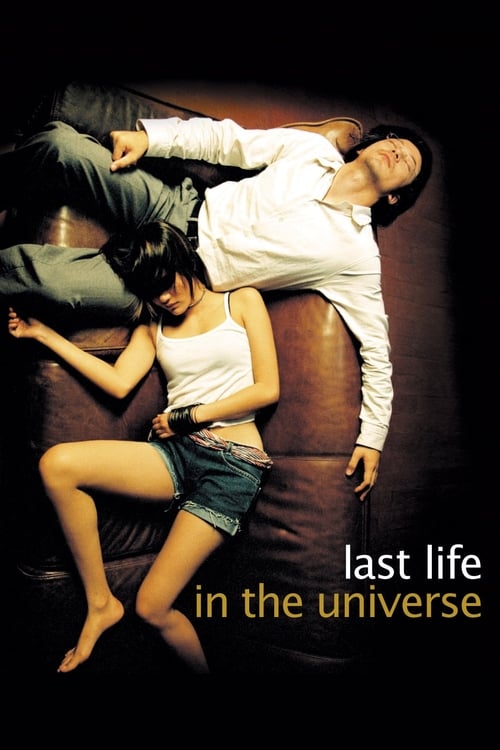
Last Life in the Universe
2003 · Pen-Ek Ratanaruang
For a late night alone when you want something meditative and quietly romantic — a film to drift inside rather than follow. Patience required; melancholy guaranteed, but it's the healing kind.
What it's about
Kenji is a fastidious Japanese librarian in Bangkok who keeps his apartment immaculate and rehearses his own suicide as a kind of daily ritual. Noi is a messy, impulsive young Thai woman whose life is upended when a sudden roadside accident kills her sister — with Kenji as witness. Stranded together in her cluttered riverside house, sharing no fluent language, these two opposites slowly begin to reorder each other's worlds.
The experience
Slow, hushed, and dreamlike — more mood than plot, with deadpan humor flickering through the grief. It works on you like humidity: you sink into its rhythm and come out the other side strangely soothed, even lightened.
Performances
Tadanobu Asano is riveting doing almost nothing — his stillness as Kenji carries whole scenes — and Sinitta Boonyasak's loose, unguarded Noi is the perfect grain of sand in his machine. Their halting, three-language conversations feel entirely real.
The craft
Shot by the great Christopher Doyle, it's gorgeous in a humid, underwater way — greens and blues, rooms that seem to breathe, compositions built from clutter and emptiness. Pen-Ek Ratanaruang directs with a wry, patient control that rewards a dark room and your full attention.
Why it matters
Premiering at Venice in 2003, it became one of the most internationally visible films of the Thai New Wave and cemented Pen-Ek Ratanaruang and Asano as art-house names far beyond their home countries.
Snapshot
Last Life in the Universe (Ruang Rak Noi Nid Mahasan) is a Thai–Japanese drama of grief, suicidal stasis, and improbable tenderness, built around two strangers stranded between languages. Kenji (Tadanobu Asano), a fastidious, obsessive Japanese librarian in Bangkok, rehearses his own suicide as a daily ritual; Noi (Sinitta Boonyasak), a chaotic young Thai woman, enters his orbit through a sudden, violent accident that kills her sister. The film pairs them in a riverside house where order and disorder, Japanese and Thai, death-wish and life-pulse slowly rub against each other. Directed by Pen-Ek Ratanaruang at the crest of the Thai New Wave and photographed by Christopher Doyle, it is among the most internationally visible Thai art films of its moment — premiering at the Venice Film Festival in 2003, where Asano's lead performance was honored — and remains a touchstone for a certain strain of hushed, transnational, magic-tinged cinema. It is less a thriller than a mood: a study of two people deciding, almost against their will, to keep living a little longer.
Industry & production
The film was produced as a Thai-led international co-production, emblematic of how Thailand's commercially minded studios increasingly underwrote auteur cinema in the early 2000s. Ratanaruang worked within the orbit of Thai industry players (his prior features moved through Five Star Production and allied Thai houses), while the project drew explicitly transnational financing and talent to match its bilingual, cross-cultural story. Japanese participation was structural rather than cosmetic: the lead and several key figures are Japanese, the yakuza subplot reaches back to Japan, and the production positioned itself for the festival and arthouse export markets where Japanese star power carried weight. Fortissimo Films, the Amsterdam/Hong Kong sales outfit deeply embedded in Asian art-cinema distribution at the time, handled international sales, which helped the picture circulate widely on the festival circuit and into specialty release in Europe and North America.
Casting was central to the film's identity and its financing logic. Tadanobu Asano was, by 2003, one of Japan's most adventurous and recognizable independent leads (a fixture of work by directors such as Takashi Miike and Nagisa Ōshima), and his presence gave a Thai-helmed film immediate purchase in Japanese and international markets. The director Takashi Miike appears in a brief cameo as a yakuza, a wink that doubles as an industry gesture — a nod from one strand of Asian genre/auteur cinema to another. The female leads, sisters in the film, were played by real-life sisters Sinitta and Laila Boonyasak, a casting choice that lent the sibling relationship an unforced intimacy. The production's most prized off-screen asset was the recruitment of cinematographer Christopher Doyle, whose international cachet — built on his work with Wong Kar-wai — materially raised the film's profile and signaled its arthouse ambitions before a frame was seen.
The reception architecture worked as intended: a Venice premiere in 2003, a strong festival run, and a recognition for Asano's performance gave the film a prestige launch that translated into specialty distribution abroad. Specific budget and box-office figures are not something I can reliably state, and I won't invent them; the film's commercial footprint was that of a successful festival-circuit art film rather than a mass-market release.
Technology
Last Life in the Universe is a film of its analog twilight: it was shot and finished as a conventional 35mm production rather than as a digital experiment, and its visual richness depends on photochemical color, controlled light, and lens craft rather than on then-emergent digital tools. This grounds the film's "magic" firmly in in-camera technique. Where the film bends reality — a cluttered house abruptly becoming pristine, bodies and spaces rearranging — the effects are achieved through staging, set dressing, framing, and editing rather than ostentatious digital compositing, which keeps the surrealism tactile and continuous with the everyday world. The result is a picture whose technological signature is essentially classical: beautiful emulsion, precise camerawork, and a sound mix that layers languages and silences with care.
Technique
Cinematography
Christopher Doyle's photography is the film's most celebrated formal element and its primary instrument of meaning. Doyle works here in a register quieter and more composed than the kinetic, smeared style of his Wong Kar-wai collaborations, favoring still or slow-drifting frames, deep saturated greens and blues, and a recurring fascination with glass, water, and reflection. Mirrors, windows, aquariums, and the river itself multiply and fracture the characters, visually rhyming with a story about doubling, watching, and the porous boundary between self and other. The library, the high-rise apartment, and the riverside house each receive a distinct palette and light logic, so that the move from Kenji's sterile order to Noi's organic disorder registers chromatically as much as dramatically. Doyle's camera tends to regard the characters with patience — holding on faces, on hands arranging objects — turning observation itself into the film's emotional grammar.
Editing
The cutting is unhurried and elliptical, prioritizing duration and atmosphere over plot propulsion. Scenes are allowed to breathe past the point of narrative necessity, so that the film accrues meaning through accumulation and repetition (Kenji's suicide rehearsals; the obsessive tidying) rather than through incident. The editing's boldest gesture is its handling of the film's reality-warps: cuts and match-cuts quietly reorganize space and continuity so that fantasy, memory, and present action blur without explicit signposting. The viewer is rarely told which register they are in, and the film's late structural turns — including a play with identity and perspective — depend on the edit withholding orientation. I'm not able to confirm the editor's credit with certainty here, so I'll describe the work rather than attribute it.
Mise-en-scène / staging
Production design carries the film's central opposition: cleanliness versus mess, control versus surrender. Kenji's apartment is a monument to obsessive order — books squared, surfaces bare — while Noi's riverside house is a drift of clutter, dishes, and debris. The narrative's emotional movement is literally staged as the gradual interpenetration of these two environments. Objects are characters: a stack of books, a plastic lizard, a noose, an aquarium. The "last lizard / last life in the universe" motif, drawn from a children's-book conceit that haunts Kenji, threads through the décor and gives the film its title and its governing metaphor of solitary survival. Staging favors twos — two people in a frame, separated by a table, a doorway, a language — visualizing intimacy as negotiated distance.
Sound
Sound is organized around language and its failures. Kenji and Noi communicate in a broken patchwork of Japanese, Thai, and halting English, and the film makes their mutual incomprehension audible and poignant; subtitling strategies in the original presentation foreground how much passes between them without being understood. Around this, the mix is spare and ambient — river sounds, room tone, the hum of solitude — punctuated by an atmospheric, melancholic score that supports the film's trance-like drift. I'm not confident of the precise composer credit and won't guess at it; what can be said firmly is that music is used sparingly and to mood rather than to underline plot, in keeping with the film's restraint.
Performance
Asano's Kenji is a study in containment: a still, interiorized performance built from small gestures, averted eyes, and the comedy and pathos of a man whose self-discipline is also a death-grip. The work earned him a best-actor recognition at Venice in 2003, and it anchors the film's wager that almost nothing happening on a face can be riveting. Sinitta Boonyasak's Noi is the counterweight — slovenly, grieving, volatile, alive — and the chemistry between the two leads is one of mismatch slowly becoming attunement. Laila Boonyasak, as the doomed sister, registers vividly in limited screen time, and Takashi Miike's cameo lends a frisson of menace. The performances collectively favor underplaying; the film's emotion lives in the gaps the actors leave open.
Narrative & dramatic mode
The film operates in a contemplative, art-cinema mode — slow, mood-driven, and elliptical — laced with sudden eruptions of violence and with passages of frank surrealism. Its dramatic engine is not suspense but the question of whether Kenji will live, and whether contact with Noi can interrupt his suicidal routine. The structure is a chamber two-hander grafted onto a yakuza-inflected crime frame: the genre material (a brother's death, gangsters, the threat of retribution) supplies pressure and stakes, but the film consistently subordinates plot mechanics to interior states. Reality is unstable by design. Fantasy sequences, possible imaginings, and a late destabilization of identity and point of view mean the film withholds a single secure account of what "happens," inviting the viewer to read its events as psychological projection as much as literal occurrence. It is a narrative built to be felt and re-read rather than solved.
Genre & cycle
Nominally cataloged across drama, thriller, and action, the film is best understood as an art-house hybrid that quotes genre without obeying it. It belongs to an early-2000s cycle of transnational Asian auteur cinema — slow, painterly, festival-facing films of alienation and longing — adjacent to the work of Wong Kar-wai (with whom it shares Doyle), Hou Hsiao-hsien, and the contemporaneous Thai New Wave. Its yakuza thread connects it to a broader Japanese crime imaginary even as it refuses that genre's velocity. The film's most distinctive cyclical position is as a cross-cultural "stranded outsider" romance: a foreigner adrift in Bangkok, communication breaking down into something tender, death shadowing connection. That configuration places it in dialogue with mood-pieces of urban estrangement from the same years while keeping its specifically Thai–Japanese inflection.
Authorship & method
Pen-Ek Ratanaruang came to cinema from a background in graphic design and advertising, and his films carry a designer's eye for surface, composition, and tonal control. Emerging in the late 1990s as part of the Thai New Wave — the generation that also produced Apichatpong Weerasethakul and Wisit Sasanatieng — he built a reputation with Fun Bar Karaoke (1997), 6ixtynin9 (1999), and Mon-Rak Transistor (2001) before Last Life in the Universe became his international breakthrough. His method here is collaborative and atmosphere-first: he assembled a transnational creative core and trusted mood, performance, and image over plot.
The decisive collaborations were three. Cinematographer Christopher Doyle shaped the film's visual identity and lent it international prestige. Screenwriter Prabda Yoon, a prominent Thai writer and a key voice of his literary generation, supplied the spare, deadpan, philosophically tinged script and the title's lizard conceit; his partnership with Ratanaruang would continue. Lead actor Tadanobu Asano functioned almost as a co-author of Kenji, his minimalism setting the film's emotional thermostat. This nucleus — Ratanaruang, Doyle, Yoon, Asano — reconvened for the director's subsequent feature Invisible Waves (2006), marking Last Life as the start of a distinct authorial cluster rather than a one-off. (I'm withholding firm editor and composer attributions, which I can't verify here.)
Movement / national cinema
The film is a landmark of the Thai New Wave's international phase. After decades in which Thai cinema circulated little beyond its domestic and regional markets, the turn of the millennium saw a cohort of Thai directors break onto the global festival circuit. Within that movement, Ratanaruang occupied the cosmopolitan, art-cinema wing — distinct from Apichatpong's experimental rural metaphysics or Sasanatieng's hyper-stylized genre pastiche — and Last Life in the Universe was one of the films that announced Thai cinema as a serious art-film source to Western audiences. Crucially, it did so as an explicitly transnational object: a Thai-authored film starring a Japanese actor, shot by an Australian-born cinematographer famous for Hong Kong cinema, financed across borders. It exemplifies how "national cinema" in the 2000s increasingly meant networks of co-production and migration rather than sealed traditions.
Era / period
Made in 2003, the film sits at a hinge between analog craft and the digital art-cinema to come, and within a brief golden window for festival-circuit Asian auteurism. It reflects a post-1997 (Asian financial crisis) Thai sensibility of dislocation and a globalized Bangkok where foreigners, languages, and economies intermingle. Its slow-cinema patience belongs to the early-2000s vogue for contemplative duration on the festival circuit, while its melancholic cool aligns it with the era's transnational mood films. Watched today, it reads as a document of a particular moment when Thai cinema, Japanese star culture, and a Doyle-defined visual idiom briefly converged.
Themes
The film's governing theme is the negotiation between death and life — suicide as a held breath, interrupted by the accident of another person. Around this orbit several others. Order versus chaos: Kenji's obsessive cleanliness against Noi's mess, and the slow contamination of each by the other, figures the way intimacy disrupts the defenses we build against grief. Communication and its limits: the trio of languages dramatizes how connection survives, and sometimes deepens, despite incomprehension. Loneliness and the "last one alive": the lizard fable gives the title its melancholy — the fantasy and dread of being the final survivor, utterly alone. Doubling and identity: mirrors, sisters, brothers, and the film's late destabilization of who is who suggest selfhood as porous and exchangeable. Foreignness and belonging: Bangkok as a space where the displaced might, briefly, find each other. The film treats these not as theses but as atmospheres, leaving them unresolved.
Reception, canon & influence
Critically, Last Life in the Universe was widely admired on its festival run and in its international release, generally praised for Doyle's photography, Asano's restrained lead performance, and the film's hypnotic tone, while a minority of critics found its slowness and opacity a barrier. Its Venice 2003 premiere and the best-actor recognition for Asano gave it durable festival prestige, and it has since settled into the canon as Ratanaruang's signature work and one of the most internationally esteemed Thai art films of its decade.
Looking backward, the film's influences are legible: the mood-cinema lineage of Wong Kar-wai (carried directly by Doyle), the durational art cinema of Hou Hsiao-hsien and the broader slow-cinema tradition, the Japanese crime imaginary it half-invokes, and the literary sensibility of Prabda Yoon's writing. The casting of Asano imports the independent-Japanese energy of his earlier collaborations with Miike and others.
Looking forward, its legacy is twofold. It consolidated a working authorial unit — Ratanaruang, Doyle, Yoon, Asano — that continued into Invisible Waves, and it helped establish a template for transnational, Doyle-shot, mood-driven Asian co-productions. More diffusely, it became a reference point for a cinema of cross-cultural estrangement and quiet, deathward romance, frequently cited in discussions of early-2000s Thai cinema's global emergence alongside Apichatpong Weerasethakul. Within Thailand and abroad it remains the film through which many viewers first encountered Pen-Ek Ratanaruang, and a key exhibit for the argument that Thai cinema in the 2000s belonged to world cinema's first rank.
A Deleuzian reading
A man stands on a chair in a clean apartment with a rope around his neck.
The full Deleuzian reading of Last Life in the Universe →
Reception
A festival darling in 2003 — it won Tadanobu Asano a Best Actor prize at Venice — but stayed underseen for years; it's since been quietly rediscovered as a defining mood piece of the Thai New Wave.
How Last Life in the Universe was received, from release to now →
Influences: the films it descends from and the films it influenced
- Chungking Express (1994) — Christopher Doyle's smeared-neon handheld and reflective surfaces here become the mood-cinema visual grammar he carries directly into Last Life.
- Fallen Angels (1995) — Doyle's extreme wide-angle proximity and saturated nocturnal palette establish the close-yet-estranged register reused in Last Life's intimacy-as-distance framing.
- In the Mood for Love (2000) — Doyle's habit of shooting longing through doorways, mirrors and glass partitions models the compositional distance Last Life uses to hold two bodies apart.
- Millennium Mambo (2001) — Hou's durational drift and Japan-inflected neon ennui supply the slow-cinema patience and ambient-mood pacing Ratanaruang adopts.
- Maborosi (1995) — Kore-eda's static, distant compositions framing grief and silence prefigure Last Life's deathward quiet and underplayed performance thermostat.
- 6ixtynin9 (1999) — Ratanaruang's own corpse-in-the-apartment dark comedy works out the order-versus-disorder staging that Last Life refines into elegy.
- Ichi the Killer (2001) — Miike's collaboration imports Asano's coiled containment and the stylized yakuza crime imaginary Last Life half-invokes through Kenji.
- Branded to Kill (1967) — Suzuki's absurdist, abstracted gangster iconography underwrites the half-ironic, dislocated yakuza figure Last Life gestures toward.
- Days of Being Wild (1990) — Christopher Doyle's cinematography transplants the amber-green palette, canted frames, and marginal body placement from WKW's visual grammar into a Thai context — direct craft transmission through the shared collaborator who codified these devices across the Doyle-WKW films.
- Happy Together (1997) — Shot by Christopher Doyle, directly transplanting Happy Together's wide-angle distortion, controlled color temperature, and step-printing vocabulary into a Thai-Japanese love story — the most direct Doyle-mediated transmission of HT's visual grammar to another national cinema.
- 2046 (2004) — Doyle continues the saturated, reflection-laden mood register he gave Last Life, extending the same glass-and-color lyricism.
- Invisible Waves (2006) — The exact Ratanaruang–Doyle–Yoon–Asano unit reconvenes to extend the transnational, atmosphere-first mood-thriller template Last Life founded.
- Paranoid Park (2007) — Doyle's elliptical, reflective slow-motion lyricism is applied to fractured chronology, carrying his Last Life sensibility into Western art cinema.
- Air Doll (2009) — A Kore-eda fable shot by Doyle, extending his glass/reflection surfaces into another deathward, quietly melancholic register.
- The Limits of Control (2009) — Doyle photographs a near-plotless chamber of deadpan encounters and architectural stillness, distilling the minimalist mood method to its bones.
- Norwegian Wood (2010) — A literary-adaptation mood piece of deathward romance scored with sparse ambient tones, extending Last Life's marriage of writerly source and atmospheric slowness.
- Lost in Translation (2003) — Builds a plotless two-hander on multilingual incomprehension and ambient mood, rendering cross-cultural estrangement as tone rather than story — the same year and same emotional key.
- 3-Iron (2004) — A near-wordless chamber two-hander where intimacy accrues through silence and shared domestic space, paralleling Last Life's language-gap tenderness.
- Tropical Malady (2004) — Thai New Wave contemporary deploying durational slow cinema and a mid-film structural rupture that destabilizes reality much as Last Life's match-cut warps do.
Similar films
- Lost in Translation (2003) — influence & lineage
- In the Mood for Love (2000) — influence & lineage
- Maborosi (1995) — influence & lineage
- 3-Iron (2004) — influence & lineage · same viewing thread
- Past Lives (2023) — same viewing thread
- Drive My Car (2021) — same viewing thread
- Tropical Malady (2004) — influence & lineage · often watched together
- Syndromes and a Century (2006) — often watched together
All the films related to Last Life in the Universe →
Watch it with: curated runs of related films
- The Ache of Almost — Watch these together for the way each circles a love that time, distance, or duty keeps just out of reach — long looks, feelings left unsent, and the life that gets lived instead.