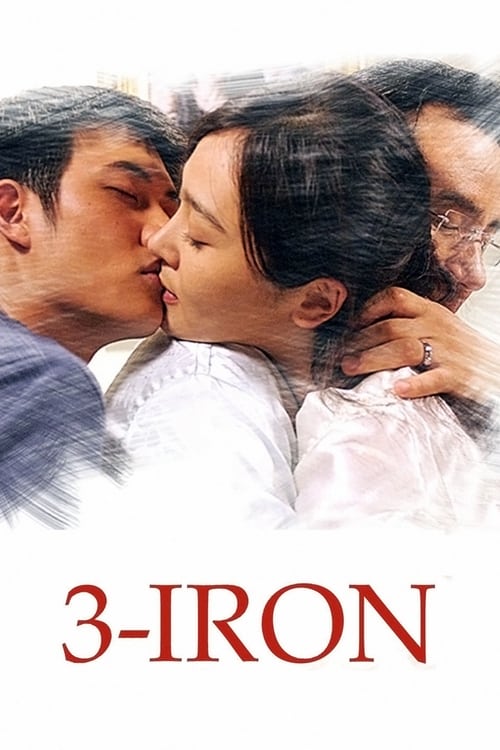
3-Iron
2004 · Kim Ki-duk
For a late night when you want something spare and spellbinding — a love story for people tired of talk. It asks a little patience and repays it with a mood that lingers for days.
What it's about
A young drifter slips into houses while their owners are away — not to steal, but to live briefly in their absence, fixing broken things and doing laundry as a kind of quiet payment. In one seemingly empty home he finds Sun-hwa, a bruised ex-model trapped in a marriage with a violent husband, and the two begin a strange, tender partnership conducted almost entirely without words.
The experience
Hushed, dreamlike, and unexpectedly romantic — the near-total silence between the lovers turns every gesture into dialogue. It drifts between deadpan comedy, menace, and grace, and by the end it feels closer to a fable than a crime story.
Performances
Jae Hee and Lee Seung-yeon do remarkable work with almost no dialogue between them, building a whole relationship out of glances, posture, and shared routines.
The craft
Kim Ki-duk composes the film like a series of still lifes — empty rooms, golf swings, photographs of other people's lives — and lets silence do the storytelling. The discipline of a nearly wordless romance is the craft feat itself: sound, framing, and rhythm carry everything speech normally would.
Why it matters
It won the Silver Lion for Best Director at Venice in 2004 and became one of the signature Korean art-house exports of its decade, a gateway film for viewers discovering that national cinema's stranger, quieter side.
Snapshot
3-Iron — Korean title Bin-jip (빈집), literally "empty house" — is Kim Ki-duk's twelfth feature, a near-wordless romance about a young drifter who breaks into homes while their owners are away, living briefly in their absence and quietly repaying the intrusion with domestic chores. When he enters the house of Sun-hwa, a battered ex-model still occupied by her abusive husband, the two form a bond conducted almost entirely without speech. The film is famous for the fact that its two leads exchange virtually no dialogue with each other across the entire running time, and for a final movement in which the protagonist trains himself to become effectively invisible, occupying the same rooms as other people while slipping into their blind spots. It won the Silver Lion for Best Director at the 2004 Venice Film Festival — the same year Kim's Samaritan Girl took the Silver Bear for direction at Berlin — making 2004 the peak of his international festival standing. The English title comes from the golf club that recurs as both weapon and motif; the Korean title points instead at the film's true subject, the charged emptiness of dwelt-in space.
Industry & production
3-Iron belongs to the mature phase of Kim Ki-duk's remarkably prolific, low-budget working method. By 2004 Kim had built a reputation as an outsider within the Korean industry: a former factory worker and self-taught painter with no film-school training, who shot fast and cheap, largely outside the mainstream studio system that was then driving the "Korean New Wave" box-office boom. He was celebrated abroad — at Venice, Berlin, Cannes, Locarno — far more consistently than he was embraced at home, where his films drew modest audiences and sometimes hostile criticism for their treatment of violence and gender. 3-Iron was produced through Kim's own production company, Kim Ki-Duk Film, in association with the Korean outfit generally credited on the film, with international sales handling its wide festival and arthouse distribution. Kim was notorious for the speed of his shoots, and 3-Iron is often cited as having been filmed in a matter of a couple of weeks; the exact figure is repeated in interviews and secondary sources rather than documented in a way I can verify precisely, so it is best treated as approximate. What is not in doubt is that the film's economy — small cast, real domestic interiors, minimal setups — was a deliberate aesthetic as much as a budgetary one. The relative commercial performance of the film in Korea appears to have been modest; I will not cite specific gross figures, as I cannot confirm them.
Technology
Technologically 3-Iron is unassuming, and deliberately so. It was shot on 35mm film in the standard manner of early-2000s Korean arthouse production, before the industry's later migration to digital acquisition. There are no visual effects of consequence, no elaborate camera rigs, and no reliance on the kind of technical spectacle associated with the genre cinema then defining Korea's international brand. The film's one genuinely "technical" preoccupation is optical and spatial rather than mechanical: its climactic conceit depends on the geometry of sightlines — a body positioned precisely where another person's eyes are not — which is achieved entirely through blocking, camera placement, and editing rather than any effect. In this sense the film's "technology" is the oldest one cinema has: the manipulation of what is and is not within the frame's and the character's field of vision. The quietness of the production apparatus is inseparable from the film's subject, which is the trace a body leaves in a space and the possibility of moving through the world without registering on it.
Technique
Cinematography
The cinematography favors clean, frontal, often static compositions of domestic interiors — the film is largely a catalog of other people's homes, each a self-contained world the drifter inhabits and then vacates. The camera tends to observe rather than pursue, holding on rooms, thresholds, and the objects that furnish a stranger's life. Light is naturalistic, sourced to windows and household lamps, giving the interiors a lived-in, slightly melancholy warmth. This restraint is essential to the film's project: because the characters do not narrate themselves in words, the images must carry the weight of interiority, and the framing repeatedly emphasizes the relationship between a human figure and the enclosing architecture. The cinematography is credited to Jang Seung-baek; beyond the film itself the detailed record of specific lensing or technical choices is thin, and I will not embellish it.
Editing
The cutting is patient and elliptical. Scenes are allowed to breathe, and transitions frequently elide connective action, trusting the viewer to bridge gaps — a method that suits a narrative increasingly organized around absence and disappearance. The editing becomes actively expressive in the late passages, where the protagonist's growing invisibility is constructed shot by shot: the film cuts to establish a sightline, then reveals that a body has been standing just outside it, so that the montage itself performs the trick of a presence that is and is not there. The rhythm is unhurried but not slack; the elisions accumulate into the sense of a life lived in the seams between other lives.
Mise-en-scène / staging
Mise-en-scène is arguably the film's central art. Each burgled home is a curated portrait of its absent owner — family photographs, appliances, unwashed dishes, a wardrobe of clothes the drifter tries on — and the protagonist's chores (laundry, repairs, watering plants) are staged as acts of intimacy with strangers. The staging repeatedly frames the two lovers together yet separate, sharing space without touching or speaking, so that proximity itself becomes the drama. The recurring 3-iron golf club and the balls the young man hits function as blunt objects of stored violence, and their placement in the frame carries menace and, eventually, consequence. In the final act the staging is organized entirely around the invisible-man premise: the choreography of where a person stands relative to another's gaze becomes the literal mechanics of the scene.
Sound
The soundtrack is defined by the near-total absence of spoken dialogue from the two leads. This silence is not empty; it foregrounds ambient and domestic sound — footsteps, appliances, the strike of a golf ball — and lends ordinary noises an unusual weight. The absence of speech also throws the film's sparse musical score into relief, used to underline emotional currents that the characters never verbalize. The score is credited on the film to the musician working under the name Slvian; specifics of its composition are not richly documented in the accessible record. The decision to withhold the lovers' voices is the film's boldest sonic gesture and one of the primary reasons it registers as a fable rather than a naturalistic drama.
Performance
The two central performances — Jae Hee (billed as Hee Jae) as the drifter Tae-suk and Lee Seung-yeon as Sun-hwa — are built almost entirely on physical presence, gesture, and gaze rather than speech. Both actors must convey desire, fear, tenderness, and defiance without the tools of dialogue, and the film's success rests on their ability to make silence legible. Lee Seung-yeon, an established Korean actress, plays the abused wife with a bruised watchfulness; Jae Hee gives the drifter a boyish, almost feline quality, more spirit than man. The supporting performances — the husband, the various homeowners, police, and a jailer — provide the friction of the spoken, ordinary world against which the lovers' wordlessness stands out.
Narrative & dramatic mode
3-Iron operates in a mode closer to parable or fable than to realist drama. Its premise is naturalistic — a squatter, an unhappy marriage, a crime — but its execution steadily abstracts toward allegory, culminating in a frankly supernatural or symbolic conceit that the film refuses to explain. The narrative is structured as a series of house-visits, an episodic accumulation that gradually deepens into a love story and then a story of transcendence. Crucially, it withholds motive and backstory: we learn almost nothing of who these people are or why the drifter lives as he does, and this deliberate opacity pushes the film toward myth. The dramatic engine is not conflict-and-resolution in the conventional sense but transformation — the protagonist's evolution from intruder to phantom — and the film's closing image, involving a bathroom scale and a shared weight, invites metaphysical rather than literal reading.
Genre & cycle
The film sits at the crossing of several genres named in its billing — drama, romance, and crime — without fully committing to any. As romance it is a story of love conducted in silence; as crime it involves breaking-and-entering, assault, wrongful imprisonment, and the club as weapon; as drama it studies domestic abuse and social invisibility. But it belongs less to any commercial genre cycle than to the arthouse tradition of the wordless or minimal-dialogue film and the "outsider/drifter" parable. Within Kim Ki-duk's own body of work it forms part of a cycle of films built around near-silent or marginal protagonists and enclosed, symbolically loaded spaces — a lineage that runs through The Isle, Bad Guy, and Spring, Summer, Fall, Winter… and Spring.
Authorship & method
3-Iron is above all an auteur's film, and Kim Ki-duk's signature is on every level of it: he wrote and directed, and his hand shaped its production. His method — fast, cheap, intuitive shooting; recurring obsessions with silence, cruelty, redemption, and confined space; a painter's attention to composition — is fully present. Kim's biography as a self-taught artist who came to film without institutional training informs the film's homemade, fable-like quality. Among collaborators, cinematographer Jang Seung-baek realized the film's clean interior imagery, and the score is credited to the musician known as Slvian; the editing, in keeping with Kim's controlling authorship, serves his elliptical structure. Where individual crew contributions are concerned, the documentary record accessible to me is comparatively thin, and I have flagged rather than filled those gaps. What is certain is that 3-Iron is a strongly unified work of single authorship, one of the clearest statements of Kim's recurring themes.
Movement / national cinema
The film is a product of Korean cinema's international ascendancy in the late 1990s and 2000s, yet it stands somewhat apart from the commercial "Korean New Wave" that made global names of directors working in thriller, horror, and melodrama. Kim Ki-duk occupied the art-cinema wing of that moment: a director far more decorated at European festivals than beloved at the domestic box office, and frequently positioned as a provocateur. 3-Iron is thus best understood within two overlapping frames — the broad flowering of Korean national cinema in this period, and the specific, more marginal current of Korean arthouse minimalism that Kim represented. Its festival triumphs at Venice helped consolidate the international perception of Korean film as a major world cinema, even as Kim's relationship to his own national industry remained fraught.
Era / period
3-Iron is very much a film of the early-to-mid 2000s: shot on 35mm in an industry not yet digitized, produced at the height of Korean cinema's global breakthrough, and released in 2004 alongside Kim's own Samaritan Girl in a year that marked the summit of his festival recognition. It reflects a contemporary, urban South Korea — apartments, model homes, consumer interiors — while abstracting that setting into something timeless. The period context also includes the intensifying critical debate around Kim's work, particularly regarding its depictions of women and violence, a debate that would follow his reputation for the rest of his career. Read from the present, the film sits in a moment before the reappraisals and controversies of Kim's later life reshaped how his oeuvre is discussed.
Themes
The film's governing themes are presence and absence, visibility and invisibility, and the intimacy of inhabiting another's space. The drifter's ethic — to use a home and repay it with care — reframes trespass as a kind of tenderness, and the film asks what it means to leave, or not leave, a trace on the world. Domestic abuse and the wish to escape it drive the romance, linking the theme of invisibility to the specific plight of a woman rendered voiceless within her marriage. Silence itself is a theme, not merely a technique: the lovers' refusal or inability to speak becomes an argument about the insufficiency of language for intimacy. The closing conceit — learning to be unseen, and the ambiguous weightlessness of the final image — pushes these ideas toward the metaphysical, suggesting states of being between the material and the spectral, the living and the ghostly, the present and the erased.
Reception, canon & influence
Critically, 3-Iron was among Kim Ki-duk's most warmly received films, widely regarded — then and since — as one of his finest and most accessible works, its lyricism and restraint winning over some critics who had recoiled from the harshness of his earlier features. Its Silver Lion for direction at Venice, together with the FIPRESCI recognition it received there, cemented its festival standing and its place in Kim's canon. Looking backward, the film draws on a deep art-cinema lineage of minimal-dialogue and wordless storytelling and on the tradition of the mute or marginal drifter-protagonist; it also extends preoccupations Kim had developed across his own earlier films, particularly the fascination with enclosed, symbolically charged spaces and characters who barely speak. Looking forward, 3-Iron has become a touchstone reference for the "silent film" experiment in contemporary art cinema — a frequently cited example of how a feature can sustain emotional and narrative complexity almost entirely without dialogue — and it remains, for many viewers, the most beloved entry point into Kim Ki-duk's difficult and contested body of work. Any fuller accounting of its influence must be tempered by the later reassessment of Kim's career and reputation, which has complicated the reception of his entire filmography; on the specific downstream films it directly shaped, the record is more impressionistic than documented, and I will not overstate it.
Reception
An instant arthouse darling — Venice 2004 gave Kim the Silver Lion for Best Director the same year Berlin gave him a directing prize for Samaritan Girl — and it became his most beloved film; today it's inseparable from the #MeToo allegations that shadowed his final years, so every rewatch comes with an asterisk.
How 3-Iron was received, from release to now →
How to watch 3-Iron: what to notice on a first viewing
- Listen for how little the two leads actually say. Tae-suk and Sun-hwa barely exchange a word across the whole film, so footsteps, appliances, and the strike of a golf ball carry the scenes instead. The film trusts gesture and glance over speech to carry what these two feel for each other.
- Notice the chores the drifter does in each house he enters. He does laundry, waters plants, and makes small repairs in homes that are not his, treating the intrusion as an act of care rather than theft. Trespass here looks almost exactly like tenderness, and the film never explains the difference.
- Watch how still and frontal the shots of rooms stay. The camera holds on doorways and furnished rooms rather than following the characters around, observing each stranger's home as its own contained world. Since nobody narrates their feelings, the rooms themselves have to carry that weight.
- Track the golf club the young man carries and swings. It returns across the film as both practice tool and blunt weapon, its placement in the frame shifting from ordinary to threatening depending on the scene. One object quietly carries stored violence long before the film lets it go off.
The whole guide to watching 3-Iron, with the keys for a rewatch →
Influences: the films it descends from and the films it influenced
- Pickpocket (1959) — Its reliance on fragmentary close-ups of hands manipulating objects and its affectless 'model' performers, who carry interiority through gesture and glance instead of speech, descends directly from Bresson's ascetic découpage and refusal of psychological dialogue.
- Vive L'Amour (1994) — Tsai's near-wordless drama of a drifter clandestinely living inside an unsold, unoccupied apartment supplies 3-Iron's exact core conceit — the trespasser who silently inhabits others' domestic space — plus its patient, dialogue-starved long-take observation.
- Late Spring (1949) — The static, frontal, low-height framing of domestic interiors and the use of vacated rooms and held empty space as emotional registers derive from Ozu's tatami-level compositional grammar.
- City Lights (1931) — Models the sustaining of a complete romance entirely through pantomime, physical business, and exchanged looks, without a spoken word passing between the lovers.
- L'Avventura (1960) — Establishes the dramaturgy of a person's disappearance and the charging of architecture and negative space with the theme of presence-and-absence, later literalized in 3-Iron's vanishing intruder.
- The Silence (1963) — An early art-cinema experiment in near-total dialogue suppression, letting ambient sound and bodily behavior carry a chamber drama, the tradition 3-Iron extends.
- Vagabond (1985) — Supplies the mute, unknowable drifter as parable-protagonist — a figure who barely speaks and refuses explanation, read through others' reactions rather than confession.
- The Isle (2000) — Kim's own template: an all-but-mute woman, an enclosed symbolically charged setting, and the signature braid of cruelty and tenderness that 3-Iron refines into lyricism.
- Spring, Summer, Fall, Winter... and Spring (2003) — Kim's immediately prior minimal-dialogue parable staged in a single confined, symbolically loaded space, developing the fable structure and elliptical seasonal cutting he carries into 3-Iron.
- Playtime (1967) — Pioneers narration through choreographed bodies moving in architectural space and a heightened, near-musical ambient sound design substituting for dialogue — the aural strategy 3-Iron adopts in its 'silent' households.
- Fireworks (1997) — Kim radicalizes Kitano's body-over-dialogue principle by making the male protagonist entirely mute throughout; physical comportment and staging carry all characterization, and ambient silence becomes the dominant sound register—performance-through-paralysis-constraint taken to its logical terminus.
- Moebius (2013) — Kim pushed 3-Iron's dialogue reduction to its terminus, delivering a feature with literally no spoken words, carried wholly by gestural performance and heightened diegetic sound.
- A Ghost Story (2017) — A silent figure haunting and inhabiting a domestic interior, its presence conveyed through absence and stillness in static, symmetrical long takes — the same 'invisible occupant of a home' craft 3-Iron pioneered.
- Le Quattro Volte (2010) — A frequently cited contemporary 'silent film' experiment sustaining a full narrative arc without functional dialogue, relying on observational static framing and ambient sound in the wake of 3-Iron's proof of concept.
- All Is Lost (2013) — Sustains a feature's emotional and narrative complexity almost entirely without speech, resting on a single gestural, nonverbal performance — the durability of the wordless-feature form 3-Iron helped canonize.
- The Tribe (2014) — Eliminates spoken dialogue and subtitles entirely, forcing meaning through gesture, blocking, and sightline-driven staging in inhabited institutional space — an extreme heir to 3-Iron's nonverbal storytelling.
- Stray Dogs (2013) — Continues the wordless-drifter-in-borrowed-space lineage with static frontal tableaux and extreme dialogue scarcity, the shared East Asian minimalism 3-Iron belongs to.
- The Turin Horse (2011) — Builds a feature from near-total dialogue absence and repeated domestic ritual filmed in austere, patient long takes, treating inhabited household routine as its entire dramatic material.
- Last Life in the Universe (2003) — A near-wordless chamber two-hander where intimacy accrues through silence and shared domestic space, paralleling Last Life's language-gap tenderness.
Similar films
- Spring, Summer, Fall, Winter... and Spring (2003) — influence & lineage
- Decision to Leave (2022) — same viewing thread
- Burning (2018) — same viewing thread
- Last Life in the Universe (2003) — same viewing thread
- House of Hummingbird (2019) — same viewing thread
- Lost in Starlight (2025) — same viewing thread
- Soulmate (2023) — same viewing thread
- In the Mood for Love (2000) — shared sensibility
All the films related to 3-Iron →
Watch it with: curated runs of related films
- The Ache of Almost — Watch these together for the way each circles a love that time, distance, or duty keeps just out of reach — long looks, feelings left unsent, and the life that gets lived instead.