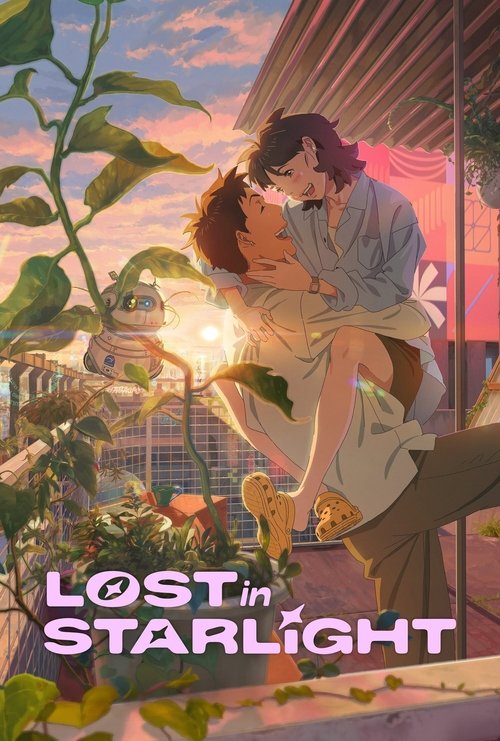
Lost in Starlight
2025 · Han Ji-won
For a cozy, slightly melancholy night in when you want to fall in love and feel a little homesick for someone at the same time. Comfort viewing with a lump in its throat.
What it's about
Seoul, 2050: a city where a Mars mission shares the skyline with vinyl shops and hand-soldered amplifiers. An astronaut training to leave Earth brings in the turntable she inherited from her mother, and the musician who repairs it becomes the person she can't stop thinking about. As launch day approaches, the two of them have to figure out what a relationship looks like when the distance between you is measured in light-minutes — with grief on her side and creative failure on his orbiting close behind.
The experience
Gentle and glowing, more bittersweet than sad — a slow-burn romance rendered in dusk purples and rain-streaked neon, where the quiet scenes of tinkering and listening carry as much charge as the space stuff. It aches in a warm way and lingers after.
Performances
Kim Tae-ri and Hong Kyung voice the leads with unusual delicacy — hesitant, lived-in line readings that make the romance feel overheard rather than performed.
The craft
Han Ji-won's animation is all texture: the grain of old speakers, the clutter of a workshop, a painterly future-Seoul that feels hand-made rather than rendered. It's a film about sound as much as image — analog music threaded through the score — so good speakers pay off as much as a big screen.
Why it matters
A flagship moment for Korean feature animation on the global stage, proving the country's independent animation scene could carry an intimate, adult-facing romance to international audiences.
In a retro-futurist Seoul of 2050 — where a Mars mission coexists with vinyl records and hand-soldered amplifiers — an astronaut preparing to leave Earth falls for a musician who repairs the turntable she inherited from her mother. Han Ji-won, who emerged from Korea's independent animation scene, treats the science fiction as scaffolding for something more intimate: a study of two people learning whether love can survive distance measured in light-minutes, with grief and creative failure orbiting close behind. The film became a flagship for Korean feature animation on the global stage, its painterly city rendered in dusk purples and neon reflected off rain, and its leads voiced with unusual delicacy by Kim Tae-ri and Hong Kyung. Han's signature is texture — the grain of old speakers, the clutter of a workshop, the way a memory plays back like a warped record. The most affecting device is the simplest: conversations across space that arrive on a delay, so that every reply answers a sentence already minutes old, and tenderness must learn to wait.
Reception
Landed in May 2025 carrying milestone weight — Netflix's first Korean original animated feature — so early reviews were as much about what it represented as what it was: near-universal awe at the visuals, shrugs at the familiar romance. A year on, it's the animation crowd, not the critics, keeping it warm.
How Lost in Starlight was received, from release to now →
Influences: the films it descends from and the films it influenced
- 5 Centimeters per Second (2007) — Structures an entire film around distance-stretched longing and unspoken words, pacing emotion through dusk skies and departing trains — the delayed-dialogue, love-across-distance grammar this film inherits.
- Your Name (2016) — Crosscuts two separated consciousnesses bound by an inherited object (the braided cord), rendered in hyper-detailed light-flare skies — the inherited-object motif and split-lovers editing.
- Wonderful Days (Sky Blue) (2003) — Established the Korean SF feature-animation template of a retro-futurist metropolis by compositing hand-painted texture over CG for a tactile, weathered future city.
- Blade Runner (1982) — Fixed the purple-neon dusk palette over a retro-futurist city where analog artifacts (photographs, origami) persist as emotional evidence in a digital age.
- Ghost in the Shell (1995) — Turned the rain-and-neon Asian megacity into a contemplative animated tone poem, using ambient analog machinery and negative space as mood rather than plot.
- In the Mood for Love (2000) — Builds romance from withheld and repeated dialogue and a saturated melancholic palette, letting shared objects and near-touches carry what words won't.
- Millennium Actress (2001) — Match-cuts seamlessly between memory and present around a chased inherited object (a key), making love-across-time a montage device — the warped-memory editing lineage.
- Perfect Blue (1997) — Pioneered animated editing that warps and skips like a damaged recording to render a mind failing — the technical root of the skipping-record memory device.
- La Jetée (1962) — Renders memory as warped still images and stakes a love that reaches across time on a single remembered instant — the photographic memory-as-device.
- Solaris (1972) — Uses SF as a vessel for grief and creative/emotional failure, materializing the lost beloved out of memory — the theme-of-grief-through-genre model.
- Belle (2021) — Fuses photoreal digital worldbuilding with hand-drawn intimacy and centers voice performance as the lead instrument — the contemporary hybrid-texture animated feature.
- Chungking Express (1994) — Neon night-city romance organized around analog fetish-objects (a dated can, a recorded cassette) and lovers who keep missing each other across distance.
- Her (2013) — Softens a digital-future romance with warm analog textures (wool, wood, warm light) and makes voice and sound design the primary emotional instrument across distance.
- Eternal Sunshine of the Spotless Mind (2004) — Edits memory as it degrades and collapses, using in-camera analog trickery to visualize grief being processed rather than narrated.
- The Red Turtle (2016) — Carries an entire arc of love and grief with almost no dialogue, trusting texture, gesture, and sound — the near-wordless, delicate-performance approach.
- Seoul Station (2016) — Demonstrates the 2010s Korean adult feature-animation pipeline with its muted, textured urban realism — the movement-peer that made a film like this producible.
Similar films
- Her (2013) — influence & lineage · same viewing thread
- Your Name. (2016) — influence & lineage
- Fallen Leaves (2023) — same viewing thread
- Past Lives (2023) — same viewing thread
- Sore: A Wife from the Future (2025) — same viewing thread
- Soulmate (2023) — same viewing thread
- Falling in Love Like in Movies (2023) — same viewing thread
- The Love That Remains (2025) — same viewing thread
All the films related to Lost in Starlight →
Watch it with: curated runs of related films
- The Ache of Almost — Watch these together for the way each circles a love that time, distance, or duty keeps just out of reach — long looks, feelings left unsent, and the life that gets lived instead.
- Love Among the Lonely — Watch these when you want love written for grown-ups — drifting, grieving, self-destructing people who find or keep each other with no fanfare — and want to feel a deadpan Helsinki karaoke bar and a warm Jakarta romance answer each other.