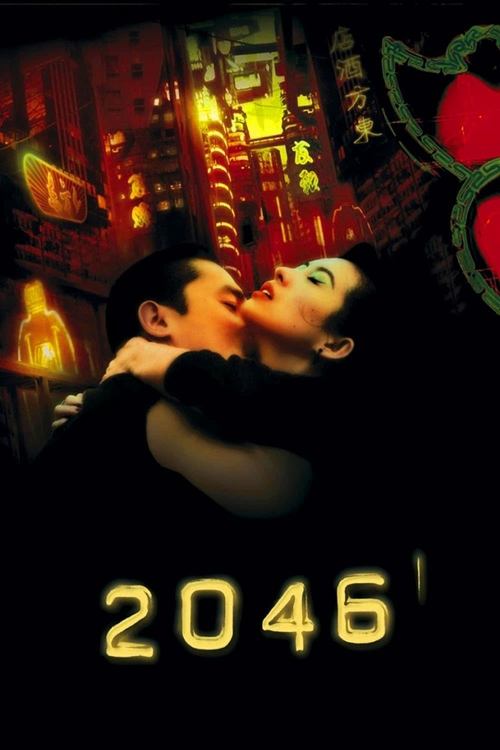
2046
2004 · Wong Kar-Wai
Generates discourse without new films: the Blossoms Shanghai TV pivot, In the Mood for Love's ascension up the Sight & Sound poll, and his permanent status as Letterboxd's most romanticized stylist.
For a solitary, rainy late night when you're nursing a memory of your own and want a film that understands heartbreak instead of fixing it. A challenge if you need momentum; a balm if you want atmosphere.
What it's about
A womanizing writer drifts through 1960s Hong Kong, taking a room in a shabby hotel and cycling through affairs he can't quite commit to — all of them haunted by the one woman he loved and lost. Between encounters he writes a science-fiction serial about a train to a place where nothing ever changes and no one can leave, and the line between his fiction and his memories keeps blurring.
The experience
Slow, sensuous, and heavy with longing — less a plot than a mood you sink into, all cigarette smoke, silk dresses, and things left unsaid. It's gorgeous and quietly devastating, the kind of film that aches rather than cries.
Performances
Tony Leung Chiu-wai is magnetic as the wounded charmer whose smile never reaches his eyes, and Zhang Ziyi matches him beat for beat as the woman who wants more than he'll give — arguably career-best work from both.
The craft
Wong Kar-Wai composes in doorways, mirrors, and slow-motion corridors, gliding between the neon steam of the hotel and the cold blue of the imagined future train. The film's colors, music, and rhythm do the storytelling; it rewards a good screen and total surrender to its pace.
Why it matters
The long-awaited close of Wong's beloved loose trilogy of Hong Kong love stories, it cemented his reputation as world cinema's great poet of romantic longing.
Snapshot
2046 is the third panel of Wong Kar-Wai's loose Hong Kong triptych, completing the arc begun in Days of Being Wild (1990) and intensified in In the Mood for Love (2000). Where those films circled a love never quite consummated, 2046 traces the wreckage: Chow Mo-wan, the journalist-turned-fiction-writer played again by Tony Leung Chiu-wai, drifts through 1960s Hong Kong conducting a series of half-committed affairs while writing a science-fiction serial about a future in which nothing changes and no one can leave. The film unfolds across two registers — the crowded, steam-lit corridors of a shabby hotel and the cold, blue-lit carriages of an imaginary train — and refuses to settle cleanly in either. Memory, desire, and political allegory are braided into a form so oblique that the film became as much a critical puzzle as a popular object. It is widely regarded as among the most formally ambitious works of twenty-first-century world cinema.
Industry & production
2046 had one of the most protracted and storied production histories in contemporary arthouse cinema. Principal photography began around 2000, in the immediate wake of In the Mood for Love, and the film was initially expected to premiere at Cannes 2003. The SARS crisis that paralyzed Hong Kong in early 2003 disrupted shooting schedules and logistics; the project was pushed back a full year. When 2046 finally appeared at the Cannes Film Festival in May 2004, in competition for the Palme d'Or, Wong was reportedly still editing — one of the more extreme instances of his well-documented practice of treating the festival premiere as a deadline rather than a completion point. The version that screened at Cannes differed in cut and color timing from the theatrical release that followed.
The production was an international co-venture, combining Hong Kong's Jet Tone Films — Wong's own company — with French and German co-producers, reflecting the financing structures that had become typical for high-ambition Hong Kong art cinema by the early 2000s. The cast was drawn from across Chinese-language cinema and reached into Japan: alongside Tony Leung and Hong Kong veterans Carina Lau and Faye Wong, the film starred mainland actresses Gong Li and Zhang Ziyi and Japanese actor Takuya Kimura, whose presence indexed Wong's deliberate expansion of the film's address beyond Hong Kong's domestic audience. Maggie Cheung, whose absence from 2046 is one of its structural facts — her character from In the Mood for Love is invoked but never shown — was originally expected to participate in some capacity; she does not appear. The reasons for her absence have not been fully explained in the public record.
Technology
2046 was shot on 35mm film. Three directors of photography are credited — Christopher Doyle, Lai Yiu-fai, and Kwan Pun-leung — a multiple-DP credit that reflects both the film's extended production period and the tensions that reportedly developed between Wong and Doyle, who had been his principal collaborator from Days of Being Wild through In the Mood for Love. Doyle and Wong did not work together again after 2046. The precise division of labor among the three cinematographers has not been exhaustively documented in English-language sources; the film reads visually as coherent, which testifies to Wong's editorial authority and to the consistency of the aesthetic he had developed across the preceding decade.
The film employs step-printing — a technique in which individual frames are repeated in the optical printing stage to produce a stuttering slow motion — to a degree that had become a signature of Wong's visual language by this point. Anamorphic widescreen framing creates the characteristic letterbox compositions in which figures are isolated within wide, half-dark frames.
Technique
Cinematography
The cinematography of 2046 continues and intensifies the signature Wong grammar: telephoto compression that flattens bodies against walls and doors, extreme shallow focus that dissolves backgrounds into molten color, and a willingness to shoot in conditions of near-darkness that push color negative film to its expressive limit. The hotel corridors — inspired in part by the Miramar Hotel in Kowloon, though the interiors are largely constructed sets — are shot in amber and rust, their geometries partially obscured. The science-fiction sequences on the train are rendered in cool blue and silver, a chromatic opposition that functions as a tonal key for the film's two registers: heat and memory on one side, cold and futurity on the other. Doyle's influence can be felt in the loosest, most kinetic passages, but parsing the individual contributions of the three DPs with confidence is not possible from available documentation.
Editing
William Chang Suk-ping edited 2046, as he has edited every Wong Kar-Wai film since the beginning of their collaboration. Chang's work here is defined by ellipsis and accumulation rather than narrative momentum: scenes are approached from oblique angles and abandoned before resolution, while emotional gestures recur across different character relationships to generate rhyme rather than continuity. The editing rhythm is calibrated to the step-printed slow motion — sequences breathe and suspend rather than cut in conventional time. The Cannes cut and the commercial release cut are said to differ meaningfully in pacing and structure, but no officially sanctioned director's cut has been released as of this writing; the theatrical version is the one that has been studied and distributed.
Mise-en-scène / staging
Chang also serves as production and costume designer — a concentration of creative control that is unusual and significant. The 1960s Hong Kong settings are built with a precise attention to fabric, surface, and color that functions as emotional indexing: the cheongsams worn by Zhang Ziyi's Bai Ling are saturated reds and golds, her body an instrument of the warmth Chow refuses to fully receive. The film's most recurring image — a figure glimpsed through or reflected in the slatted partitions and doorways of the hotel — is a staging decision that creates visual echo with In the Mood for Love while literalizing the theme of proximity without contact. The science-fiction train is a deliberately artificial environment, its production design aspirationally minimal, like an installation in motion.
Sound
2046 does not employ a composed original score in the conventional sense. Wong characteristically assembles a soundtrack from pre-existing recordings, and the result is one of the most poetically curated soundscapes in his body of work. Shigeru Umebayashi's "Yumeji's Theme" — a waltz composed for Seijun Suzuki's 1991 film Yumeji and used prominently in In the Mood for Love — recurs here as an explicit emotional callback, tying the films into a single phenomenal space. Connie Francis songs appear alongside Bellini's "Casta Diva" from Norma, and passages of Ennio Morricone appear in a characteristic Wong cross-cultural juxtaposition. The effect is of a sensibility that treats musical time as continuous with personal memory: the songs are not background but structural, marking emotional recurrences the way leitmotifs function in opera.
Performance
Tony Leung Chiu-wai anchors the film in a performance of deliberate withholding: Chow Mo-wan is charming, self-aware, and fundamentally unreachable, and Leung calibrates every scene so that warmth is offered and retracted in the same gesture. Zhang Ziyi's Bai Ling is the film's emotional center in a different register — her need is explicit, her hurt is legible, and she gives the film its most conventionally tragic arc. The contrast between her expressiveness and Leung's reticence is one of the film's organizing tensions. Faye Wong plays a double role — a hotel guest and her android counterpart in the science-fiction sequences — and her casting carries the resonance of her earlier appearance in Chungking Express (1994) without being reducible to it. Gong Li appears in fewer scenes but with a gravity that gives the figure of the other Su Li Zhen — the name shared, pointedly, with Maggie Cheung's character in In the Mood for Love — its appropriate weight.
Narrative & dramatic mode
The film's central conceit is that its fiction-within-fiction frame — Chow's serialized science-fiction story — is simultaneously a projection of his grief and an account of a place numbered 2046 from which no one who enters ever returns unchanged, and to which no one can truly return. This structure allows the science-fiction sequences to function as unconscious commentary on the drama: the android who cannot tell a suitor whether she loves him — the time it takes her circuits to process the feeling is rendered in step-printed slow motion — mirrors every human character who cannot answer the same question in the contemporary world.
The narrative is non-linear and fragmented, organized around repetition and variation rather than causality. Chow passes through a series of women — Bai Ling, Wang Jing Wen (Faye Wong), the gambler Su Li Zhen (Gong Li) — and each relationship traces a different version of the same impasse. Voiceover narration is used to frame and partly ironize events, as throughout Wong's oeuvre, giving the story the quality of a memoir being revised as it is told.
Genre & cycle
2046 occupies the juncture between melodrama, art cinema, and — in its speculative sequences — a kind of lyric science fiction uninterested in plot mechanics. Its SF register owes more to the tradition of the literary fantastic than to genre filmmaking: the imaginary train to 2046 functions as emotional metaphor rather than extrapolation. The film belongs to the cycle of 1990s–2000s Hong Kong art cinema that used the melodramatic mode to process the political anxieties of the handover period, a cycle that includes Stanley Kwan's Rouge (1987) and Ann Hui's retrospective work of the same years. Within that cycle, Wong's triptych is the most formally radical instance: where Rouge uses the ghost story to negotiate past and present, 2046 uses science fiction, but both mobilize genre as a container for historical feeling.
Authorship & method
Wong Kar-Wai is the presiding authorial intelligence, and 2046 is both the fullest expression of his method and its most sustained test. He is well-documented as working without a completed screenplay, generating scenes on set and discovering the film's shape in the editing room — a practice he has sustained across his entire career. This is not mere improvisation: it is a disciplined exploration of emotional possibility that treats the shoot as research and the edit as composition. The five-year production extended this process to an extreme that even sympathetic collaborators found difficult, and the film's long gestation is inseparable from its subject matter.
William Chang's roles as editor, production designer, and costume designer make him effectively a co-author of the film's visual and temporal world. His oversight of three distinct aesthetic registers — period décor, contemporary wardrobe, and science-fiction production design — gives 2046 its unusual internal coherence across modes. The music assembly, which functions as another authorial act, belongs wholly to Wong: the decision to return "Yumeji's Theme" across two films is a compositional choice that retroactively turns In the Mood for Love into a prequel and 2046 into a meditation on that earlier film as much as on the story it tells.
Movement / national cinema
2046 belongs to Hong Kong cinema's second wave of international prestige — the period following the 1997 handover in which filmmakers navigated questions of identity, belonging, and Sinophone cultural geography under new political conditions. Wong had been a central figure of Hong Kong's 1990s new wave alongside Stanley Kwan, Johnnie To, and Clara Law, and by 2004 he had become a major figure of international art cinema broadly, with Happy Together (1997) and In the Mood for Love widely distributed and critically honored in Europe and North America. The film's international co-production structure and its pan-Chinese-language cast reflect both the commercial necessities and the cultural ambitions of post-handover Hong Kong cinema's positioning in the world market.
The 1960s setting — the city at the height of its Shanghainese refugee culture, its colonial modernity, its political relative stability — is characteristic of post-handover Hong Kong cinema's retrospective orientation, in which the recent past is a site of both nostalgia and political analysis.
Era / period
2046 arrives at the midpoint of a decade of significant formal experimentation in world art cinema. The early 2000s saw the consolidation of what critics would come to describe as "slow cinema" — a tendency toward durational, observational forms visible across European, East Asian, and Latin American arthouse work. Wong's film is not slow cinema in the strict sense — it is too densely composed, too emotionally volatile — but it shares the era's resistance to narrative efficiency and its insistence on phenomenal time over plot time. It appeared at Cannes 2004 alongside a diverse competition slate; the Palme that year went to Michael Moore's Fahrenheit 9/11, a reminder that festival competition rarely reflects pure aesthetic affinity.
Themes
Memory and the impossibility of return are the film's governing concerns. The number 2046 is a double sign: it refers to Room 2046 in the fictional Oriental Hotel, the room where Chow lived while writing In the Mood for Love, the room his new neighbors variously inhabit and vacate; and it refers to the year 2046, the last year of the fifty-year guarantee of Hong Kong's autonomy under the Sino-British Joint Declaration of 1984 — the year before 2047, when the territory's separate status is scheduled to expire. The year-as-number is never explicitly glossed in the dialogue, but its resonance for a Hong Kong audience in 2004 is unambiguous: 2046 is the last moment before an uncertain future, a threshold that cannot be crossed without loss.
The theme of emotional inaccessibility runs through every relationship. Chow is a man who loved once and cannot love again in the same way, and whose affairs are variations on a pattern of desire and withdrawal. The women he encounters are not types but specific people with their own trajectories; the film's accomplishment is that it renders their suffering as real while acknowledging that the narrative is organized around Chow's consciousness, which filters everything through nostalgia and self-exculpation.
Time as both theme and formal principle are inseparable in 2046. The step-printing that suspends motion, the science-fiction conceit of a train from which no traveler returns unchanged, the five-year production: all are expressions of a preoccupation with duration and the emotional weight of waiting.
Reception, canon & influence
2046 was received at Cannes with admiration and considerable ambivalence. Critics who had championed In the Mood for Love found the new film richer in detail but more difficult to hold: a common response to work that deliberately frustrates resolution. It did not win major prizes at Cannes but received sustained critical attention in the months and years following its international release. The film gathered strong notices in specialist press across Europe and North America and appeared in numerous year-end polls and critics' surveys for 2004–2005.
Influences on the film: The primary cinematic ancestors are the memory films of the French New Wave and its satellites. Alain Resnais is the presiding figure: Hiroshima Mon Amour (1959) and Last Year at Marienbad (1961) establish the formal vocabulary of fragmented time and amorous impasse that Wong develops in his own register. Michelangelo Antonioni's films of emotional desolation — L'avventura (1960), La notte (1961) — are another layer of influence, particularly in the treatment of physical proximity without emotional connection. The classical Hollywood melodrama tradition, especially Douglas Sirk's use of heightened color and suppressed emotion, informs the film's visual palette and its willingness to take romantic suffering seriously. Within Asian cinema, the Shanghai films of the 1930s and 1940s are a cultural reference point for the Shanghainese Hong Kong world the film inhabits; the films of Seijun Suzuki — whose Yumeji supplies the recurring waltz — constitute a more oblique formal kinship across the two countries' arthouse traditions.
Legacy: 2046 has been widely influential on subsequent Asian art cinema and on the broader world arthouse. The film's visual grammar — shallow focus, stepped-frame slow motion, telephoto compression in intimate spaces — was absorbed into the work of a generation of filmmakers working through the 2000s and 2010s. Wong Kar-Wai's influence on cinematographic practice in this period is broad enough that individual elements are often cited without attribution; the film's color palette and compositional habits can be traced in work ranging from South Korean romantic drama to international prestige television. Among critics and scholars, 2046 is regularly included in serious assessments of the decade's major films. Its specific contribution to the discourse around Hong Kong's post-handover identity and the uses of nostalgia in cinema continues to be examined in film studies literature. The film is generally understood alongside In the Mood for Love as the twin summit of Wong's career — two works that cannot be fully understood without the other, and that together constitute one of the more sustained meditations on time and loss in the history of the medium.
A Deleuzian reading
Start with the android who cannot answer.
The full Deleuzian reading of 2046 →
Reception
At Cannes 2004 it screened famously unfinished and drew a shrug next to In the Mood for Love; two decades on it's been reappraised as the bruised, maximalist culmination of Wong's whole project rather than a lesser sequel.
How 2046 was received, from release to now →
Influences: the films it descends from and the films it influenced
- In the Mood for Love (2000) — Step-printing synchronized to Shigeru Umebayashi's 'Yumeji's Theme' and the hotel-corridor slatted-partition compositions were carried directly into 2046 as its foundational aural-visual grammar; Wong splices actual footage from this film into 2046's closing Singapore flashback.
- Days of Being Wild (1990) — William Chang's first role as simultaneous editor, production designer, and costume designer established the integrated creative-control model that governs 2046; Tony Leung's wordless final-scene cameo seeds the through-line of displacement and withheld desire that 2046 completes.
- Happy Together (1997) — Christopher Doyle developed the specific frame-repeat step-printing ratio — printing individual frames two or three times in the optical stage to produce a stuttering motion-smear — that 2046 applies to its hotel corridors and train sequences.
- Hiroshima mon amour (1959) — Resnais's editorial grammar of romantic trauma as involuntary repetition — past and present intercutting without conventional flashback cues, the wound that replays without announcement — is the direct structural precedent for 2046's non-linear accumulation of parallel love affairs across different women.
- L'Année dernière à Marienbad (1961) — Elliptical editing that returns to the same gestures and spaces without confirming their ontological status — memory, fantasy, or fact — established the formal license for 2046's accumulation structure, in which scenes approach from oblique angles and dissolve before resolution.
- Providence (1977) — A dying novelist constructs genre-inflected fictional scenarios that interpolate his family members, with the authorial imagination visibly deforming and replaying scenes across registers — the closest cinematic model for Chow Mo-wan's science-fiction serial as a mechanism for processing unresolved romantic grief.
- Letter from an Unknown Woman (1948) — Ophüls's melodrama engine — one lover who remembers everything, one who has repeatedly forgotten — is the direct structural template for 2046's pattern of women who invest more fully than Chow returns; doorway and threshold architecture spatializes desire as obstruction.
- Lola Montès (1955) — Anamorphic widescreen isolating a woman within overloaded décor, combined with a framing-fiction device — the circus showman narrating and curating memory as spectacle — anticipates 2046's science-fiction serial as a meta-narrative structure through which a controlling author aestheticizes personal loss.
- Solaris (1972) — Lyric science fiction in which a future technology literalizes unresolved grief — the dead lover returned as a projection the station cannot expel — is the direct generic precedent for 2046's train where androids embody the passengers' longing; slow contemplative pace against spectacular SF design establishes the genre convention 2046 inherits.
- Last Life in the Universe (2003) — Doyle continues the saturated, reflection-laden mood register he gave Last Life, extending the same glass-and-color lyricism.
- The Grandmaster (2013) — Step-printing and optical slow-motion are extended to martial-arts choreography at higher frame-repeat ratios; William Chang's integrated editor-designer method, chromatic opposition between warm amber and cool steel-blue, and Tony Leung's deliberate-withholding performance are transplanted intact into a wuxia genre frame.
- Three Times (2005) — DP Mark Lee Ping Bing — who contributed cinematography to In the Mood for Love — applies shallow telephoto compression across three historical-register stories; a compiled 1960s Taiwanese pop soundtrack with leitmotif recurrence mirrors 2046's compiled-score methodology, while the 1966 segment's elliptical editing withholds romantic resolution by identical means.
- The Assassin (2015) — Mark Lee Ping Bing's extreme telephoto compression and slatted framing through silk screens, beaded curtains, and foliage partially obscures figures using the same staging grammar as 2046's partition shots; deliberate-withholding performance combined with shallow-focus chromatic bokeh constitutes the deepest formal echo of 2046's cinematographic language in subsequent world cinema.
- Eternal Sunshine of the Spotless Mind (2004) — Non-linear reverse-chronological reconstruction of a romantic relationship through fragments rather than continuity, with an SF conceit — memory erasure — embedding a fiction-within-fiction; elliptical editing withholds the moments of consummation and accumulates emotional weight through repetition rather than narrative momentum.
- Carol (2015) — DP Ed Lachman, explicitly citing Wong Kar-Wai's telephoto shallow-focus grammar, shoots withheld desire through glass, rain-streaked windows, and mesh partitions in anamorphic widescreen; chromatic opposition between wintry exterior grays and warm interior amber performs the same emotional-key function as 2046's blue-silver train versus amber-rust hotel.
- Her (2013) — Lyric SF in which a future technology literalizes the inability to move past loss — the OS as projection of longing — extends the 2046 train conceit into an American register; a compiled acoustic score (Arcade Fire, Owen Pallett) operates as leitmotif across tonal register shifts in the same manner as 2046's recurring Umebayashi compositions and Connie Francis recordings.
- Touch (2024) — A man's serial return to a single unrecoverable love across time renders memory as a room repeatedly revisited — the memory-quest as melancholy recurrence.
Similar films
- In the Mood for Love (2000) — influence & lineage
- Happy Together (1997) — influence & lineage
- Days of Being Wild (1990) — influence & lineage
- The Grandmaster (2013) — influence & lineage
- Millennium Mambo (2001) — same viewing thread
- Goodbye, Dragon Inn (2003) — same viewing thread
- What Time Is It There? (2001) — same viewing thread
- Long Day's Journey Into Night (2018) — same viewing thread
All the films related to 2046 →
Watch it with: curated runs of related films
- Sinophone Slow Cinema — A run of Chinese-language films — Taiwan's New Wave and its mainland and Bi Gan heirs — where time pools and city, family, and memory recur; watch them near each other, from A Brighter Summer Day to An Elephant Sitting Still, for how they rhyme on drift and the weight of the past.