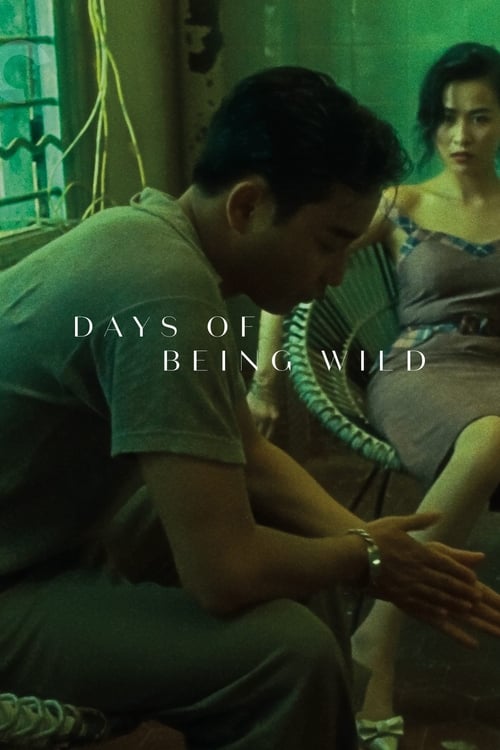
Days of Being Wild
1990 · Wong Kar-Wai
Generates discourse without new films: the Blossoms Shanghai TV pivot, In the Mood for Love's ascension up the Sight & Sound poll, and his permanent status as Letterboxd's most romanticized stylist.
For a late night alone when you want to marinate in longing rather than be entertained — a film for the melancholy-romantic frame of mind. It asks patience and repays it with atmosphere few films ever touch.
What it's about
Hong Kong, 1960. Yuddy is a magnetic young drifter who collects women and discards them, haunted by the discovery that the woman who raised him isn't his real mother. The film moves among the people caught in his orbit — a quiet ticket-seller, a showgirl, a night-beat policeman — as Yuddy's search for his origins pulls him toward the Philippines.
The experience
Languid, humid, and heartsick — less a plot than a mood you inhabit, all rain, radios, and clocks ticking past midnight. It leaves you with the ache of moments that were already slipping away while they happened.
Performances
Leslie Cheung is mesmerizing as Yuddy — vain, wounded, and impossible to look away from — while Maggie Cheung breaks your heart with almost nothing, playing abandonment as a kind of quiet vigil.
The craft
This is where Wong Kar-Wai found his signature and Christopher Doyle's camera found its language: green-tinted rooms, rain-slicked streets, faces held in loaded close-up. The film cares about texture and time more than story, and its drifting, sensuous style rewards total surrender in a dark room.
Why it matters
A foundational work of Hong Kong art cinema that launched one of the great director-cinematographer partnerships and set the template for a whole strain of moody, time-obsessed romantic filmmaking.
Snapshot
A foundational text in late-twentieth-century world cinema, Days of Being Wild (Cantonese: 阿飛正傳, A Fei Zhengzhuan, roughly "Story of a Rogue") marks the point at which Wong Kar-Wai discovered his mature sensibility and Christopher Doyle became the cinematographer who would define a visual grammar for Hong Kong art cinema. Set in 1960 and centered on Yuddy (Leslie Cheung), a magnetic, self-destructive young man who drifts between women and finally towards a Philippines he imagines will resolve his identity, the film is less interested in story than in the phenomenology of time — the peculiar way a moment can be simultaneously experienced and already lost. Its famous "one-minute" scene, in which Yuddy tells a girl to remember that they shared sixty seconds together on April 16, 1960, encapsulates everything the film is: intimate, elegiac, and quietly devastating.
Industry & Production
Wong had made one prior feature, As Tears Go By (1988), a commercially successful genre film that gave him the leverage to pursue something more personal. Days of Being Wild was produced through In-Gear Film Production. The shoot became notorious in Hong Kong industry circles for its length, its improvisational atmosphere, and the absence of a conventional shooting script. Wong worked from fragments and impressions rather than a complete screenplay, and the production extended far beyond its initial schedule.
The film was a significant commercial disappointment at the Hong Kong box office on its release in April 1991 — a fact widely reported, though specific grosses should be verified against contemporary trade records. The failure was felt acutely, and it temporarily strained Wong's relationship with the mainstream industry. Critical and awards recognition arrived quickly to compensate: the film swept the 11th Hong Kong Film Awards in 1992, winning Best Film, Best Director, Best Actor for Leslie Cheung, and Best Cinematography for Doyle, among others. International festival exposure in the early 1990s began a longer rehabilitation that has never reversed.
A planned sequel, which would have continued Yuddy's story and the mysterious drifter glimpsed in the final minutes, was never made in the form originally envisioned. Elements of that suspended continuation migrated across the subsequent two decades of Wong's work.
Technology
Shot on 35mm with a 1.85:1 aspect ratio, the film represents an early instance of the hybrid shooting style — mixing handheld intimacy with very deliberate compositional framing — that Doyle and Wong would formalize over successive collaborations. The production made use of available and practical light in the cramped interior spaces of 1960s Hong Kong tenements, supplemented by artificial sources used to produce the film's signature amber-and-green warmth. Slow-motion effects, used selectively for moments of heightened temporal awareness, were achieved in-camera through controlled frame rates rather than purely in post-production, though the precise technical workflow of individual shots has not been exhaustively documented in published sources.
William Chang Suk-ping, who served as production designer and costume designer (and who would later co-edit several Wong films), sourced and built the period interiors with meticulous attention to texture and decay. The Philippines-set sequences, filmed partly on location, introduced a tropical register — lush greens, rain, mud — that functions as a visual and emotional counterpoint to the claustrophobic Hong Kong material.
Technique
Cinematography
Doyle's work here inaugurates the visual language associated with Wong's cinema: canted frames, rack-focus used expressively rather than correctively, extreme close-ups of faces and objects that charge the mundane with lyric intensity, and a pronounced sensitivity to the way artificial light pools and bleeds in confined spaces. The camera is frequently placed at oblique angles to its subjects, refusing the neutral frontality of conventional commercial filmmaking. Movement is sometimes jarringly fast, sometimes languid to the point of stasis, creating an oscillating rhythm that mimics the film's emotional content. The color palette — saturated yellows and greens, warm ambers — became so closely identified with a certain nostalgia for 1960s Hong Kong that it effectively defined the visual terms by which subsequent films and images recalled that era.
Editing
Patrick Tam Kit-ming, a central figure of the Hong Kong New Wave and one of Wong's key mentors, edited the film. Tam's own directorial work (The Sword, 1980; Final Victory, 1987) had already demonstrated his sympathy for elliptical narrative and formal risk; his editing of Days of Being Wild is characterized by abrupt, unmotivated cuts that strip transitions of conventional connective tissue. Scenes begin in medias res and end before resolution; temporal continuity is deliberately fractured. The cumulative effect is a film that feels like memory — fragmentary, unreliable, intensely present in isolated moments.
Mise-en-scène / Staging
Wong's staging resists the theatrical conventions of scene-building. Characters frequently address each other without facing the camera or each other; conversations happen in corridors, doorways, and half-lit rooms where bodies occupy marginal rather than central space. Yuddy's bedroom — crowded, warm, a sealed world — becomes a recurring architectural emblem of his inability to exist outside his own subjectivity. The film's choreography of bodies within spaces emphasizes proximity and distance simultaneously: people are close together and unreachable. The dance sequence, in which Yuddy moves alone to Xavier Cugat's Latin rhythms, stands as one of the most precise images of narcissism and yearning in modern cinema.
Sound
The film's sound design is inseparable from its use of pre-existing popular music, predominantly Latin recordings: Xavier Cugat and his orchestra, the guitar duo Los Indios Tabajaras (whose "Always in My Heart" / Siempre en mi Corazón creates a recurring refrain of displacement), and selections from the mambo-era popular catalog. The choice of Latin music for 1960s Hong Kong is historically grounded — Latin pop had genuine currency in Southeast Asian popular culture of that period — but Wong exploits its connotations of sensuality, longing, and geographic elsewhere to amplify the film's emotional register. The music is not ironic; it is used as feeling itself, bypassing the discursive and landing directly on sensation. Ambient sound — rain on rooftops, traffic, the creak of tenement buildings — is mixed with unusual care for a Hong Kong commercial production of this era.
Performance
Leslie Cheung had been primarily known as a Cantopop star and mainstream genre actor; this performance revealed a depth and interiority the industry had not previously required of him. His Yuddy is charismatic without being sympathetic in any conventional sense — the film refuses to explain or excuse him. Cheung communicates the character's solipsism without turning him into a villain, a tonal difficulty the film navigates continuously. Maggie Cheung, playing Su Li-zhen, the first woman Yuddy abandons, produces an affecting study in dignified devastation with minimal screen time relative to her emotional weight. Andy Lau and Jacky Cheung, both major stars, take supporting roles that constrain and showcase them differently than genre work would. Tony Leung Chiu-wai appears in only the final minutes of the film, in a scene of ambiguous narrative relation to everything preceding it, and establishes — entirely through presence and small gesture — a character the viewer immediately wants to follow.
Narrative & Dramatic Mode
The film rejects conventional dramatic architecture. There is no unified plot; the narrative disperses across multiple characters whose connections are lateral rather than causal. Yuddy is the nominal protagonist, but the film's consciousness is distributed: Su Li-zhen's grief, Tide's (Andy Lau) quiet devotion, Mimi's (Carina Lau) hunger and hurt all receive attention that exceeds their narrative function. The Philippine sequence, which follows Yuddy's attempt to find his biological mother and ends in his death, resolves nothing thematically — it simply concludes, with violence arriving abruptly, as a punctuation mark rather than a revelation. Time, not event, is the film's organizing principle. Wong's recurring inscription of specific dates and times (April 16, 1960, 3 p.m.) transforms duration itself into dramatic material: the film asks what it means for a moment to have existed, to pass, to be remembered.
Genre & Cycle
Days of Being Wild inhabits and transforms the youth-rebel genre that had circulated through Hong Kong cinema since the 1950s — the A Fei (阿飛) as local variant of the James Dean delinquent archetype, culturally specific and internationally legible simultaneously. Wong is aware of this heritage and uses it: the title foregrounds the genre while the film itself deconstructs it, replacing the genre's typical narrative of transgression and consequence with something more interested in interiority and drift. The film also participates in the late-1980s/early-1990s Hong Kong mode of period nostalgia, looking back at the 1960s from the anxious vantage of a city approaching its 1997 handover to China, though Wong's engagement with that anxiety is oblique rather than allegorical.
Authorship & Method
Wong Kar-Wai's approach to filmmaking was already, on this second feature, definitively non-scriptural: he constructs films through accumulation and discovery rather than prior design. His working method — extended shoots, improvised scenes, material discarded or added late — places enormous demands on collaborators and on production financing. The creative partnership with Doyle, which began here and continued through Chungking Express (1994), Fallen Angels (1995), Happy Together (1997), and In the Mood for Love (2000), constitutes one of the defining director-cinematographer collaborations of the period. William Chang's role as production designer, costume designer, and (on later films) editor makes him arguably the most constant shaping intelligence in Wong's visual world. Patrick Tam's mentorship, both as editor on this film and as an earlier influence on Wong's development as a writer, represents a direct transmission from the Hong Kong New Wave's first generation.
Movement / National Cinema
Days of Being Wild is central to what is sometimes called the Hong Kong Second Wave — the generation of filmmakers who followed Ann Hui, Tsui Hark, and the first-wave directors into more formally experimental territory in the late 1980s and early 1990s. It arrived at a moment when Hong Kong cinema was at its commercial peak internationally, yet Wong moved against that commercial current toward an art-cinema mode with stronger affinities to European modernism than to genre entertainment. The film's international reception positioned Hong Kong cinema within world art film circuits in a way that genre productions, however accomplished, had not managed.
Era / Period
The film belongs to the brief, extraordinary period of Hong Kong cultural production in the years immediately preceding the 1997 handover — a moment of retrospection, heightened by political uncertainty, toward the city's colonial past. The 1960s setting is not arbitrary: it places the action in the last decade of unambiguous Hong Kong identity before the demographic and political pressures of subsequent decades, and the film's pervasive atmosphere of impermanence reads, in retrospect, as historically overdetermined. This reading was applied by critics after the fact more than Wong explicitly solicited it, but the film's formal preoccupations — time as loss, belonging as impossibility — resonated strongly with that cultural moment.
Themes
Time, memory, and the impossibility of possession are the film's central preoccupations. Yuddy's famous self-description — "I've heard that there's a kind of bird without legs that can only fly and fly, and sleep in the wind when it is tired. The bird only lands once in its life... that's when it dies" — announces the film's governing metaphor: identity as rootlessness, desire as perpetual deferral. The film is equally concerned with the asymmetry of love: Su Li-zhen and Mimi love Yuddy more than he can reciprocate; Tide loves Su Li-zhen without expectation; the film maps a network of displaced affection in which no one quite reaches anyone else. Maternal abandonment and the search for origins underpin the psychological architecture: Yuddy's knowledge that he was adopted drives his restlessness, and the Philippines journey is revealed as a search not for a mother but for a self that can be grounded somewhere.
Reception, Canon & Influence
Backward influences: Wong's acknowledged debts run toward the French New Wave — Godard's fragmented narrative structures and Truffaut's lyrical humanism — and toward Michelangelo Antonioni's cinema of alienation and stalled time. The youth-rebel tradition from Nicholas Ray's Rebel Without a Cause (1955) inflects the film's cultural inheritance of the A Fei archetype. Alain Resnais's temporal disjunctions have been cited by critics if not explicitly by Wong himself. The influence of Patrick Tam's own directorial sensibility, developed over the prior decade, should not be understated.
Critical reception: Initially received in Hong Kong with commercial disappointment and mixed critical response, the film's reputation shifted rapidly as international attention accumulated. By the mid-1990s it was being written about in the context of world art cinema's most formally ambitious work. The canonical reassessment has been total: it appears consistently in retrospective lists of the greatest films of its decade and of Hong Kong cinema as a whole.
Forward legacy: The influence is simultaneously internal to Wong's own filmography and external. In the Mood for Love (2000) revisits the 1960s Hong Kong setting, uses the character name Su Li-zhen, continues the preoccupation with repressed desire and the physical texture of period interiors, and can be understood as a companion text made a decade later with greater formal refinement. 2046 (2004) continues this chain. Externally, the film's visual grammar — handheld intimacy, step-printed slow motion, saturated color fields — entered the vocabulary of international art cinema and advertising simultaneously, becoming so widely referenced that its specific genealogy sometimes obscures its originality. Directors working in the subsequent two decades across Hong Kong, Taiwan, mainland China, South Korea, and beyond absorbed its formal lessons, and the film's model of affective cinema — prioritizing sensation and duration over conventional narrative — became a template for a strain of world art filmmaking that continues to the present.
A Deleuzian reading
Start with the clock.
The full Deleuzian reading of Days of Being Wild →
Reception
Bankrolled as a star-packed blockbuster after As Tears Go By, it bombed so badly in Hong Kong that its planned second part was scrapped — then swept Best Film and Best Director at the Hong Kong Film Awards and is now enshrined as the true beginning of Wong Kar-Wai's cinema.
How Days of Being Wild was received, from release to now →
Influences: the films it descends from and the films it influenced
- À bout de souffle (1960) — Godard's jump cut — the excision of frames within a continuous shot as deliberate expressive act rather than error — is the technical progenitor of WKW's unmotivated cuts that remove connective tissue between emotional states without spatial disorientation.
- L'Avventura (1960) — Antonioni's vanishing protagonist structure — Anna disappears after the first act, redistributing narrative weight to emotionally becalmed secondary figures who cannot fill the absence — is the formal template for Yuddy's mid-film departure to the Philippines.
- Rebel Without a Cause (1955) — Dean's Jim Stark — the parentally abandoned, emotionally volatile male youth whose surface aggression conceals a hunger for authentic belonging — defines the A Fei archetype that Leslie Cheung's Yuddy inhabits as its Hong Kong cultural heir.
- Bande à part (1964) — The Madison dance sequence — characters performing an impromptu popular dance cut against diegetic silence and period music — directly prefigures the staging logic and emotional irony of Leslie Cheung's mirror solo dance.
- Hiroshima mon amour (1959) — Resnais's alternation of two temporal planes without conventional flashback signaling — present Hiroshima and past Nevers treated as equally co-present — is the formal model for WKW's temporal fracture, where the 1960 timeline is distributed across emotionally incompatible registers.
- Les Quatre Cents Coups (1959) — Truffaut's non-judgmental camera intimacy with a self-destructive youth — refusing explanatory psychology in favor of sensation and duration — prefigures WKW's approach to Yuddy's emotional inaccessibility, including the freeze-frame refusal of conventional resolution.
- Nomad (1982) — Tam's Hong Kong youth film's elliptical editing — hard cuts between emotional registers, deliberate withholding of narrative connective tissue — is literally embedded in Days of Being Wild through Tam's role as the film's editor, making this a direct craft transmission from the New Wave's first generation.
- That Day, on the Beach (1983) — Christopher Doyle, whose feature cinematography career the seed inaugurated, brings that expressive lensing to Wong here, propagating the debut's visual DNA into the defining Asian art-film look.
- Lola (1961) — Wong builds a film out of missed encounters, characters who circle the same locations at different hours, and a slow lateral camera moving past foreground obstructions — then extends the roster across later films, using Lola's shared-universe practice to make doubling-across-time the organizing structure of a body of work.
- Chungking Express (1994) — The Doyle collaboration's step-printed slow motion and available-light handheld grammar first developed in Days is here refined and doubled across parallel love narratives — the same formal toolkit applied to contemporary Hong Kong, with popular music (Mamas & Papas, Dennis Brown) continuing the anachronistic affective function of the Latin recordings.
- Happy Together (1997) — The Buenos Aires setting literalizes the anachronistic Latin popular music deployed in Days — Caetano Veloso's 'Cucurrucucú Paloma' fulfills the sonic register opened by Los Indios Tabajaras, while Doyle's step-printing, black-and-white to color transitions, and marginal staging continue the visual grammar.
- In the Mood for Love (2000) — Directly revisits the 1960s Hong Kong setting and the character name Su Li-zhen from Days; the step-printed slow motion of Maggie Cheung's corridor walk is the formal fulfillment of Yuddy's mirror dance, now governed by repression rather than narcissism, and the amber-green interior palette is brought to its highest saturation.
- Millennium Mambo (2001) — Voice-over narration identifying the action as already past ('In the year 2001, Vicky was twenty years old') while images unfold in present tense absorbs WKW's temporal inscription and retrospective melancholy, transposing it to Taipei club spaces with slow-motion duration in practical neon light.
- Last Life in the Universe (2003) — Christopher Doyle's cinematography transplants the amber-green palette, canted frames, and marginal body placement from WKW's visual grammar into a Thai context — direct craft transmission through the shared collaborator who codified these devices across the Doyle-WKW films.
- Tropical Malady (2004) — The film's formal bisection — a protagonist and narrative dissolve and reconstitute in an entirely new register mid-film — extends WKW's dispersed/vanishing protagonist technique into Southeast Asian mythological cinema, where structural rupture carries ritual rather than psychological weight.
- 2046 (2004) — William Chang's first role as simultaneous editor, production designer, and costume designer established the integrated creative-control model that governs 2046; Tony Leung's wordless final-scene cameo seeds the through-line of displacement and withheld desire that 2046 completes.
- Fallen Angels (1995) — First deploys the voiceover-as-interiority method — characters narrating desires their bodies never act on — and the mood-montage editing that constructs emotional atmosphere through repetition of gesture rather than causal incident, both carried wholesale into Fallen Angels.
- The Grandmaster (2013) — Launches Wong's elliptical voiceover narration and clock/time motif with Christopher Doyle, the formal time-and-memory grammar Le Sourd later inherits and sculpts.
- Comrades, Almost a Love Story (1996) — Built romance from elliptical time jumps, mood and period pop around a minimalist Maggie Cheung — the withheld-longing-across-time editing grammar Comrades adopts.
- Ashes of Time (1994) — First deployment of the step-printed smear and Doyle's saturated, filtered palette married to a drifting, present-tense voice-over interiority — the exact grammar Ashes pushes to abstraction.
- The Terrorizers (1986) — Yang's dispersed narrative across disconnected Taipei figures — fragmented editing that withholds conventional causation between storylines, available light, characters whose paths intersect without resolution — represents a parallel Chinese-language second-wave development of the same formal solutions WKW pursued in Hong Kong.
- The Hole (1998) — Tsai deploys Grace Chang's 1950s–60s Mandarin pop songs as anachronistic fantasy counterpoint to contemporary urban isolation — the same structural strategy of using period popular recordings against present-tense alienation that WKW established with his Latin selections.
Similar films
- In the Mood for Love (2000) — influence & lineage · same viewing thread
- Happy Together (1997) — influence & lineage · same viewing thread
- Chungking Express (1994) — influence & lineage
- Millennium Mambo (2001) — influence & lineage
- Fallen Angels (1995) — same viewing thread
- Farewell My Concubine (1993) — same viewing thread
- 2046 (2004) — shared sensibility
- Ashes of Time (1994) — shared sensibility
All the films related to Days of Being Wild →
Watch it with: curated runs of related films
- Love Against the Grain — A run of films where desire refuses the shape its world demands — opera stages, drought-struck Taipei, an honor-bound Lahore household, drenched Buenos Aires — and burns brighter, and more dangerously, for the refusal.