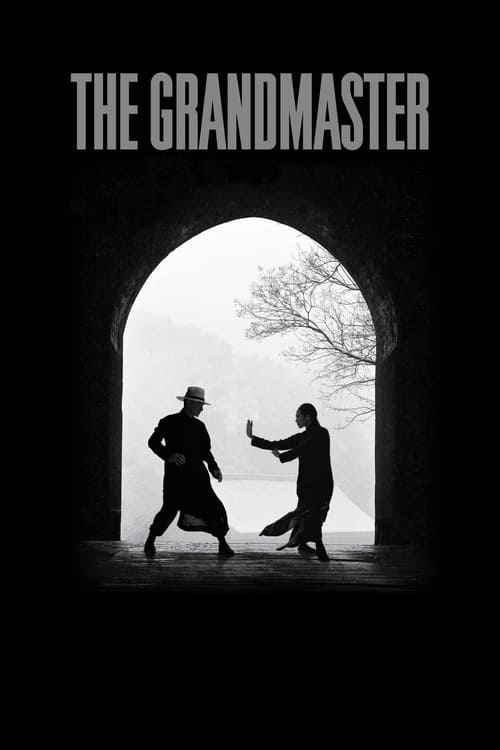
The Grandmaster
2013 · Wong Kar-Wai
Generates discourse without new films: the Blossoms Shanghai TV pivot, In the Mood for Love's ascension up the Sight & Sound poll, and his permanent status as Letterboxd's most romanticized stylist.
For when you want beauty and longing more than a straight story — a swooning, contemplative night rather than an action fix. Somewhere between comfort and challenge: gorgeous to watch, sad to sit with.
What it's about
Ip Man, a Wing Chun master living quietly in Foshan, is drawn into the martial-arts world's great question of succession when a Northern grandmaster comes south seeking an heir — and the grandmaster's brilliant daughter, Gong Er, challenges Ip to defend her family's honor. War then scatters everyone: Ip struggles to rebuild in Hong Kong while Gong Er weighs vengeance against everything else her life could be.
The experience
Dreamy and elliptical — the fights fall like rain-soaked ballet, and between them hangs the ache of things unsaid and lives unlived. It moves by mood and image rather than plot, and it leaves a lingering melancholy.
Performances
Tony Leung gives Ip Man a stillness that says more than speeches, and Zhang Ziyi is ferocious and heartbreaking as Gong Er — a woman who gives up everything for honor — in what many consider her finest work.
The craft
Every fight is shot like a love scene: slow motion, close-ups on a wrist, a hat brim, raindrops off a fist, with a decade of craft poured into the choreography and the amber-and-rain photography. It's ravishing on a big screen with the sound up — the opening downpour brawl alone is worth it.
Why it matters
A decade in the making, it became one of Wong Kar-Wai's biggest commercial successes and redefined what a martial-arts biography could be — elegy first, combat second.
Snapshot
The Grandmaster (一代宗師, Yi dai zong shi) is Wong Kar-Wai's elliptical, decade-in-the-making martial-arts epic, nominally a biography of the Wing Chun master Ip Man (Yip Man) but in practice a meditation on the passing of an entire world — Republican-era China and its lineages of combat, honor, and obligation — refracted through Wong's signature poetics of memory, longing, and lost time. Tony Leung Chiu-Wai plays Ip Man as a figure of quiet poise; Zhang Ziyi plays Gong Er, the daughter of a Northern grandmaster who renounces marriage, children, and her own art to avenge her father. Though it carries the iconography of the kung-fu film — schools, challenges, masters, the encroaching Japanese occupation — the picture is closer to a tone poem about thresholds: the line between North and South, between the prewar and postwar worlds, between a life lived and a life relinquished. It premiered as the opening film of the 2013 Berlin International Film Festival and circulated internationally in markedly different cuts, a fact inseparable from its reception.
Industry & production
The film is among the most protracted productions in Wong Kar-Wai's career, and that long gestation is central to its legend. Wong has described conceiving the project years before shooting, undertaking extensive research into the martial-arts world of the early twentieth century and interviewing surviving practitioners and inheritors of the various schools. Tony Leung trained in Wing Chun for an extended period in preparation — a regimen widely reported to have included an injury to his arm during training, which delayed the shoot. Principal photography itself was famously drawn-out, spanning multiple years and locations across China.
The production was a Hong Kong–mainland China co-production through Wong's company Jet Tone, with Sil-Metropole and other backers, reflecting the integrated Chinese-language industry of the period and the access to mainland locations and resources that a film of this scale required. Action design was entrusted to the legendary choreographer Yuen Woo-ping, whose involvement aligned Wong's art-cinema sensibility with one of the genre's foremost technicians.
Crucially, The Grandmaster exists in several distinct versions. The original Chinese-language release ran roughly 130 minutes; the international cut shown at Berlin was somewhat shorter; and the North American release, handled by The Weinstein Company, was re-edited to around 108 minutes with added explanatory intertitles and a reorganized structure aimed at Western audiences less versed in the historical and martial-arts context. The existence of these competing cuts has shaped scholarly and critical discussion ever since, with many critics regarding the longer Chinese cut as the fuller realization of Wong's intentions.
Technology
The film was shot photochemically in the tradition of Wong's earlier work, and its technical signature lies less in novel capture technology than in the meticulous control of light, water, and slow-motion. Action sequences make extensive use of high-frame-rate cinematography to render combat as a series of legible, almost tactile micro-events — droplets, hatbrims, the crease of fabric — rather than as kinetic blur. Reliable, specific public detail about the exact camera and lens packages is comparatively thin, and I will not assert particulars I cannot ground; what is well established is the film's reliance on practical atmospheric effects (rain, snow, steam, smoke) and precise artificial lighting to sculpt its surfaces.
Technique
Cinematography
The Grandmaster marks a significant departure in Wong's collaborative history: it was photographed not by his longtime cinematographer Christopher Doyle but by the French cinematographer Philippe Le Sourd. The result is a images of extraordinary density and texture — rain hammering a courtyard in the opening street fight, lamplight catching on wet stone and fur collars, the cold blue-white of a snowbound railway platform. Le Sourd's work favors shallow focus, fragmentary framing (faces half-seen, action glimpsed through foreground objects), and a chiaroscuro palette that makes each frame feel excavated from memory rather than observed in the present. The cinematography earned an Academy Award nomination (86th Academy Awards), a notable recognition for a Chinese-language martial-arts film.
Editing
Editing is credited to William Chang Suk-Ping, Wong's indispensable long-term collaborator, who also served as production and costume designer — a triple role that gives the film an unusual unity of conception. The cutting is associative and elliptical rather than continuous: time skips, motives are withheld, and emotional climaxes arrive obliquely. The fight scenes, by contrast, are cut for percussive clarity, isolating gestures and impacts. The very different North American re-edit underscores how load-bearing the editing is to the film's meaning; restructuring the material into a more conventional chronology measurably altered its register.
Mise-en-scène / staging
Chang's design work is the film's other great achievement, recognized with a second Oscar nomination for Best Costume Design. The recreated Foshan of the 1930s — its brothels and martial-arts halls, the celebrated Gold Pavilion — is rendered with sumptuous specificity, and the costuming distinguishes North from South, prewar abundance from postwar austerity. Staging repeatedly organizes combat around architecture and weather: the opening rain-soaked melee, the duel between Ip Man and Gong Er across the polished interior of a grand house (where the wager is not to break the furniture), and the climactic confrontation between Gong Er and Ma San on a railway platform amid falling snow and a passing train. Space, surface, and season carry as much dramatic weight as blows.
Sound
The score is credited principally to Shigeru Umebayashi — who had previously given Wong the indelible themes of In the Mood for Love and 2046 — and Nathaniel Méchaly. As is characteristic of Wong, the film also draws on pre-existing music: most conspicuously Ennio Morricone's "Deborah's Theme" from Once Upon a Time in America, whose romantic melancholy is grafted onto the film's sense of irrecoverable time. Sound design heightens the tactility of the action — the snap of cloth, the strike of fists, rain and steam — so that combat registers as much through the ear as the eye.
Performance
Tony Leung's Ip Man is a study in restraint: stillness, courtesy, and a watchfulness that reads as moral as much as martial. The film's emotional center, however, is Zhang Ziyi's Gong Er, widely regarded as the standout performance — a portrait of discipline turned into self-erasure, of a woman who masters her family's "64 Hands" only to vow never to pass it on. Chang Chen appears as the swordsman "The Razor" (Yixiantian), and Song Hye-kyo plays Ip Man's wife, Zhang Yongcheng, a largely silent figure whose absence haunts the later film. The supporting ensemble of veteran martial artists lends the schools and lineages their texture of authenticity.
Narrative & dramatic mode
The film's dramatic mode is lyrical and fragmentary rather than biographical-linear. It moves by association, voiceover, and intertitle, compressing decades and withholding causal connective tissue. Where a conventional biopic would dramatize Ip Man's later fame as Bruce Lee's teacher, Wong instead lingers on a road not taken — the unconsummated affinity between Ip Man and Gong Er, two people whose mutual recognition can never become a shared life. The result is a structure of parallel fates: Ip Man survives, adapts, and carries his art into postwar Hong Kong; Gong Er triumphs in vengeance but forfeits her future. The film treats martial arts itself as a narrative subject — schools, transmissions, and the question of whether a tradition lives or dies with its keeper.
Genre & cycle
The Grandmaster belongs to the long lineage of the kung-fu and wuxia-adjacent martial-arts film, but it sits self-consciously athwart that tradition as an art-cinema reframing of popular genre. It arrived amid a notable cycle of Ip Man films in the late 2000s and early 2010s — most prominently Wilson Yip's Ip Man (2008) starring Donnie Yen and its sequels, alongside other treatments of the figure — a cycle that made the master a touchstone of Chinese national-popular cinema. Wong's contribution is the prestige, auteurist outlier: where the Donnie Yen films deliver nationalist crowd-pleasing spectacle, The Grandmaster aestheticizes and interiorizes the same history, treating the genre's conventions as elegy.
Authorship & method
The film is unmistakably a Wong Kar-Wai work in its preoccupations — time, memory, missed connection, the dignity of restraint — and in its method: years of research and preparation, protracted shooting, and an openness to reshaping the material in the edit, even after release. Wong's authorship here is collaborative in his characteristic way. William Chang Suk-Ping's combined editing-and-design role is fundamental to the film's identity, continuing one of the most important director–designer partnerships in modern cinema. Composer Shigeru Umebayashi extends his earlier work for Wong. The major shift is at the camera: Philippe Le Sourd's arrival in place of Christopher Doyle gives the film a distinct, more sculpted visual idiom while preserving Wong's sensibility. Action choreographer Yuen Woo-ping supplies a genre authority that Wong's previous films (including his earlier wuxia experiment Ashes of Time) had handled more abstractly. The screenplay is credited to Wong with collaborators, developed out of the project's long research phase. Notably, the character of Gong Er is a fictional creation, not a historical figure — a sign that Wong's interest is thematic and emotional rather than documentary.
Movement / national cinema
The film stands within the second-wave / post–New Wave Hong Kong art cinema that Wong himself helped define, while also belonging to the era of integrated mainland-Hong Kong co-production that reshaped Chinese-language filmmaking in the 2000s–2010s. It is at once a Hong Kong auteur film and a pan-Chinese historical epic, and its subject — the migration of Southern martial-arts masters to Hong Kong after the war — literalizes that very passage from the mainland to the colony. As Hong Kong's submission for the Academy Award for Best Foreign Language Film, the film also functioned as a national-cinema standard-bearer on the international circuit.
Era / period
Set principally from the 1930s through the postwar years, the film spans the prewar prosperity of Foshan, the rupture of the Second Sino-Japanese War and Japanese occupation, and the diaspora to Hong Kong that followed. Period is not mere backdrop but the film's true subject: the war does not so much appear on screen as hollow out the world between scenes, separating an age of flourishing schools and codes from a diminished aftermath in which those traditions must survive in exile or perish. The film's elegiac tone is bound to this sense of a vanished prewar order.
Themes
Its central themes are the transmission and potential extinction of tradition; the cost of honor and vengeance, especially for women bound by familial duty; the relationship between martial discipline and inner cultivation ("kung fu" as a way of being, not merely fighting); and Wong's perennial concerns — time, memory, regret, and love that goes unspoken and unfulfilled. The recurring motif of the line or threshold (North/South, horizontal/vertical, the title's "grandmaster") frames the film as an inquiry into what it means to keep faith with a teaching, a person, or a lost moment. Gong Er's renunciation crystallizes the film's tragic argument: that fidelity to the past can be both the highest virtue and a form of self-destruction.
Reception, canon & influence
Critically, The Grandmaster was widely admired, particularly for its visual beauty, its design, and Zhang Ziyi's performance, even as the existence of multiple cuts complicated consensus; a number of critics regretted that English-speaking audiences first encountered the shortened, re-explained North American version rather than the longer Chinese cut. The film was a strong awards presence in Asia, performing well at the Hong Kong Film Awards and Asian Film Awards, and it earned two Academy Award nominations — Best Cinematography (Philippe Le Sourd) and Best Costume Design (William Chang) — a rare international honor for a Chinese-language martial-arts film. (Precise award tallies vary by ceremony, and I am noting the categories I can state with confidence rather than enumerating totals I cannot verify exactly.)
In terms of influences on the film, it draws backward on the entire kung-fu and wuxia tradition, on Wong's own earlier excursion into period martial arts (Ashes of Time), and on his romantic-melancholic mode from In the Mood for Love and 2046; its use of Morricone signals a self-conscious dialogue with the operatic memory-cinema of Once Upon a Time in America. Looking forward, its legacy is felt less in direct imitation than in its demonstration that the martial-arts film could be a vehicle for high art-cinema seriousness on the world stage — reinforcing a tradition that runs through Ang Lee's Crouching Tiger, Hidden Dragon and Zhang Yimou's Hero and House of Flying Daggers, and offering a model of the genre as elegy. Within the broader Ip Man cycle, Wong's film remains the auteurist counterpoint, the version that treats the master not as a nationalist hero but as a figure of memory and loss.
A Deleuzian reading
Rain, and a man in a hat.
The full Deleuzian reading of The Grandmaster →
Reception
In 2013 it landed as a divisive, fragmented curiosity — sold in the US as a chopped-down 108-minute Weinstein cut with explanatory intertitles — but it's since been reappraised as major late Wong Kar-Wai, with the longer Chinese cut now the version cinephiles insist you seek out.
How The Grandmaster was received, from release to now →
Influences: the films it descends from and the films it influenced
- Ashes of Time (1994) — Wong's first wuxia, where William Chang's editing dissolves swordplay into smeared abstract motion and the memory-driven elliptical structure directly prefigures Grandmaster's fragmentary fights and combined design-edit authorship.
- In the Mood for Love (2000) — Establishes the slow-motion choreography of bodies in cramped period interiors and the grammar of unconsummated restraint that Grandmaster transposes onto Gong Er and Ip Man's withheld attraction.
- 2046 (2004) — Shigeru Umebayashi's recurring waltz-leitmotif scoring of period melancholy is the exact scoring template Grandmaster reuses to convert action into elegy.
- Days of Being Wild (1990) — Launches Wong's elliptical voiceover narration and clock/time motif with Christopher Doyle, the formal time-and-memory grammar Le Sourd later inherits and sculpts.
- Once Upon a Time in America (1984) — Grandmaster appropriates Ennio Morricone's 'Deborah's Theme' wholesale, importing Leone's operatic-memory mode of scoring a life as retrospective lament.
- A Touch of Zen (1971) — King Hu stages combat amid architecture, weather, and natural elements with trampoline-and-cut lift, the staging tradition Grandmaster's rain-soaked, lantern-lit opening brawl extends.
- Come Drink with Me (1966) — Founds the balletic, Peking-opera-derived wuxia choreography vocabulary of poised stances and rhythmic exchange that Grandmaster's duels stylize.
- Drunken Master (1978) — Yuen Woo-ping's breakthrough as choreographer establishes the precise, style-legible hand-to-hand grammar he supplies to Grandmaster, giving Wong genre authority his abstract Ashes of Time lacked.
- The 36th Chamber of Shaolin (1978) — Shaw Brothers' rigorous dramatization of martial schools and lineage discipline supplies the 'transmission of tradition' subject Grandmaster mourns as a vanishing world.
- Crouching Tiger, Hidden Dragon (2000) — Marries Yuen Woo-ping's wirework choreography to art-cinema lyricism and doomed restraint, proving on the world stage that wuxia could carry serious authorship — the model Grandmaster reinforces.
- The Assassin (2015) — Pushes wuxia fully into elliptical art cinema with long static painterly tableaux, withheld and abruptly truncated action, and period restraint — extending Grandmaster's genre-as-art-cinema license.
- Shadow (2018) — Builds combat inside an ink-wash monochrome palette and rain-soaked architecture, extending the painterly, weather-staged elegiac wuxia mode Grandmaster crystallized.
- Long Day's Journey Into Night (2018) — Inherits Wong's elliptical memory structure and chiaroscuro-soaked longing, building a Chinese-language art cinema of fragmented time directly downstream of the Grandmaster idiom.
- Hero (2002) — Christopher Doyle's saturated, color-blocked painterly cinematography elevates wuxia to formalist art cinema, a sibling experiment in treating the martial-arts image as composed canvas.
- House of Flying Daggers (2004) — Extends the elegiac doomed-romance wuxia with heightened, percussive sound design (the echo-drum duel) coupling combat to emotional tempo as Grandmaster couples it to memory.
- Ip Man (2008) — Sammo Hung's grounded Wing Chun choreography frames the same Ip Man biography as nationalist-hero spectacle, the literal counter-reading against which Grandmaster defines its memory-elegy treatment.
Similar films
- Ip Man (2008) — influence & lineage
- Crouching Tiger, Hidden Dragon (2000) — influence & lineage
- Shadow (2018) — influence & lineage
- Hero (2002) — influence & lineage
- The Assassin (2015) — influence & lineage
- In the Mood for Love (2000) — influence & lineage
- House of Flying Daggers (2004) — influence & lineage
- The 36th Chamber of Shaolin (1978) — influence & lineage
All the films related to The Grandmaster →