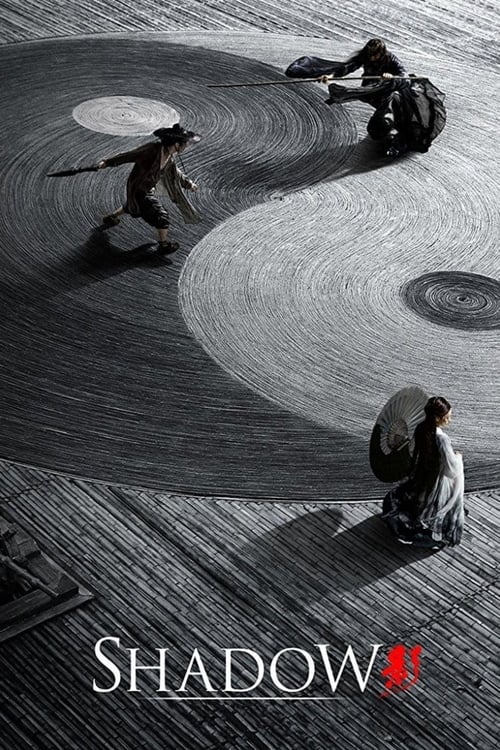
Shadow
2018 · Zhang Yimou
For when you want something gorgeous and strange — a martial-arts film that plays like a chess match. Better suited to a night when you're up for elegance and tension than popcorn thrills.
What it's about
In an ancient Chinese kingdom ruled by a young, capricious king, the military commander guards a dangerous secret: a body double — a 'shadow' — trained since boyhood to impersonate him at court and in combat. As the commander schemes to retake a lost city against his king's wishes, the double is pushed to the center of a lethal game of politics, identity, and desire, with the commander's wife caught between the man and his copy.
The experience
Cool, coiled, and hypnotic — long stretches of whispered palace intrigue that suddenly erupt into rain-slicked, umbrella-bladed combat. It keeps you slightly off balance the whole way, unsure who anyone really is, and the beauty of it is almost overwhelming.
Performances
Deng Chao plays both the commander and his double, and the film rests on how completely he makes them two different men — one wasting and venomous, one yearning and alive.
The craft
Zhang Yimou drains the film of nearly all color, staging it in the grays, whites, and ink-blacks of traditional Chinese brush painting — everything except skin and blood. Constant rain, silk, and steel give it an astonishing texture, and the sound of water and blades makes this one to watch big, loud, and in the dark.
Why it matters
It marked a return to form for Zhang Yimou in the wuxia mode he helped globalize, proving the genre could be an art object as much as a spectacle — austere, painterly, and formally daring.
Snapshot
Shadow (影, Yǐng) is Zhang Yimou's austere, near-monochrome wuxia tragedy of doubles, staged in a fictionalized echo of China's Three Kingdoms era. A dying military commander of the Pei kingdom, Ziyu, conceals his decline behind Jingzhou ("Jing"), a body double — a "shadow" — trained from boyhood to impersonate him in court and combat. From this premise Zhang builds an intricate machine of substitution, conspiracy, and reversal: the commander schemes to retake the lost city of Jing against his sovereign's wishes, the shadow is sent to do the dying, and the commander's wife, Xiao Ai, drawn to the double, becomes the pivot on which authenticity itself turns. The film is best known not for its plot but for its look — drained of nearly all color into the grays, whites, and inky blacks of Chinese brush-and-water painting (shuimo), with red blood and human skin almost the only chromatic exceptions. It is the deliberate photographic negative of Zhang's own Hero (2002), and a return to the wuxia spectacle from which his ill-fated Hollywood coproduction The Great Wall (2016) had detoured.
Industry & production
Shadow belongs to the mature phase of China's commercial blockbuster era — the "dapian" (big-picture) model that Zhang himself helped inaugurate with Hero in 2002, and which by 2018 had matured into a confident, capital-rich industry. The film premiered out of competition at the Venice Film Festival in late August/September 2018, screened at Toronto, and opened theatrically in China later that year. Its festival launch positioned it squarely as a prestige-art object for the international circuit even as it functioned domestically as a star vehicle.
The casting is itself a production fact worth noting: Deng Chao plays both the real commander Ziyu and his shadow Jing, a dual role demanding two distinct physical registers — the gaunt, hunched invalid and the upright, powerful double — for which the actor reportedly underwent significant physical transformation. Sun Li, Deng Chao's wife off-screen, plays Xiao Ai, lending the central triangle a real-world charge. The ensemble includes Zheng Kai as the volatile young King Peiliang, Hu Jun as the rival general Yang Cang, Wang Qianyuan, Wang Jingchun, Leo Wu (Wu Lei), and Guan Xiaotong as Princess Qingping. The precise financing and box-office figures I will not assert here; the verifiable record is that the film performed respectably rather than spectacularly in China and traveled widely abroad, where its visual design was the principal selling point.
Technology
Shadow is, technically, a film about subtraction. Its signature is the near-elimination of color — and crucially, this was achieved not as a black-and-white capture but as a constructed gray world. The production designed sets, costumes, and props in graded tones of ink — screens, robes, and architecture painted and dyed across a calibrated greyscale — so that the desaturation reads as painterly intention rather than a missing-color accident. Skin tones and blood retain their hue, which means the technology serves a thematic end: in a world of imitation and gray ambiguity, only flesh and wound are unfeignedly "real." This required tight coordination between art direction, costume, lighting, and digital color grading; the look is a hybrid of practical (painted, dyed, lit) and post (graded) techniques rather than a single trick. The Pei umbrellas — bladed, articulated metal weapons that double as sleds down a rain-slicked mountain pass — are the film's most conspicuous piece of designed weaponry, requiring choreography, rigging, and VFX support to read convincingly.
Technique
Cinematography
The cinematography is by Zhao Xiaoding (ASC), Zhang's longtime collaborator on House of Flying Daggers (2004) and Curse of the Golden Flower (2006). Here Zhao works against everything those earlier films flaunted. Where Daggers and Golden Flower are riots of saturated color, Shadow is a study in tonal gradation — the image built from the interplay of black ink, gray wash, and the paper-white of skin and silk. Compositions repeatedly echo the framing logic of Chinese scroll painting: figures small against vast, mist-softened space; calligraphic verticals of rain; screens and lattices that flatten depth into layered planes. Light is diffuse and often sourceless, mimicking the even luminance of brushwork rather than the modeled chiaroscuro of Western painting. The persistent rain — the climactic assault unfolds in a downpour — gives Zhao a moving texture of gray on gray, dissolving the boundary between figure and ground exactly as the plot dissolves the boundary between man and shadow.
Editing
The film's editing alternates between two rhythms: the patient, near-static chamber scenes of court intrigue, held long to let performance and composition breathe, and the percussive acceleration of the umbrella-borne assault and the duels. The intercutting of the taiji-diagram training sequences — the shadow learning to defeat Yang's spear by adopting a yielding, "feminine" style — builds the film's combat grammar in advance, so that the payoff battle reads as the completion of a thesis. I will not attribute the cut to a named editor with confidence, as that credit is not something I can verify here; the discipline of the assembly, however, is plainly of a piece with Zhang's measured late style.
Mise-en-scène / staging
This is the film's center of gravity. The great recurring set-piece is the taiji (yin-yang) diagram painted on the floor of the training hall and reprised as the conceptual battlefield: the secret to defeating the rival general Yang Cang's overwhelmingly "male," hard spear technique is to fight in the yin manner — yielding, circular, water-like — a martial philosophy literally diagrammed in the staging. The bladed umbrella is the physical emblem of this idea: a soft, rounded, "feminine" object turned lethal. Zhang stages court and chamber scenes against vast hanging screens of gray calligraphy and ink-wash landscape, so that characters are continually framed as figures within paintings, or as ink stains on paper. Costuming in patterned grays makes bodies read as brushwork. The mise-en-scène is thus not decoration but argument: a sustained visual essay on duality, on the soft defeating the hard, and on the world as a painted surface across which authentic and counterfeit are indistinguishable.
Sound
Music is unusually load-bearing in Shadow, because it is partly diegetic and plot-critical. The guqin (seven-string zither) and a paired stringed instrument recur as a duet — a piece that the commander's wife Xiao Ai and the shadow play together, the harmony of two instruments standing for the doubling and the forbidden intimacy at the story's heart. The score foregrounds these traditional timbres against the rush and hiss of rain, which functions as a near-continuous sonic bed during the climax. I will refrain from firmly naming the composer, as I cannot verify that credit with certainty; what is securely the case is that the music is conceived as part of the drama rather than as underscoring laid over it.
Performance
Deng Chao's dual turn is the performance event of the film: the wasted, trembling commander Ziyu and the disciplined, ascendant shadow Jing are differentiated through posture, voice, and physical mass, and the film's suspense depends on the audience always knowing which is which while the characters often do not. Sun Li's Xiao Ai is the moral and emotional fulcrum — her divided loyalty, and the film's refusal to resolve what she ultimately knows, culminates in a celebrated final shot of her at a door, her face an unreadable seam between recognition and concealment. Zheng Kai plays the young king as mercurial and dangerous, his apparent foppishness masking shrewdness, which keeps the court intrigue genuinely uncertain.
Narrative & dramatic mode
The dramatic mode is tragic court intrigue welded to wuxia spectacle — closer to chamber drama than to battlefield epic for much of its length. The narrative is a clockwork of substitution and betrayal: the real commander manipulates the shadow, the king maneuvers against the commander, the shadow develops his own will, and Xiao Ai's allegiance is the wild card. The structure withholds its full design until late, so that the climactic reversals — the shadow turning on his master, the collapse of the court — land as the springing of a long-set trap. It is a drama about agency and disposability: the shadow is a tool that acquires a self, and the tragedy is that selfhood, in this world, can only be claimed by erasing the original.
Genre & cycle
Shadow sits within the post-2000 Chinese wuxia/historical-epic cycle that Zhang's Hero launched and that includes his own House of Flying Daggers and Curse of the Golden Flower, alongside the broader vogue for prestige period combat films. But it deliberately inverts the cycle's house style. Where the genre had become synonymous with maximal color and scale, Shadow strips the palette to ink and recenters the form on a single tragic premise. It also belongs to a transnational lineage of "body double" narratives — most pointedly Akira Kurosawa's Kagemusha (1980), whose Japanese title literally means "shadow warrior," and which similarly turns the impersonation of a dying warlord into a meditation on power and emptiness. The kinship is thematic and structural rather than imitative.
Authorship & method
Shadow is unmistakably a Zhang Yimou film in its conviction that visual design can carry a film's meaning entire. Zhang adapted the screenplay with Li Wei; the project reportedly originated in material drawn from Three Kingdoms lore — the contest over Jing Province — which Zhang abstracted into an invented kingdom so that the story could function as a fable of doubles rather than a costume history. The authorial signature is the chromatic concept: just as Hero assigned narrative meaning to blocks of red, blue, green, and white, Shadow makes its single radical color decision — near-monochrome — the organizing principle of everything from costume to combat philosophy. The key collaborators are Zhao Xiaoding behind the camera, the art-direction and costume teams whose greyscale world-building is the film's foundation (and which drew significant awards recognition), and the writer Li Wei. The film's recognition at the 55th Golden Horse Awards — including Best Director for Zhang and wins in art direction, costume/makeup, and visual effects — confirms that the craft departments were understood as the film's authorial core.
Movement / national cinema
Zhang Yimou is the most internationally visible figure of China's Fifth Generation, the cohort of Beijing Film Academy graduates (Chen Kaige among them) who reshaped Chinese cinema in the 1980s with films like Red Sorghum. Shadow belongs to Zhang's later, commercial-prestige phase rather than that early art-cinema moment, but it carries the Fifth Generation's foundational commitment to image as meaning — color, landscape, and composition as the primary bearers of theme. Within national cinema, Shadow is a statement about the Chinese blockbuster's capacity for restraint: a homegrown spectacle that turns toward classical painting tradition (shuimo, shanshui) rather than toward Hollywood-style maximalism, made by the same director whose The Great Wall had just tested the limits of the Hollywood-China coproduction.
Era / period
The film arrives in 2018, at a high-water mark of Chinese industrial filmmaking and at a reflective point in Zhang's career. Coming directly after The Great Wall (2016) — a costly, internationally financed experiment widely judged a misfire — Shadow reads as a deliberate recommitment to what Zhang does best on his own terms: a contained, design-driven wuxia made within the Chinese system. Its monochrome austerity can be understood as a corrective gesture, a return to artistic first principles after a detour into transnational spectacle.
Themes
The governing theme is duality — yin and yang, hard and soft, original and copy — diagrammed literally in the taiji floor and the umbrella, and dramatized in every relationship. Adjacent to it: authenticity and performance (who is the "real" commander when the shadow does the living and the dying?); the disposability of the human instrument and its revolt into selfhood; the theatricality of power, where rule is itself a kind of impersonation. Water is the persistent symbol — rain, the yielding principle, the medium of ink — set against the rigidity of male force. The film argues, through its plot and its palette alike, that the soft and the counterfeit can overthrow the hard and the authentic, and that this victory is indistinguishable from tragedy.
Reception, canon & influence
Critical reception was broadly favorable, especially internationally, where the ink-wash visual design was near-universally singled out as the film's triumph; reservations tended to concern the density and chilliness of the intrigue. Domestically the film was respected without becoming a phenomenon, and it was honored at the 55th Golden Horse Awards, where Zhang won Best Director and the film took craft prizes in art direction, costume and makeup, and visual effects.
The influences on the film are legible and several: Kurosawa's Kagemusha for the dying-warlord-and-double premise and its sense of power as hollow performance; the Chinese ink-wash and landscape painting traditions for the entire visual scheme; the Three Kingdoms narrative tradition for its raw material; the broader wuxia lineage running back through King Hu; and Zhang's own Hero and House of Flying Daggers, against whose saturated color Shadow defines itself by negation.
Its forward influence is still consolidating, as is fair to say of any film only a few years old. Its most concrete legacy is as a high-profile demonstration that a major commercial wuxia can be built on chromatic restraint and painterly design rather than spectacle-by-saturation — a proof of concept for monochrome and limited-palette art direction in big-budget genre filmmaking. Within Zhang's own evolving body of work it stands as a key late statement, the film in which the director who taught the wuxia blockbuster to use color most extravagantly then showed what the form could do with almost none. Tracing a wider lineage of films it has shaped would, at this remove, risk overstating a record that is not yet written; what can be said securely is that Shadow has entered the conversation as one of the most formally distinctive entries in the modern Chinese historical epic.
A Deleuzian reading
Watch the rain in the last act of *Shadow* and you stop being able to say where one gray ends and the next begins.
The full Deleuzian reading of Shadow →
Reception
Landing two years after the critically savaged The Great Wall, Shadow was instantly hailed as Zhang Yimou's return to form — a Venice premiere, four Golden Horse Awards including Best Director, and reviews treating it as his best wuxia since Hero.
How Shadow was received, from release to now →
Influences: the films it descends from and the films it influenced
- Kagemusha (1980) — Supplies the dying-warlord-and-double engine that Shadow rebuilds — the commoner trained to impersonate a great man, with sovereignty staged as hollow performance and the substitution as the narrative's withheld design.
- Throne of Blood (1957) — Pioneers the fog-bound, diffuse sourceless light and near-monochrome studio atmosphere that Shadow's greyscale world extends, dissolving figures into a flat painterly field rather than naturalistic depth.
- Ran (1985) — Establishes color (or its absence) as the governing design grammar of an epic — assigning chromatic blocks dramatic meaning — the principle Shadow inverts by making the single decision to drain color its organizing logic.
- A Touch of Zen (1971) — Founds the choreographic wuxia vocabulary — combat as edited, gravity-defying dance staged against landscape — and the scroll-like horizontal composition that Shadow inherits through the genre line.
- Come Drink with Me (1966) — Codifies the inn-and-courtyard wuxia template and the female swordsmanship rhythm that the whole tradition behind Shadow descends from.
- Yellow Earth (1984) — Zhang Yimou's own cinematography here builds meaning from vast off-center landscape framing and a restrained earth palette — the Fifth Generation compositional training that Shadow's scroll-painting widescreen draws directly on.
- One and Eight (1983) — Zhang Yimou as DP strips the image toward harsh, near-monochrome desaturation and brutal asymmetric framing — the proof that he was pursuing a drained palette decades before Shadow's greyscale.
- Kwaidan (1964) — Models the wholly constructed, painted-studio aesthetic where every background is frankly artificial — the anti-naturalist set-as-painting approach Shadow uses for its ink-wash interiors.
- Spring in a Small Town (1948) — Imports the literati-painting sensibility into Chinese cinema — restraint, negative space, emotion held in muted grays and slow movement — the native aesthetic ancestor of Shadow's ink-wash restraint.
- Hero (2002) — Zhang's earlier experiment assigning narrative meaning to saturated color blocks (red, blue, white) — Shadow is its explicit negation, the same color-as-meaning method run at zero saturation.
- House of Flying Daggers (2004) — Shares cinematographer Zhao Xiaoding and the signature of combat choreographed around a natural element (drums/fabric there, water and the bladed umbrella here) as both weapon and visual motif.
- The Grandmaster (2013) — Stages martial combat as rain-soaked slow-motion poetry organized around water — the yielding, splashing element as both choreographic medium and philosophical principle, paralleling Shadow's water-as-yielding concept.
- Detective Dee: The Four Heavenly Kings (2018) — A same-era big-budget Chinese fantasy-wuxia that leans on integrated VFX-driven set-pieces — the spectacle-by-effects path against which Shadow's award-winning constructed-greyscale offers the contemporary counter-proposal.
- Crouching Tiger, Hidden Dragon (2000) — Reframes wuxia as painterly art cinema with landscape-as-canvas combat (the bamboo duel), establishing the prestige-wuxia mode Shadow operates within.
- Curse of the Golden Flower (2006) — Zhang's other palace-intrigue piece where art direction and costume carry the drama entire — the same craft-department-as-author logic, only inverted from gold maximalism to gray minimalism.
- The Assassin (2015) — The contemporary painterly-minimalist wuxia — long-held, screen-like compositions and a hushed restraint that, like Shadow, treats the wuxia frame as a moving classical painting rather than an action delivery system.
Similar films
- The Assassin (2015) — influence & lineage · same viewing thread
- House of Flying Daggers (2004) — influence & lineage · often watched together
- Hero (2002) — influence & lineage · often watched together
- Crouching Tiger, Hidden Dragon (2000) — influence & lineage
- The Grandmaster (2013) — influence & lineage
- Come Drink with Me (1966) — influence & lineage
- Kagemusha (1980) — influence & lineage
- Throne of Blood (1957) — influence & lineage
All the films related to Shadow →
Watch it with: curated runs of related films
- Stillness, Then the Blade — Watch these back to back for the way each one holds its breath — painterly stillness, coiled calm, and violence that lands like a single brushstroke.