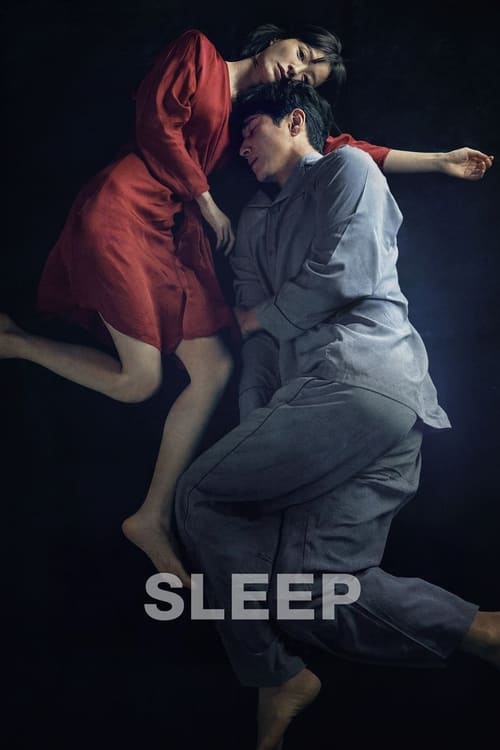
Sleep
2023 · Jason Yu
When you want smart, contained horror that runs on suspense and relationship truth rather than gore — ideal for couples brave enough to watch it in bed.
What it's about
A happily married couple — she's pregnant, he's a struggling actor — share a small apartment and a rule that problems get solved together. Then one night he sits up in bed and says, 'Someone's inside.' His sleepwalking grows stranger and more dangerous, medicine offers one explanation and her mother's shaman offers another, and the marriage becomes the thing under siege.
The experience
A tight, three-chapter chamber piece that slides from warm domestic comedy into skin-crawling paranoia — the scariest presence in the room may be the person you love, unconscious. It's funny, then nerve-shredding, and it keeps you guessing between the rational and supernatural explanations to the last stretch.
Performances
Jung Yu-mi and Lee Sun-kyun are superb as the couple: his transformations between gentle husband and blank-eyed sleeper are quietly terrifying, and her slide from supportive spouse to sleepless, wild-eyed protector carries the whole film.
The craft
A remarkably assured first feature from Jason Yu, who wrings sustained tension from a single apartment through precise staging, sound design that makes every nighttime creak count, and a clean three-chapter structure. The writing balances marriage drama, dark comedy, and horror without dropping any of them.
Why it matters
One of the most acclaimed horror debuts of its decade in Korea, it premiered to international festival praise and announced its first-time director — a protégé of Korea's top genre filmmakers — as a major new voice.
Snapshot
Sleep (Korean: Jam, 잠) is a South Korean horror-thriller and the first feature written and directed by Jason Yu (Yu Jae-sun). Nearly all of it takes place in one apartment. Soo-jin (Jung Yu-mi) is pregnant and works an office job. Her husband Hyun-su (Lee Sun-kyun) is an actor whose career has stalled. One night he sits up in bed and says, "Someone's inside." His sleep disturbances then get steadily worse: he scratches his own face bloody, raids the refrigerator for raw meat and fish, and eventually endangers the family pet and the newborn child. Medicine offers a diagnosis, REM sleep behaviour disorder, and a treatment regimen. Soo-jin's mother offers a different explanation: a restless spirit, to be dealt with by a shaman. The film is divided into three titled chapters. It moves from domestic comedy to paranoid chamber horror, and ends on a deliberately ambiguous resolution about belief, performance, and the limits of a marriage.
The film premiered in the Critics' Week (Semaine de la Critique) at Cannes in 2023. Bong Joon-ho, whom Yu had worked under, praised it publicly and widely, calling it the most unique horror film and smartest debut he had seen in a decade. It did well commercially in South Korea and travelled widely on the international genre-festival circuit. It is also among the last films Lee Sun-kyun completed before his death in December 2023, and that fact now affects how audiences read his performance.
Industry & production
Sleep is a modestly scaled Korean genre picture made inside the mainstream commercial system. It is not an independent or festival-only production. Lotte Entertainment, one of the country's major vertically integrated distributors, released it domestically in early September 2023. The release came at a weak moment for Korean theatrical attendance, which had not recovered to pre-pandemic levels. Against that backdrop, the film passing one million domestic admissions was widely reported as an unusual success for a debut with a contained premise and a cast of essentially two leads.
Casting Jung Yu-mi and Lee Sun-kyun was central to the project's viability. Both were established stars. Jung was known from Train to Busan (2016) and Kim Ji-young: Born 1982 (2019), and Lee had become internationally recognisable through Parasite (2019). They had also played opposite each other several times, notably in Hong Sang-soo's films, so audiences arrived already familiar with them as a pair.
Yu came to directing through the industry's apprenticeship pathways. His best-known prior credit is as an assistant director on Bong Joon-ho's Okja (2017), and he had made short films before Sleep. Bong's public endorsement of the film should be understood partly in that light: a mentor promoting a protégé. It still mattered a great deal to the film's international profile.
The production companies, budget, and shooting schedule are not well documented in widely available English-language sources, and this dossier does not speculate on them. Magnet Releasing (the genre label of Magnolia Pictures) handled the North American release in 2024.
Technology
Nothing about the film's technology is unusual. Sleep is a digitally shot, contemporary commercial production. Its technical interest lies in how it uses domestic recording devices inside the story. Soo-jin installs a camera to record Hyun-su at night, and the footage becomes evidence and a new source of dread. This connects Sleep to a lineage running from the night-vision bedroom surveillance of Paranormal Activity (2007) back to older fears of the sleeping body caught on tape. Yu does not turn this into found footage, though. The monitoring images are shown within an otherwise conventionally photographed film. They mark Soo-jin's growing reliance on watching and documenting as a way to control what she cannot understand.
Technique
Cinematography
The camera stays mostly inside the couple's apartment, and the photography plays the domestic space in two registers. By day the flat is bright, ordinary, and a little cluttered: a young middle-class couple's home with a framed motto on the wall. By night it becomes a dim arrangement of doorways, the glow of an open refrigerator, and a dark bedroom in which a figure might be standing. Many of the most frightening images come from simple staging, such as Hyun-su seen from behind, motionless at the foot of the bed or in the kitchen. They do not depend on elaborate camera movement. As the story goes on, the framing tightens and the apartment's geometry turns oppressive. This matches Soo-jin's barricading of the home, and in the third chapter the space reads as a fortress or a cell.
The film's cinematographer is credited, but there is little detailed English-language critical discussion of the photographic choices. Claims beyond the visible evidence of the film should therefore be treated with caution.
Editing
The three-chapter structure is the organising principle of the cut. Each chapter ends on an escalation and jumps forward in time. The ellipsis between the first and second chapters, which covers the birth of the child, is especially effective. It lets the film leave out the intervening weeks and return with the situation sharply worse. Inside individual scenes, Yu's editing is economical and often comic. Critics frequently pointed out that the film puts a laugh and a scare close together, and the timing of reaction cuts does much of that work. At about ninety-five minutes, the film is noticeably tight for a contemporary Korean genre release.
Mise-en-scène / staging
The apartment is the film's main expressive instrument, and its props carry meaning. A framed household motto, roughly "Together, we can overcome anything," hangs on the wall as a statement of marital faith. The plot puts that faith under steadily more pressure, and the ending turns it around. The refrigerator becomes a site of horror once Hyun-su starts eating from it in his sleep. As Soo-jin's fear grows, she rearranges the space with locks, security measures, and finally ritual objects and talismans. That transformation shows the arc in visual terms: a home rebuilt first around a medical regimen, then around a supernatural one.
A secondary thread involves complaints from the downstairs neighbour about noise. This ties the film to the very common Korean civic grievance of inter-floor noise in apartment blocks (cheungan soeum), and through it to the wider film tradition of apartment-complex unease.
Sound
Night-time sound is the main source of unease: mumbling, chewing, scratching, footsteps, a door opening at the wrong hour. The sound design often lets the audience hear what Soo-jin hears before they see what she sees, which aligns the viewer with her listening, sleepless position. The score is used sparingly. The film relies more on silence and amplified domestic noise than on musical cues to build tension. The composer's other work and their specific methods on this production are not well documented in English.
Performance
The film is essentially a two-hander, and the shift in power between the performers is its dramatic engine. Lee Sun-kyun plays Hyun-su in two modes. Awake, he is mild, apologetic, a slightly hapless supporting-role actor. Asleep, he becomes a blank, unreachable body. Lee had long worked in the register of the ordinary, likeable, slightly compromised Korean man, and his performance turns that persona into something uncanny. The final act depends on the audience recognising that Hyun-su is himself a professional actor.
Jung Yu-mi carries the film's arc. Soo-jin begins as a rational, organised partner and ends as a figure of exhausted, absolute conviction. Critics generally singled out Jung's performance as the film's centre and praised how she kept a precarious balance between pathos and comedy as Soo-jin's methods became extreme. Kim Kuk-hee as Soo-jin's mother, along with the doctors and the shaman, fill out a small supporting ensemble.
Narrative & dramatic mode
The story is built as a three-act escalation, and the chapter structure turns each act into a phase in the couple's interpretation of the crisis.
- Chapter one treats the sleepwalking as a medical problem. It is shared, embarrassing, and manageable. Clinic visits and medication are bound up with the couple's commitment to facing everything together.
- Chapter two, after the baby's birth, moves the danger onto the child. Soo-jin's account of events also begins to shift from the clinical toward the supernatural, encouraged by her mother and by a shaman's reading.
- Chapter three reverses the power dynamic. Hyun-su has been treated and appears to be getting better. Soo-jin, sleepless and certain, has become the source of threat and control.
Throughout, the film keeps both readings open: neurological disorder or possession. It refuses to confirm either one in the conventional way. The climax turns on an act of performance. Whatever Hyun-su "really" is, he chooses to give his wife the ending her belief requires, and the film leaves the audience to decide whether that is love, surrender, possession, or all three. The mode is tragicomic. Dark comedy about married life and caregiving sits right next to real horror, and the film's surprise comes from its willingness to let the absurd and the frightening share a frame.
Genre & cycle
Sleep sits where several genre strands meet.
- Domestic and marital horror, in which the home and the spouse become unknowable. Polanski's Rosemary's Baby (1968) is the obvious ancestor: a pregnant wife, a husband whose behaviour changes, and the question of whether her fear is paranoia or perception.
- Medical-versus-supernatural ambiguity, in the tradition that The Exorcist (1973) helped codify. There, modern medicine is tried and exhausted before ritual is invoked.
- *Korean shamanic (mudang) horror, which gained new international visibility after Na Hong-jin's The Wailing (2016). It continued with Jang Jae-hyun's Exhuma (2024), released a few months after Sleep, which became a large domestic hit. Sleep* is a smaller, more ironic entry in this cycle: the shaman appears, but the film is more interested in what belief in shamanism does to a marriage than in staging spectacular rites.
- Contained, single-location horror of the 2010s–2020s, a low-cost mode that rewards precise staging and performance.
Critics frequently also placed it in the wider wave of "elevated" or psychologically driven horror, alongside Hereditary (2018) and The Babadook (2014), where the supernatural threat is closely tied to grief, caregiving, or a family under strain.
Authorship & method
Jason Yu (Yu Jae-sun), writer-director. Sleep is his first feature. His apprenticeship on Bong Joon-ho's Okja is often cited, and critics found Bong-like traits in the film: sudden shifts between comedy and terror, attention to the material details of class and domestic life, and genre used to look at social institutions, here marriage and the family. Yu has said in interviews that he wanted to make a film about a couple and that he approached the story partly as a love story. This framing explains why the ending prioritises the marriage over resolving the mystery. Because he has made only one feature so far, any claims about his long-term authorial signature are premature.
Key collaborators. Jung Yu-mi and Lee Sun-kyun, who had worked together repeatedly before, are the film's most important creative partners, and their history as a screen pair is built into how the film works. The cinematographer, composer, and editor are credited on the film. Detailed accounts of their contributions are scarce in English-language criticism, and this dossier does not assign specific stylistic choices to them without documentation.
Movement / national cinema
Sleep belongs to post-Parasite South Korean commercial cinema. After the 2019–2020 international success of Bong's film, Korean genre filmmaking drew more global attention than ever. At the same time, the domestic theatrical market was struggling with the after-effects of the pandemic and with competition from streaming platforms. Mid-budget original films had a hard time in that environment. Part of Sleep's significance in industry discussion is that it showed a tightly made genre debut built on stars could still find an audience in cinemas.
The film also reflects the long-standing strength of Korean cinema at mixing tones. Comedy, melodrama, and horror exist side by side without being kept apart, a quality critics associate with Bong, Park Chan-wook, and Na Hong-jin. Its interest in apartment living, inter-floor noise, the pressures of work and career, and generational tension (the mother's faith in shamans versus the couple's modern medical approach) places it within recognisably contemporary Korean social preoccupations.
Era / period
The film is set in the present day and was made and released in 2023. It belongs to a moment when "elevated" horror and festival-premiered genre films were established routes into international markets, and when Korean genre cinema was a dependable export category. The mid-2020s revival of interest in shamanism in Korean popular culture, which peaked with Exhuma, is the immediate context in which Sleep was received. Its release period is also marked by Lee Sun-kyun's death in December 2023, only months after the Korean release. That event changed how the film was received internationally in 2024.
Themes
- Marriage as a pact of shared reality. The film's real subject is whether two people can keep believing in the same version of events. The household motto is first tested and then grimly fulfilled.
- The unknowable intimate. Sleep shows that the person closest to us has a whole existence we cannot reach. The sleeping spouse is the most familiar body and the most foreign one.
- Caregiving and exhaustion. Pregnancy, a newborn, and a partner's illness all fall mainly on Soo-jin. The film reads her escalating behaviour partly as what sleep deprivation and unshared responsibility do to a person. Many critics noted the gendered dimension: the wife carries both the labour of care and the blame for her response to it.
- Science versus belief. The clinic and the shaman are presented as competing systems of explanation, each with its own rituals, authorities, and limits. The film does not award victory to either.
- Performance and sincerity. Hyun-su's profession as an actor reframes the ending. When performing is the only form of care left, is it still honest?
- Domestic security and paranoia. Fortifying the home against an internal threat turns protection into imprisonment.
Reception, canon & influence
Critical reception. Sleep was well received at Cannes and through its festival run, and English-language reviews after its 2024 North American release were broadly positive. Critics praised the economy of the script, the tonal control, Jung Yu-mi's performance, and the ambiguous resolution. Some reservations were also common: a few reviewers found the third act's tonal pivot or the ending's ambiguity less satisfying than the setup, and some felt the film was slighter than the critical noise around it suggested. Bong Joon-ho's endorsement was central to its promotion and was quoted widely. The film appeared on various genre-critics' year-end lists and won awards on the genre-festival circuit. Specific awards are not itemised here, beyond noting its Critics' Week premiere and its strong festival performance.
Influences on the film (backward). Critics and the film's own design point to Rosemary's Baby and Polanski's apartment-horror films (Repulsion, The Tenant) for the domestic space as a site of paranoia. The Exorcist is the template for exhausting medicine before turning to ritual. The Wailing supplies the Korean shamanic dimension and the refusal of epistemic certainty. Bong Joon-ho's work shows in the tonal mixing and the treatment of domestic class detail. The bedroom-surveillance horror of the Paranormal Activity tradition informs the night-camera scenes. Yu has spoken in interviews about his general love of genre cinema, but not every resemblance listed here has been confirmed by him as a deliberate reference.
Legacy (forward). It is too early to judge the film's long-term influence. Within a few years of release, Sleep was regularly cited in three ways:
- as evidence that low-cost, high-concept Korean horror could succeed both at home and abroad after the pandemic;
- as part of the mid-2020s run of Korean shamanic and occult genre films alongside Exhuma;
- as one of the final major showcases for Lee Sun-kyun, which gave it a commemorative place in his filmography.
It also established Jason Yu as a debut director worth watching, and how his later films develop will shape how Sleep is placed historically. For Sightlines' purposes, its clearest lines run backward to Rosemary's Baby and The Wailing, sideways to Exhuma and the contemporary marital-horror cycle, and forward into whatever Yu's career becomes.
Influences: the films it descends from and the films it influenced
- Rosemary's Baby (1968) — A pregnant wife alone in the couple's apartment comes to suspect the husband beside her. Doctors, neighbours and the husband's reassurances are staged as possible gaslighting. Sleep keeps that apartment-bound, wife's-eye structure.
- Repulsion (1965) — Polanski makes one flat stand for a mind falling apart: the rooms get messier, the doors get barricaded, and the nights get longer. Sleep's third chapter turns the apartment into the same kind of record of a breakdown, with talismans covering every surface.
- The Tenant (1976) — The horror comes from noise inside the building. Bumps and scrapes heard from bed are never fully explained. Sleep builds its nocturnal sound design the same way, from the fridge door, footsteps and scratching heard from the bedroom.
- The Exorcist (1973) — The film works through clinical medicine step by step, with tests, scans and doctors who find nothing, before turning to ritual. Sleep's middle act uses the same order, moving from the sleep clinic and medication to the mudang.
- The Shining (1980) — Title cards move the story forward in jumps of time while a family man slowly becomes the threat inside a closed home. Sleep borrows both its chapter-card ellipses and the image of the husband as a danger to his wife and child.
- The Housemaid (1960) — This is the founding Korean domestic-horror chamber piece: a middle-class home's layout, stairs and rooms become the battleground of a marriage. Sleep inherits the Korean tradition of reading class and family anxiety through how a home is laid out.
- Paranormal Activity (2007) — A couple set a camera on their own bedroom and watch the night footage back the next morning. Sleep's home surveillance camera and its replayed sleepwalking footage use the same device.
- Oki's Movie (2010) — Hong first paired Jung Yu-mi and Lee Sun-kyun here (and again in Our Sunhi), in long-take, naturalistic two-handers. Sleep draws on that established screen chemistry so that a marital two-hander reads as real before the horror arrives.
- Mother (2009) — Bong's control of tone lets deadpan comedy and dread share the same shot. A protective woman's devotion also tips over into something monstrous. Sleep borrows both the comic-scare timing and the wife's escalation.
- Parasite (2019) — Bong uses the apartment as a precise map of class: where people sit, the props of aspiration, and the sudden swing from farce into violence. Lee Sun-kyun plays the respectable man of the house here. Sleep scales that design down to a newlywed flat.
- The Wailing (2016) — The mudang's gut ritual is staged as a sustained set piece, and the film refuses to settle whether the cause is supernatural or human. Sleep's shamanic turn and its unresolved possession-or-illness ending come straight from it.
- Possession (1981) — A marriage falling apart is literalised as something monstrous taking over a spouse inside a closed apartment. Sleep shares that marital-horror premise, where the couple themselves are the genre.
- Exhuma (2024) — Released the following year, it gives the mudang rite a process-driven staging and pairs it with deadpan humour. It is the companion piece in the mid-2020s wave of commercial Korean shamanic horror that Sleep helped prove could sell.
- Together (2025) — A couple played by a real-life acting pair, Dave Franco and Alison Brie, live through codependency as literal body horror. It extends Sleep's idea of the marriage itself as the horror engine, with a chosen union as the resolution.
- The Babadook (2014) — The film works through sleep deprivation inside a closed home. One parent's mounting exhaustion makes it impossible to tell psychosis from haunting, and the ending is a pact rather than an exorcism. Sleep ends on the same kind of negotiated settlement.
- Relic (2020) — An illness such as dementia and a haunting are kept fully interchangeable through a domestic chamber shoot. The resolution is an act of care rather than a cure, which is the same medical-versus-possession balance Sleep holds.
- The Priests (2015) — This film helped show that a modestly budgeted, commercial Korean occult procedural could work: the ritual is shot as tense, step-by-step process cinema. It cleared the way for Sleep's exorcism set piece.
Similar films
- Exhuma (2024) — influence & lineage · same viewing thread
- The Wailing (2016) — influence & lineage · same viewing thread
- Possession (1981) — influence & lineage
- Relic (2020) — influence & lineage · same viewing thread
- Ju-on: The Grudge (2002) — same viewing thread
- Goodnight Mommy (2015) — same viewing thread
- The Invitation (2016) — same viewing thread
- The Medium (2021) — same viewing thread
All the films related to Sleep →
Watch it with: curated runs of related films
- Whatever's Wearing That Face — A run of horror-thrillers where the real terror is that you can't trust what a person appears to be — a double, a shapeshifter, a smiling stranger, the one you desire.
- Cursed and Contagious — Watch these back to back for how each imagines evil as something that moves — a curse handed off by a smile, a demon incubated in a neighbor, a possession creeping family member by family member.