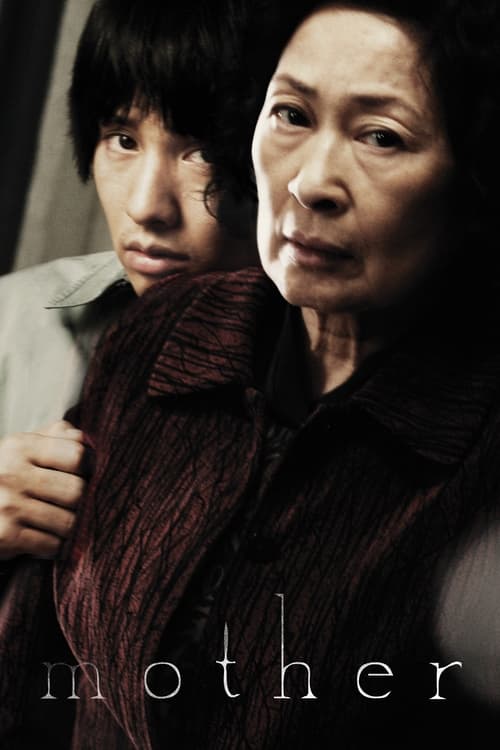
Mother
2009 · Bong Joon Ho
For when you're craving a smart, twisty crime story and you're willing to be unsettled rather than reassured. This is challenge viewing — gripping, but it doesn't let you off the hook.
What it's about
In a small Korean town, a widow scrapes by selling medicinal herbs and hovering over her adult son, a gentle, intellectually disabled young man she has protected his whole life. When a teenage girl is found murdered and he becomes the easy suspect, the police close the case fast — so the mother starts investigating herself, with no resources except an obsessive, bottomless devotion. The question of what that devotion is capable of becomes the real mystery.
The experience
A slow-coiling thriller that keeps tightening — darkly funny in flashes, then genuinely unnerving. It gets under your skin the way few crime films do, and the unease outlasts the runtime.
Performances
Kim Hye-ja, beloved in Korea for decades of warm maternal TV roles, weaponizes that image in a ferocious, unforgettable performance; Won Bin is quietly affecting as the son whose innocence everyone, including the audience, keeps trying to read.
The craft
Bong Joon Ho builds a murder investigation that doubles as a character study, staging small-town spaces and faces with meticulous, off-kilter framing that makes ordinary places feel wrong. The bookending images — including a dance sequence you won't shake — show a director in total control of tone.
Why it matters
Coming between The Host and Snowpiercer, it confirmed Bong as a master of genre subversion and remains, for many, his most concentrated film — a key entry in the Korean crime-thriller wave that reshaped world cinema.
Snapshot
Mother (마더) is Bong Joon Ho's most psychologically concentrated film: a crime thriller systematically dismantled from within. A nameless middle-aged woman — played by Kim Hye-ja, one of South Korean television's most beloved maternal figures — fights to exonerate her intellectually disabled son Do-joon (Won Bin) after he is accused of murdering a young village woman. Over the course of 128 minutes, the film strips the genre of every comfort it offers, revealing the investigation to be a container for something more disturbing: an inquiry into the nature of maternal love itself, and the lengths to which guilt, obsession, and self-deception can be dressed as devotion. Where Bong's previous films had channeled social critique through creature features and procedural thrillers, Mother channels it through melodrama — and through the face of an actress whose presence carries four decades of accumulated Korean domestic virtue, now turned inside out.
Industry & production
Mother was produced by Barunson with CJ Entertainment handling South Korean distribution. Following the enormous commercial success of The Host (2006), Bong operated with considerably greater creative latitude; the production budget was modest relative to The Host's scale, returning to the intimate, location-grounded approach of Memories of Murder (2003). Won Bin had been largely absent from cinema following mandatory military service and was known primarily as a romantic lead in popular Korean drama; casting him as a cognitively impaired young man carried deliberate cultural dissonance. Kim Hye-ja had built roughly four decades of work in Korean television, almost exclusively as the selfless, suffering mother of domestic drama. Bong selected her precisely because of this accumulated iconography, engineering the film's central irony from the audience's deep-seated affective associations with her image. The film had its international premiere at the Cannes Film Festival in May 2009 and was subsequently selected as South Korea's submission for the Academy Award for Best Foreign Language Film at the 83rd ceremony.
Technology
Mother was shot on 35mm film in the 2.35:1 anamorphic widescreen ratio, consistent with Bong's feature filmography to that point. The photochemical texture of the image — warm in daylight exteriors, cool and slightly desaturated in institutional interiors — is intrinsic to the film's atmosphere. A digital intermediate was employed in post-production for color grading, as had become standard in South Korean industry practice by the late 2000s. The grain and tonal depth of the 35mm negative are load-bearing aesthetic elements; the specific quality of diffused daylight in the film's rural exteriors would have been considerably more difficult to achieve with digital capture of the period. No unusual or experimental technology is recorded in production accounts — the film's ambitions were formal and performative rather than technological.
Technique
Cinematography
Cinematographer Hong Kyung-pyo — working here in an early collaboration with Bong that would later yield Snowpiercer and Parasite — builds the visual grammar around wide, composed frames that hold the mother at a slight formal distance even in close physical proximity. The opening and closing sequences, shot in a broad sun-scorched meadow, establish an aesthetic of estrangement: the widescreen frame contains the figure of the mother at a remove that makes her dancing both intimate and inexplicably alien. Hong's deep-focus work in interior spaces emphasizes the claustrophobia of the mother-son domestic world; rooms feel inhabited but airless, objects on counters and shelves pressing against the characters from every plane. Handheld camera is deployed selectively and with precise purpose, most strikingly during the film's nocturnal investigative sequences, where the instability of the image encodes the mother's precarious position within a world of male power and police indifference. A recurring compositional strategy places the mother in the lower register of the widescreen frame, the space above her occupied by the architecture of institutional authority — police stations, courtroom corridors, cramped bureaucratic hallways — that dwarfs and marginalizes her.
Editing
The editing rhythm is governed by accumulation rather than acceleration. Bong and editor Moon Sae-kyoung resist the pulse-quickening cutwork typical of genre thrillers, allowing scenes to breathe past the point of comfort — a strategy that makes sudden violence, when it arrives, feel genuinely shocking rather than anticipated. The film's most decisive formal choice is structural rather than granular: the opening dance sequence, presented without contextual grounding, is only fully legible in retrospect after the final scene. This circular architecture — the film's most deliberate rhyme structure — transforms the narrative into something approaching a closed system, where every action the mother takes has already, in some sense, been completed. The editing withholds rather than guides, trusting the accumulation of withheld information to produce a retrospective recontextualization that changes the meaning of everything that came before.
Mise-en-scène / staging
The unnamed village — a fictional rural community that functions as a compressed social world — is dressed with the specificity of observed life: herb shops, police stations that resemble municipal waiting rooms, junk-strewn back alleys. The staging frequently positions the mother as a figure of inadvertent comedy that shades imperceptibly into horror; her intrusions into spaces she has no business occupying carry the quality of farce until they do not. Bong choreographs bodies with attention to the social geometry of class and gender — Do-joon's friend Jin-tae (Ku Jin) inhabits rooms with the sprawled masculine authority that Do-joon, by virtue of his disability, is never granted. The film's most formally daring staging choice is the opening dance, in which Kim Hye-ja looks directly into the lens while moving alone in the field: a fourth-wall address that makes a demand of the audience that the film will spend its entire running time explicating.
Sound
Lee Byung-woo's score — his third consecutive collaboration with Bong, following Memories of Murder and The Host — is organized around a spare, keening string theme of unusual emotional ambiguity. It is the sound of grief compressed to something near blankness, surfacing at intervals that resist straightforward alignment with the emotional logic of individual scenes. The score does not comfort or confirm; it frames with a kind of cold sympathy. The film's sound design contrasts the ambient textures of institutional life (the white noise of a police station waiting area, televisions audible through thin walls) with the relative quiet of exterior spaces where the most important knowledge is either disclosed or suppressed. The rhythmic, quotidian sound of the mother grinding and preparing herbal medicines runs through the domestic sequences with documentary patience, anchoring the film in the material texture of her labor.
Performance
Kim Hye-ja's performance is the film's central technical achievement. She plays a character who is, in a precise clinical sense, in denial — her self-image as devoted and suffering mother is built on a suppressed act of violence against the very child she now protects — while never suggesting the performance is a performance of delusion. The characterization is inhabited rather than indicated: small physical habits (her particular handling of a pestle and mortar, the quality of her listening when she cannot afford to hear what is being said), a repertoire of facial registers that moves from tenderness to ferocity with the economy of a long-form actor's training. Won Bin performs cognitive impairment with a discipline that foregrounds the ethical complexity of such work: Do-joon is neither pitiable nor menacing in simple outline but suspended in an ambiguity — guileless, sometimes frightening, sometimes acutely aware of his surroundings — that makes him the film's structural enigma. Ku Jin as Jin-tae provides the film's most legibly genre-coded performance: the corrupt, charismatic hanger-on whose function is to give the mother a surrogate for the justice the police will not provide.
Narrative & dramatic mode
The film opens as a wrong-man thriller: an innocent man is charged; his protector sets out to prove it. The genre contract is honored, then voided. Investigation reveals not that Do-joon is innocent but that the crime is more complicated than any available account — and that the mother's determination to secure his exoneration involves silencing a witness, an act she subsequently suppresses by pressing an acupuncture needle into a specific point on her thigh that she says controls memory. The dramatic mode is consequently tragic in the classical sense: the protagonist's defining virtue — her love for her son — is also the mechanism of her complicity and moral ruin. The film withholds its most devastating revelation until near the end: the mother had once tried to kill herself and Do-joon by feeding them rat poison during a period of extreme poverty. Do-joon survived; whether this act left some cognitive damage is left unresolved. Her protectiveness is inseparable from guilt. The final image — the mother dancing on a bus excursion with other village women, having achieved a willed, chemical amnesia — is an ending from which all genre consolation has been surgically removed.
Genre & cycle
Mother sits at the intersection of three genre traditions: the crime procedural, the domestic melodrama, and the psychological thriller. Its immediate Korean context is the cycle of prestige genre films that emerged from the New Korean Cinema of the late 1990s and 2000s — work by Park Chan-wook, Lee Chang-dong, Kim Jee-woon, and Bong himself that used genre infrastructure to carry sociological and philosophical freight. Within Bong's own filmography, the film forms a loose informal trilogy with Memories of Murder (2003) in its concern with crime, institutional failure, and the violence latent within ordinary domestic life. It belongs to a specific Korean melodramatic tradition inflected by haan — the cultural concept of unresolved grief and resentment — while simultaneously functioning as a critique of the maternal archetype that tradition often celebrates uncritically. The genre is both the vehicle and the subject: the film is about what crime thrillers allow us to want and not see.
Authorship & method
Bong Joon Ho co-wrote the screenplay with Park Eun-kyo, who had collaborated with him on Memories of Murder. Bong's authorial signature is immediately identifiable: tonal oscillation between comedy and dread; the use of genre convention as social X-ray; the deliberate withholding of sympathy from characters who seem to demand it. His method involves extensive pre-visualization — he is known to produce detailed storyboards that function as negotiable blueprints rather than absolute constraints, creating room for collaboration and accident within a tightly pre-conceived structure. The collaboration with Hong Kyung-pyo, among their first major feature work together, established a visual language that would mature through Snowpiercer into the formal precision of Parasite: wide compositions, commitment to practical location photography, a preference for natural light supplemented rather than replaced by artificial sources. Lee Byung-woo's scoring practice, by the third film, demonstrates a shared aesthetic principle fully consolidated: music as structural commentary rather than emotional punctuation, the score functioning most powerfully when it resists the scene rather than supports it.
Movement / national cinema
Mother is a product of the New Korean Cinema, the critical and commercial renaissance that began in the late 1990s with liberalized censorship laws, the emergence of multiplex infrastructure, and a generation of directors educated in international film culture. The movement had no single aesthetic program but was characterized by formal ambition, genre fluency, and a willingness to engage with Korea's historical and contemporary traumas through oblique rather than declarative means. Mother engages with specifically contemporary Korean concerns: the treatment of cognitive disability by law enforcement and civil society; police indifference to crimes against poor and marginalized women; the class stratification that determines who receives legal representation and who is left to a public defender's inattention. The film's social critique is embedded in generic architecture rather than thematic declaration — the village exists as a realist social world first, a symbol second.
Era / period
The film was made and released in the period immediately following Korean genre cinema's global consolidation, marked domestically by The Host and internationally by Oldboy. By 2009, South Korean film occupied a recognized position in international festival programming; films from the peninsula appeared regularly at Cannes, Venice, and Berlin. Mother arrived at a moment of transition: Korean cinema's genre ambitions had been recognized globally, but the full international canonization represented by Parasite's Palme d'Or was still a decade away. The film reflects the period's relative freedom — a filmmaker could take a known property (the beloved television mother) and publicly dismantle it without institutional resistance, because Korean cinema's critical prestige had created enough space for that kind of structural provocation.
Themes
The film's central thematic inquiry concerns the dark underside of maternal love: how devotion, stripped of its social romance, becomes indistinguishable from possession, denial, and violence. The mother's protectiveness of Do-joon is genuine but pathological, built on a suppressed history that the film's structure slowly excavates. Alongside this runs an interrogation of how social systems fail those at the margins — the cognitively disabled, poor women, people without social capital or legal access. The acupuncture needle as literal memory management is both thematic and formally resonant: the film itself is about the administration of strategic amnesia, about what a society, a family, and a genre choose not to see. The victim, Moon Ah-jung — dismissed by villagers with a cruel nickname and treated by the narrative as a problem to be solved rather than a life to be mourned — carries a secondary feminist charge that the film handles with restraint; her marginalization mirrors and enables the mother's.
Reception, canon & influence
Mother received near-universal critical acclaim upon festival premiere and Korean release. Kim Hye-ja won the Blue Dragon Film Award for Best Actress; the film received multiple Grand Bell Award nominations. International critics — including those writing for Variety, The Guardian, and Film Comment — identified it as a formal and emotional advance on Bong's earlier work, his most controlled and penetrating film to that point. It placed highly in numerous year-end critical lists for 2009 and entered serious discussion as one of the defining South Korean films of the decade.
Influences on the film (backward): The wrong-man thriller architecture derives most directly from Hitchcock, whose structural influence on Bong is documented and frequently acknowledged in interviews — The Wrong Man (1956) and Frenzy (1972) are the closest generic antecedents. The tradition of the maternal figure as bearer of haan in Korean literature and drama is both invoked and ironic ally subverted. Roman Polanski's Chinatown (1974) exerts pressure — particularly in the film's resistance to the consolation of revealed truth and its insistence on the systemic continuity of injustice. The film's engagement with the casting of Kim Hye-ja is in explicit dialogue with Korean television melodrama of the 1980s and 1990s: Bong is working with and against a specific cultural text that most international viewers could not fully read.
Legacy (forward): Mother was instrumental in establishing Bong Joon Ho as a director of the first rank in global critical discourse — not merely a commercially adept genre craftsman but a filmmaker of serious analytical ambition. Its international reception opened the path to the co-production architecture of Snowpiercer (2013) and ultimately to the conditions under which Parasite could be made and received as it was. Within Korean cinema, the film's treatment of cognitive disability, legal vulnerability, and class indifference influenced subsequent crime dramas engaging similar terrain, most notably The Attorney (2013). The opening and closing dance sequences — their fourth-wall address, their formal circularity, their retroactive transformation of meaning — became among the most analyzed images in Korean cinema scholarship of the period, cited in discussions of the female body, spectatorship, and the ethics of the maternal gaze. Kim Hye-ja's performance remains a benchmark in discussions of screen acting within Korean critical and academic contexts, a sustained demonstration of how deeply a culturally legible persona can be used against itself.
A Deleuzian reading
She is alone in a field of dry grass, and she begins to dance.
The full Deleuzian reading of Mother →
Reception
A Cannes (Un Certain Regard) hit in 2009 that was warmly received but overshadowed by Bong's splashier work — then Parasite's 2019 sweep sent a wave of viewers back to it, and it's now routinely held up as maybe his most quietly devastating film.
How Mother was received, from release to now →
Influences: the films it descends from and the films it influenced
- The Wrong Man (1956) — Procedural entrapment of a socially vulnerable innocent establishes the narrative architecture Bong inverts — where Hitchcock maintains dramatic irony by keeping the audience informed of truth, Bong withholds it, making the viewer complicit in the Mother's deception until the retroactive reveal.
- Vertigo (1958) — Mid-film revelation that retroactively transforms every preceding scene's emotional and ethical meaning is the structural mechanics Mother's circular bookend sequences deploy: the viewer returns to the opening dance having been made to misread it.
- Frenzy (1972) — Class position determining legal credibility regardless of evidence — the respectable man believed over the disreputable one — supplies the social logic Mother applies to rural Korean hierarchy, where cognitive disability and poverty make a man structurally unbelievable to the state.
- Chinatown (1974) — Investigation that terminates not in restored justice but in deeper complicity — the detective's logic leads into a corruption that perpetuates itself — is the structural template for Mother's refusal of genre consolation, where solving the crime reveals the solution as catastrophe.
- Mildred Pierce (1945) — The melodrama architecture in which a mother's sacrificial overprotection generates the conditions for crime and moral catastrophe is the template Mother inherits and radicalizes: where Mildred enables the monster, the Mother is the monster, the complicity structural rather than inadvertent.
- Peppermint Candy (2000) — Circular temporal structure — the film returns to its opening image having retroactively transformed its meaning through the intervening reverse-chronological narrative — is the formal device Mother's bookend dance sequences precisely replicate, using spatial return to encode moral inversion.
- Oasis (2002) — Establishes within Korean social realism the performance and representational framework for cognitive difference that refuses both sentimentality and redemptive arc — the son's intellectual disability in Mother draws on this precedent for portraying limitation without condescension.
- Secret Sunshine (2007) — Lee Byung-woo scored both films; his practice of score-as-structural-irony — the music's emotional register deliberately countering rather than supporting the scene's surface affect — reaches comparable formalization here, two years before Mother consolidates the method.
- Memories of Murder (2003) — Co-written by Park Eun-kyo in both films; the grammar of rural Korean crime investigation as social exposure — bureaucratic failure and class indifference as the real subject of a murder case — was fully established here, with Bong's tonal oscillation between comedy and dread consolidated.
- Save the Green Planet! (2003) — Hong Kyung-pyo photographs another maternal-melodrama register deployed as a weapon — the sincere, unironic mother-and-damaged-son material shot with full melodramatic warmth so that its later collapse into complicity lands as betrayal rather than irony.
- Parasite (2019) — Cinematographer Hong Kyung-pyo — in their first major feature collaboration with Bong on Mother — carries the visual grammar to formal apex here: compositional marginalization of figures at frame edges to spatialize class position, and wide practical-light interiors, reach their most precisely engineered expression.
- Snowpiercer (2013) — Bong's pre-visualization storyboard method — a negotiable blueprint practice consolidated through Mother — governs Snowpiercer's strict spatial narrative logic; and the genre-as-social-X-ray principle, where genre conventions function as class analysis, extends Mother's crime-melodrama method into science-fiction allegory.
- The Attorney (2013) — Mother's treatment of legal vulnerability as class function — the judicial apparatus preserving social order rather than the individual — directly informs this film's crime procedural structure, which engages state persecution and the criminalization of poverty within the same New Korean Cinema ethical and formal register.
- Aasha (2026) — Hands an entire escalation thriller to a senior actress and keeps the camera on the ageing face while the plot happens at its edges; the performance, not the reveal, is the suspense mechanism.
- Poetry (2010) — Lee Byung-woo composed both scores in the same structural mode; both films center an older Korean woman bearing impossible ethical weight — complicity, haan, social erasure — with the score amplifying rather than resolving the moral impasse the narrative refuses to close.
- A Separation (2011) — Melodrama-crime hybrid where a parent's protective action generates criminal liability and narrative truth is permanently withheld from viewer and characters alike — the structural parallel to Mother is precise, both films using crime-genre conventions to expose the catastrophe of protective love while refusing consolation.
- Burning (2018) — Wide compositions deploying negative space as a register of social and cognitive uncertainty, paired with crime-genre conventions that promise resolution while permanently withholding it — the same formal strategy Mother uses to implicate the viewer in retrospective recontextualization of what they believed they understood.
Similar films
- Memories of Murder (2003) — influence & lineage · same viewing thread
- Parasite (2019) — influence & lineage · same viewing thread
- Poetry (2010) — influence & lineage
- Burning (2018) — influence & lineage
- The Host (2006) — same viewing thread
- Memoir of a Murderer (2017) — same viewing thread
- A Tale of Two Sisters (2003) — same viewing thread
- Joint Security Area (2000) — same viewing thread
All the films related to Mother →
Watch it with: curated runs of related films
- New Korean Cinema — Watch these in a run and you feel one national cinema flip between monster movie, revenge thriller, gothic horror, and slow-burn procedural without ever loosening its grip on class, history, and family.