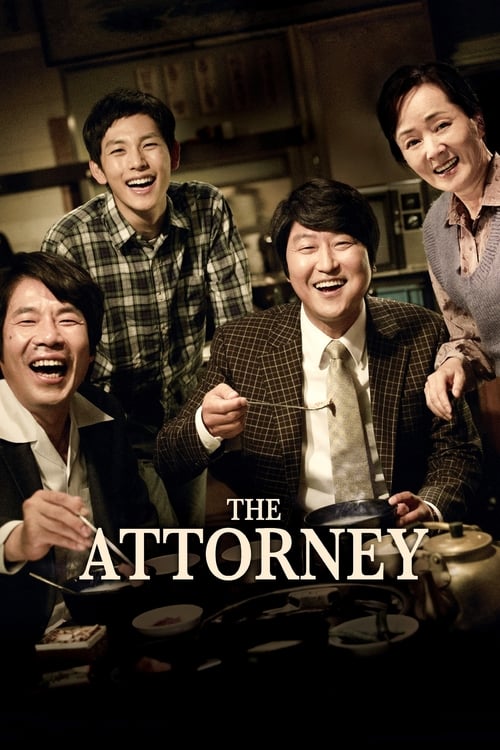
The Attorney
2013 · Yang Woo-seok
For when you want to feel righteous — an underdog-versus-the-system story to watch when you need a film to restore your fight. Crowd-pleasing in shape but with real historical weight behind the punches.
What it's about
In early-1980s Busan, Song Woo-seok is a self-made tax lawyer with a booming practice and zero interest in politics. Then the son of a woman who once fed him on credit is arrested and tortured under South Korea's authoritarian regime, accused of communist sympathies for joining a student book club. Song takes the case, and the courtroom becomes the front line of a fight over what the law is actually for.
The experience
It starts warm and almost comic — a scrappy underdog hustling his way up — then shifts gears into furious, rousing courtroom drama. By the final stretch you're leaning forward; it's the kind of film that makes your blood rise and your eyes sting in the same scene.
Performances
Song Kang-ho carries the whole film, turning a status-anxious hustler into a moral force so gradually you barely see the seams — his courtroom outbursts land because he's spent an hour earning them.
The craft
The screenplay's smartest move is spending real time on Song's ordinary life — money, family, small vanities — so his transformation costs something. The courtroom scenes are staged for maximum confrontation, and the period recreation of 1980s Busan grounds the outrage in a specific, lived-in place.
Why it matters
One of the defining Korean films of its decade — a massive box-office hit that put the country's democratization struggle back at the center of public conversation, drawn from the early career of a lawyer who later became South Korea's president.
Snapshot
The Attorney (변호인, Byeonhoin) is a South Korean legal and historical drama that became one of the defining commercial and political films of its decade in Korea. It dramatizes the awakening of Song Woo-seok (Song Kang-ho), a self-made commercial lawyer in early-1980s Busan who has built a lucrative practice on tax and real-estate work and who has, by his own contented admission, no interest in politics — until the son of a woman who once fed him on credit is arrested, detained, and tortured under the National Security Law, accused of being a communist sympathizer for belonging to a student reading group. Taking the case almost reluctantly, Song is transformed from a comfortable, status-anxious striver into a fierce courtroom advocate for the democratic rights of the accused, and the film charts that conversion as both a personal moral reckoning and an indictment of the authoritarian machinery of the Fifth Republic under Chun Doo-hwan. The character is widely understood to be modeled on the early career of Roh Moo-hyun, the human-rights lawyer who would become President of South Korea (2003–2008) and whose 2009 death lent the film, on its December 2013 release, an extraordinary emotional and political charge. A debut feature for director Yang Woo-seok, it drew more than eleven million admissions, ranking among the most-watched Korean films ever made, and won Song Kang-ho a sweep of domestic Best Actor honors.
Industry & production
The Attorney arrived at a moment when the South Korean film industry, fully consolidated after the post-1990s renaissance, had developed both the commercial muscle and the political confidence to make large-scale popular dramas out of the traumatic recent history of military rule. The picture was produced by Withus Film and distributed by Next Entertainment World (NEW), the aggressive young distributor that in the same period was reshaping the Korean theatrical market and that had a remarkable run of hits in 2013. The production was mounted on a mainstream commercial scale — period reconstruction of 1980s Busan, a large supporting ensemble, sustained courtroom sequences — but its budget was modest by tentpole standards, and its returns were spectacular: the film crossed the eleven-million-admission threshold within weeks, a figure that places it in the very top tier of Korean box-office history.
The decisive production fact is the casting of Song Kang-ho. By 2013 Song was arguably the most bankable and critically respected leading man in Korea, the face of Memories of Murder, The Host, Thirst, and Snowpiercer; his attachment signaled seriousness and guaranteed an audience. That a debuting director secured him is itself notable, and the film functions in large part as a vehicle for Song's particular gift for playing ordinary, slightly comic men who grow into moral weight. Around him the production assembled a strong character ensemble — Kim Young-ae as Choi Soon-ae, the gukbap-restaurant owner whose son is arrested; Im Si-wan, then a young idol-actor, as the student Jin-woo; and reliable supporting players including Oh Dal-su and Kwak Do-won — casting that balanced star power with the texture of a recognizable Busan working-class world.
Yang Woo-seok came to the project from outside the conventional film-school and assistant-director pipeline: he had been a webtoon artist and writer before directing, and The Attorney was his first feature. The screenplay, which Yang developed, frames a "based on a true story" account while declining to name Roh Moo-hyun directly — a discretion that is partly legal caution and partly a deliberate generalizing of the story into a fable of conscience. Detailed English-language documentation of the below-the-line crew is comparatively thin, and where the record does not clearly support an attribution this dossier declines to supply one.
Technology
The Attorney is a conventionally produced digital-era commercial feature, and it makes no claim to technological innovation; its resources are spent on period reconstruction and performance rather than on any formal or technical novelty. By 2013 mainstream Korean production had largely moved to high-end digital capture, and the film's clean, controlled images are consistent with that norm. Its real "technology" is the apparatus of historical reconstruction: the dressing of streets, interiors, courtrooms, and a working-class eatery to evoke Busan circa 1981, and the costuming and styling that situate Song's rising lawyer within the consumer textures of the early Chun years. The record offers no indication of unusual technical means, and it would be invention to claim otherwise.
Technique
Cinematography
The cinematography serves a classical, legible dramatic style rather than an overtly authored visual signature. The film distinguishes its worlds tonally: the early sequences of Song's domestic and professional rise carry a warm, almost comic brightness, the light of a man enjoying his success, while the interrogation and detention scenes turn cold, confined, and shadowed, and the courtroom is staged with the frontal, hard clarity appropriate to a drama of argument and confrontation. The camera generally stays close to Song Kang-ho's face, trusting the actor to carry the film's emotional information, and reserves its more emphatic movements and compositions for the rhetorical peaks of the trial. The visual scheme is built to support meaning and feeling, not to call attention to itself.
Editing
The film's structure is essentially bipartite, and the editing manages a pronounced tonal shift across it. The long first movement is leisurely, even genial, accumulating the comedy and pathos of Song's self-made ascent — his commercial-law hustle, his thin-skinned pride before condescending elites, his bond with the restaurant family — so that the audience is fully invested in his comfortable life before that life is disrupted. The second movement tightens into the procedural rhythm of detention, investigation, and trial, the cutting growing more insistent as the courtroom sequences build toward their oratorical climaxes. The editing's strategy is one of deferred ignition: it spends real screen time establishing an apolitical man's contentment precisely so that his radicalization registers as a costly, hard-won turn rather than a foregone conclusion.
Mise-en-scène / staging
The staging maps a clear social geography. The gukbap restaurant — the humble eatery where the young Song once ate without paying and to which he returns in prosperity — anchors the film's emotional and class world, a space of warmth, debt, and obligation. Against it stand the offices and social settings of Song's professional rise, and then the brutal, enclosed spaces of state power: the interrogation room where torture is administered, the cells, and finally the courtroom. That courtroom is the film's central stage, blocked as an arena of unequal combat in which a lone advocate faces the assembled weight of the prosecution, the bench, and the security apparatus. Period production design fills these spaces with the material detail of early-1980s Korea, and the costuming tracks Song's trajectory from striver to advocate, the prosperous lawyer's wardrobe giving way to the embattled posture of a man who has put everything at risk.
Sound
The score works in the broadly emotive register of mainstream Korean drama, swelling beneath the courtroom set-pieces and the moments of moral recognition, and is calibrated to amplify the film's appeals to feeling and outrage. (English-language sources do not consistently document the composer, and this dossier will not attribute the music to a named figure absent reliable confirmation.) More striking than the music is the film's use of the human voice: the trial is built around speech — testimony, cross-examination, and above all Song's rising oratory — and the climactic courtroom declamations, delivered in the rhythms of impassioned legal argument, are the film's true sonic centerpiece. The contrast between the muffled, off-screen brutality of the interrogation scenes and the public, ringing articulacy of the courtroom is part of the film's design.
Performance
Performance is the film's foundation, and Song Kang-ho's central turn is among the most celebrated of his career. He builds Song Woo-seok from the ground up as a recognizable type — proud, slightly buffoonish, defensive about his lack of pedigree, delighted by his own success — and then tracks, in fine gradations, the man's transformation under moral pressure into an advocate of conviction. The performance's power lies in its refusal to make the hero a saint from the outset: the audience watches an ordinary, self-interested man discover his own conscience, and Song modulates between comedy and gravity, between bluster and genuine fear, without a false step. The supporting playing reinforces the film's emotional architecture: Kim Young-ae's Soon-ae embodies the maternal, working-class stakes of the case, and Im Si-wan's portrayal of the tortured student supplies the raw fact of state cruelty that galvanizes Song. The Best Actor awards that followed were a recognition of a performance that carries the entire moral weight of the film.
Narrative & dramatic mode
The Attorney operates in the mode of the conversion narrative fused with the courtroom drama. Its dramatic engine is moral transformation: the spectacle of an apolitical, self-satisfied man forced by a concrete injustice — done to people he knows and loves — to become the thing he had no wish to be, a defender of democratic rights against the state. The first half is structured as a comedy of ascent and the second as a drama of trial, and the film's effectiveness depends on the hinge between them. As courtroom drama it deploys the familiar and reliable machinery of the genre — the lone advocate, the rigged proceeding, the suppressed evidence, the climactic speech — but it bends those conventions toward a specifically political end: the trial is not merely about the guilt or innocence of the accused but about the legitimacy of an authoritarian order that manufactures enemies of the state out of students reading books. The mode is frankly emotional and rhetorical, designed to move a mass audience to outrage and to identification, and it does not pretend to documentary neutrality; it is melodrama in the serious sense, a drama of conscience and recognition.
Genre & cycle
The film belongs to the courtroom and legal-drama genre, but its more important affiliation is with a distinct cycle of South Korean popular cinema that revisits the trauma of the dictatorship years and the long struggle for democratization. This cycle — which includes films treating the Gwangju uprising, the broader resistance to the Park and Chun regimes, and the abuses of the security state — uses mainstream genre form to perform a kind of public memory work, dramatizing recent history for a mass audience in ways that carry clear contemporary political resonance. The Attorney sits at the commercially successful center of this tendency, and it is frequently paired with later entries such as A Taxi Driver (2017), which likewise stars Song Kang-ho and likewise turns an ordinary, apolitical man's eyewitness encounter with state violence into a story of moral awakening. Within the cycle, The Attorney is the legal-system variant: its battleground is the court rather than the street, and its weapon is constitutional argument rather than protest.
Authorship & method
The Attorney is best understood as the meeting of a first-time director's conviction with a great actor's authority. Yang Woo-seok, working from his own screenplay and from a background outside conventional filmmaking, approaches the material with the directness of a storyteller more interested in moral clarity and emotional force than in formal experiment; the film's method is one of patient setup and emphatic payoff, building audience investment in an ordinary life before detonating it. The decision to base the protagonist on Roh Moo-hyun while declining to name him is itself an authorial strategy, generalizing a specific historical figure into an exemplary figure of conscience and thereby broadening the film's appeal and its claim to representative truth.
The film's authorship is, however, inseparable from Song Kang-ho, whose performance functions as a kind of co-authorship: the character's blend of comedy, pride, fear, and hard-won principle is so completely realized in Song's playing that the role becomes the film's organizing intelligence. Among the other collaborators, the supporting ensemble — Kim Young-ae and Im Si-wan in particular — supplies the human stakes that justify the hero's transformation. English-language documentation of the key technical collaborators (cinematographer, editor, composer) is comparatively limited, and this dossier deliberately refrains from attributing those roles to named individuals it cannot reliably confirm; the central creative fact of the film, in any case, is the partnership of director and star.
Movement / national cinema
The film is a product of mature contemporary South Korean commercial cinema — the industry that, after its 1990s–2000s renaissance, combined sophisticated craft with broad popular reach and an unusual willingness to engage national history and politics head-on. It exemplifies a defining feature of that national cinema: the capacity to make hugely popular entertainment out of difficult, recent, and contested history, and to do so in a register that is both emotionally accessible and politically pointed. The film's roots in the specific locality of Busan, its working-class textures, and its engagement with the democratization struggle place it within a national-cinematic tradition that treats the cinema as a site of collective memory and public argument. It also belongs to the remarkable run of commercially dominant Korean films of 2013, a year that demonstrated the strength of the domestic industry against imported competition.
Era / period
The Attorney is set with deliberate precision in the early 1980s, during the Fifth Republic established by Chun Doo-hwan after the 1979 coup and the 1980 suppression of the Gwangju uprising — a period of intensified authoritarian control, pervasive use of the National Security Law, and the routine fabrication of "communist" conspiracies to justify the detention and torture of students and dissidents. The central case dramatized in the film corresponds to the Burim incident, a 1981 Busan affair in which members of a book-reading study group were arrested and abused as supposed subversives, and which the historical Roh Moo-hyun took up as defense counsel — the case that, by most accounts, turned him from a commercial lawyer into a human-rights and labor advocate. The film's reconstruction of this milieu — the security apparatus, the compliant courts, the climate of fear, and equally the rising prosperity of a developmental-state economy that allowed a man like Song to grow rich — captures a specific, fraught moment in modern Korean history. Made in 2013, only four years after Roh Moo-hyun's death in 2009, the film also belongs unmistakably to its own moment of release, when its portrait of an earlier authoritarianism carried sharp implications for contemporary South Korean politics.
Themes
The film's governing theme is the awakening of conscience — the proposition that political and moral responsibility can fall upon, and be embraced by, the most ordinary and self-interested of people. Around this center turn several linked concerns. There is the theme of the rule of law and its perversion: the film insists, through Song's courtroom arguments, that the state derives its legitimacy from its citizens and their constitutional rights, and it stages the trial as a contest between that principle and a regime that treats the law as an instrument of repression. There is the theme of class and self-making: Song is a high-school-educated, self-built man, proud and prickly about his origins, and the film ties his moral growth to the working-class world — the restaurant, the mother, the student — that formed and fed him. There is the theme of state violence and its victims, embodied in the tortured student and made the concrete, unbearable fact that converts the hero. And, surrounding all of it, there is the theme of historical memory: the film is an act of public remembrance, asking a mass contemporary audience to confront what was done in the recent national past and to recognize the cost paid by those who resisted it.
Reception, canon & influence
The Attorney was an enormous popular success on its December 2013 release, drawing more than eleven million admissions and ranking among the most-watched Korean films in history to that point. Critical and awards recognition centered, predictably and deservedly, on Song Kang-ho, who took the major domestic Best Actor honors of the season; the film and its director also figured prominently in the year's award conversations, a striking achievement for a first feature. The reception was inseparable from the film's politics: audiences and commentators read it explicitly in relation to Roh Moo-hyun's legacy and to the political climate of the early 2010s, and the picture became a touchstone in public debate, embraced and contested along the lines of South Korea's larger ideological divisions.
Influences on the film run backward to the long tradition of the courtroom drama and the conversion narrative, and, more specifically, to the documented historical record of the Burim incident and Roh Moo-hyun's career as a human-rights lawyer, which supply the film's events and its central figure. It also draws on the established conventions of Korean popular historical drama, with its fusion of melodramatic emotion and political seriousness.
Its influence forward is most visible in the consolidation and continuation of the cycle of mainstream Korean films about the dictatorship and the democratization struggle. The film helped demonstrate, on a spectacular commercial scale, that recent political history could be made into top-tier popular entertainment, and it stands as a clear forerunner to later hits in the same vein — most directly A Taxi Driver (2017), which reunites the figure of Song Kang-ho's ordinary man with another story of awakening to state violence. For Song Kang-ho, the role added another landmark to a career already central to modern Korean cinema. More broadly, The Attorney secured a durable place as a model of the politically engaged Korean blockbuster: proof that a film can be at once a mass-market success, an act of historical memory, and an argument about the meaning of citizenship and the rule of law.
A Deleuzian reading
The bowl of soup comes first.
The full Deleuzian reading of The Attorney →
Reception
A phenomenon on release — over 11 million admissions made it one of Korea's biggest hits ever — but politically radioactive, cheered by liberals and attacked by conservatives as hagiography of Roh Moo-hyun. A decade on it's settled into the canon of the Korean political-drama wave, its stature only growing after the real-life case it dramatized ended in acquittals.
How The Attorney was received, from release to now →
Influences: the films it descends from and the films it influenced
- To Kill a Mockingbird (1962) — Establishes the template of the closing-argument oration as a film's moral and structural climax — a principled attorney's sustained courtroom speech defending the powerless against communal prejudice, the same oratory-centerpiece design The Attorney builds toward.
- 12 Angry Men (1957) — Demonstrates the legal arena as pure dramatic engine, where rhetoric and the patient dismantling of a fabricated case reverse a foregone verdict in real time — the courtroom-as-pressure-cooker staging The Attorney adopts for its torture-trial reversal.
- A Man for All Seasons (1966) — Models the conscience-bound man tried by the state, articulating the rule of law against raw power within a juridical frame — the exact moral architecture of the lawyer who turns the trial into an argument about citizenship.
- JFK (1991) — Stages the climactic courtroom oration as a mobilization of historical-political argument into emotional crescendo, and pioneers the docudrama built around a real figure refashioned into an exemplary moral spokesman.
- Peppermint Candy (1999) — Renders Fifth Republic state torture and the era's moral wounding through a single man's trajectory, supplying the cinematic vocabulary for the Burim-incident brutality that ignites The Attorney's second half.
- Memories of Murder (2003) — Fixes the Song Kang-ho persona — the comic, prideful everyman colliding with the indifferent and brutal apparatus of the 1980s authoritarian state — and the tonal-contrast slide from comedy toward horror that The Attorney reuses.
- Silmido (2003) — Proved on a blockbuster scale that recent traumatic state history could be top-tier popular entertainment, founding the commercial model of the mainstream political-history film The Attorney consolidates.
- Taegukgi: The Brotherhood of War (2004) — Sets the Korean historical-blockbuster grammar of fusing large-scale melodramatic emotion with national-political seriousness, the melodrama-plus-history compound at the heart of The Attorney's mass appeal.
- Silenced (2011) — Builds a social-issue courtroom drama on deferred ignition — patient setup of injustice before trial scenes indict institutional power — the same delayed-detonation structure and protest-film politics.
- Mother (2009) — Mother's treatment of legal vulnerability as class function — the judicial apparatus preserving social order rather than the individual — directly informs this film's crime procedural structure, which engages state persecution and the criminalization of poverty within the same New Korean Cinema ethical and formal register.
- A Taxi Driver (2017) — Directly reunites Song Kang-ho's apolitical everyman with a story of awakening to state violence (Gwangju), extending The Attorney's conversion-narrative arc and its blockbuster-scale historical memory-work.
- 1987: When the Day Comes (2017) — Carries the politically-engaged Korean blockbuster forward into an ensemble democratization epic where ordinary individuals ignite collective resistance, the cycle The Attorney's commercial success helped license.
- Ode to My Father (2014) — Routes modern Korean political history through one ordinary life with emphatic melodramatic payoff, applying the same melodrama-as-historical-memory engine to mass audiences.
- Default (2018) — Recasts recent national trauma (the IMF crisis) as mainstream entertainment carrying a populist political argument, inheriting The Attorney's proof that contested recent history sells as top-tier cinema.
- New Trial (2017) — Centers a crusading lawyer dismantling a state-coerced wrongful conviction through courtroom combat, extending the principled-attorney-versus-fabricated-case structure directly downstream of The Attorney.
- Steel Rain (2017) — Yang's own debut established his core authorial template — the conscientious individual confronting an unjust state apparatus through classical continuity editing that privileges emotional legibility over formal experimentation — which Steel Rain transposes wholesale onto the inter-Korean division scenario.
- The President's Barber (2004) — Casts Song Kang-ho as an apolitical ordinary man swept into dictatorship-era state violence and torture, an awakening-of-conscience everyman arc that directly rehearses his role here.
- The Host (2006) — Pairs Song Kang-ho's bumbling everyman against a coercive, incompetent state in the comedy-to-pathos register, the same performer-driven tonal modulation The Attorney deploys around its hero.
- The Man Standing Next (2020) — Korean institutional-naturalism drama set during the same Park/Chun authoritarian period: ensemble procedural performance in bureaucratic settings, the protagonist as system-embedded functionary drawn into moral definition through institutional crisis rather than personal heroism.
Similar films
- A Taxi Driver (2017) — influence & lineage
- Silenced (2011) — influence & lineage
- Memories of Murder (2003) — influence & lineage
- Tae Guk Gi: The Brotherhood of War (2004) — influence & lineage
- The Host (2006) — influence & lineage
- 12.12: The Day (2023) — shared sensibility
- Miracle in Cell No. 7 (2013) — shared sensibility
- The Man Standing Next (2020) — shared sensibility