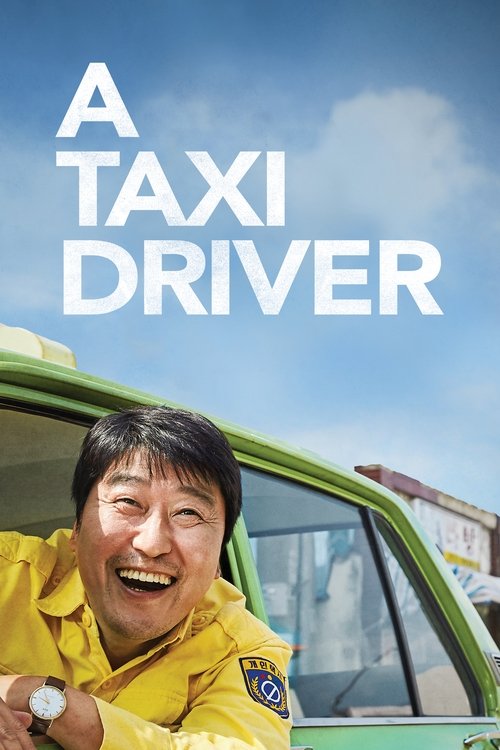
A Taxi Driver
2017 · Jang Hoon
When you want a big, emotional true-story drama — one that entertains like a mainstream crowd-pleaser and then hits you with real history. Bring tissues.
What it's about
Seoul, May 1980. A broke cabbie raising his young daughter alone grabs an unusually fat fare: drive a foreigner down to the southern city of Gwangju and back before curfew. His passenger turns out to be a German TV journalist, and the city they roll into is under a military crackdown the rest of the country isn't being told about.
The experience
It starts as a breezy odd-couple road comedy and shifts, almost without your noticing, into something urgent and devastating. Expect to laugh early, grip your seat in the middle, and come out wrecked.
Performances
Song Kang-ho is the whole engine: a money-minded everyman whose face registers each stage of comprehension and conscience — one of Korea's greatest actors doing signature work.
The craft
Jang Hoon rebuilds 1980 at immersive scale — streets, uniforms, crowds — and balances tones that shouldn't coexist: comedy, thriller tension, and grief. The large-scale street scenes and chases reward a big screen.
Why it matters
A phenomenon in South Korea with roughly 12 million admissions, it landed at a charged political moment and became part of how the country remembers the Gwangju uprising and its own path to democracy.
Snapshot
A Taxi Driver (택시운전사) is a South Korean historical drama in which an apolitical Seoul cabdriver named Kim Man-seob ferries a German television journalist named Jürgen Hinzpeter into Gwangju during the military crackdown of May 1980, unwittingly becoming a witness to one of the defining atrocities in modern Korean history. The film triangulates three perspectives — the mercenary taxi driver, the committed foreign journalist, and the Gwangju citizens themselves — to reconstruct an event that the South Korean state suppressed for years. Released on 2 August 2017 amid a charged political atmosphere following the impeachment of President Park Geun-hye, the film became a cultural and commercial phenomenon, drawing approximately 12 million admissions in South Korea and entering the conversation about how democratic memory is built and maintained through popular cinema.
Industry & production
The film was produced by The Lamp, the mid-size production company that had worked with Jang Hoon on earlier projects, and distributed by ShowBox. Development centered on the story of the real Jürgen Hinzpeter — a West German ARD correspondent who had filmed the Gwangju massacre clandestinely and carried the footage out of the country, providing the world with some of its only visual evidence of the military's actions. Hinzpeter had publicly searched for his taxi driver for decades without success; the man he knew only as Kim Sa-bok died before the film was completed and before his identity was confirmed to Hinzpeter, who himself passed away in January 2016, roughly a year before the picture's release. The narrative of lost witnesses reuniting — a reunion that history denied — became part of the film's emotional architecture.
The production secured Song Kang-ho, at that point already an internationally recognized figure through collaborations with Bong Joon-ho and Park Chan-wook, as Man-seob. Thomas Kretschmann, the German actor best known internationally for his role in Roman Polański's The Pianist (2002), was cast as Hinzpeter, lending the production a measure of transnational credibility. Kretschmann prepared for the role with research into Hinzpeter's filmed interviews and public record; the extent of his access to materials beyond those is not precisely documented in the public record. The script, credited to Eom Yu-na, shaped a film that needed to balance the historical obligation of proximity to real events with the demands of mainstream genre filmmaking — a tension that defines the work from its opening scenes.
The political timing of the release was not incidental. South Korea's Candlelight Revolution had swept Park Geun-hye from power in 2016–17; public appetite for films interrogating the authoritarian legacy of Chun Doo-hwan, and by extension the entire military-era political order, was intense. A Taxi Driver arrived in this climate alongside 1987: When the Day Comes (dir. Jang Joon-hwan, also 2017) as part of a concentrated cycle of pro-democracy historical films that reflected, and amplified, a national reckoning.
Technology
The film was shot digitally, consistent with mainstream Korean commercial production by 2017, which had largely moved away from celluloid for this budget tier. The digital format afforded flexibility in the Gwangju exteriors and the extended night and interior sequences depicting the crackdown. Period accuracy required substantial production design effort: the film is set in 1980, and locating or constructing environments that credibly evoke late-Park/early-Chun-era Seoul and Gwangju — the taxi interiors, the street layouts, the military hardware, civilian dress — demanded both archival research and practical reconstruction. Specific details about the digital format (sensor, camera model) and any particular post-production pipeline choices are not well-documented in the available public record.
Technique
Cinematography
Cinematography is credited to Ko Nak-seon. The visual strategy operates in two distinct registers that mirror the film's tonal arc. The Seoul-set opening reels are relatively bright and crowded in their palette — the city's bustle rendered with an almost screwball texture suited to Man-seob's hustling, comic mode. As the taxi moves south toward Gwangju and the political reality sharpens, the visual temperature cools, contrast tightens, and compositions begin to incorporate the geometry of military cordons, barricades, and bodies in public space. Ko's framing during the crackdown sequences tends toward a documentary adjacency: handheld approaches, compressed focal lengths during crowd chaos, close framings that deny the viewer any reassuring wide overview. The film does not attempt the severely desaturated look of war photography but keeps enough color naturalism to maintain the tension between ordinary life and political violence.
The sequence in which Man-seob drives back toward Gwangju after initially fleeing — one of the film's moral pivots — is rendered as a solitary drive through early morning light, the landscape quiet and indifferent, the visual emptiness emphasizing the weight of his choice. This is one of the film's more formally deliberate passages, using geography as psychological space in a way characteristic of the Korean road-movie tradition.
Editing
The editing navigates the considerable tonal range the film requires, moving between the near-farcical energy of Man-seob's early scenes, the procedural tension of Hinzpeter's clandestine filming operation, and the extended action-drama sequences of the military assault and the taxi's flight. The pacing loosens noticeably during the film's middle sections in Gwangju, where the film allows itself extended time with the local characters — the student activists, the garage owner Hwang Tae-sul, the younger driver Ki-joon — building an investment in individual lives that makes the violence to come legible as catastrophe rather than spectacle. Specific editorial credits and the degree to which Jang Hoon's own earlier cutting background (he began his career as an editor's assistant in the industry) shaped the work on set are not precisely documented in available English-language scholarship.
Mise-en-scène / staging
Jang Hoon's staging reflects a director most comfortable in what might be called the commercial-realist mode: the spatial logic is always clear, performances are grounded in behavioral specificity rather than stylized affect, and the film earns its set-pieces through character investment rather than spectacle for its own sake. The staged chaos of the military assault on civilian demonstrators — soldiers beating unarmed people in public squares, vehicles moving against crowds — is filmed with enough disorientation to register as horror without tipping into the kind of visceral exploitation that would make the history illegible. Jang trusts Song Kang-ho's face to do considerable narrative work in scenes that in other hands might have required more explicit verbal exposition.
The car interior is a persistent site of staging throughout the film. Much of the drama unfolds in the cramped space between driver and passenger, a space that registers the growing understanding between Man-seob and Hinzpeter as well as their persistent cultural and linguistic distance. The cab — a 1970s-era Hyundai Pony, or a period-appropriate approximation — functions almost as a confined dramatic stage in the theatrical sense, a pressure vessel for the film's central relationship.
Sound
The sound design oscillates between immersive period texture — the acoustic signature of a 1980 Korean city, the radio broadcasts of state media delivering falsified reports — and the sudden percussion of military intervention. State radio is used particularly effectively as an ironic device: the calm official voice describing normalcy counterpointed against images of violence situates the film within the broader question of how the state controls information and therefore controls history. The score (composed by Jo Yeong-wook, who has worked across a significant range of Korean commercial and arthouse productions) follows the film's tonal structure, more restrained in its dramatic underlining than the Korean historical drama register sometimes produces, though certain emotional payoffs in the final act are given explicit musical support.
Performance
Song Kang-ho's work here is one of the primary reasons the film functions as well as it does. Man-seob is introduced as a comic figure — scrambling for fares, lying to a neighbor to steal a passenger, preoccupied entirely with money and his daughter's school fees — and Song plays this register with the loose, self-deprecating physical comedy that is part of his repertoire. The film's task is then to credibly transform this figure into someone capable of moral courage without betraying the character's essential ordinariness, and Song manages this through accumulation rather than revelation: no single moment of conversion, but a gradual weight of witnessed events that shifts his axis. Kretschmann plays Hinzpeter with a particular quality of professional purposefulness — a man for whom the camera is a moral instrument — that avoids hagiography. Yoo Hae-jin, as the local Gwangju driver Hwang Tae-sul, brings warmth and comedic timing to a role that functions partly as a point of identification with the Gwangju community itself.
Narrative & dramatic mode
The film is structured as a road movie in its first movement, a witness drama in its central core, and something approaching an action-chase picture in its final third, with the taxi evading military checkpoints on the return journey. The generic hybridity is characteristic of mainstream Korean commercial cinema's facility with tonal range and is here deployed in service of an essentially didactic project: to make the Gwangju events emotionally accessible to audiences, including younger South Koreans for whom 1980 is historical rather than living memory.
The narrative's strategic use of outside witnesses — Hinzpeter as foreign journalist, Man-seob as Seoul native rather than Gwangju citizen — is a formal choice with ideological implications. It allows the film to position its primary audience as co-witnesses, discovering events alongside characters who share their initial ignorance, rather than positioning them as insiders who already know. This is a mode of historical dramatization indebted in part to Costa-Gavras's political cinema and to the broader tradition of international witness journalism films, while being distinctly Korean in its calibration.
Genre & cycle
A Taxi Driver belongs to a clearly definable South Korean genre that might be called the democratization trauma film — historical dramas centered on the pro-democracy struggles of the 1970s and 1980s against military dictatorship. Earlier entries in this cycle include May 18 (화려한 휴가, dir. Kim Ji-hoon, 2007), which dramatized the Gwangju Uprising more directly from the perspectives of Gwangju citizens, and The Attorney (변호인, dir. Yang Woo-suk, 2013), which fictionalized the early legal career of Roh Moo-hyun against the backdrop of 1980s state repression. 1987: When the Day Comes, released four months after A Taxi Driver, extended the cycle to cover the June Democracy Movement of 1987. Collectively these films constitute a popular historiography project coinciding with, and partially produced by, the political conflicts of the 2010s over the authoritarian legacy.
Authorship & method
Jang Hoon entered the industry as an assistant and associate, working within the commercial mainstream before directing his own features. His earlier work includes Rough Cut (야수와 미녀, 2008), Secret Reunion (의형제, 2010), and The Front Line (고지전, 2011) — the last of which, set during the Korean War, established his competence with large-scale historical staging and ensemble performance management. His is a cinema of craft rather than pronounced personal style in the auteurist sense: what distinguishes Jang is a particular facility with genre mechanics deployed in the service of socially serious material. He does not impose formal signatures that call attention to themselves; the tendency is to let the human material dictate the film's rhythm. This makes his work legible and effective for large audiences while making it somewhat difficult to isolate from the collaborative contributions of cinematographer, writer, and lead performer.
Screenwriter Eom Yu-na's contribution shaped the architecture of the Man-seob/Hinzpeter relationship and the decision to structure the film around a character who is explicitly not politically committed at the outset. This is a significant dramatic choice: it is the absence of prior ideology in the protagonist that makes his witnessing and eventual moral choice legible as representative rather than exceptional.
Movement / national cinema
The film is a product of the mature commercial Korean cinema that emerged from the late 1990s renaissance following the collapse of quota-driven protectionism and the emergence of a new production infrastructure. Korean cinema by 2017 had developed robust mechanisms for combining commercial genre filmmaking with politically and historically serious content — a combination that distinguishes it from most Hollywood equivalents. The democratization trauma cycle is specifically Korean in its subject matter but participates in a broader global tradition of transitional justice cinema: films made after authoritarian periods end that seek to construct democratic memory through popular form. Comparisons can be drawn to Argentine films of the post-Dirty War period or to Polish cinema's engagement with Communist-era history, though the Korean commercial scale and genre fluency give these films a distinctive character.
Era / period
The film depicts May 1980 but was produced and received in 2017, and the gap is constitutive of its meaning. The political urgency of the post-impeachment moment — the sense that democratic institutions had been threatened and preserved simultaneously — gave historical films about earlier democratic struggles an immediate contemporary resonance. Audiences watching Man-seob navigate military checkpoints in Gwangju were doing so in the weeks after a president had been removed from office partly through mass civic protest. The period setting functions as a mirror.
Themes
The film's central thematic concern is the ethics and mechanics of witnessing. Hinzpeter's professional commitment to documentation — the camera as moral tool — is contrasted with Man-seob's initial indifference, and the film traces the way that seeing, really seeing, compels response. The motif of the camera-within-the-film (Hinzpeter's footage, the evidence that actually existed and was historically consequential) gives the film an unusual grounding: it is partly about an act of filmmaking that happened and mattered.
Closely related is the theme of information control and its relationship to historical memory. The state's suppression of news from Gwangju — the film depicts checkpoints turning back journalists, soldiers confiscating film, broadcasts reporting normalcy — is shown as the primary mechanism of atrocity. The film argues, implicitly, that Hinzpeter's footage was itself a form of resistance.
The Man-seob arc raises questions about political awakening and the sufficiency of ordinary decency. The film does not make him a hero in a conventional sense; his return to Gwangju is driven as much by loyalty to specific individuals he has met as by abstract principle. The film endorses this as its form of political vision: democratic commitment grounded in human particularity rather than ideology.
Reception, canon & influence
Critical reception: The film received broadly positive reviews in South Korea, with praise directed particularly at Song Kang-ho's performance and at the film's handling of the Gwangju material. Some critics noted the film's tendency toward melodramatic resolution in its final act, and the question of whether a mainstream genre framework can adequately hold the weight of historical trauma was raised by several reviewers — a tension common to this genre cycle. International critical reception was more limited, partly because the film was not positioned as a prestige arthouse export in the way that contemporaneous Korean films like Okja or The Wailing were.
Influences on the film: The film draws on the established Korean democratization drama tradition, including May 18 (2007) and The Attorney (2013). Behind those, the broader lineage of political thriller filmmaking — Costa-Gavras's Z (1969) being the foundational European reference point for this genre; the witness-journalism film tradition extending through works like The Year of Living Dangerously (dir. Peter Weir, 1982) and Salvador (dir. Oliver Stone, 1986) — provides a template for the outsider-observer narrative. The road movie format, used as an ironic genre frame within which history erupts, has Korean precedents in films across the 2000s.
Legacy and forward influence: A Taxi Driver contributed, alongside 1987: When the Day Comes, to solidifying the democratization trauma cycle as a commercially and culturally viable genre in Korean cinema. The film reignited public interest in the real Jürgen Hinzpeter's archive and in the ongoing question of the taxi driver's identity. The confirmed identification of Kim Sa-bok's daughter, who came forward following the film's release, became itself a news event that extended the film's life as a piece of living historical memory rather than fixed archive. The film's domestic commercial scale — it belongs among the highest-grossing Korean films of its decade — demonstrated that explicitly political historical material could reach mainstream audiences without requiring the kind of formal moderation or ideological softening that had sometimes constrained the genre. This arguably expanded the license for subsequent Korean filmmakers working with politically sensitive historical material, though the direct causal relationships are difficult to establish with precision.
A Deleuzian reading
A calm voice fills the taxi.
The full Deleuzian reading of A Taxi Driver →
Reception
A monster hit in Korea on release — 2017's biggest film there and the country's Oscar submission — it then found a second global life post-Parasite, as Letterboxd users working through the Song Kang-ho canon kept arriving at it and being wrecked by it.
How A Taxi Driver was received, from release to now →
Influences: the films it descends from and the films it influenced
- The Battle of Algiers (1966) — Establishes the handheld pseudo-documentary visual grammar for depicting urban state violence — the shaky, close, immediate image as epistemological claim that we are seeing recorded fact rather than reconstruction; Jang Hoon's cinematographic approach to the Gwangju uprising sequences inherits this formal logic of authenticated atrocity.
- Z (1969) — Provides the foundational grammar of the political thriller as witness drama: a protagonist inserted into state violence who functions as the audience's surrogate, with semi-documentary visual urgency fused to genre mechanics to make atrocity legible to mainstream audiences — the direct precursor to A Taxi Driver's formal architecture.
- Missing (1982) — The civilian outside-witness structure: an apolitical character drawn into the machinery of state terror through physical movement across a dangerous city, whose professional identity (the 'innocent abroad') is the dramatic precondition for the audience's surrogate moral awakening — the craft template for Man-seob's arc.
- The Year of Living Dangerously (1982) — The foreign journalist as ethical outside-witness to Third World state violence; the film's specific handling of the bystander's moral crisis — the professional imperative to document versus the human imperative to act — directly informs the Hinzpeter narrative strand and the outside-witness strategy as dramatic engine.
- Salvador (1986) — The vehicle interior as a space of moral negotiation while driving toward atrocity — the journalist protagonist's car as a container where cynical professional instinct and the imperative to witness are dramatized in transit; also the handheld urgency of violence sequences that refuses to aestheticize what it shows.
- Night on Earth (1991) — Establishes the taxi interior as a fully sufficient dramatic stage — the confined two-shot space between driver and passenger as a container for a complete emotional arc, the temporary social contract of the fare as a device for class and character revelation; Jang Hoon draws on this staging convention to hold the Man-seob/Hinzpeter relationship through extended road sequences.
- Peppermint Candy (1999) — Establishes the Gwangju uprising as the originating historical wound of the democratization generation in Korean arthouse cinema, using a single protagonist's trajectory to embody the period's damage; A Taxi Driver works within the tradition of Gwangju representation this film founded while translating its register from formal art cinema into mainstream genre, democratizing access to the same material.
- Memories of Murder (2003) — Installs Song Kang-ho's comic-to-serious performance register as a genre resource in Korean historical drama: the bumbling, self-interested protagonist whose encounter with historical violence strips away his self-protective incompetence to reveal latent moral seriousness; Jang Hoon's Man-seob arc depends on the audience already having this Song Kang-ho persona as a framework.
- May 18 (2007) — The immediate Korean predecessor in the Gwangju dramatization cycle; establishes the template for staging the uprising with civilian protagonists — the balance between personal loss and collective political event, and the genre hybridization of melodrama with historical document — which A Taxi Driver refines by introducing the outside-witness as its organizing structural device.
- The Attorney (2013) — The direct craft template for A Taxi Driver's central architecture: Song Kang-ho as an apolitical man whose professional identity (attorney / taxi driver) initially insulates him from political commitment, and who is radicalized by contact with state injustice; this film establishes both the specific performance arc and the democratization drama as commercially viable Korean mainstream genre.
- The Man Standing Next (2020) — Extends the commercially viable Korean political historical drama into the assassination of Park Chung-hee, inheriting A Taxi Driver's demonstration that the authoritarian period can sustain mainstream thriller mechanics without requiring arthouse modulation; the confined-space staging of power negotiation — rooms, vehicles, corridors — and the use of bureaucratic irony as tonal counterpoint are direct formal inheritances.
- Hunt (2022) — Continues the 1980s democratization-era political thriller in commercial genre form using KCIA operations as its setting; benefits from the audience appetite for explicit political historical material that A Taxi Driver established at scale, and inherits the two-register palette — procedural surface holding atrocity underneath — as its dominant cinematographic mode.
- 12.12: The Day (2023) — The most commercially successful extension of the democratization-era historical drama cycle; dramatizes the Hanahoe coup d'état as a real-time military thriller with genre mechanics — the ticking-clock structure, the procedural handheld coverage of institutional spaces — directly extending the license for explicit political historical drama as mainstream event cinema that A Taxi Driver and 1987 established in 2017.
- The Front Line (2011) — Same director; establishes Jang Hoon's facility with large-scale historical conflict staging — crowd-sequence management, the two-register palette between banal routine and sudden violence, the ensemble performance grammar holding individual arcs inside collective historical events — which A Taxi Driver inherits and applies to the civilian setting of the Gwangju period.
- 1987: When the Day Comes (2017) — Co-occupant of the democratization cycle in the same release year; where A Taxi Driver uses the single outside-witness to concentrate historical event through one pair of eyes, 1987 deploys a relay-narrative that passes perspective across multiple institutional positions — the contrast in structure demonstrates two distinct solutions to the problem of representing collective historical agency in mainstream commercial form.
- Steel Rain (2017) — Co-occupies the 2017 Korean humanist political thriller cycle; both films stage individual moral awakening against state violence through a two-character central relationship, anchoring political urgency in personal emotional stakes via classical Hollywood continuity editing that refuses formal complexity in favor of populist legibility.
- Escape from Mogadishu (2021) — Shares EfM's tonal architecture — ironic social comedy that pivots into mortal political stakes — and its strategy of channeling historical meaning through an ordinary protagonist whose institutional position (driver, diplomat) is stripped away by the event.
Similar films
- 12.12: The Day (2023) — influence & lineage · same viewing thread
- Memories of Murder (2003) — influence & lineage · same viewing thread
- The Attorney (2013) — influence & lineage
- Train to Busan (2016) — same viewing thread
- Parasite (2019) — same viewing thread
- A Hard Day (2014) — same viewing thread
- The Host (2006) — same viewing thread
- The Handmaiden (2016) — same viewing thread
All the films related to A Taxi Driver →
Watch it with: curated runs of related films
- New Korean Cinema — Watch these in a run and you feel one national cinema flip between monster movie, revenge thriller, gothic horror, and slow-burn procedural without ever loosening its grip on class, history, and family.