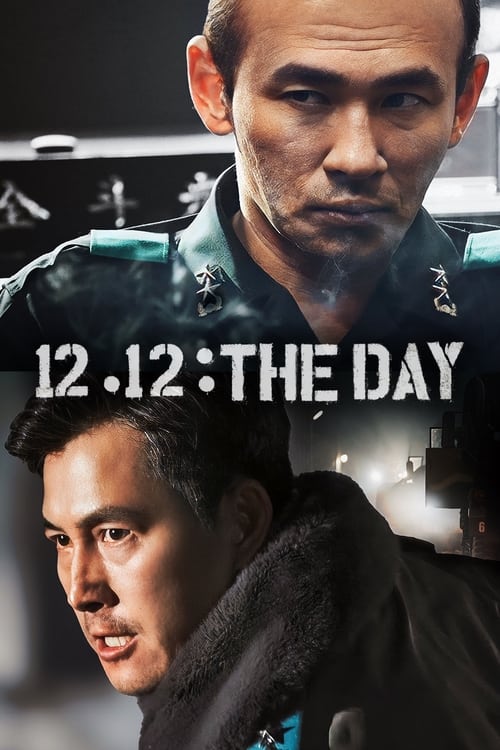
12.12: The Day
2023 · Kim Sung-soo
For when you want a smart, furious political thriller that grabs you by the collar and doesn't let go — the kind you finish and immediately want to read the history behind. Gripping rather than cozy; it's a film that wants you outraged.
What it's about
Seoul, December 1979: the president has just been assassinated, martial law is in force, and in the space of one night an ambitious security commander and his private clique of officers move to seize control of the army. Standing against them is the capital's defense commander, a stubborn soldier who believes the military has no business in politics. The film reconstructs those nine hours almost in real time — phone calls, troop movements, bluffs, and betrayals — as the fate of a country comes down to who blinks first.
The experience
Relentless. It plays like a ticking-clock thriller even though it's built from meetings, maps, and telephone standoffs — two hours of escalating pressure where every hesitation costs something. Knowing it really happened makes it angrier, and the anger lingers.
Performances
Hwang Jung-min is chilling as the coup leader Chun Doo-gwang, all reptilian charm and naked appetite, while Jung Woo-sung gives the loyalist commander a granite decency that makes his losing position devastating to watch.
The craft
Kim Sung-soo stages the coup as a procedural chess match, crosscutting between command posts so you always know exactly what's at stake on both ends of every phone line. The near-real-time structure and precise geography of Seoul at night turn military bureaucracy into white-knuckle action filmmaking.
Why it matters
A phenomenon in South Korea — one of the highest-grossing domestic films ever, with over thirteen million admissions — it reopened a national conversation about the country's authoritarian past for a generation that never lived it.
Snapshot
Released in South Korea on November 22, 2023 under the original title 서울의 봄 (Seoul-ui Bom, "Seoul Spring"), Kim Sung-soo's 12.12: The Day reconstructs the military coup of December 12, 1979, when Defense Security Command chief Chun Doo-hwan seized control of the South Korean armed forces in the nine turbulent hours following the assassination of dictator Park Chung-hee. The film dramatizes that night as a procedural thriller in near-real-time, pitting a cabal of conspiring officers against a small cadre of constitutionalist loyalists who lack the political will, institutional support, or simple luck to stop them. It became one of the highest-grossing South Korean films in domestic history, surpassing thirteen million admissions and igniting a sustained public conversation about the country's authoritarian past at a moment when both Chun Doo-hwan and Roh Tae-woo — the chief architects of the coup — had died, in October and November 2021 respectively, just two years before the film's release. That convergence of mourning and reckoning shaped the film's cultural atmosphere in ways difficult to separate from its formal achievement.
Industry & production
The film was produced by Haewadal Film and distributed by Plus M Entertainment (now CJ ENM), situating it within the commercial mainstream of Korean studio filmmaking rather than the art-house or auteur margins. Kim Sung-soo developed the project over several years, drawing on Choi Hun's screenplay, which leans heavily on documented historical records, journalistic accounts, and the 1993 Korean Broadcasting System documentary series on the era. Characters bear lightly fictionalized names: Chun Doo-hwan becomes Chun Doo-gwang (Hwang Jung-min), Roh Tae-woo becomes Lee Hak-sung (Lee Sung-min), and the loyalist Capital Defense Commander Jang Tae-wan becomes Lee Tae-shin (Jung Woo-sung). This thin fictional membrane allowed the production to navigate defamation law while preserving historical specificity.
The film's commercial scale — multiple simultaneous locations reconstructed, a large ensemble of uniformed principals, period-accurate weapons, vehicles, and communications equipment — required the kind of mid-to-large budget that Korean studio cinema has increasingly supported for prestige historical projects since the early 2010s. Its opening weekend performance broke records, and its sustained theatrical run across the winter demonstrated the appetite Korean audiences have for revisiting the dictatorship decades when the treatment is dramatically rigorous rather than melodramatic or hagiographic. Specific production budget figures have not been publicly released with precision.
Technology
12.12: The Day was shot digitally, consistent with contemporary Korean commercial filmmaking practice. The production relied heavily on practical locations and physical set construction rather than digital environments, grounding the thriller's claustrophobia in tangible architecture: actual military compound interiors or detailed reconstructions, telephone switchboards, jeeps and command cars, and the amber and fluorescent lighting of late-1970s institutional spaces. The period required meticulous attention to communications technology — rotary phones, teletype machines, radio handsets — since the entire plot turns on who can reach whom and how quickly, making the prop and set-decoration departments central to the film's dramatic logic. Specific details of camera systems and post-production workflows used have not been extensively documented in English-language trade coverage.
Technique
Cinematography
The film's visual strategy is one of controlled constriction. The camera rarely escapes into open space; when it does — exterior shots of the Seoul winter night, troop movements through city streets, convoys rolling in darkness — the openness reads as exposure rather than relief. For the majority of the running time, Kim and his cinematographer work in corridors, anterooms, command centers, and offices: tight framings that keep figures in mid-shot and close-up, emphasizing faces reading faces, hands reaching for telephone receivers, eyes waiting for subordinates to comply with orders. The color palette leans toward institutional greens, khaki, and the cold blue-gray of winter concrete, punctuated by the warm amber of desk lamps and cigarette smoke. This creates a visual grammar in which warmth signals private complicity and cool light signals bureaucratic deadlock. Deep focus is used selectively to keep both the commanding figure and the officer being pressured in the same plane of clarity, denying the viewer the escape of a blurred background.
Editing
The editing is the film's most technically accomplished dimension. The entire plot unfolds across geographically dispersed locations — the Defense Security Command compound, the Joint Chiefs of Staff building, the Capital Defense Command headquarters, the Defense Minister's residence — and the coup's success depends precisely on the time it takes information, orders, and armed men to travel between them. The editing exploits this geography as a dramatic resource, crosscutting between simultaneous events to let the audience measure, in real time, the fatal gap between the loyalists' belated recognition of the coup and their inability to respond before each window closes. The rhythm modulates carefully: long, agonizing phone-call sequences where a general refuses to commit, followed by rapid-cut montages of troop movements, followed by near-static two-shots in which the silence of a decision not being made does all the work. The effect is procedural suspense of a particularly political kind — not "will they survive?" but "will anyone act?"
Mise-en-scène / staging
Kim Sung-soo stages the ensemble with the precision of a theater director who has also studied the mechanics of military rank. Physical proximity and distance carry political meaning throughout: who enters whose office uninvited, who stands while others sit, who places a hand on a telephone before the other reaches it. The film is especially attentive to the performance of authority in institutional space — the coup's success is partly a matter of convincing performance, of Chun Doo-gwang making subordinates believe orders have been sanctioned before sanction arrives. The blocking frequently places Hwang Jung-min in the physical center of a room, with other officers arranged around him in a geometry that reads as both military formation and audience. Against this, Jung Woo-sung's Lee Tae-shin occupies space differently — often at the margin, at a desk phone, separated from the men he commands by the ceiling of bureaucratic protocol that Chun is willing to shatter and he is not.
Sound
Sound design is used to reinforce the film's procedural logic. Telephone rings carry disproportionate weight — each unanswered ring, each transferred call, each click of a line going dead is amplified into the rhythm of the night. The score (by a composer whose identity the English-language record does not firmly establish at the time of writing) operates largely in the register of orchestral dread, using sustained strings and low brass to extend the audience's experience of waiting through scenes in which nothing visible is happening but everything is being decided. Ambient military sound — radio static, the clatter of equipment, the rumble of APCs — is used to mark the progress of the coup in real time even when the camera is elsewhere.
Performance
Hwang Jung-min delivers what is broadly considered one of the defining performances of his career. His Chun Doo-gwang is not conventionally villainous — he is charming, paternal, quick to laugh, and terrifying precisely because his warmth reads as genuine rather than calculated. Hwang refuses to play the character as a monster in retrospect; he plays him as a man who believes his own rhetoric about saving the nation even as he subverts everything the nation's constitution requires. Jung Woo-sung is the film's moral center but deliberately not its protagonist in any conventional heroic sense — his Lee Tae-shin is constitutionalist, unbending, and ultimately insufficient, a portrait of virtue without cunning. Lee Sung-min as the Roh Tae-woo figure offers the film's most psychologically layered supporting performance: a man who knows the coup is wrong, continues to cooperate, and finds justifications in sequence as each justification collapses. The ensemble below the leads — playing the generals who one by one decline to resist — is calibrated to make cowardice and complicity legible without reducing them to caricature.
Narrative & dramatic mode
The film operates as a procedural political thriller in near-real-time, a mode that requires the audience to track institutional hierarchy and military geography as prerequisites for understanding the drama. The screenplay makes no concessions to viewers unfamiliar with the Korean military command structure of 1979; it trusts that the emotional logic — the feeling of watching a constitutionalist system collapse not from military superiority but from the failure of nerve — will carry the uninitiated even when the bureaucratic specifics elude them. The narrative withholds flashback, backstory, and psychological explanation in favor of action and reaction in the present tense of that single night. What makes this formally rigorous is that the film's subject — how coups actually succeed — is genuinely a matter of timing, momentum, and the perception of inevitability, and the real-time procedural mode enacts that argument rather than merely describing it.
Genre & cycle
12.12: The Day belongs to a specific and thriving cycle of South Korean historical political films that emerged in the 2010s and sustained into the 2020s: The Attorney (양우석, 2013), A Taxi Driver (장훈, 2017), 1987: When the Day Comes (장준환, 2017), The Man Standing Next (우민호, 2020). These films share the project of revisiting the Park Chung-hee and Chun Doo-hwan eras through genre filmmaking — legal drama, road movie, espionage thriller, procedural — rather than through documentary or prestige literary adaptation. The cycle reflects a generational and political reckoning: these are films made by and for South Koreans who grew up after the dictatorship but under its institutional legacies, and who are now reconstructing it through the formal vocabulary of popular cinema. 12.12 distinguishes itself within the cycle by being almost purely procedural rather than personal — it lacks the civilian protagonist and the redemption-through-solidarity arc that structures Taxi Driver and 1987. Its closest generic kin internationally is the political thriller as practiced by Costa-Gavras: Z (1969), The Confession (1970), State of Siege (1972) — films that depict political catastrophe as a mechanism, cold and impersonal, that crushes individuals who attempt to stop it.
Authorship & method
Kim Sung-soo (born 1966) is among the more consistently ambitious genre directors of his generation in Korean cinema. His debut Beat (1997) established an interest in masculine codes and institutional loyalty under pressure; Musa: The Warrior (2001) demonstrated his capacity for large-scale historical spectacle across geographically complex action sequences; Asura: The City of Adulation (Asura: The City of Madness, 2016) was the most direct precursor to 12.12, a police procedural thriller about systemic corruption that used a similar dramaturgy of pressure applied through institutional hierarchy. What unites these films is Kim's interest in systems — military, criminal, bureaucratic — and in the individual as the point where system and conscience collide. 12.12 represents the fullest elaboration of this interest: a film in which the system is the subject, and the individual failures that allow it to function are the drama. Kim has spoken in interviews about his desire to make the mechanics of the coup legible to audiences who know the outcome — to transform historical fact into genuine suspense — but specific methodological statements from him about directing the film are not extensively documented in English-language sources.
The screenplay by Choi Hun grounds the fictional events in documented historical records while maintaining the procedural compression the drama requires. Choi's contribution — managing an ensemble of approximately twenty major speaking roles across a single night — is a structural achievement seldom remarked upon in reviews focused on Kim's direction and the performances.
Movement / national cinema
The film participates in the Korean New Wave's late phase — sometimes called post-wave or global Korean cinema — in which the directors who came of age during the 1990s renaissance (Park Chan-wook, Bong Joon-ho, Kim Jee-woon, and peers) have consolidated into a mature studio system capable of producing genre films with genuine formal ambition. Kim Sung-soo is slightly outside the canonical New Wave cohort but fully situated within its industrial and aesthetic conditions. 12.12 is also a specifically Korean political film in a tradition that includes Im Kwon-taek's historical reconstructions, Park Kwang-su's dissident cinema of the late 1980s, and the democratization-era films that emerged after the transition from authoritarian rule. The cycle of dictatorship films to which it belongs is distinct from this earlier tradition in being retrospective — made by filmmakers who did not live under the conditions they depict — and therefore concerns itself with memory, accountability, and the gap between historical knowledge and emotional reckoning.
Era / period
The film reconstructs December 12, 1979 — the fifty-six days between Park Chung-hee's assassination on October 26 and the consolidation of Chun Doo-hwan's power through the 1980 Gwangju Uprising and its suppression. The Korean title, Seoul Spring, names this interregnum as a season of democratic possibility that was crushed before it could flower, invoking the idiom of the Prague Spring and the pattern of thaw-and-crackdown in Cold War authoritarian states. The period detail — the clothing, the vehicles, the institutional decor, the weapons — is meticulous, but the film's period work is not primarily nostalgic or aesthetic; it is forensic, reconstructing the material conditions under which power was exercised and resisted.
Themes
The film's central argument, pursued with unusual rigor, is that coups succeed not through superior force but through the exploitation of procedural legitimacy and institutional hesitation. Chun Doo-gwang wins because he acts; the loyalists lose because they wait for authorization that will not come in time, because they respect chains of command that the coup has already severed, because they believe the system contains its own protection. This is a deeply conservative insight deployed in the service of a democratic argument: constitutional order is only as strong as the willingness of individuals to defend it in real time, at personal cost, without waiting for consensus. The film refuses to sentimentalize Lee Tae-shin's resistance — he loses — and refuses to demonize the generals who capitulate; it treats their failures as comprehensible and therefore all the more sobering.
Secondary themes include the nature of military loyalty (to institution versus to individual), the political neutrality of armed force as an ideal versus a fiction, and the specific texture of Korean military culture in the late Cold War period — its factionalism, its patronage networks, its investment in personal honor as a substitute for legal accountability.
Reception, canon & influence
Influences on the film (backward): The Costa-Gavras political thriller is the film's primary international antecedent — particularly Z (1969) and State of Siege (1972) in their depiction of state violence as bureaucratic process. Alan J. Pakula's procedural thrillers (All the President's Men, 1976; The Parallax View, 1974) offer a comparable dramaturgy of documents, phone calls, and institutional obstruction. Within Korean cinema, The Man Standing Next (우민호, 2020), which dramatizes the events leading to Park Chung-hee's assassination from the perspective of the KCIA, is a direct thematic predecessor. Kim Sung-soo's own Asura: The City of Madness (2016) prefigures the procedural structure and the moral entrapment of its protagonist in institutional crime.
Critical reception: The film received strong critical notices in Korea and was recognized at the Grand Bell Awards and Blue Dragon Film Awards, with Hwang Jung-min's performance singled out across virtually all substantive criticism. International critical coverage, while more limited in scope given the film's primarily domestic release, noted its procedural sophistication and its refusal of the cathartic resolution characteristic of the democratic-uprising cycle. Some critics observed that the film's formal achievement — generating suspense from an outcome the audience already knows — placed it in the company of the best historical political thrillers regardless of national origin.
Commercial legacy: The thirteen-million-plus admissions figure made it one of the highest-grossing South Korean films in domestic history, surpassing major commercial landmarks. Its success confirmed the appetite for dictatorship-era political cinema among Korean audiences and is likely to accelerate production of similar projects across the remainder of the decade. Its particular achievement — producing a film about institutional cowardice that is itself neither cowardly nor comfortable — suggests that the Korean industry has developed the craft and the commercial confidence to treat its own traumatic history with the seriousness it requires.
Forward influence: It is too early to assess the film's long-term influence on Korean cinema or on international political filmmaking; it was released in late 2023, and its downstream effects within the industry remain to be observed. What can be said is that it has raised the benchmark for the historical procedural within Korean commercial cinema, demonstrating that an ensemble of institutional functionaries — not heroes or victims — can sustain two hours of dramatic tension when the writing, direction, and performances are equal to the task.
A Deleuzian reading
Start with a telephone nobody is allowed to answer in time.
The full Deleuzian reading of 12.12: The Day →
Reception
A November 2023 sleeper that word-of-mouth turned into a juggernaut — it out-grossed every other Korean film that year, crossed 13 million admissions, and swept Best Film at both the Baeksang and Blue Dragon awards. Barely two years on it's already treated as a modern Korean classic, the film that proved mid-budget historical drama could still own the box office post-pandemic.
How 12.12: The Day was received, from release to now →
Influences: the films it descends from and the films it influenced
- Z (1969) — The film's formal strategy of staging political assassination as bureaucratic event — crosscutting between institutional functionaries performing assigned roles rather than exercising conscience — is the direct template for 12.12's depiction of the coup as administrative procedure unfolding across separated command centers.
- State of Siege (1972) — Costa-Gavras's procedural anatomy of a state apparatus rendered through rooms, telephone lines, and chain-of-command is the specific organizational grammar 12.12 adopts: both films make the authorization chain — who called whom, who obeyed, who hesitated — the dramatic substance rather than its backdrop.
- The Parallax View (1974) — Pakula's tight framing that reduces protagonists' headroom within institutional architecture — corridors, operations rooms, corporate lobbies — encodes systemic entrapment visually; 12.12 inherits this grammar of constriction as its dominant cinematographic vocabulary for depicting rank-bound authority.
- All the President's Men (1976) — Pakula's dramaturgy of institutional obstruction rendered through telephone negotiations, document gatekeeping, and hierarchical pressure translates directly into 12.12's military-command procedural, with orders and counter-orders replacing tips and sources as the units of dramatic currency.
- The Battle of Algiers (1966) — Pontecorvo's decision to render counterinsurgency as organizational process — showing the administrative machinery by which state violence is authorized, distributed, and deniably executed rather than dramatizing individual perpetrators — establishes the precedent for 12.12's mechanism-over-character political dramaturgy.
- United 93 (2006) — Greengrass's near-real-time geographic crosscutting between separated command centers — simultaneously tracking the hijacked aircraft and the FAA/military response rooms — provides the procedural structural template for 12.12's parallel-timeline coup architecture, generating suspense from an outcome the audience already knows.
- Asura: The City of Madness (2016) — Kim's own police procedural about a detective trapped in institutional corruption prefigures 12.12's complicity arc and its method of building dramatic tension through accumulated hierarchical pressure — each scene a new demand for moral capitulation — rather than conventional hero-antagonist opposition.
- The Man Standing Next (2020) — This dramatization of the Park Chung-hee assassination through the KCIA director's institutional perspective establishes the insider-apparatus POV approach to Korean military-era political history that 12.12 inherits, developing it into near-real-time procedural form across the coup night that followed.
- A Taxi Driver (2017) — Jang Hoon's staging of civilian penetration into military-controlled urban geography — using checkpoints, roadblocks, and rank-delineated spatial restriction as the film's primary dramatic devices — develops the authority-geometry vocabulary that 12.12 applies to its command-center confrontations between generals.
- The President's Last Bang (2005) — Im's dramatization of the assassination immediately preceding 12.12's timeline employs the same institutional POV staging — rendering political violence as administrative failure rather than moral drama — and shares 12.12's formal strategy of deflating historical catastrophe into procedural banality populated by functionaries rather than heroes.
- 1987: When the Day Comes (2017) — Jang's multi-strand geographic crosscutting across institutional levels — interrogators, bureaucrats, journalists, students — renders Korean state violence as a procedural network of complicity, sharing 12.12's formal strategy of tracing the authorization chain rather than following a singular protagonist through the event.
- Hunt (2022) — Set in the same 1980s ANSP institutional world, Lee Jung-jae's debut employs a double-complicity arc — two protagonists simultaneously investigating and being investigated — and a hierarchical staging of intelligence authority that extends the Korean political thriller's formal vocabulary of institutional entrapment in direct dialogue with 12.12's moment.
- Tinker Tailor Soldier Spy (2011) — Alfredson's institutional Cold War procedural deploys the same muted color palette of bureaucratic interiors (institutional green, khaki, drained gray), tight framing that constricts characters within hierarchical space, and orchestral dread as ambient pressure — sharing 12.12's complete visual-sonic grammar of systemic betrayal.
- Spotlight (2015) — McCarthy's investigative procedural renders institutional obstruction through the same formal toolkit 12.12 deploys in a military register: telephone calls that expose hierarchy rather than transmit information, documents that trace authorization chains, and near-real-time compression of institutional process into legible dramatic tension.
- Zodiac (2007) — Fincher's procedural compression of a multi-year investigation into a mechanism-driven narrative — in which institutional process, documentary evidence, and jurisdictional friction displace psychological character study as the film's substance — shares 12.12's formal commitment to depicting systemic failure through procedural accumulation rather than individual tragedy.
Similar films
- A Taxi Driver (2017) — influence & lineage · same viewing thread
- The Man Standing Next (2020) — influence & lineage
- Asura: The City of Madness (2016) — influence & lineage
- A Hard Day (2014) — same viewing thread
- Joint Security Area (2000) — same viewing thread
- Tae Guk Gi: The Brotherhood of War (2004) — same viewing thread
- No Other Choice (2025) — same viewing thread
- Decision to Leave (2022) — same viewing thread
All the films related to 12.12: The Day →
Watch it with: curated runs of related films
- New Korean Cinema — Watch these in a run and you feel one national cinema flip between monster movie, revenge thriller, gothic horror, and slow-burn procedural without ever loosening its grip on class, history, and family.