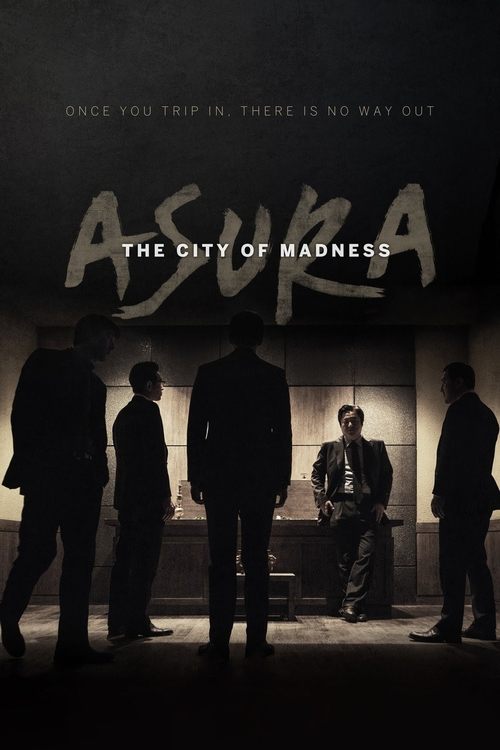
Asura: The City of Madness
2016 · Kim Sung-soo
For when you want crime cinema with the safety off — maximum intensity, zero comfort, everyone compromised. Not a casual pick; reach for it when you're in the mood to be worked over.
What it's about
Detective Han Do-kyung is barely a cop anymore — he's muscle for Park Sung-bae, the monstrous, untouchable mayor of a corrupt satellite city outside Seoul, doing his dirty work and laundering his violence. When a bulldog prosecutor from the anti-corruption unit gets leverage on Han and squeezes him to inform on his boss, Han is trapped between two ruthless masters — and makes the mistake of pulling his idealistic junior partner into the machine with him.
The experience
Relentless and pitch-black — a two-hour vise that keeps tightening, punctuated by some genuinely bruising action. There are no good guys here, and the film's refusal to offer one is the point; you come out rattled.
Performances
Hwang Jung-min's mayor is a horror-show of grinning charisma — one of the great screen monsters of Korean cinema — while Jung Woo-sung plays the hollowed-out detective caught in his orbit with mounting desperation.
The craft
Muscular, rain-slicked filmmaking in the top tier of Korean thriller craft: brutal close-quarters set pieces, a city shot like a lower circle of hell, and an escalation that builds to a genuinely operatic finale. Loud, physical, and best experienced with the volume up.
Why it matters
It pushed South Korea's already merciless crime-film tradition to its nihilistic outer edge and has grown a devoted cult standing among fans of the country's thrillers.
Snapshot
Asura: The City of Madness (아수라, Asura) is a South Korean crime thriller that pushes the country's already pitiless noir tradition toward something closer to outright nihilism. Detective Han Do-kyung (Jung Woo-sung) is a hollowed-out police enforcer who launders violence on behalf of Park Sung-bae (Hwang Jung-min), the monstrous mayor of the fictional satellite city of Annam. When a prosecutor from the anti-corruption unit, Kim Cha-in (Kwak Do-won), squeezes Han into informing, Han drags his idealistic junior, Moon Sun-mo (Joo Ji-hoon), into the trap — and watches him curdle into something worse than the men they were hunting. The film's title is the giveaway: "Asura" names the Buddhist realm of perpetual rage and warfare, and the movie treats its corrupt city as a literal lower world from which no character escapes clean. Released in September 2016 to a divided reception and disappointing returns, Asura has since hardened into a cult landmark, frequently cited alongside New World and A Bittersweet Life as a defining text of modern Korean crime cinema.
Industry & production
Asura arrived as a marquee event picture, assembled around one of the deepest ensembles in contemporary Korean cinema: Jung Woo-sung and Hwang Jung-min — both bona fide leading men — flanked by Kwak Do-won, Joo Ji-hoon, and the reliably venomous character actor Jung Man-sik. Marshalling five actors of that weight into a single mid-budget crime film signaled an industry confident in the commercial durability of the noir-thriller, a cycle that had been minting hits since the late 2000s. The film was produced by Sanai Pictures, the company behind Park Hoon-jung's New World (2013), a lineage that is legible in Asura's textures of male loyalty, institutional rot, and operatic bloodshed; distribution was handled through the major-studio apparatus that dominated Korean exhibition in the period (CJ Entertainment). The exact financing structure and budget are not something I can state with precision without inventing figures, so I will leave it characterized rather than quantified.
The production reunited director Kim Sung-soo with Jung Woo-sung, the actor Kim had made a star nearly two decades earlier — a relationship that functioned as both creative engine and marketing hook. Asura was positioned for the lucrative Chuseok holiday corridor, the most contested release window in the Korean calendar, where it ran against family-friendly counter-programming. That positioning would prove consequential: a relentlessly grim, violent film is an awkward fit for a holiday audience, and the commercial result fell short of the expectations its cast had set.
Technology
Asura was shot and finished digitally, in line with standard Korean studio practice of the mid-2010s, and its look leans on the control that digital capture affords in low light — the film lives in rain, fluorescent corridors, parking garages, and night exteriors. I should be candid that I cannot confirm the specific camera system or post-production pipeline from the historical record without guessing, so I won't attribute particular hardware. What is unambiguous on screen is the film's reliance on practical, physical effects for its violence: the set-piece car collisions, the squib-and-blood work, and above all the closing massacre are staged as tangible, in-camera chaos rather than digital augmentation. The technological signature of the film is therefore less about novel tools than about an old-fashioned commitment to weight and impact — bodies that fall hard, vehicles that crumple, blood that sprays with unglamorous abundance.
Technique
Cinematography
The film's visual scheme is built on desaturated, sodium-and-steel palettes and a camera that crowds its characters. Interiors are claustrophobic and over-lit in the sickly way of institutional spaces; exteriors are frequently wet, the rain functioning both as atmosphere and as a moral solvent that smears every surface. The camera favours tight, jostling framings during confrontation and handheld immediacy in the action, withholding the clean geometric compositions that might lend the corruption any grandeur. I'm not able to confirm the director of photography by name with confidence, and I'd rather flag that gap than assign a credit I can't verify; the work itself, however, is coherent and purposeful — a deliberate refusal of beauty.
Editing
Asura is cut for accumulation and escalation. The early stretches braid Han's competing obligations — to the mayor, to the prosecutor, to his dying wife — into a tightening vice, while the action sequences are assembled with a brutal, collision-heavy rhythm that prizes confusion over legibility. The notorious finale, a melee in a funeral hall, is edited as sustained pandemonium: the film stops sorting its combatants into heroes and villains and simply lets the violence metastasise, the cutting refusing the reassurance of a clear victor. The pacing has been a point of contention — some viewers find the middle stretch punishing — but the structure is clearly designed as a descent rather than a build to catharsis.
Mise-en-scène / staging
The staging insists on the city as a closed system. Annam is rendered through redevelopment sites, half-built towers, hospital wards, police bullpens, and back rooms — spaces of transaction and decay rather than spectacle. Costume and physical presence do enormous characterizing work: Hwang Jung-min's mayor is all expansive, grinning body language, a glad-handing predator who fills every room; Jung Woo-sung's detective is shot to look perpetually exhausted and compromised, his physical beauty (long Kim Sung-soo's stock-in-trade) deliberately degraded into something haggard. The blocking repeatedly traps characters in doorways, corridors, and cars — boxes within the larger box of the city.
Sound
The sound design foregrounds impact: the wet, percussive register of blows and crashes is mixed for maximum bodily discomfort, and the film's quieter passages are tense with institutional ambience — phones, traffic, the hum of fluorescent rooms. The score works in a brooding, propulsive mode that underlines dread rather than supplying relief, though I can't responsibly attribute the composition to a specific composer without confirmation. What's clear is that music and sound are deployed to deny the audience release, keeping the film in a state of sustained nervous pressure.
Performance
Performance is the film's greatest asset and the chief engine of its cult reappraisal. Hwang Jung-min's Mayor Park is a landmark portrait of charismatic evil — jovial, tactile, and instantly switchable into savagery — a performance pitched at operatic scale without tipping into camp. Jung Woo-sung gives one of his most self-lacerating turns, playing Han as a man already spiritually dead, reacting more than acting, absorbing punishment. Kwak Do-won makes the crusading prosecutor as repellent as the criminals, his self-righteousness curdled into its own kind of brutality. And Joo Ji-hoon executes the film's central arc — the rookie's transformation from frightened pawn into the story's most frightening figure — with a chilling gradualism. The ensemble's willingness to be ugly is the point.
Narrative & dramatic mode
Asura operates in the tragic-noir mode, but strips out the residual romanticism that usually survives in the genre. There is no detective-as-last-honest-man, no institution worth saving, no redemptive private sphere — Han's home life, organized around a dying wife and ruinous medical costs, is presented as the reason he is trapped rather than a refuge from the trap. The dramatic structure is a tightening noose: each choice Han makes to escape one master delivers him to another, until the only available action is annihilating violence. The film withholds moral orientation deliberately, refusing to grant the viewer a character to root for. This is its boldest and most divisive formal decision — a sustained moral vacuum that some read as bracing honesty and others as exhausting cynicism.
Genre & cycle
The film belongs squarely to the Korean crime-noir cycle that crystallized in the late 2000s and dominated the 2010s — the lineage of A Bittersweet Life (2005), The Unjust (2010), Nameless Gangster (2012), and especially New World (2013), with which Asura shares producers, preoccupations, and a taste for institutional rot. Within that cycle, Asura occupies the extreme nihilist end. Where many entries retain a thread of loyalty, brotherhood, or tragic grandeur, Asura burns those consolations away. It is also a corruption procedural in the tradition of the dirty-cop drama, but one that treats the dirty cop as already beyond salvation at frame one, foreclosing the usual arc of fall.
Authorship & method
Kim Sung-soo is a director whose career frames Asura meaningfully. He broke through with Beat (1997), the youth-gangster drama that turned Jung Woo-sung into a national star, and continued with City of the Rising Sun (1999) and the epic Musa: The Warrior (2001). Asura is thus both a late-career statement and a reunion with the actor he discovered — and it reads as a deliberate inversion of Beat's romanticism, replacing youthful doomed glamour with middle-aged, exhausted damnation. Kim is credited as the film's writer as well as director, which accounts for the work's unified, uncompromising vision; the bleakness is authorial, not accidental.
On key collaborators I will be deliberately careful. Kim's screenplay is the clearest authorial element. The below-the-line craft — cinematography, editing, score — is plainly accomplished and internally consistent, but I am not able to attribute those specific credits by name with the confidence this dossier demands, and I would rather mark that limit than risk a false attribution. What can be said firmly is that the performances, particularly Hwang Jung-min's and Jung Woo-sung's, function as co-authoring forces, and that the producing hand of Sanai Pictures ties the film's sensibility to the New World school of Korean noir.
Movement / national cinema
Asura is a product of the mature commercial New Korean Cinema — the post-millennial industry that fused genre fluency, technical polish, and a distinctively unsparing attitude toward violence and institutional corruption. Korean crime cinema of this era is marked by a willingness to deny moral resolution that distinguishes it from most Hollywood analogs, and Asura is among the purest expressions of that tendency. Its vision of the city — a satellite town consumed by redevelopment graft, where police, prosecutors, and politicians are merely competing predators — speaks to a recurring national anxiety about the collusion of state, capital, and law that runs through the country's crime films and reflects real public preoccupations with elite corruption.
Era / period
The film is firmly of the mid-2010s, a high-water moment for the Korean genre film's confidence and a period of intense public scrutiny of political corruption in South Korea. While Asura is not a roman-à-clef, its portrait of a glad-handing, brutal local strongman and the rotten machinery surrounding him resonated with the era's mood, and its reputation has only grown as that mood deepened. Stylistically it sits at the point where the Korean noir cycle had fully matured and begun to test its own limits — Asura is what the genre looks like when it stops flinching.
Themes
The governing theme is announced by the title: existence as the asura realm, a world of ceaseless, jealous conflict from which there is no exit and no higher ground. Corruption in Asura is not a problem to be solved but the medium everyone swims in; the film systematically refuses the categories — clean cop, principled prosecutor, redeemable man — that the genre usually preserves. Connected to this is the theme of contamination as inheritance: Moon Sun-mo's transformation dramatizes how the system reproduces its own monstrosity, the pupil surpassing his corrupt teachers. The dying-wife subplot grounds the abstraction in economic desperation, suggesting that damnation here is as much about money and debt as about evil. And the recurring motif of the city-as-construction-site — perpetually torn up, never finished — figures a society building its own hell.
Reception, canon & influence
Critically and commercially, Asura opened to a divided response. Reviewers and audiences split sharply over its unrelenting bleakness and violence, with detractors finding it punishing and hollow and admirers prizing exactly that refusal of comfort; its holiday release slot worked against a film this grim, and it underperformed relative to the expectations created by its cast. I won't cite specific admissions or box-office figures I can't verify, but the consensus that it disappointed at release is well established. What followed is the more remarkable part of its story: a passionate fan movement coalesced around the film after its theatrical run, championing it as misunderstood, and over subsequent years Asura was steadily reappraised into cult-classic status, its reputation now far exceeding its original reception. Reports of an English-language remake circulated, which — verified or not — testify to the film's growing stature.
Looking backward, the influences ON the film are legible. The Korean noir lineage of A Bittersweet Life and especially Sanai Pictures' own New World supplies the immediate template of institutional corruption and operatic violence. Behind that stand the Hollywood and Hong Kong traditions of the corruption thriller — the informant-caught-between-two-masters structure descends from the Infernal Affairs/The Departed lineage, while the vision of a city as a totalising web of graft recalls the American police-corruption dramas of the Sidney Lumet school and the Ellroy-esque mode of L.A. Confidential. Kim Sung-soo's own Beat is the most personal antecedent, the romantic original of which Asura is the despairing photographic negative.
Looking forward, Asura's legacy is now secure as a touchstone of extreme Korean noir — a reference point invoked whenever the genre's nihilist wing is discussed, and a film whose funeral-hall finale and Hwang Jung-min's mayor have become canonical images. Its trajectory from box-office disappointment to cult monument has itself become part of its meaning, a case study in critical reappraisal, and its uncompromising refusal of moral resolution helped license an even darker register in the Korean crime films that followed.
A Deleuzian reading
The mayor never stops touching people.
The full Deleuzian reading of Asura: The City of Madness →
Reception
A #1 opening in Korea that quickly fizzled at the box office and split critics as 'nihilism for its own sake' — then, almost uniquely in Korean film history, was resurrected by its own fandom within a couple of years, and got a fresh wave of love after director Kim Sung-soo's 12.12: The Day (2023) became a phenomenon.
How Asura: The City of Madness was received, from release to now →
Influences: the films it descends from and the films it influenced
- New World (2013) — The Sanai Pictures template Asura directly extends — operatic institutional-corruption staging where an undercover man is crushed between syndicate and police hierarchies, the same producing house wiring both films to one noir sensibility.
- Nameless Gangster (2012) — Pushes the corrupt-cop-caught-between-powers framework into nihilist excess, descending from Yoon's portrait of a small man surviving by serving every master at once until the favors run out.
- 12.12: The Day (2023) — Kim's own police procedural about a detective trapped in institutional corruption prefigures 12.12's complicity arc and its method of building dramatic tension through accumulated hierarchical pressure — each scene a new demand for moral capitulation — rather than conventional hero-antagonist opposition.
- A Bittersweet Life (2005) — Established the glossy-yet-brutal Korean noir register of a loyal enforcer destroyed by the patron he serves, the desaturated-elegant violence and self-lacerating lead that Asura inherits.
- Infernal Affairs (2002) — Source of the informant-caught-between-two-masters structure — the mole architecture and divided-loyalty tension Han Do-kyung's character mechanically descends from.
- The Departed (2006) — The American remake that fused the double-mole premise with gutter profanity and explosive betrayals, the foul-mouthed institutional rot Asura's police-prosecutor war echoes.
- L.A. Confidential (1997) — The Ellroy-esque vision of a city as a totalising web of graft where every badge is compromised, the corruption-as-ecosystem worldview Asura transposes to Annam.
- Serpico (1973) — The Lumet police-corruption school — institutional graft rendered as inescapable systemic contamination rather than individual villainy, the moral-vacuum framework Asura absorbs.
- Prince of the City (1981) — Lumet's portrait of an informant cop drowning as he tries to play both sides, the descent-structure of a man whose every betrayal deepens his entrapment that Asura formalizes.
- Beat (1997) — Kim's own romantic youth-gangster origin starring Jung Woo-sung, of which Asura is the deliberate photographic negative — doomed glamour inverted into middle-aged exhausted damnation.
- Nameless Gangster: Rules of the Time (2012) — Sibling anatomy of prosecutor-gangster collusion in Korean officialdom, the bureaucratic graft-network and venal-public-servant milieu Asura shares.
- The Chaser (2008) — Sibling in handheld, impact-foregrounded brutality and a relentless descent denied catharsis, the punishing collision-heavy Korean thriller grammar Asura intensifies.
- I Saw the Devil (2010) — Sibling in the nihilist wing of extreme Korean cinema — sustained moral vacuum and contamination of the avenger by what he fights, the no-redemption register Asura shares.
- The Yellow Sea (2010) — Sibling in collision-heavy, blunt-weapon action choreography where bodies are flung through closed urban spaces, the kinetic desperation Asura's set-pieces extend.
- A Hard Day (2014) — Sibling dirty-cop noir where a single corrupt detective spirals through escalating cover-ups, the compromised-protagonist descent-structure Asura runs to its bleakest end.
Similar films
- New World (2013) — influence & lineage
- The Gangster, the Cop, the Devil (2019) — influence & lineage
- I Saw the Devil (2010) — influence & lineage
- A Hard Day (2014) — influence & lineage
- Night in Paradise (2020) — influence & lineage
- The Chaser (2008) — influence & lineage
- The Yellow Sea (2010) — influence & lineage
- A Bittersweet Life (2005) — influence & lineage