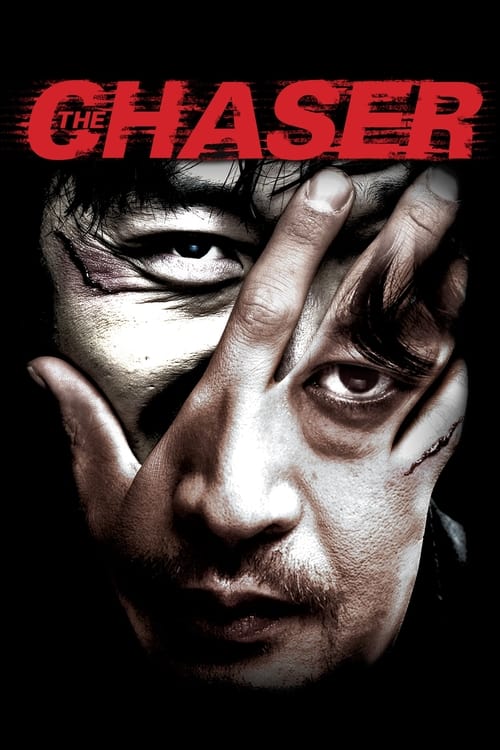
The Chaser
2008 · Na Hong-jin
For when you want a thriller that genuinely stresses you out — the lean, mean, stay-up-past-midnight kind. Not a comfort watch: it's grim, violent, and angry, and that's exactly the appeal when you're in the mood to be put through it.
What it's about
Joong-ho is an ex-detective turned pimp in Seoul, broke and furious because his girls keep disappearing without paying their debts. Digging through call records, he notices every vanished woman was summoned by the same client — and one of his girls is with that client right now. What kicks off as a sleazy debt-collection errand turns into a desperate hunt through back alleys and police stations, where the real enemy is as much bureaucratic incompetence as the man he's chasing.
The experience
Relentless. It sprints — rain-soaked foot chases, fists, dead phones, wrong turns — and then twists the knife by making you watch the clock while institutions dither. It's brutal, sometimes hard to watch, and it grips like a hand on the back of your neck for two hours.
Performances
Kim Yoon-seok is magnetic as the bullish, morally compromised Joong-ho, and Ha Jung-woo is chilling precisely because he plays the killer as bland, mumbling, and ordinary — two career-making turns facing off.
The craft
Na Hong-jin's debut direction is astonishingly assured: the chases are shot on real Seoul hillside streets at night, wet and cramped and shot close enough that you feel every stumble. The editing keeps multiple clocks running at once, and the violence lands with ugly, unglamorous weight.
Why it matters
A huge Korean box-office success that announced Na Hong-jin overnight and became a cornerstone of the Korean thriller wave that reshaped the genre worldwide.
Snapshot
The Chaser (추격자, Chugyeok-ja) is the feature debut of Na Hong-jin, a propulsive Seoul-set thriller that inverts the conventional serial-killer manhunt. Its premise is announced almost as a provocation: a former detective, now a low-rent pimp named Joong-ho, realizes that the women working for him have been vanishing, and that the same client summoned each of them. Rather than withholding the killer's identity for a third-act reveal, Na hands it over early — the murderer, Je Yeong-min, is identified, caught, and even confesses well before the film is half over. From that point the picture becomes a study in friction and futility: a question not of who but of whether a still-living victim can be reached before the system's incompetence and the killer's evasions run out the clock. Released in Korea in early 2008, it became a substantial commercial and critical success and announced Na as a major new voice in a national cinema already crowded with formidable thriller stylists. It is grounded loosely in the case of South Korean serial murderer Yoo Young-chul, though Na fictionalizes freely and the dossier treats that lineage as inspiration rather than reconstruction.
Industry & production
The Chaser emerged from the mid-2000s Korean industrial moment when domestic genre cinema was both commercially dominant at home and increasingly visible abroad. The film was produced by Bidangil Pictures and distributed by Showbox, one of the major Korean theatrical distributors of the period; this placed a first-time director's relatively dark, unglamorous thriller inside a robust commercial pipeline rather than at the art-house margins. The casting strategy was central to the production's identity: Kim Yoon-seok, a respected stage and character actor not yet established as a leading man, was given the central role of Joong-ho, while Ha Jung-woo — then an emerging actor — took the murderer. Both performances proved career-defining, and the film's success is inseparable from the gamble of building a mainstream thriller around two faces without conventional star wattage.
The production's most consequential downstream industrial fact was international: Warner Bros. acquired remake rights, with the project at various points attached to writer William Monahan. The American remake was never realized, but the rights sale signaled the degree to which Korean genre filmmaking had become a recognized source of intellectual property for Hollywood in the wake of films like Oldboy and A Tale of Two Sisters. Precise budget and admissions figures circulate in various forms; rather than cite numbers I cannot firmly verify, it is enough to say the film was a clear box-office success in Korea and a festival traveler abroad, including a Midnight Screenings berth at Cannes the year of its release.
Technology
The Chaser is a film of conventional late-2000s production technology deployed for maximal kinetic and atmospheric effect rather than for any technical novelty. It was shot on 35mm and exhibited photochemically, in keeping with most Korean theatrical features of its moment, before the wholesale migration to digital capture. The film's technological signature lies not in format but in craft: the integration of handheld camerawork, practical nighttime location lighting in a real hillside neighborhood, and physically demanding stunt and chase choreography. Where the film feels "modern" is in its embrace of the textures of a wired, surveilled, bureaucratized city — mobile phones that summon and track, police databases and call records, the administrative apparatus that should make the killer findable and instead repeatedly fails. The technology that matters most in The Chaser is diegetic: the infrastructure of a modern state that, the film insists, cannot save the person in front of it.
Technique
Cinematography
Shot by cinematographer Lee Sung-je, The Chaser is built around the geography of Mangwon-dong, a hilly Seoul neighborhood of narrow stepped alleys, blind corners, and steep grades. The camera exploits this verticality and tightness relentlessly: the film's celebrated foot chases are legible precisely because the space is so concrete, the audience always aware of who is above, below, around the next turn. The palette is rain-slicked and nocturnal, a sodium-and-shadow register that keeps the city damp and oppressive. Handheld operation predominates in the pursuit sequences, lending urgency and instability, while the camera tightens claustrophobically in interiors — the killer's house, the police station, the cramped rooms where violence is done. Lee's images privilege spatial clarity over expressionist flourish; the horror is in the topography.
Editing
The editing is the film's structural argument made rhythmic. Its boldest decision is dramaturgical: collapsing the "mystery" by revealing and capturing the killer early, then sustaining tension across a long middle and final stretch through cross-cutting between Joong-ho's increasingly frantic search and the fate of the captive victim. The cutting modulates between the breathless acceleration of the chases and longer, more agonizing held passages of waiting and procedural stalling. This tonal control — knowing when to sprint and when to let dread accumulate — is what allows a film that surrenders its whodunit to remain almost unbearably suspenseful. The editorial logic converts the absence of mystery into a different engine: the race against bureaucratic and temporal limits.
Mise-en-scène / staging
Na stages the film in resolutely unglamorous spaces: a shabby brothel operation, a grimy police station, the killer's dank and ordinary house, the steep public stairways of a working-class district. The mise-en-scène refuses the stylized abstraction common to the era's revenge thrillers; its menace is banal and material. The killer's domestic interior, where the worst of the violence is implied and shown, is rendered as mundane rather than gothic, which intensifies its horror. Staging frequently emphasizes obstruction — bodies, walls, traffic, officials physically blocking Joong-ho's path — so that the frame itself dramatizes thwarted momentum.
Sound
The score, credited to composers working in a percussive, tension-driven idiom (Kim Jun-seok and Choi Yong-rak are associated with the film's music), reinforces the chase-and-dread structure rather than overwhelming it; the film leans heavily on the sounds of the city, footsteps on wet stone, breath, rain, and the abrupt brutality of impact. Sound design is essential to the spatial intelligibility of the pursuits and to the visceral physicality of the violence, which is staged to land as blunt and consequential rather than balletic.
Performance
The film is anchored by two extraordinary performances. Kim Yoon-seok's Joong-ho is an antihero with almost no redeeming surface — a corrupt ex-cop and pimp driven initially by money rather than morality, whose pursuit slowly, ambiguously curdles into something closer to conscience. Kim plays him as a coiled, profane, physically exhausted man, and the performance won wide acclaim, including major Korean acting honors. Ha Jung-woo's Je Yeong-min is the film's chilling counterweight: blank, soft-spoken, unreadable, his ordinariness more frightening than any theatrical menace. The dynamic between the two — particularly in interrogation scenes where the captured killer's placidity defeats the system's procedures — supplies the film's moral and dramatic charge.
Narrative & dramatic mode
The Chaser operates in a mode of sustained dramatic irony and procedural frustration. By giving the audience knowledge the institutions lack — we know who the killer is, we know a victim may still be alive — Na transforms the thriller's usual epistemology. The suspense is not investigative but ethical and temporal: the agony of watching the right answer fail to translate into rescue because of evidentiary technicalities, jurisdictional incompetence, and political distraction. The narrative is structured as a descent: each apparent break (a capture, a confession, a witness) is neutralized by systemic failure, and the film withholds the consolations of the genre. Its dramatic register is bleak, kinetic, and unsentimental, building toward an ending that refuses redemptive payoff.
Genre & cycle
The film belongs to the Korean crime-thriller cycle of the 2000s, a body of work — Memories of Murder, Oldboy, A Bittersweet Life, I Saw the Devil (the last of which postdates it) — that fused Hollywood genre architecture with a distinctively Korean tonal volatility: sudden shifts between brutality and dark comedy, morally compromised protagonists, and a pervasive distrust of institutions. The Chaser sits squarely in the serial-killer subgenre while deliberately dismantling its conventions, and it shares with Bong Joon-ho's Memories of Murder a foundational concern with police incompetence and the failure of the state to protect its citizens. It also belongs to the broader cycle sometimes labeled "Korean extreme" cinema, marked by graphic violence and bleak resolution, though it is more grounded and procedural than the more baroque revenge films of the period.
Authorship & method
The Chaser is the work that established Na Hong-jin's authorial identity: a cinema of relentless physical pursuit, institutional critique, and unrelieved dread, executed with technical precision. His method here favors concrete location, spatial legibility, and escalating bleakness over stylistic ornament. The film inaugurates preoccupations he would develop across The Yellow Sea (2010) — which reunited him with Kim Yoon-seok and Ha Jung-woo and extended his interest in pursuit and brutal physicality across borders — and the metaphysical horror of The Wailing (2016). Key collaborators include cinematographer Lee Sung-je, whose handling of the Mangwon-dong topography is central to the film's effect, and the actors Kim Yoon-seok and Ha Jung-woo, whose pairing became something of a signature. Na is also credited on the screenplay, and the writing's structural audacity — discarding the mystery to foreground systemic failure — is the clearest fingerprint of his authorship. Where the precise division of labor among writers and the music team is concerned, the published record in English is comparatively thin, and I note that rather than overstate attributions.
Movement / national cinema
The film is a product of the mature phase of the Korean New Wave's commercial consolidation. By 2008, South Korean cinema had spent a decade building a confident domestic industry — supported by a strong exhibition market, a generation of internationally recognized auteurs, and an audience receptive to dark, ambitious genre work. The Chaser exemplifies the period's defining synthesis: globally fluent craft married to specifically Korean anxieties about urban anonymity, class precarity, sex work, and the impotence or corruption of public institutions. It belongs to the national cinema's tradition of using genre as social diagnosis, in which the thriller becomes a vehicle for indicting the state's failure to its most vulnerable citizens.
Era / period
Made and set in contemporary mid-2000s Seoul, The Chaser is intensely of its period: a city of mobile phones, call logs, police databases, and 24-hour news cycles, where a killer should be trivially traceable and yet is not. The film registers the texture of a fully modern, surveilled, bureaucratized society and finds horror precisely in the gap between that society's apparent capacities and its actual failures. Its setting in a working-class hillside district also grounds it in the social geography of the era — the unglamorous Seoul of debt, sex work, and economic desperation that runs beneath the gleaming surface of the developmental-state success story.
Themes
The film's central theme is institutional failure: the police are variously corrupt, incompetent, distracted by a political embarrassment (a public-relations crisis involving the mayor), and hamstrung by evidentiary procedure, so that knowing the truth changes nothing. Around this sit interlocking concerns: the commodification and disposability of women, particularly sex workers, whose disappearances barely register; the ambiguity of moral redemption, embodied in a protagonist who begins as an exploiter and is never fully cleansed by his pursuit; and the futility of individual effort against systemic rot. The film is notably pessimistic about justice, withholding catharsis and refusing to let competence or conscience triumph. Its violence is framed not as spectacle but as the consequence of collective failure to see and protect the vulnerable.
Reception, canon & influence
The Chaser was met with strong critical acclaim and commercial success on release, and it swept major Korean film honors, with recognition across categories including direction and Kim Yoon-seok's lead performance at the country's principal awards. Internationally it screened at Cannes and circulated widely on the festival and cinephile circuit, where it was praised as a bracing, intelligent reinvention of the serial-killer thriller.
Looking backward, the film's influences are legible: the procedural-pessimist DNA of Bong Joon-ho's Memories of Murder (2003), the broader Korean thriller cycle's appetite for morally compromised protagonists and institutional critique, and the documentary specificity of the real Yoo Young-chul case as loose inspiration. One can also read it against the international tradition of the inverted detective story, in which the audience knows more than the investigators.
Looking forward, its legacy is considerable. It cemented the Kim Yoon-seok–Ha Jung-woo–Na Hong-jin axis that would extend into The Yellow Sea, and it helped consolidate a template for grounded, kinetic, institutionally skeptical Korean thrillers that influenced subsequent work in the national cinema. The Warner Bros. remake rights acquisition — even though the American version never materialized — marked the film as part of the wave of Korean genre cinema that Hollywood mined for remakes in the late 2000s and 2010s. Within Na Hong-jin's own body of work, The Chaser stands as the foundational statement, the film that established both his thematic obsessions and his reputation as one of the most forceful genre stylists to emerge from Korean cinema in the period. Its standing in the canon of 21st-century Korean thrillers is secure.
A Deleuzian reading
Start with the phone.
The full Deleuzian reading of The Chaser →
Reception
A smash in South Korea in 2008 — a first-time director outdrawing the big studios and sweeping the local awards — it rode Cannes midnight-screening buzz into the West and has since settled in as a founding text of the Korean-thriller boom that international audiences spent the 2010s catching up on.
How The Chaser was received, from release to now →
Influences: the films it descends from and the films it influenced
- Memories of Murder (2003) — Establishes the Korean procedural-pessimist template Na inherits: rural/urban location specificity, investigators who are physically and institutionally outmatched, and a refusal to grant the catharsis of a solved case.
- M (1931) — Foundational serial-killer manhunt that cross-cuts between hunters and hunted through a topographically mapped city, treating the dragnet as a procedural geography rather than a mystery — the structural blueprint for inverted-detective pursuit.
- Le Boucher (1970) — Pioneers banal-menace staging in which the killer is an ordinary, unremarkable presence in a known community, withholding suspense from 'who' to dwell on quotidian dread.
- Cure (1997) — Builds dread through low-key naturalistic lighting, dead urban spaces and a serial-killer logic that exposes institutional and social hollowness rather than puzzle-solving.
- Seven (1995) — Codifies the nocturnal, rain-soaked thriller palette and a downbeat ending where the detectives' diligence cannot prevent the killer's design — the tonal pessimism Na pushes further.
- The Silence of the Lambs (1991) — Sets the modern serial-killer thriller's ticking-clock structure where a captive victim's survival hinges on the protagonist racing institutional incompetence.
- The Vanishing (1988) — Inverted-detective dread that hands the audience the abductor's identity early and extracts horror from the gap between what we know and what the searcher does — Na's dramatic-irony engine.
- Peeping Tom (1960) — Aligns the camera with the killer's POV and implicates the viewer's complicit gaze, the disturbing identification Na deploys when staging Ji Young-min's banal predation.
- The Wages of Fear / Clouzot lineage — Diabolique (1955) — Suspense built from procedural realism and audience foreknowledge rather than mystery, the dramatic-irony tradition Na's structure descends from.
- Oldboy (2003) — Korean New Wave benchmark for kinetic handheld violence and morally compromised protagonists, establishing the national-cinema appetite for brutal physicality Na channels.
- A Bittersweet Life (2005) — Nocturnal Seoul-set genre stylism with choreographed escalating violence and a doomed lone protagonist, part of the immediate Korean thriller cycle Na builds on.
- The Yellow Sea (2010) — Na's direct follow-up reuniting Kim Yoon-seok and Ha Jung-woo, extending the relentless physical-pursuit choreography and handheld kinetic brutality across a transnational chase.
- The Wailing (2016) — Carries forward Na's institutional-failure thesis and unrelieved dread, transposing the impotent-investigator structure into metaphysical horror with the same location-rooted spatial legibility.
- I Saw the Devil (2010) — Korean cat-and-mouse serial-killer thriller that inverts the hunt into the pursuer becoming the monster, sharing Na's grounded brutal physicality and moral collapse of the protagonist.
- Confession of Murder (2012) — Develops the Korean crime thriller's spatially coherent pursuit grammar and the structural premise of a known criminal operating freely while institutions fail to contain him — the procedural DNA Confession of Murder reconfigures around media spectacle.
- A Hard Day (2014) — Established the Korean crime-escalation template A Hard Day inherits directly: a compressed single-protagonist timeline, procedural specificity in staging urban pursuit, and an antagonist whose calm intelligence makes flight impossible — the architecture Kim Seong-hun tightens into a single night.
- The Gangster, the Cop, the Devil (2019) — Korean serial-killer thriller built around kinetic handheld pursuit and procedural institutional failure that forces a civilian into the investigator role; Akinjeon inherits the controlled-handheld chase staging and the premise of the reluctant expert dragged into police work.
- Deliver Us from Evil (2020) — Hong's own co-writing school: escalation built from compressed, geographically specific pursuit through stairwells, alleys and doorways, where tension is generated by measurable distance between two bodies on a real map rather than by withheld information.
- Zodiac (2007) — Contemporary inverted/unsolved procedural that foregrounds the friction of bureaucracy and jurisdiction over the chase, sharing Na's institutional-failure thesis and forensic location realism.
- Bedevilled (2010) — Korean New Wave thriller sharing the theme of women's disposability and institutional indifference, with the same handheld, location-anchored violence.
- No Country for Old Men (2007) — Pursuit thriller that strips out genre catharsis and lets institutional law-enforcement arrive perpetually too late, sharing Na's bleak fatalism and banal-evil antagonist.
- The Wire (procedural-realist lineage) — Traffic (2000) — Cross-cut, location-shot ensemble that frames crime as systemic failure rather than individual mystery, a parallel of Na's institutional-critique structure.
- Asura: The City of Madness (2016) — Sibling in handheld, impact-foregrounded brutality and a relentless descent denied catharsis, the punishing collision-heavy Korean thriller grammar Asura intensifies.
Similar films
- Memories of Murder (2003) — influence & lineage · same viewing thread
- Oldboy (2003) — influence & lineage · same viewing thread
- The Yellow Sea (2010) — influence & lineage
- I Saw the Devil (2010) — influence & lineage
- The Wailing (2016) — influence & lineage
- Memoir of a Murderer (2017) — same viewing thread
- A Hard Day (2014) — same viewing thread
- Joint Security Area (2000) — same viewing thread
All the films related to The Chaser →
Watch it with: curated runs of related films
- New Korean Cinema — Watch these in a run and you feel one national cinema flip between monster movie, revenge thriller, gothic horror, and slow-burn procedural without ever loosening its grip on class, history, and family.