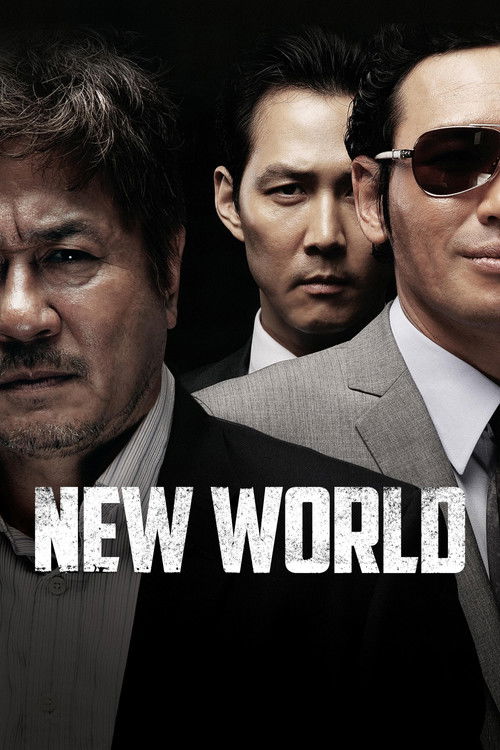
New World
2013 · Park Hoon-jung
For when you want a serious, chewy crime saga — the kind you lean forward into and argue about afterward — not a comfort watch, but deeply satisfying if you love loyalty-and-betrayal stories.
What it's about
Detective Ja-sung has spent eight years undercover inside Goldmoon, a crime syndicate that now runs more like a multinational corporation than a street gang. When the chairman dies suddenly, his police handler launches an operation to steer the succession — and Ja-sung is caught between the force that planted him and the criminal brothers who trust him, with both sides tightening their grip.
The experience
Slow-burning and coiled rather than action-packed: long stretches of maneuvering and dread punctuated by sudden, savage violence. It plays like a succession drama where every handshake might be a death sentence, and the moral ground keeps sliding out from under you.
Performances
Lee Jung-jae carries the film's exhaustion and dread as a man erased by his own cover story; Choi Min-sik is quietly ruthless as the police chief pulling the strings; and Hwang Jung-min nearly steals the whole thing as a flamboyant, foul-mouthed gangster whose loyalty is the film's beating heart.
The craft
Park Hoon-jung writes and directs with patient, chess-like plotting — the tension comes from information, not chases — then releases it in bravura set pieces, including a close-quarters brawl that's become iconic. Sleek corporate interiors and rain-slicked streets give the underworld a boardroom sheen.
Why it matters
A landmark of the modern Korean gangster film, hugely popular at home and a touchstone for how the undercover story can be told as corporate power struggle; it cemented Park Hoon-jung as a major crime filmmaker.
Snapshot
New World (신세계, Shin Se-gye) is a South Korean crime epic in which the undercover genre buckles under the weight of its own moral gravity. Detective Ja-sung (Lee Jung-jae) has spent eight years embedded in Goldmoon, the country's largest organized crime syndicate, watching its operations come to resemble a multinational corporation more than a street gang. When the chairman dies in a car accident, the police chief Kang (Choi Min-sik) launches "Operation New World," a gambit to steer Goldmoon's succession toward a loyalist before rival factions can consolidate power. What follows is less a procedural than a Shakespearean succession drama—a study of institutional loyalty, manufactured identity, and the point at which an undercover officer stops performing the criminal and becomes one. The film's final image, Ja-sung enthroned at the head of the organization he was sent to destroy, is one of the decade's most unsparing moral conclusions in world crime cinema.
Industry & production
New World was produced by Sidus FNH, one of South Korea's major mid-tier production houses, and released on February 21, 2013. It arrived at a moment when the Korean crime genre had matured into a commercially reliable and critically respected mode, partly on the strength of a generation of writer-directors willing to push past genre comfort zones. The production assembled a cast of exceptional commercial draw: Lee Jung-jae, Choi Min-sik (globally known by then from Oldboy), and Hwang Jung-min, whose performance here would accelerate his trajectory to becoming one of Korean cinema's most bankable stars. The film performed strongly at the domestic box office, drawing several million admissions and establishing itself as a tent-pole crime release. Exact admission figures varied across reporting sources and should be verified against the Korean Film Council (KOFIC) database rather than cited from memory. Park Hoon-jung wrote the screenplay as well as directing, an arrangement that gave the film unusual authorial coherence—the plot's labyrinthine corporate-gang structure required someone who understood the architecture from the inside.
Technology
New World was shot digitally, situating it within the post-celluloid transition that Korean genre cinema had largely completed by the early 2010s. The digital acquisition enabled the film's distinctive tonal range—its ability to move between the antiseptic blue-white of police interrogation rooms, the warm amber of gangster hospitality suites, and the cold steel of parking garages without losing visual precision. Digital intermediates allowed for the controlled desaturation that characterizes the film's institutional spaces, reinforcing the film's central argument that organized crime and the police state operate by identical logistical grammars. No distinctive or unusual technology is on record as having been deployed; the film's achievements are compositional and editorial rather than technical.
Technique
Cinematography
The cinematography, by Choi Young-hwan, is formal to the point of geometry. Goldmoon's executive meetings are framed as boardroom tableaux—wide, symmetrical, the camera at table height so that power is measured in proximity to the center seat. The film systematically uses deep focus in interior scenes to keep hierarchies legible across multiple planes; when characters are excluded from the frame's center, their marginalization reads as organizational fact. Handheld work appears sparingly, almost always keyed to Ja-sung's emotional disorientation rather than to action sequences per se. The color palette is one of the film's most expressive instruments: the police world runs cool, blue-tinged, fluorescent; Goldmoon's upper echelon favors warm interiors that read as more genuinely domestic than anything in Ja-sung's actual home life. This chromatic encoding of belonging is the cinematography's most pointed commentary—the gang's world looks like home; the law looks like a holding cell.
Editing
The editing by Yang Jin-mo manages an unusually dense information load—Goldmoon has multiple factions, the police have competing agendas, and Ja-sung occupies a position of lethal ambiguity within all of them—without resorting to the expository shortcuts common in ensemble crime films. Scenes are cut on decision rather than on action, so that the film's rhythm is dictated by cognitive turning points rather than physical ones. The result gives even the film's set pieces an analytical quality; violence arrives as the punctuation at the end of a logical argument rather than as spectacle inserted for tempo. The succession drama in the film's long middle section benefits from intercutting that holds the audience in the same information bind as Ja-sung, never granting omniscient perspective on which faction will prevail.
Mise-en-scène / staging
Park Hoon-jung stages the gangster world as a corporation in all but name. The film's iconic early sequence—a Goldmoon executive gathering that looks indistinguishable from a company retreat—announces the conceit immediately: men in suits, conference tables, organizational hierarchies debated through euphemism. This is a deliberate inheritance from and comment on the actual trajectory of Korean organized crime, which had by the 2000s increasingly structured itself through front companies and legal entities. The staging of physical violence is notably restrained relative to the genre's excesses; when it does arrive, it is abrupt and unglamorous, stripped of the balletic choreography associated with Hong Kong crime cinema. The exception is a celebrated corridor brawl sequence that borrows the functional brutality of Park Chan-wook's Oldboy (2003) while serving a different tonal purpose—it establishes not virtuosity but desperation. The private spaces afforded to Ja-sung and his closest Goldmoon ally, Jung Cheong (Hwang Jung-min), are staged as the film's warmest environments, a visual argument that these bonds are more real than any the police side can offer.
Sound
The film's most discussed sonic element is its deployment of Dvořák's Symphony No. 9 in E minor, "From the New World"—from which the film explicitly draws its title and some of its thematic register. The symphony's association with longing, displacement, and the idea of a promised land that may not exist provides an ironic counterpoint to Ja-sung's trajectory. The score (credited composers should be verified against the production's own records rather than assumed) operates largely in the register of restraint, favoring low tonal drones and sparse orchestration for the film's institutional spaces. Dialogue is mixed with unusual dryness in interrogation and meeting scenes, stripping ambient warmth from environments meant to feel bureaucratically hostile. Sound design in the violence sequences emphasizes weight—impacts are physical, not stylized—consistent with the film's anti-glamour argument about criminal work.
Performance
The three lead performances are constructed around different kinds of legibility. Lee Jung-jae's Ja-sung is the film's most technically demanding role: he must be performing an identity to every character in the film, including the audience, for most of its runtime, while registering the erosion of a self beneath the performance. Jung-jae achieves this through economy, holding his face in a near-permanent stillness that reads differently depending on who is observing him. Choi Min-sik, playing against his reputation for volcanic intensity, delivers Kang as a man whose cruelty is bureaucratic rather than passionate—perhaps the film's most disturbing performance precisely because of its reasonableness. Hwang Jung-min's Jung Cheong is the film's emotional pivot: a gangster whose charisma and genuine warmth toward Ja-sung are precisely what make his exploitation catastrophic. The bromantic chemistry between Lee and Hwang is the film's heart and its ethical trap.
Narrative & dramatic mode
New World operates in the register of the tragic succession narrative. Its deep structure is closer to Macbeth or the Henry IV plays than to the procedural thriller: a man is asked to serve an institutional power, finds himself more at home in the world he was sent to observe, and arrives at a throne whose legitimacy is entirely hollow. The film refuses the undercover genre's usual resolution—exposure, rescue, return—and instead follows the logic of identity displacement to its endpoint. Ja-sung does not infiltrate Goldmoon; over eight years, Goldmoon infiltrates Ja-sung. The screenplay's most sophisticated structural move is making the audience recognize this before Ja-sung does, and then watching the realization arrive. The film is also formally committed to withholding omniscience: we are never certain, for long stretches, whose plan is actually working, which aligns the audience with the cognitive condition of undercover work itself.
Genre & cycle
New World belongs to a distinct Korean crime cycle of the 2000s and early 2010s that might be characterized as the "corporate gangster" film—works that read organized crime through the grammar of late-capitalist business culture. Antecedents in the cycle include A Dirty Carnival (Yu Ha, 2006) and A Bittersweet Life (Kim Jee-woon, 2005), though New World takes the corporate metaphor further and more literally than either. The Infernal Affairs trilogy (Wai Ka-fai and Andrew Lau, Hong Kong, 2002–2003) is the genre's most direct international parent: the double-agent structure, the mutual infiltration of police and criminal organization, the question of which institution is more corrupting. Park Hoon-jung inherits this architecture and extends it by removing the possibility of a clean exit. The film also participates in a Korean genre tradition of the "noir of institutions"—films that treat every formal structure, whether state or criminal, as fundamentally equivalent in their demands on individual loyalty. Within Korean cinema, The Yellow Sea (Na Hong-jin, 2010) and I Saw the Devil (Kim Jee-woon, 2011)—the latter scripted by Park Hoon-jung—are close contemporaries in tone.
Authorship & method
Park Hoon-jung arrived at New World having established himself as one of Korean cinema's most gifted genre screenwriters. His script for I Saw the Devil (2011) demonstrated a willingness to follow moral extremity to its structural conclusions, and his screenplay for The Thieves (Choi Dong-hoon, 2012) showed facility with ensemble logistics. New World was a significant marker in his transition to director-writer, a role that gave him control over whether the screenplay's tonal exactitude survived into production. His method as a writer favors information-dense plotting in which characters are defined almost entirely by institutional function and the pressures those functions exert on individual psychology. He is not a filmmaker of interiority in the expressionist sense—his characters are legible through behavior and decision, not through conventional psychological depth. This approach suits crime narratives where identity is itself a performed construct. Cinematographer Choi Young-hwan's collaboration with Park produced a visual language well-matched to this behavioral emphasis: surfaces are read carefully because depths are withheld. Park subsequently continued in the crime genre with The Tiger: An Old Hunter's Tale (2015) and The Gangster, the Cop, the Devil (2019), consolidating a filmography defined by institutional violence and moral system failure.
Movement / national cinema
New World is a product of the mature Korean commercial cinema that consolidated in the decade following the 1998–1999 screen quota reforms and the boom years of the early 2000s. By 2013, Korean genre filmmaking operated with a sophistication and industrial confidence that allowed films like New World to be both commercially mainstream and formally serious without contradiction. The film participates in what critics and scholars have identified as a specifically Korean inflection of crime cinema—one preoccupied with the relationship between institutional legitimacy and organized power, reflecting a postwar history in which the line between state authority and criminal enterprise has been genuinely contested. The chaebols, the authoritarian governments, the corporate crime organizations—Korean cultural memory provides a context in which Goldmoon is not metaphor but near-reportage. This is the national cinema context that gives New World much of its particular gravity; the corporate-gangster conceit lands differently in a society with living memory of that overlap.
Era / period
The film registers the early 2010s moment in global crime cinema when the genre, energized by the critical and commercial success of the Korean wave's action output, was absorbing prestige-television influence—the long-form, institutional scale of The Wire (HBO, 2002–2008) had become a visible reference point for what crime drama could achieve in terms of systemic analysis. New World is perhaps the Korean feature most directly in conversation with that ambition: its ensemble scope, its interest in bureaucracy, and its refusal of individual heroism all read as feature-length responses to the prestige serial. It arrived the same year as the domestic success of The Attorney and participated in a broader early-decade moment in Korean cinema when films treating institutions—legal, criminal, political—with unsparing skepticism found substantial audiences.
Themes
The film's dominant thematic concern is the porosity of identity under institutional pressure. Eight years of undercover work have not left Ja-sung with a divided self so much as dissolved the original self entirely; the character the police file describes is a fiction, and the man Goldmoon knows is, paradoxically, more real. This is not a film about corruption in the conventional sense—Ja-sung is not seduced by money or power in crude terms—but about the way prolonged performance of a role constitutes the self that performs it. Adjacent to this is the film's interest in loyalty as the organizing principle of all institutions, criminal and state alike, and its argument that the police are simply a gang with better paperwork. Kang's willingness to sacrifice Ja-sung the moment the operation demands it mirrors exactly the Goldmoon leadership's willingness to destroy loyalists for organizational advantage. The film also engages, more quietly, with friendship as the only relationship that exists outside institutional logic—and then with the tragedy of what happens when friendship is built on a lie of identity.
Reception, canon & influence
New World was received on release as a major achievement in Korean genre filmmaking. Domestic critical response was largely enthusiastic, recognizing the ambition of the screenplay and the quality of the ensemble performances. The film accumulated a strong following in subsequent years as Korean cinema gained international visibility, and it is now regularly cited in discussions of the finest Korean crime films, alongside Memories of Murder (Bong Joon-ho, 2003), A Bittersweet Life, and The Wailing (Na Hong-jin, 2016). International festival and critical attention increased after Parasite (2019) intensified global interest in Korean cinema retrospectively.
Backward influences: The Infernal Affairs trilogy is the clearest progenitor of the structural architecture. The Godfather films (Coppola, 1972–1974) and their treatment of criminal succession as dynastic tragedy are evident in the film's scale and seriousness of moral purpose. Within Korean cinema, Kim Jee-woon's procedural noir work and the urban crime films of the mid-2000s cycle provide the immediate generic inheritance.
Forward influence: New World has been frequently cited as a touchstone by Korean filmmakers and audiences in discussions of the crime genre's potential for serious dramatic ambition. The film demonstrably influenced the visual and tonal register of subsequent Korean crime productions, and Park Hoon-jung's later work as director—The Gangster, the Cop, the Devil (2019) in particular—developed themes first articulated here. The film's ending, which refuses any redemptive reading, raised the stakes for what Korean crime cinema's moral conclusions could look like and arguably licensed subsequent films to follow through on their darkest premises. Its corporate-gangster framework was absorbed into Korean streaming crime dramas through the mid-2010s and beyond, including productions that treated organized crime's administrative infrastructure as dramatic subject matter in its own right. Whether New World directly shaped specific later works or operated as part of a broader genre evolution that it helped to crystallize is a question the record does not yet settle with precision.
A Deleuzian reading
There's a shot the film keeps returning to: a long table, men in good suits, the camera set at table height so you read power as a seating chart.
The full Deleuzian reading of New World →
Reception
A solid hit in Korea in 2013, it spent the next decade climbing from genre-fan favorite to consensus classic abroad — with a fresh wave of discovery after Squid Game sent viewers hunting down Lee Jung-jae's back catalog.
How New World was received, from release to now →
Influences: the films it descends from and the films it influenced
- Infernal Affairs (2002) — The intercutting-information-parity structure — parallel mole plots in which audience knowledge is calibrated exactly to each institutional side — is the direct architectural template for New World's dual-track suspense engine and its withheld-omniscience narrative design.
- The Godfather (1972) — Criminal hierarchy staged through deep-focus blocking that assigns spatial depth to rank — the boss recessed behind the desk, supplicants layered in the foreground — is the visual grammar New World inherits for its corporate-gangster mise-en-scène and its choreography of institutional power in enclosed rooms.
- The Godfather Part II (1974) — Shakespearean succession structured as dynastic tragedy in which the heir's ascent destroys the moral framework that made ascent worth having — the precise narrative architecture Park Hoon-jung reproduces in New World's refusal of any redemptive reading for its conclusion.
- Election (2005) — Triad succession staged as corporate board proceduralism — formal votes, negotiated legitimacy, administrative ritual — is the specific mise-en-scène template for New World's treatment of organized crime as institutional governance rather than romantic outlaw spectacle.
- Election 2 (2006) — Identity erosion through institutional compliance — the protagonist sacrifices individual ethics to remain structurally inside the organization — directly anticipates the performance mode of bureaucratic-restraint-as-self-dissolution that New World builds its central character arc on.
- A Bittersweet Life (2005) — The Korean institutional noir template: a loyal institutional actor destroyed by the hierarchy he faithfully serves, performed with controlled stillness against chromatic precision — the immediate generic predecessor whose tonal register and staging of anti-glamour violence New World works within and extends.
- Memories of Murder (2003) — Established procedural-institutional withheld omniscience — the killer is never conclusively identified — as a viable conclusion for serious Korean genre cinema, licensing New World's own refusal to resolve its moral arithmetic and raising the stakes for what Korean crime film endings could withhold.
- The Departed (2006) — Decision-cut editing rhythm in a dual-mole narrative — cuts timed to the moment of institutional decision rather than physical action — is the American-lineage refinement of the Infernal Affairs model that New World also inherits, with particular influence on the intercutting of information between police command and criminal hierarchy.
- The Yellow Sea (2010) — Anti-glamour violence aesthetics in Korean crime cinema — protracted, effortful, unglamorous physical struggle stripped of choreographic elegance — established the genre convention that New World deploys in its corporate-gangster staging of institutional violence as bureaucratic rather than spectacular.
- Nameless Gangster (2012) — Carries forward the serious, corporate-scaled Korean crime epic with overlapping ensemble loyalties and dialect-coded factions, extending Yoon's notion of the syndicate as a bureaucracy of personal relationships.
- The Gangster, the Cop, the Devil (2019) — Authorial descendant: Park develops New World's corporate-gangster institutional framework, retaining anti-glamour violence staging and bureaucratic performance restraint while shifting the succession crisis from undercover infiltration to open alliance politics between institutional power centers.
- Inside Men (2015) — Korean institutional corruption staged through the chromatic and spatial vocabulary of corporate mise-en-scène — conference rooms, hierarchical office blocking, the suit as costume-for-power — extending the generic convention New World crystallized into the explicitly political terrain of media and political corruption.
- Asura: The City of Madness (2016) — Undercover identity dissolution pushed to institutional complicity — a police detective coerced into serving the criminal hierarchy he investigates — extends New World's narrative architecture of identity erosion through bureaucratic entrapment, with the same withheld-omniscience information structure applied to the question of which institution the protagonist actually serves.
- Veteran (2015) — Corporate crime within legitimate conglomerate structure — the chaebol as criminal organization — extends New World's corporate-gangster framework into the specifically Korean institutional context of industrial capitalism, absorbing the staging convention where boardroom hierarchy and criminal hierarchy are visually indistinguishable.
- Night in Paradise (2020) — Park's own gangster epic establishes his fixation on loyalty, betrayal and the moral architecture of organized crime, plus his use of casting contrast among bosses; Night in Paradise strips that intricate machinery down to a single doomed line.
- Drug War (2012) — Undercover identity dissolution staged as a behaviorist exercise — characters perform institutional function so completely that personal identity becomes structurally undetectable — shares New World's identity-erosion-stillness performance mode and dry-dialogue procedural mix, arrived at concurrently through the shared Infernal Affairs lineage.
- The Thieves (2012) — Park Hoon-jung's own screenplay demonstrates his ensemble-logistics method — characters defined by institutional function and the pressures those functions exert — and the dry information-dense plotting that carries directly into New World's script architecture and its treatment of identity as performed construct.
- Confession of Murder (2012) — Demonstrates the mature-phase Korean genre film's tonal compression — tragedy, institutional critique, and action spectacle held within a single coherent register — the same tonal management problem Confession of Murder addresses through its media-satire frame.
Similar films
- The Gangster, the Cop, the Devil (2019) — influence & lineage · same viewing thread
- A Bittersweet Life (2005) — influence & lineage · same viewing thread
- Asura: The City of Madness (2016) — influence & lineage
- Memories of Murder (2003) — influence & lineage
- The Yellow Sea (2010) — influence & lineage
- Infernal Affairs (2002) — influence & lineage
- Sympathy for Mr. Vengeance (2002) — same viewing thread
- Lady Vengeance (2005) — same viewing thread
All the films related to New World →
Watch it with: curated runs of related films
- Elegant Savagery — A run of sleek, merciless thrillers where vengeance arrives in tailored suits and is paid in broken bone — watch these when you want beauty and brutality in the same frame.