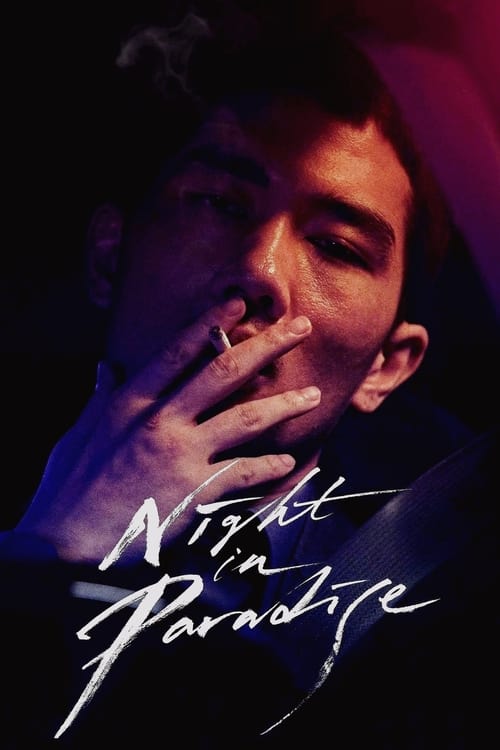
Night in Paradise
2020 · Park Hoon-jung
For when you want a gangster film that hurts — melancholy, fatalistic, gorgeous — and you're prepared for it to break your heart instead of pumping you up. A challenge watch, not a comfort one.
What it's about
Tae-goo, a loyal gang enforcer, refuses an offer to defect to the rival Bukseong outfit — and the refusal costs him his sister and niece. After taking bloody revenge on the rival chairman, he flees to Jeju Island to wait for passage abroad, where he's sheltered by an arms dealer and the dealer's terminally ill niece, Jae-yeon, a young woman with a caustic wit and nothing left to lose. Meanwhile the men he wronged are closing in.
The experience
Mournful and hushed between eruptions of ferocious violence — more a film about two doomed people keeping each other company than a rampage. It takes its time, lets the island's beauty sink in, and leaves you with a heavy, lingering sadness rather than a thrill.
Performances
Jeon Yeo-been is the standout as Jae-yeon, playing terminal illness with dry, unsentimental bite instead of pathos — she gives the film its soul and its sting.
The craft
Park Hoon-jung shoots Jeju's coastlines and gray skies with an elegiac calm that makes the brutality land harder, and stages the violence with punishing, unglamorous weight. The contrast between paradise scenery and noir doom is the film's whole visual argument.
Why it matters
Released globally on Netflix after premiering at Venice, it reached a wide international audience and stands as a key example of the Korean noir's melancholy, anti-cathartic streak.
Snapshot
Night in Paradise (낙원의 밤, Nak-won-eui-bam) is South Korean writer-director Park Hoon-jung's elegiac entry in the long lineage of Korean gangster noir — a revenge film that pointedly withholds the catharsis the genre conditions us to expect. Its protagonist, Tae-goo (Uhm Tae-goo), is a loyal enforcer for one crime organization who refuses an overture to defect to a rival outfit, the Bukseong gang headed by Chairman Doh; the refusal costs him his sister and niece, and his retaliatory slaughter of Doh forces him to flee to Jeju Island, ostensibly to await safe passage abroad. There he is sheltered by an arms dealer and the dealer's terminally ill niece, Jae-yeon (Jeon Yeo-been), a young woman with nothing left to lose and a caustic, fatalistic wit. What begins as a hideout interlude curdles into a closing pincer as Bukseong's ruthless second-in-command, Executive Ma (Cha Seung-won), tracks Tae-goo to the island. The film premiered out of competition at the 77th Venice International Film Festival in September 2020 and, with theatrical exhibition disrupted by the COVID-19 pandemic, reached most of its audience as a Netflix release in April 2021. It is at once one of Park's most controlled and most despairing works: a generic crime thriller in its bones, but one whose true subject is the futility of the violence its form depends upon.
Industry & production
Night in Paradise was produced through Goldmoon Film, the production company associated with Park Hoon-jung, and represents the work of a filmmaker operating with substantial autonomy within the Korean commercial industry. By 2020 Park had established himself as one of the most commercially bankable auteurs of Korean genre cinema, first as a screenwriter — most consequentially on Kim Jee-woon's I Saw the Devil (2010) and Ryoo Seung-wan's The Unjust (2010) — and then as the director of the gangster epic New World (2013), the period creature feature The Tiger (2015), the corporate-serial-killer thriller V.I.P. (2017), and the genre-bending action-horror The Witch: Part 1. The Subversion (2018). That track record allowed him to mount a star-driven crime picture with an established leading ensemble.
The most significant production circumstance is contextual rather than internal: the film was completed for theatrical release but arrived in the teeth of the pandemic, which decimated Korean and global box office through 2020–2021. Its selection for Venice 2020 — a festival held under heavy public-health constraints — gave it international prestige exposure, while distribution ultimately shifted to streaming via Netflix, which released it worldwide in April 2021. This places Night in Paradise among a cohort of Korean films whose intended theatrical lives were truncated and whose reception was reshaped by the streaming pivot. Hard release-window and box-office figures for the film are not the right register here; what matters is that a picture conceived in the theatrical idiom of Korean noir found its primary public on a platform, a fate that conditioned how widely and in what context it was seen.
Technology
Night in Paradise is a conventionally produced contemporary digital feature, shot for theatrical-scale presentation and offers no claim to technological novelty; its sophistication lies in craft rather than apparatus. The film makes pronounced use of location work on Jeju Island, exploiting the island's volcanic coastlines, agricultural interiors, and overcast maritime light as a counterpoint to the urban mainland scenes. The record does not indicate any unusual technical regimen, and it would be invention to claim otherwise; the technology is entirely subordinated to atmosphere and to the staging of its violence, which favors practical, tactile brutality over digitally augmented spectacle.
Technique
Cinematography
The cinematography is by Kim Young-ho, and it is among the film's most discussed assets. Kim works in a register of restrained, painterly composition that holds the camera at a contemplative distance for long stretches, allowing the Jeju landscape to function as an emotional field rather than mere backdrop — wide, becalmed frames of sea and stone that register as beautiful and indifferent at once. The palette tends toward cool grays, muted greens, and nocturnal blacks, with the island's diffuse daylight lending the central interlude a melancholy lucidity that the film will later violate. When violence erupts, the visual approach tightens and hardens, but Kim resists the kinetic, hyper-cut style common to the genre; the photography keeps its composure even in carnage, an aesthetic decision that frames the bloodshed as something to be soberly witnessed rather than thrilled to. The contrast between the serene compositions of the Jeju idyll and the abattoir clarity of the climax is the film's central visual argument.
Editing
The editing, by Jang Lae-won, organizes the film around a deliberately uneven rhythm that has divided viewers and is plainly intentional. The picture opens with a compressed, efficient establishment of the gangland double-cross and Tae-goo's revenge, then decelerates markedly once the action relocates to Jeju, settling into the slow accretion of the relationship between Tae-goo and Jae-yeon. This long central lull — patient, conversational, almost becalmed — is structurally load-bearing: it is the "paradise" the title names, the interval of grace that the film exists to destroy. The final movement then accelerates into sustained, escalating violence. The editing's refusal to maintain a uniform thriller tempo is the mechanism by which the film withholds genre gratification, making the audience inhabit the dead time of waiting before collapsing it into slaughter.
Mise-en-scène / staging
Park's staging draws a sustained opposition between worlds. The mainland gangster milieu is rendered in the familiar grammar of the Korean crime film — corporate offices, hospitals, clinics, the antiseptic spaces where organized violence wears a businessman's suit. Against this stands Jeju: the arms dealer's home, the coastline, the open agricultural land, spaces of provisional refuge coded as a respite outside the criminal economy. The staging of violence is notably frank and unbeautiful, emphasizing the physical labor and ugliness of killing rather than choreographed grace. Costuming and physical bearing do much of the characterization: Tae-goo's contained, watchful stillness; Jae-yeon's dishevelled, defiant carelessness as a dying woman who has stopped performing health; Executive Ma's impeccable, almost dandyish presentation, which makes his cruelty more unsettling. The recurring iconography of the sea and the island as a false sanctuary threads the staging throughout.
Sound
The score is by Mowg (Lee Sung-hyun), a frequent Park Hoon-jung collaborator whose work spans New World, V.I.P., and The Witch. For Night in Paradise Mowg supplies a spare, brooding soundscape that leans on ominous electronic textures alongside jazz-inflected and string elements, music that underscores the melancholy of the central interlude and the dread of the gathering threat without tipping into bombast. The sound design favors the naturalistic ambience of the island — wind, sea, the quiet of rural space — against which the abrupt, percussive noise of violence registers with greater shock. The contrast between near-silence and sudden brutality is integral to the film's affect.
Performance
Performance is where the film's restraint pays its deepest dividends. Uhm Tae-goo (credited internationally in several forms) plays Tae-goo as a study in suppression — a man hollowed by grief who externalizes almost nothing, his impassivity reading as both professional discipline and emotional death. The performance is deliberately undemonstrative, placing the weight of feeling beneath the surface. Jeon Yeo-been's Jae-yeon is the film's vital counterforce: acerbic, blackly funny, unsentimental about her own dying, she supplies the abrasive energy that the muted Tae-goo lacks, and the chemistry between the two — built on prickly companionship rather than romance — is the emotional engine. Cha Seung-won, a major Korean star, relishes the role of Executive Ma, investing the antagonist with a sardonic, theatrical menace that nearly walks off with the film; his late-arriving dominance reframes the closing act. Lee Ki-young and Park Ho-san anchor the surrounding criminal hierarchy.
Narrative & dramatic mode
Night in Paradise's dramatic mode is tragedy worked in the materials of the revenge thriller. Structurally it follows the genre template — wrong done, vengeance taken, flight, pursuit, reckoning — but it systematically denies the template's consolations. The revenge that motivates the plot is dispatched early and brings Tae-goo no relief, only a deeper enclosure in the machinery of retribution; the central Jeju interlude offers the possibility of an exit from that machinery and is precisely what the narrative is structured to foreclose. The film's mode is fatalistic: from the moment refuge is established, its destruction is felt as inevitable, and the dramatic interest lies not in whether the violence will come but in the bleak arithmetic by which it consumes everyone. The pairing of two characters already marked for death — Tae-goo by the gang war, Jae-yeon by terminal illness — gives the film the shape of a death-haunted two-hander, in which connection is offered only to be rendered futile. The closing movement, an extended bloodletting that resolves the plot while annihilating its human stakes, is the logical endpoint of a film whose argument is that the cycle of gangland vengeance leads nowhere but the grave.
Genre & cycle
The film is a Korean gangster noir, and it participates self-consciously in one of the most productive cycles of post-2000 Korean cinema — the organized-crime thriller as elaborated by films such as Kim Jee-woon's A Bittersweet Life (2005) and Park's own New World (2013). With A Bittersweet Life it shares a foundational situation: a loyal enforcer caught between bosses, undone by a refusal, propelled toward a doomed and bloody reckoning. Within that cycle, Night in Paradise is a deliberately austere and downbeat variant. Korean crime cinema is renowned for its operatic violence and tonal mixture of brutality and dark comedy, and the film deploys both, but it subordinates them to an elegiac fatalism that withholds the genre's customary momentum and triumph. It can be read as a critique from inside the cycle — using the full apparatus of the gangster film to insist on the emptiness of what that apparatus usually celebrates. The romance-on-the-run and the dying-woman melodrama are folded into the crime structure, complicating the pure revenge form with strands of tragic intimacy.
Authorship & method
Night in Paradise is a Park Hoon-jung film in the fullest sense — written and directed by him, produced through his own Goldmoon Film, and continuous with the preoccupations of his body of work. Park's authorship is defined by a fascination with loyalty, betrayal, and the moral architecture of criminal and institutional power, themes traceable from his screenwriting on I Saw the Devil and The Unjust through New World and V.I.P. What distinguishes Night in Paradise within that filmography is its restraint: where New World is expansive and intricately plotted, this film is pared down, slow, and tonally bleak, suggesting a director deliberately working against his own genre virtuosity. His method here is one of withholding — of building a meticulous genre machine and then refusing to let it deliver pleasure.
The key collaborators are integral to the result. Cinematographer Kim Young-ho realizes the film's contemplative-then-brutal visual scheme. Editor Jang Lae-won executes the deliberately unbalanced tempo on which the film's meaning depends. Composer Mowg, a recurring Park collaborator, supplies the spare, foreboding score that binds melancholy to dread. The casting of Cha Seung-won as the antagonist and the pairing of Uhm Tae-goo with Jeon Yeo-been reflect Park's instinct for using performance contrast — stillness against volatility — as a structural device.
Movement / national cinema
The film belongs to contemporary South Korean cinema at the height of its global visibility — the same national industry that produced the international breakthroughs of Bong Joon-ho and Park Chan-wook and that, by 2020, commanded unprecedented worldwide attention. It sits within the muscular tradition of Korean genre filmmaking, with its hallmark willingness to push violence, tonal complexity, and moral bleakness further than most national cinemas permit. Its production and release also illuminate a specific industrial moment: the deepening entanglement of Korean cinema with global streaming distribution, accelerated by the pandemic, whereby a film made in the theatrical idiom of national genre cinema reached its audience as international streaming content.
Era / period
Night in Paradise is a film of 2020 and is marked by its moment in ways both contextual and aesthetic. Industrially it is a pandemic-era production whose distribution was reshaped by the collapse of theatrical exhibition and the ascendancy of streaming. Aesthetically, it reflects a maturation of the Korean crime film roughly two decades into its modern run — a point at which the cycle's conventions are sufficiently established that a major practitioner can interrogate and deflate them from within. Its fatalism can be read against the genre's earlier exuberance: where the Korean gangster film of the 2000s often reveled in stylish excess, this 2020 entry turns that style toward exhaustion and mourning.
Themes
The film's governing theme is the futility of revenge and the inescapability of cyclical violence. Tae-goo's vengeance solves nothing and only binds him more tightly to the machinery that will destroy him; the film insists that within the gangland economy there is no exit, only postponement. Closely related is the theme of impermanent refuge — the "paradise" of the title is a bitter irony, a sanctuary that exists only to be violated, and the island idyll is structured as a grace period the film exists to revoke. Mortality saturates the work: both central figures are effectively already dead — Jae-yeon by illness, Tae-goo by his circumstances — and their fragile connection is an assertion of feeling in the face of certain extinction. The film also probes loyalty and its betrayal, the corporate banality of organized crime, and the way violence consumes the perpetrators along with their targets. Its final movement renders these themes literal in an accumulation of death that leaves no victor.
Reception, canon & influence
Night in Paradise was generally well received by critics, who praised its visual elegance, its performances — Cha Seung-won and Jeon Yeo-been singled out repeatedly — and its mournful, restrained tone, while a recurring critical reservation concerned its deliberate pacing, particularly the long central lull, which some found a structural risk and others its very point. Its Venice premiere conferred festival prestige, and its Netflix release gave it broad international reach within the wave of global interest in Korean cinema and content following Parasite and Squid Game. The specifics of its awards record beyond the Venice selection are not something I can detail confidently, and I will not invent them.
Looking backward, the film's most evident influences are the Korean gangster-noir tradition and, in its premise of a loyal enforcer caught between bosses and driven to a doomed reckoning, Kim Jee-woon's A Bittersweet Life (2005), alongside Park Hoon-jung's own New World (2013) and his formation on I Saw the Devil and The Unjust. The broader noir lineage of the doomed criminal and the fatalistic crime tragedy stands behind it as well.
Looking forward, Night in Paradise is too recent for its full legacy to be assessed, and it would be premature to claim a discernible line of films shaped by it. Its more durable significance to date is twofold: as a consolidation of Park Hoon-jung's standing as a leading voice in Korean genre cinema, and as a representative case of the pandemic-era migration of Korean theatrical genre filmmaking onto global streaming platforms — a film whose form belongs to the cinema and whose audience belongs to the stream.
Sources: IMDb full credits · La Biennale di Venezia 2020
A Deleuzian reading
Begin with the image the film keeps returning to: a man standing at the edge of Jeju's volcanic coast, the sea behind him gray and enormous and entirely uninterested in his grief.
The full Deleuzian reading of Night in Paradise →
Reception
Premiered at Venice 2020 to respectful-but-muted notices — many critics filed it as 'New World-lite' — then found a much bigger second life when Netflix dropped it worldwide in April 2021, where Korean-noir fans began arguing it was better than the reviews said.
How Night in Paradise was received, from release to now →
Influences: the films it descends from and the films it influenced
- A Bittersweet Life (2005) — Supplies the core template of the loyal enforcer destroyed by his bosses, paired with Kim's signature alternation of glassy, composed stillness and sudden brutal eruption — the contemplative-then-violent rhythm Night in Paradise inherits wholesale.
- New World (2013) — Park's own gangster epic establishes his fixation on loyalty, betrayal and the moral architecture of organized crime, plus his use of casting contrast among bosses; Night in Paradise strips that intricate machinery down to a single doomed line.
- I Saw the Devil (2010) — Park's screenwriting formation here — frank, unbeautiful violence staged without catharsis or stylistic relish — directly seeds the film's refusal to let bloodshed deliver pleasure.
- The Unjust (2010) — Another Park screenwriting credit whose cynicism about institutional power and the futility of clean outcomes underwrites the film's fatalism.
- Le Samouraï (1967) — The foundational model of the laconic, doomed professional killer rendered through spare framing, withheld dialogue and a cool muted palette where silence is the dominant register — the noir grammar of fatalism the film descends from.
- Le Cercle Rouge (1970) — Extends Melville's deterministic structure in which the criminal's defeat is foreordained from the first frame, modeling the anti-cathartic crime tragedy whose ending is mourning rather than payoff.
- The Killer (1989) — The Hong Kong heroic-bloodshed lineage of the honorable killer betrayed by his code, whose romantic fatalism the Korean gangster-noir tradition absorbed and Night in Paradise inherits in austerer form.
- A Better Tomorrow (1986) — Codifies the loyalty-and-betrayal melodrama between criminal brothers that the Korean noir tradition reworked; Night in Paradise keeps the emotional architecture while draining the operatic gunplay.
- Friend (2001) — Early pillar of Korean gangster-noir establishing the doomed-loyalty narrative and the tragic, mournful tone that the tradition Night in Paradise extends was built upon.
- V.I.P. (2017) — Park's own colder, bleaker genre exercise sharing the antagonist-driven structure and the willingness to push frank violence past the point of audience comfort.
- The Witch: Part 1 (2018) — Park's adjacent work pairing suppressed-stillness performance against sudden volatility and deploying contrast casting as a structural device — the same performance grammar Night in Paradise builds on with Uhm Tae-goo and Jeon Yeo-been.
- The Man from Nowhere (2010) — Korean revenge-thriller sibling sharing the lone-avenger figure and the alternation of quiet melancholy with concentrated, frank brutality, set against a cool desaturated palette.
- A Dirty Carnival (2006) — Korean gangster tragedy built on the same engine — a low-ranking enforcer climbing then crushed by the organization's hierarchy — sharing the genre's fatalistic determinism.
- Burning (2018) — Shares the deliberately withheld momentum and long central lull as a formal device, plus landscape-as-emotion cinematography where rural Korean space carries dread the plot refuses to discharge.
- The Wild Goose Lake (2019) — Contemporaneous Asian noir using painterly composition and a doomed fugitive criminal to fuse visual elegance with fatalism — the same marriage of beauty and bleakness, silence and sudden violence.
- Drive (2011) — Parallel revival of the Melvillian laconic killer through a spare electronic score, suppressed-stillness lead performance and pools of silence ruptured by abrupt violence — the same sound design ethos Mowg's score serves.
- No Country for Old Men (2007) — Shares the anti-cathartic crime structure that denies the genre's expected resolution, using near-scoreless silence and landscape to render violence as futile and inevitable rather than thrilling.
- Asura: The City of Madness (2016) — Descendant from the same Sanai-school authorship, carrying forward Asura's desaturated tragic-noir fatalism and the enforcer with no exit.
- Deliver Us from Evil (2020) — Contemporary doomed-enforcer strain: a hardboiled lead who is never given a redemption speech, an arc that terminates in mutual annihilation rather than absolution, and regional location work used as inescapable enclosure.
Similar films
- New World (2013) — influence & lineage
- A Bittersweet Life (2005) — influence & lineage
- I Saw the Devil (2010) — influence & lineage
- Burning (2018) — influence & lineage
- The Man from Nowhere (2010) — influence & lineage
- Beasts Clawing at Straws (2020) — shared sensibility
- Deliver Us from Evil (2020) — shared sensibility
- Lady Vengeance (2005) — shared sensibility
All the films related to Night in Paradise →