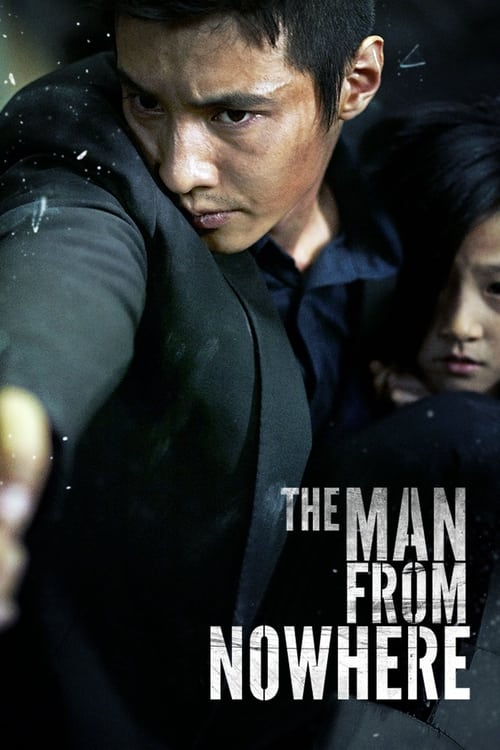
The Man from Nowhere
2010 · Lee Jeong-beom
When you're craving a hard-hitting action night — something sleek and cathartic that earns its emotion instead of just its body count. Not for the squeamish, deeply satisfying for everyone else.
What it's about
A silent, reclusive pawnshop owner in a Seoul backstreet has one human connection: So-mi, the neglected little girl next door, whose addict mother is mixed up with very dangerous people. When the girl is taken by a criminal organization trafficking in drugs and children, the pawnbroker's buried past as a special-forces operative surfaces — and he goes through the underworld like a blade to get her back.
The experience
Ferocious and surprisingly tender at once — long stretches of coiled quiet broken by some of the most bruising, precise action ever put on screen. It's a punch to the heart as much as the gut; the violence hurts because the bond at the center feels real.
Performances
Won Bin is magnetic in near-silence, carrying grief and lethal purpose in stillness, and young Kim Sae-ron matches him beat for beat as So-mi — their scenes together give the mayhem its ache.
The craft
Lee Jeong-beom stages the action with brutal clarity — no shaky-cam confusion, just controlled choreography that peaks in a knife fight of astonishing, close-quarters intensity. The film looks polished and shadowy, all rain-slick streets and neon, and it hits hardest loud and on a big screen.
Why it matters
South Korea's biggest domestic hit of 2010 and a benchmark for the modern lone-wolf action thriller — its stripped-down style and knife choreography echo through a decade of action cinema in Korea and Hollywood alike.
Snapshot
A near-mute ex-intelligence operative named Cha Tae-sik runs a pawnshop in a Seoul backstreet, pointedly removed from the world, until the kidnapping of So-mi—the neglected daughter of his drug-addicted neighbor—forces him back into the extreme violence he had buried. The Man from Nowhere (아저씨, Ajeossi, lit. "Mister" or "Uncle") became South Korea's highest-grossing domestic film of 2010 and one of the defining action pictures of the post-New Wave Korean commercial cinema. It operates in the tradition of the lone-wolf revenge thriller but sharpens the emotional grammar of the form with an unusual severity of craft: controlled staging, sparse dialogue, and a breakout physical performance from Won Bin that strips the genre of its usual bravura excess. The film travels the arc from withdrawal to intervention, asking what it takes to re-enter a world you have renounced—and at what cost.
Industry & production
The Man from Nowhere was produced by Opus Pictures and distributed by CJ Entertainment, the dominant force in Korean commercial cinema through the 2000s and 2010s. CJ's distribution infrastructure gave the film broad theatrical reach at a moment when Korean multiplex culture was fully established. The project centered on Won Bin, one of the most prominent television drama stars of the early 2000s (known to domestic audiences from Autumn in My Heart, 2000, and Friends, 2002) who had since completed his mandatory military service and was making his first major feature film in a lead role. His casting was a significant commercial gamble: a beloved drama celebrity submitting to a brutal, largely silent action part. That gamble produced the film's central tension—audiences familiar with Won Bin's romantic image watching him renegotiate his persona entirely. The production supported extensive pre-production training for Won Bin in hand-to-hand combat, knife technique, and firearms handling; reports at the time indicated months of dedicated preparation, which is visible in the unhesitating physical economy of his performance. Child actress Kim Sae-ron, born in 2000 and approximately nine or ten years old during principal photography, was cast as So-mi; her raw, unaffected screen presence was critical to grounding the film's emotional stakes. The film ran approximately 119 minutes. Specific budget figures are not reliably documented in English-language sources.
Technology
The Man from Nowhere was shot on 35mm film, placing it at the tail end of the analog era in Korean commercial production; digital intermediate processing was standard by this point, allowing the color grade to deepen the film's desaturated, steel-blue urban palette in post. The action sequences, particularly the climactic knife duel, used conventional camera and stunt methodology rather than the wire-heavy Hong Kong-inflected choreography that had dominated Korean action films a decade earlier. The lack of overt digital enhancement in the fight work is deliberate: the violence reads as unglamorous and kinetic rather than spectacular. Handheld photography is deployed selectively—disciplined rather than reflexive—keeping the visual grammar legible under pressure. There is no notable recourse to CGI augmentation; the film's technological choices consistently subordinate spectacle to credibility.
Technique
Cinematography
The film's cinematographer—whose credited contribution has received relatively little attention in English-language critical writing, a gap in the available record—establishes a palette of nocturnal blues, concrete grays, and the sickly amber of underpowered interior lighting. Seoul's lower-income residential quarters are rendered without picturesque poverty: cramped corridors, water-stained walls, fluorescent-lit stairwells. The framing of Won Bin is notably compressed, faces pushed close to the lens in a manner that reads less as vanity photography than as forensic inspection. The camera frequently denies the audience the wide-angle geography of action cinema; spatial orientation is withheld, the world reduced to the immediate surface of bodies in proximity. When space opens—in the film's urban night exteriors—there is a sense of hostile exposure rather than freedom. Key close-ups on So-mi isolate her smallness against adult scale, a compositional argument made without commentary.
Editing
The cutting is restrained by the standards of contemporaneous Hollywood action cinema. Rather than fragmented quick-cutting, the editing favours longer takes within action sequences, allowing Won Bin's physical preparation to be legible. The knife fight—the film's most formally ambitious sequence—achieves its effect partly through duration: the audience is not edited away from the difficulty and danger of close-quarters blade work. The pacing in the film's first act is notably slow for a genre picture, building dossier on Tae-sik's silence and disconnection before the thriller machinery engages. This patience is a calculated risk that the film's emotional payoff depends on; the editing structure earns the violence by delay.
Mise-en-scène / staging
Lee Jeong-beom stages his action with an emphasis on geometry and ground truth. The spaces are carefully blocked to exploit narrow corridors, staircases, and confined rooms rather than open arenas—environments that translate the film's thematic constriction into spatial fact. Choreography by the film's stunt team avoids the balletic stylization associated with John Woo or the theatrical excess of the Bourne series; instead, the physical language draws on practical military and law enforcement technique, with a visible debt to Filipino Kali/Eskrima knife-fighting systems in the close-quarters sequences. Staging is often built around economy of information: Tae-sik operates with minimum motion and maximum intent, a visual vocabulary of efficiency that communicates both his training and his desire to end violence as quickly as possible. The film does not linger on damage. Brutality lands and is passed through.
Sound
The film's sound design works in tandem with a score—credited, in available Korean production documentation, to Shim Hyun-jung, though English-language sources are thin on this—that blends orchestral tension-building with electronic textures appropriate to the urban-crime milieu. The score is restrained in the action sequences, allowing practical sound—blade impact, breath, footfall on concrete—to carry the physical argument. The deliberate sparseness of Tae-sik's dialogue means that silence itself becomes a sound design choice: the film trains the audience to read hesitation and stillness as communicative.
Performance
Won Bin's performance is the film's primary technical achievement. He suppresses the warmth his television audience associated with him and offers instead a face calibrated to minimal expressiveness: flat affect that breaks, very seldom, into something almost unbearably exposed. The emotional investment he generates comes not from conventional actorly demonstration but from the gradual revelation that stillness is a form of control over suffering. Kim Sae-ron's performance as So-mi operates in a different register—direct, impulsive, unguarded—and the interaction between their styles generates the film's emotional core. Thanayong Wongtrakul, a Thai actor cast as the principal assassin Ramrowan, brings a physical presence and cold deliberateness to the role that gives the climactic confrontation genuine menace; his casting across ethnic lines within the story's criminal network gives the film an unusual regional texture for Korean commercial cinema of the period.
Narrative & dramatic mode
The narrative logic is classical Hollywood genre structure adapted through Korean sensibility: the inciting event (So-mi's kidnapping) is delayed for a measured first act that establishes the stasis Tae-sik inhabits, then the thriller machinery drives toward its inevitable confrontation. The backstory—Tae-sik is a former intelligence operative who retreated from the world after the killing of his pregnant wife—is parcelled out in fragments, reaching completion only in the final act. This narrative withholding is both a genre convention (the mysterious past) and a psychological argument: the audience must discover who Tae-sik was in order to understand why he became who he is, and why rescuing So-mi is the one act that can reach him.
The dramatic mode blends action-genre procedural with something closer to melodrama in the Korean tradition—an emotional directness about grief and attachment that would be considered excessive or sentimental in equivalent Hollywood product but is normalized within Korean popular cinema's conventions. The film does not resolve its violence into catharsis in the American mode; the final images carry the weight of loss even inside the rescue. The relationship between Tae-sik and So-mi is not sentimentalized; it is observed, functional, and finally, quietly devastating.
Genre & cycle
The Man from Nowhere inhabits the surrogate-parent revenge thriller, a subgenre with robust international lineage. The most immediate reference point is Luc Besson's Léon: The Professional (1994): male killer withdrawn from society, relationship with a neglected child, reluctant return to lethal capability, emotional resolution through sacrifice. Lee Jeong-beom has not, in available interviews, denied the comparison, and it would be implausible to do so; the structural and thematic parallels are too specific to be coincidental. The film is, however, more than a reworking: it internalizes the template through distinctly Korean formal habits—pacing, tonal register, the specific inflection of male grief—and produces something that reads as its own object.
It also participates in the broader early-2010s cycle of "paternal action" cinema—Liam Neeson's Taken (2008) was the Hollywood marker of the same commercial logic—in which the action hero's motivation is relocated from professional obligation to protective love, and the body of a child becomes the primary dramatic stake. Within Korean cinema, it belongs to a commercial action tradition that had been building competence through the 2000s—films like A Bittersweet Life (Kim Jee-woon, 2005) and The Chaser (Na Hong-jin, 2008)—and that would continue in its wake.
Authorship & method
Lee Jeong-beom's first feature, Cruel Winter Blues (잔인한 겨울, 2006), was a crime film that demonstrated facility with genre without attracting the international attention The Man from Nowhere would command. His directorial method, as far as available production accounts allow inference, privileges physical authenticity over stylization and resists the operatic excess of the Korean genre cinema that preceded him. He wrote the screenplay as well as directing, and the careful withholding of backstory and motivation across the script's structure reflects a writerly patience with the audience. His collaborators on the film—cinematographer, composer, and editor—are not extensively documented in English-language scholarship, a significant gap in the available critical record that reflects the general underrepresentation of Korean production craft in Western film studies. What is documented is Won Bin's account of Lee's insistence on preparation and physical authenticity; the director appears to have treated action choreography as an extension of character rather than spectacle. Lee's subsequent directing output has been sparse, which has had the effect of making The Man from Nowhere stand as a self-contained achievement rather than one entry in a developing filmography—an authorial situation not unlike that of certain benchmark films in Korean cinema.
Movement / national cinema
The Man from Nowhere sits within the second major phase of the Korean commercial cinema revival that had begun in the mid-1990s. The first phase—associated internationally with Park Chan-wook, Bong Joon-ho, Kim Ki-duk, and the Pusan International Film Festival's global promotion of Korean auteur work—established Korea's reputation through formally ambitious, often extreme art-genre hybrids. By 2010, that auteur wave had created a critical infrastructure and international distribution framework on which commercially oriented genre films could build. The Man from Nowhere is emphatically a commercial mainstream film, not an art-cinema intervention, but it benefits from the elevated craft standards the auteur decade had installed across Korean production. It represents "Chungmuro"—the traditional center of Korean film industry—operating at a high competence level within popular forms, a demonstration that Korean genre cinema had matured beyond the point of needing foreign templates to structure its ambitions.
The film's implicit treatment of Korean-Chinese organized crime networks, drug economies in low-income urban districts, and the invisible operational structures of the security state is culturally specific in ways that Hollywood genre equivalents rarely are; the social geography is local even when the thriller architecture is global.
Era / period
The film belongs to the period of Korean cinema's gradual accumulation of global visibility—a decade-long process that would achieve its culmination with Parasite's Palme d'Or and Academy Award sweep in 2019. In 2010, Korean cinema had international festival prestige but limited mainstream Western penetration. The Man from Nowhere circulated internationally through online fandom and informal distribution—it was among the most-watched Korean films outside Korea in the early 2010s—and served as a gateway work for international audiences discovering Korean cinema, alongside Oldboy and The Chaser, without requiring the cultural contextualization demanded by more formally demanding Korean work. It occupies a hinge period: post-art wave, pre-full global mainstream, when Korean genre competence was being assembled into a form that could travel on its own commercial terms.
Themes
The film's primary thematic territory is male grief as a form of social death. Tae-sik's withdrawal from the world is not presented as strength but as a form of living entombment; the film is interested in what it means to have survived when those you were responsible for did not, and what the specific economy of violence and love might demand of someone so situated. The child So-mi functions not as an object to be rescued but as an agent who perceives Tae-sik's condition and chooses to maintain the connection he would sever: her insistence on their bond is the film's emotional engine.
Secondary themes include the invisibility of urban poverty (the world Tae-sik and So-mi inhabit is made of precarity and neglect), the instrumentalisation of the vulnerable by criminal economies, and the ethics of a state that trains men to kill and discards them. The Korean security apparatus looms as a structural absence in Tae-sik's past—present in his capacity for violence, absent in any protective or redemptive function. The film does not politicize this observation but allows it to sit within the narrative as a given condition.
The father-surrogate bond that structures the film is notably uncomplicated by the anxieties that attend similar relationships in Western genre cinema; Korean melodrama's conventions allow direct emotional investment in protective attachment between unrelated adults and children without the cultural static that would qualify it elsewhere.
Reception, canon & influence
Critical reception. The film was a significant commercial success in South Korea, achieving approximately six million admissions—figures placing it at the top of the domestic 2010 box office, outperforming both Korean and Hollywood competition for its run. These approximate figures are widely cited in Korean entertainment press; precise verified numbers should be sourced from KOFIC (Korean Film Council) records. International critical reception was initially limited to festival and online circuits; as the film circulated more widely, it attracted sustained positive notice for its craft discipline and Won Bin's performance, if not for formal innovation. Korean-language critical discourse acknowledged it as a competent commercial achievement within a tradition, not as a landmark comparable to the auteur films of the preceding decade.
Influences on the film (backward). Léon: The Professional (Besson, 1994) is the unavoidable structural predecessor. John Woo's heroic-bloodshed films, particularly A Better Tomorrow (1986) and The Killer (1989), inform the emotional intensity placed around male action protagonists, even as the visual style diverges sharply. Within Korean cinema, A Bittersweet Life (Kim Jee-woon, 2005) had recently demonstrated that Korean action cinema could sustain stylistic rigor alongside genre mechanics. The Japanese chambara (sword-fight film) tradition—particularly its emphasis on the dueling body as a site of moral disclosure—is legible in the film's approach to blade work. American neo-noir procedurals in the Mann tradition (Heat, 1995; Collateral, 2004) contribute to the urban-night visual vocabulary. The spare, damaged male figure of Korean noir melodrama, traceable through decades of domestic genre production, provides the tonal register for Tae-sik's interiority.
Legacy and forward influence. The Man from Nowhere consolidated Won Bin as a cinematic actor rather than a drama celebrity, though he has appeared in very few projects since, making the film effectively a singular statement within his screen career. The film contributed substantially to the international pre-streaming audience for Korean genre cinema and is frequently cited as an entry point in personal accounts of discovering Korean film. Within Korean commercial production, it set a benchmark for the integration of credible physical action and emotional architecture that subsequent action thrillers—including The Outlaws series, The Gangster, the Cop, the Devil (2019), and others—negotiated against. The surrogate-parent action thriller format it exemplifies has remained commercially productive in Korean cinema through the 2010s and into the 2020s. Its global circulation ahead of the mainstream Hallyu breakthrough means it occupies an unusual position: a gateway work that predates the gate, familiar to dedicated international audiences long before Korean cinema became a media-industry talking point.
A Deleuzian reading
Start with the face.
The full Deleuzian reading of The Man from Nowhere →
Reception
A massive hit at home — the best-selling Korean film of 2010 — it then traveled abroad as a cult action discovery, and post-John Wick it got re-canonised as the sleek revenge thriller that was doing 'one man, one mission' cool years early.
How The Man from Nowhere was received, from release to now →
Influences: the films it descends from and the films it influenced
- Léon: The Professional (1994) — The child-in-jeopardy surrogate-parent dyad as structural engine — the specific device of a child's mortal jeopardy forcing a withdrawn professional killer back into violence, providing both the action motor and the protagonist's sole emotional aperture.
- Le Samouraï (1967) — Melville's behavior-only characterization of the male professional — constructing interiority entirely through observed routine, a sparse apartment, and withheld dialogue rather than exposition, the direct antecedent for Tae-sik's minimalist affect and Lee's first-act silence.
- Heat (1995) — Mann's first-act procedural patience that withholds character motivation behind professional observation — the delayed-revelation technique of building a male protagonist's interiority through disciplined deferral before emotional rupture, which informs Lee's fragmented backstory structure.
- Collateral (2004) — Mann's specific steel-blue desaturated nocturnal urban palette — color temperature and digital stock controlled to render city nightscape as morally evacuated blue-gray environment, the direct visual ancestor of Lee's cinematographic register.
- Oldboy (2003) — Park's unbroken long-take corridor fight — the formal device of staging sustained combat in a single extended shot so that physical exhaustion is embedded in viewing duration, the specific technique Lee adapts for the pharmacy sequence and establishes as a Korean genre signature.
- A Bittersweet Life (2005) — Kim's establishment of geometric framing within confined Korean urban interiors as a viable action-film visual grammar — demonstrating that stairwells, corridors, and hotel rooms could constitute rigorous spatial staging, setting the aesthetic threshold Lee inherits.
- The Killer (1989) — Woo's melodramatic honor-code frame for professional violence — the convention of surrounding a hitman's action with registers of loyalty, sacrifice, and masculine moral clarity that Lee inherits as a structural skeleton while stripping away the operatic visual excess.
- A Better Tomorrow (1986) — The heroic-bloodshed grammar of male withdrawal and reentry — the damaged man estranged from violence whose emotional obligation to another forces his return, providing the tonal and moral architecture the Korean paternal action cycle later secularizes.
- Sanjuro (1962) — Kurosawa's grammar of the deferred warrior — the apparently ordinary withdrawn figure whose sudden eruption of physical mastery constitutes a moral disclosure, structuring the entire logic of Tae-sik's pawnshop first act and establishing the chambara convention Lee's eskrima choreography inherits.
- John Wick (2014) — Wick extends the withdrawn male professional — specific physical discipline staged in long-take sequences within confined architectural geometry — into global commercial cinema, absorbing the legible-choreography/spatial-constraint formal vocabulary that Lee's film helped disseminate through pre-streaming international audiences.
- Atomic Blonde (2017) — Leitch extends the long-take stairwell combat sequence — a formal device running through the Oldboy/Man from Nowhere lineage — into a sustained set piece where exhaustion and duration become the action's explicit subject, retaining the desaturated blue-gray nocturnal palette as the tradition's visual signature.
- The Outlaws (2017) — The commercially dominant Korean franchise that absorbed Lee's integration of physical combat credibility with surrogate-protection emotional architecture, demonstrating that Man from Nowhere's formal synthesis had become the domestic action-genre standard — the benchmark measured against rather than a singular exception.
- Deliver Us from Evil (2020) — Hong directly extends Lee's surrogate-parent revenge-action template — damaged professional, child in jeopardy, kali-adjacent close-quarters knife choreography, desaturated palette — making explicit the continuation of Lee's specific formal vocabulary within the Korean commercial genre tradition.
- The Gangster, the Cop, the Devil (2019) — Codified the hyper-real impact-weight action register in Korean genre cinema — the sound design and physical staging of body-on-body collision as percussive spectacle — that Akinjeon's action sequences adopt as genre standard.
- Nobody (2021) — The Korean action template of a quiet, unremarkable-looking man with suppressed professional combat training provoked into defense supplies Nobody's core narrative premise and its approach to close-quarter knife and gun work staged in domestic and commercial spaces.
- Drive (2011) — Both films, released within months of each other, independently converge on silence and ambient sound as the primary register of masculine interiority — substituting score and exposition with environmental sound to externalize a surrogate-protector's affect, parallel formal solutions to the same problem.
- The Raid: Redemption (2011) — Evans and Lee independently arrive at the formal principle that confined spatial architecture generates choreographic vocabulary — building fight sequences from the geometry of enclosed rooms and corridors rather than imposing choreography onto neutral settings, each film discovering the same constraint as creative engine.
- I Saw the Devil (2010) — Produced simultaneously, the film deploys the identical desaturated nocturnal steel-blue palette to frame brutality as morally evacuated — both films represent Korean genre cinema using color temperature to refuse the expressive-lighting conventions of the preceding decade at the same production moment.
- Night in Paradise (2020) — Korean revenge-thriller sibling sharing the lone-avenger figure and the alternation of quiet melancholy with concentrated, frank brutality, set against a cool desaturated palette.
Similar films
- A Bittersweet Life (2005) — influence & lineage · same viewing thread
- I Saw the Devil (2010) — influence & lineage · same viewing thread
- Deliver Us from Evil (2020) — influence & lineage
- Oldboy (2003) — influence & lineage
- John Wick (2014) — influence & lineage
- The Killer (1989) — influence & lineage · same viewing thread
- A Better Tomorrow (1986) — influence & lineage · same viewing thread
- Sympathy for Mr. Vengeance (2002) — same viewing thread
All the films related to The Man from Nowhere →
Watch it with: curated runs of related films
- Elegant Savagery — A run of sleek, merciless thrillers where vengeance arrives in tailored suits and is paid in broken bone — watch these when you want beauty and brutality in the same frame.