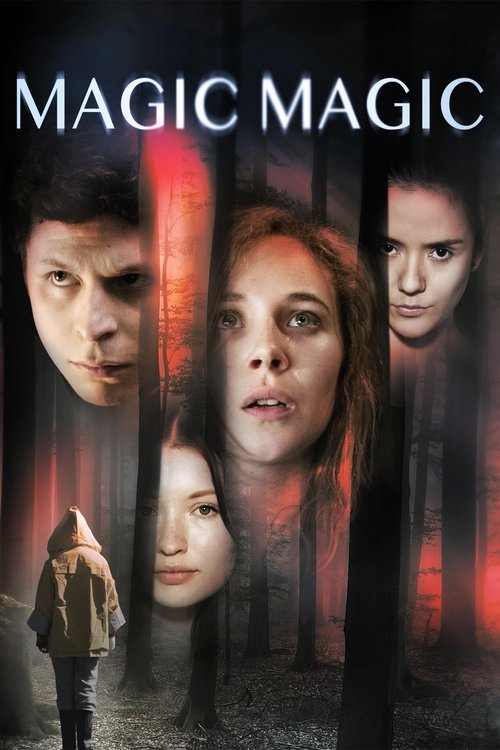
Magic Magic
2013 · Sebastián Silva
For when you want a quiet, unnerving psychological spiral rather than jump scares — a film that makes you squirm through awkward silences. Definitely a challenge watch, not a comfort watch; reach for it when you're ready to sit in dread.
What it's about
A young American woman travels to Chile to visit her cousin, then joins a trip to a remote island in the country's south with people she barely knows. When the cousin is abruptly called away, she's stranded among strangers — a boyfriend, his sister, and an American friend whose teasing carries a quiet edge of cruelty. She stops sleeping, and her grip on what's real starts to slip while the group treats her distress as a mood or a joke.
The experience
Slow-creeping and claustrophobic — less a thriller of events than of social discomfort, where every group interaction tightens the screws. It gets under your skin by making you share the heroine's uncertainty about whether she's paranoid or genuinely being toyed with, and it leaves a bruised, uneasy feeling rather than a cathartic one.
Performances
Juno Temple is remarkable as Alicia, charting a believable descent from jet-lagged awkwardness into real breakdown, and Michael Cera plays startlingly against type — his familiar nervous charm curdled into something mocking and quietly menacing.
The craft
Sebastián Silva builds horror almost entirely out of social behavior: misread jokes, small cruelties, and the isolation of not speaking the language around you. The remote Chilean island setting does real work, its damp forests and grey water making the psychological entrapment physical. It's a film of mood and performance rather than spectacle, best watched somewhere quiet where its slow accumulation can hold you.
Why it matters
It marked an unsettling left turn for Silva and became a cult example of Michael Cera deliberately dismantling his nice-guy screen persona, finding its audience over time after a quiet release.
Snapshot
Magic Magic is a psychological thriller by the Chilean writer-director Sebastián Silva. A young American woman, Alicia (Juno Temple), travels to Chile to visit her cousin Sara (Emily Browning). She joins Sara and a small group of Sara's friends on a trip to a remote island in the south of the country. Sara is called away almost as soon as they arrive. Alicia is left with people she hardly knows: Sara's Chilean boyfriend Agustín (Agustín Silva, the director's brother), his sister Bárbara (Catalina Sandino Moreno), and Brink (Michael Cera), an American who is by turns friendly, mocking and quietly hostile. Alicia stops sleeping, and her hold on reality starts to give way. The others treat her distress as a mood, a joke or an inconvenience, and their responses grow steadily less adequate.
The film premiered in the Park City at Midnight section of the Sundance Film Festival in January 2013 and was then selected for the Directors' Fortnight at Cannes that May. Its photography is by Christopher Doyle, best known for his work with Wong Kar-wai. Magic Magic was shot in Chile in the same period as Silva's Crystal Fairy & the Magical Cactus (2013), which also starred Cera, and the two films are usually discussed together. Crystal Fairy is a loose, comic road movie about a mescaline trip. Magic Magic turns similar material, Americans abroad in Chile with an abrasive outsider among them, toward dread. It has a modest but steady reputation. It is admired for Temple's committed performance and for casting Cera against type as a menacing figure, and it is often cited among 2010s films that place psychological horror inside a social group that refuses to take a woman's suffering seriously.
Industry & production
Magic Magic is an English-language film made in Chile. It sits between the American independent sector and Chilean production. Silva came to it after the international festival success of La Nana (The Maid, 2009), which won the World Cinema Grand Jury Prize for drama at Sundance, and his reputation from that film allowed him to make two English-language features with American actors on Chilean locations. Michael Cera's involvement in both Magic Magic and Crystal Fairy was central to the double project. Cera had been living in Chile around that time, and accounts from the period tie the two films to his collaboration with Silva.
Detailed public information on the financing, producers' shares and budget is limited. The film was clearly a low-budget production built around a small cast, a handful of locations and a short shoot, and this account does not give figures. After Sundance and Cannes it was released in the United States in 2013 on a small scale that leaned toward on-demand and digital platforms rather than a wide theatrical run, which was typical of genre-adjacent independent films of the time. Box-office figures are not reported here. Like many films of its kind, it found most of its audience after release, through streaming and word of mouth among genre viewers.
Technology
The film uses ordinary contemporary digital and lightweight production methods. It does not depend on any technological innovation. What matters technically is how few resources it needs: natural and practical light in rural houses, exterior work in variable southern Chilean weather, and a small crew suited to remote locations. Doyle had long been known for handheld, available-light work, and he adapted that approach to an environment with a very different light from his urban Hong Kong films: wet, overcast and green-grey. Published technical detail on the camera package and finishing pipeline is thin, so this account does not specify formats.
Technique
Cinematography
Doyle's camera does most of the work of putting Alicia's instability on screen. The images are often close and mobile, and they stay near Temple's face and body. The effect is less of watching her than of being trapped with her. The southern Chilean landscape of water, forest, mist and wooden houses is shot to make it beautiful and claustrophobic at once. The open space around the house offers no escape, and the island becomes a pressure chamber. Doyle uses changing light and soft, diffused exteriors so that day never fully reassures, and the night scenes, when Alicia lies awake, are shot in low, enveloping darkness that blurs where things are.
Critics noted how unusual Doyle's presence was in a small genre-inflected film. His habits from the Wong Kar-wai films show up in a quieter form here: skewed angles, a readiness to let the frame drift, and an interest in texture over clarity. The cinematography does not present Alicia's hallucinations as stylized set pieces. It erodes stability gradually, which suits a film more interested in ambiguity than in shocks.
Editing
Detailed attribution of the editing team is not covered here beyond its effects. The cutting follows Alicia's sleep deprivation. Time becomes less certain as the film goes on, scenes start and stop abruptly, and the plain rhythm of the opening, with its arrivals, meals and swims, gives way to a more broken structure as Alicia's sense of continuity breaks down. The film avoids the conventional thriller's build-and-release pattern. It lets awkward social scenes run on past the point of comfort and treats the long silences of a weekend among strangers as a source of tension.
Mise-en-scène / staging
The main setting is a rural house on an island, reached by ferry and car. It is the familiar isolated-retreat setting of horror cinema, but nothing here is obviously supernatural. Silva stages many scenes as group tableaux: people around a table, in a car, on a dock. Alicia is placed slightly apart in the frame, half-included and half-excluded. The staging turns social exclusion into something spatial. Conversations in Spanish go on around her while she stands in the doorway or at the edge of the group. Animals, the domestic routines of the household, and local customs and remedies form a background whose meaning shifts with Alicia's state, so that ordinary rural life becomes ominous through her eyes.
Sound
Sound is a primary source of the film's unease. Doyle's images are soft-edged, and the soundtrack fills in the menace: wind, water, animal noises, the creaking of the house at night, and stretches of near-silence. Language works as a sound element too. A good deal of the dialogue is in Spanish, and Alicia, who speaks little of it, is often surrounded by speech she cannot follow. The audience shares her alienation, or watches it from outside, depending on whether they understand Spanish. Brink's habit of switching languages and his talk of hypnosis make speech itself a tool of manipulation. This account does not name a composer, because published credits for a conventional score are not well documented. The film's acoustic identity rests on ambient and diegetic sound more than on music.
Performance
Juno Temple's performance is the film's centre and the element reviewers praised most consistently. She plays Alicia's breakdown physically: exhaustion, hypersensitivity, sudden flashes of hostility and desperate appeals for help. She does not make the character simply likeable or simply a victim. Alicia is anxious, awkward and sometimes abrasive, and this complicates the audience's sympathy in a way that mirrors the other characters' failure of empathy.
Michael Cera's Brink is the film's most talked-about piece of casting. Up to then Cera had been known for gentle, awkward comic roles in Superbad, Juno and Arrested Development. Here he turns the same mannerisms (the halting delivery, the deadpan, the boyish manner) into something needling and sinister. Brink teases, intrudes and plays games with Alicia's mind, and it is never quite clear whether he is malicious or merely oblivious. Taken alongside his unbearable American traveller in Crystal Fairy, the role is a deliberate deconstruction of Cera's screen persona.
Emily Browning's role is brief by design, since Sara's departure sets the crisis in motion. Catalina Sandino Moreno, Oscar-nominated for María Full of Grace (2004), plays Bárbara with a reserve that reads as coldness. Agustín Silva's Agustín is easygoing and ineffectual, and he embodies the film's central diagnosis: the harm here comes less from cruelty than from casual neglect.
Narrative & dramatic mode
The film's structure is close to that of a chamber piece. A small group, a confined location and a short span of time combine with steady psychological escalation. It begins as a trip abroad and turns gradually into a descent into derangement, and it withholds a firm answer about the cause. Insomnia, mental illness, a hostile environment, manipulation by Brink, and the local suggestion of something supernatural are all available as explanations, and none is confirmed.
This ambiguity is the film's central dramatic strategy. The audience mostly shares Alicia's point of view, but is also shown how she looks to the others: irritable, erratic, an awkward presence on someone else's holiday. The suspense depends less on external threat than on the growing gap between her experience and the group's response. The others' improvised attempts to handle her, which draw on folk remedy and amateur intervention instead of real medical help, lead to the bleak outcome the TMDB synopsis summarizes as being ignored "until it's too late." The ending is abrupt and offers no catharsis or explanation.
Genre & cycle
The film is billed as a thriller, but it sits on the boundary between psychological thriller, psychological horror and art-house drama. Its most obvious genre ancestors are films about a woman's mental disintegration in which the audience cannot tell whether the threat is internal or external: Polanski's Repulsion (1965) and Rosemary's Baby (1968), and Robert Altman's Images (1972). It also belongs with "travel horror," films in which the foreign setting itself becomes a source of menace. Magic Magic adjusts that formula by making the American visitor's isolation partly her own doing. The locals and companions are not monsters so much as indifferent, and the film is aware of how the tourist's anxiety projects threat onto the landscape and culture.
It appeared in the early 2010s, a period of festival-supported, slow-burn, ambiguous psychological horror that would become far more visible later in the decade. Its premiere in Sundance's midnight programme places it in the festival circuit's growing appetite for genre films made by art-cinema directors.
Authorship & method
Sebastián Silva (born 1979, Santiago) wrote and directed the film. His work across features keeps returning to class tension, domestic space and the strain of social bonds. La Nana follows a live-in maid whose hold on a household's affections grows fierce and territorial. Old Cats (Gatos viejos, 2010) is a claustrophobic family drama set in an apartment. After Magic Magic and Crystal Fairy came Nasty Baby (2015), set in Brooklyn; Tyrel (2018), an American study of racial isolation at a weekend getaway; and Rotting in the Sun (Pudriéndose al sol, 2023), a dark meta-comedy. Tyrel has the closest structural affinity with Magic Magic. In both, a lone outsider is surrounded by a group on a retreat, and social discomfort hardens into dread. Silva's method favours small casts, naturalistic and partly improvised performance, family members and close collaborators in the cast (here his brother Agustín), and confined settings.
Christopher Doyle shot the film. Known above all for Chungking Express, Happy Together and In the Mood for Love, Doyle brought international prestige and a distinctive sensory, improvisatory approach to the camera. His collaboration with Silva illustrates how the 2010s festival circuit let cinematographers of world-cinema stature work on small, internationally made genre projects.
Information on the editor and composer is not set out here because the public record is too thin to state it with confidence. The film's sound and editing are best read as serving Silva's overall design.
The Cera collaboration. The film cannot be separated from its companion piece, Crystal Fairy & the Magical Cactus, which Silva made with Cera at about the same time and which won Silva the directing award in Sundance's World Cinema Dramatic competition in 2013. Together the two films amount to a two-part study of the American abroad in Chile: one comic and disarming, the other paranoid and tragic.
Movement / national cinema
Silva belongs to the generation of Chilean filmmakers who gained international attention from the late 2000s, sometimes grouped as the novísimo cine chileno. The group includes Pablo Larraín, Sebastián Lelio, Alicia Scherson, Matías Bize and Dominga Sotomayor, among others. These directors, supported in part by state funding and the festival circuit, brought Chilean cinema to a level of international visibility it had not had in decades.
Magic Magic is an unusual case within that context. It is in English, its protagonists are foreigners, and its genre is not typical of the movement's realist and political tendencies. Even so, it uses Chilean landscape and Chilean characters to examine outsiders' perception, and its interest in class and social belonging links it to Silva's Chilean work. The film shows a wider trend of the period, in which Latin American auteurs with festival reputations moved into English-language or transnational co-productions without leaving their home country.
Era / period
The film belongs to the early-2010s independent landscape, shaped by digital production, festival premieres leading to VOD and streaming distribution, and the growing prestige of "elevated" or art-house horror. It came out shortly before the wave of A24-era psychological horror (The Babadook, It Follows, The Witch, Hereditary, Midsommar) and shares that wave's interest in grief, mental illness and social dynamics framed through genre. It also reflects the period's wariness of the American traveller abroad, seen in films and series that cast Western tourists as entitled, oblivious or out of place. Casting Cera, a defining comic face of late-2000s American youth culture, in a sinister role fits the decade's habit of turning familiar personas against themselves.
Themes
Disbelief and neglect. The film's central theme is the failure to believe a person in distress. Alicia's companions keep reading her terror as excess, rudeness or a bid for attention. The horror lies in their banal inattention, the social pressure to keep the holiday pleasant, more than in any monster. Many readers have linked this to how women's mental and physical suffering is dismissed.
Language and exclusion. Alicia's limited Spanish and the group's code-switching make communication itself a theme. Not understanding becomes a kind of exile, and Brink turns linguistic and psychological games into a means of control.
The outsider's perception. The film questions the traveller's gaze. Chile's landscape and folk customs appear threatening partly because Alicia's fear makes them so. The film refuses to make the locals villains, and that refusal points the critique back at the visitor and at the group.
Sleep, mind and suggestion. Insomnia, hypnosis and suggestibility appear throughout. Brink's hypnosis game and the group's improvised remedies show how fragile perception is, and how easily other people can shape a vulnerable mind.
Ambiguity of the supernatural. The title's doubled "magic" hints at folk belief, illusion and stage trickery. The film keeps the supernatural and the psychological unresolved.
Reception, canon & influence
Critical reception. Reviews from the Sundance and Cannes screenings and the 2013 release were mixed to positive. Critics generally praised Temple's fearless lead performance, Cera's unsettling turn against type and Doyle's atmospheric photography. Others found the film's ambiguity frustrating and its ending abrupt. Some faulted the story for being too thin to sustain its tension, while admirers argued that the opacity was the point. Comparisons with Crystal Fairy were common, and critics often treated the two as complementary halves of a single artistic period. Aggregate scores and commercial figures are not given here.
Influences on the film (backward). The clearest lineage is the "woman unravelling" psychological thriller: Polanski's Repulsion and Rosemary's Baby, and Altman's Images, which likewise pairs a woman's breakdown with an isolated rural setting. Its premise of a holiday group fracturing in a remote landscape calls to mind Antonioni's L'avventura (1960) and the wider tradition of uneasy art-cinema holidays. In horror, it draws on the isolated-retreat tradition while removing most of its conventional mechanics. Doyle's presence links it to the sensory, unstable image-making of 1990s Hong Kong art cinema.
Legacy (forward). Magic Magic is not a canonical or widely seen film, but it has kept a following among viewers of psychological horror and is regularly recommended in discussions of slow-burn, ambiguous horror and of Michael Cera's career. Its themes, a woman's suffering dismissed by those around her, horror rooted in social dynamics, and dread on a holiday among strangers, anticipate concerns that became central to later-2010s art-house horror, especially films like Midsommar (2019) that turn group trips and the outsider's isolation into horror. There is no documented line of influence connecting it to those films, so the relationship is best described as anticipation, not influence. In Silva's own work it is a turning point toward the genre-inflected, socially pointed approach that Tyrel and Rotting in the Sun later developed. In Cera's career it marked an early, influential break with his established persona, a sign of the stranger and more abrasive roles he would increasingly take on.
Influences: the films it descends from and the films it influenced
- Repulsion (1965) — Its subjective breakdown grammar shapes Alicia's collapse in Magic Magic: amplified ambient sounds (ticking, dripping, distant voices), a camera that stays close to an isolated woman, and a deliberate refusal to separate what she perceives from what is really there.
- Rosemary's Baby (1968) — It builds dread out of a woman's physical complaints being calmly brushed aside by the people around her, and Silva turns that into his central mechanism as the group puts Alicia's sleeplessness and distress down to fragility.
- Images (1972) — It moves the woman-unravelling thriller into a remote rural house and uses wind, water and the landscape's sounds as a menacing ambient bed, which is the same isolated-retreat setup Magic Magic places on a Chilean island.
- L'avventura (1960) — Its holiday group drifts across a barren island landscape while one woman's distress is absorbed and forgotten by the others, establishing the art-film holiday that Silva stages as a marginal figure in group tableaux.
- Picnic at Hanging Rock (1975) — Its diffused, hazy natural light, landscape that feels alive and calmly unresolved ending model Magic Magic's sunlit, foggy dread and its refusal to explain anything.
- Don't Look Now (1973) — It defined travel horror as a breakdown abroad, where an untranslated foreign language and a disorienting place turn the couple's alienation into menace, and Magic Magic uses Spanish the same way against its American lead.
- Safe (1995) — Its unexplained physical decline of a woman, observed with cool detachment while the people around her offer therapeutic dismissal, prefigures the film's refusal to diagnose Alicia.
- Chungking Express (1994) — Christopher Doyle's improvised handheld work at close range here, which treats the image as nerve-ending sensation, is the method he brings to Magic Magic's restless closeness to Temple.
- Happy Together (1997) — Doyle shot it in Argentina with foreigners stranded in a South American landscape, using bleached natural light and drifting handheld coverage, and it is the direct template for his Chilean exteriors in Magic Magic.
- Tyrel (2018) — Silva reuses the Magic Magic structure, a lone outsider surrounded by a loud, drunken group on a weekend retreat, and plays the social discomfort as horror without ever delivering a genre payoff.
- Rotting in the Sun (2023) — It extends Silva's habit of turning a holiday's social dynamics into dread, and adds meta-casting of himself that grows out of the family-and-friends casting first used here.
- The Invitation (2015) — It runs the same chamber-piece engine: one guest's growing alarm is dismissed by a friendly group as personal fragility, and it holds back for most of its length on whether the threat is real.
- Midsommar (2019) — A woman's suffering is dismissed by her boyfriend's friend group on a foreign trip, under untranslated speech and bright daylight, and the film expands the sunlit travel-horror form that Magic Magic anticipated (an affinity, not documented influence).
- The Lodge (2019) — In an isolated retreat, a woman's sleep loss and dissociation are both caused and disbelieved by the people around her, cut so that the viewer shares her disorientation.
- The Maid (La Nana) (2009) — In Silva's own breakthrough, a handheld, partly improvised chamber drama follows a woman pushed to the edge of a group (the household) as her insomnia and physical collapse are mistaken for bad behaviour, which is the setup Magic Magic moves into genre.
- Crystal Fairy & the Magical Cactus (2013) — It was shot back to back in Chile with Cera playing an abrasive American abroad and with the same improvised, small-cast road-trip method, so it works as the comic mirror of Magic Magic's group-turns-on-outsider dynamic.
- Ema (2019) — A fellow Novísimo Cine Chileno title, it pairs a world-class cinematographer's sensory, saturated imagery (Sergio Armstrong) with an opaque, unexplained female lead and leaves the ending unresolved.
Similar films
- Rotting in the Sun (2023) — influence & lineage
- Repulsion (1965) — influence & lineage
- Ivy (2015) — shared sensibility
- The Currents (2025) — shared sensibility
- Thelma (2017) — shared sensibility
- Close Your Eyes (2023) — shared sensibility
- Hokum (2026) — shared sensibility
- Skinamarink (2023) — shared sensibility