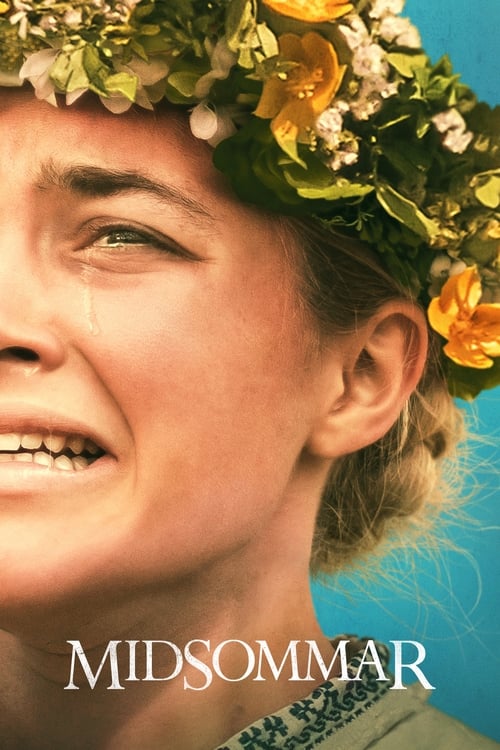
Midsommar
2019 · Ari Aster
Went from horror wunderkind (Hereditary, Midsommar) to deliberate audience-divider: Beau Is Afraid was a notorious A24 money-loser people still argue about, and Eddington, his COVID-era conspiracy western, split Cannes down the middle. The director people cite when debating whether "divisive" means brave or self-indulgent.
For when you want a horror film that gets under your skin instead of jumping out at you — something to chew on for days, or the strangest breakup movie ever made. Firmly a challenge, not a comfort watch.
What it's about
Dani, freshly shattered by a family tragedy, tags along when her checked-out boyfriend and his anthropology-grad friends travel to a remote Swedish commune for a midsummer festival held once every ninety years. The sun never sets, the locals are radiantly welcoming, the meadows are full of flowers — and the rituals the visitors came to study slowly start asking things of them. Underneath the pageantry it's the anatomy of a relationship in its final days.
The experience
Dread in broad daylight: it moves slowly and blooms rather than jolts, wrapping mounting horror in flowers, folk songs and woozy hallucinations. It's disturbing and strangely cathartic at once, with a streak of pitch-black comedy, and Dani's grief hits harder than any scare.
Performances
Florence Pugh is devastating as Dani — her grief comes out in full-body convulsive sobs that are harder to watch than any of the ritual violence, and the whole film rests on her face slowly changing its mind.
The craft
Aster stages horror in blazing white sunlight, all symmetrical wide shots, meticulous folk-art production design and images that subtly breathe and warp as the drugs kick in. The score swells from pastoral strings into something ecstatic and terrible. It's gorgeous and precise — see it big and bright if you can.
Why it matters
Arriving right after Hereditary, it confirmed Ari Aster as one of horror's defining new voices and became a centerpiece of the folk-horror revival and the A24 era of slow-burn, art-house scares.
Snapshot
Midsommar is Ari Aster's second feature, a daylight folk-horror film that doubles as a clinical study of grief, codependency, and the slow dissolution of a relationship. Dani (Florence Pugh), reeling from a catastrophic family loss, accompanies her emotionally absent boyfriend Christian (Jack Reynor) and his anthropology-graduate-student friends to a midsummer festival held by an isolated commune, the Hårga, in rural Hälsingland, Sweden. Over nine days of perpetual northern sunlight, the visitors are absorbed, one by one, into a pagan ritual cycle that culminates in human sacrifice and, for Dani, a perverse coronation as May Queen. Aster has repeatedly framed the film not primarily as horror but as a breakup movie dressed in the clothes of a fairy tale, and the dossier that follows treats it as both: a genre exercise in the folk-horror tradition and an unusually exposed melodrama of attachment and abandonment. Its signature inversion — terror staged in relentless brightness rather than darkness — became the film's most discussed formal gambit and a touchstone in late-2010s horror.
Industry & production
Midsommar was produced and distributed by A24, the American company whose name had by 2019 become shorthand for a certain kind of auteur-driven genre filmmaking. It followed Aster's debut Hereditary (2018), also an A24 release, which had been a critical and commercial breakout; the studio's confidence in Aster as a brand is evident in the speed with which the second feature followed. The production was an international co-financing arrangement involving A24, the Swedish company B-Reel Films, and Aster's producing partners at Square Peg (Lars Knudsen and others). The film's nominal setting is Sweden, but principal photography took place largely in Hungary, on constructed sets and locations outside Budapest, in the summer of 2018 — a practical decision that gave the production control over a purpose-built village commune and its elaborate decorative program.
The budget was modest by studio standards — reported in the single-digit-millions range — and the film recouped well in excess of that in worldwide theatrical release, though I would treat any single precise gross with caution rather than assert an exact figure. Commercially it performed as a profitable mid-size release rather than a blockbuster; its cultural footprint outran its box-office scale. A24 later released an extended "director's cut" running substantially longer than the theatrical version, restoring scenes that deepen the relationship material and the commune's internal logic — a release strategy consistent with the studio's cultivation of cinephile audiences and home-format collectors.
Technology
Midsommar was shot digitally. The most consequential technical problem the production faced was lighting: a horror film conceived almost entirely in daylight removes the genre's traditional tool of concealment. The filmmakers leaned into high-key, broadly diffused illumination and a palette dominated by white linen, green meadow, and saturated floral color, which required careful management of contrast and exposure to keep the image from flattening. Where the real midnight sun of Scandinavia could not be relied upon, lighting was engineered to mimic the quality of a sun that never sets. The film also makes pointed use of in-camera and practical effects for its ritual violence and its hallucinogenic sequences, favoring tactile prosthetics and set-piece construction over heavy digital compositing, with digital tools reserved largely for the subtle "breathing" distortions that render the characters' drug experiences — flowers that pulse, grass that grows through skin, faces that ripple.
Technique
Cinematography
The cinematography is by Pawel Pogorzelski, Aster's collaborator from Hereditary. The film's visual signature is its commitment to symmetry, stillness, and centered framing: the Hårga village is shot as a geometric, almost diagrammatic space, with the camera frequently locked into formal compositions that present ritual life as ordered, legible, and inescapable. Pogorzelski and Aster employ slow, deliberate camera moves — creeping push-ins, floating overhead shots, and one celebrated inverted move as the characters drive toward the commune, the image rotating until the landscape hangs upside down, a visual announcement that the world has turned over. The relentless daylight is itself the boldest cinematographic choice: by denying horror its customary darkness, the film makes brightness oppressive, exposing the characters and offering them no shadow to hide in.
Editing
Lucian Johnston edited the film. The cutting is patient and architectural, allowing scenes to extend past comfort so that ritual durations register as endurance. Editing is also the film's chief mechanism of foreshadowing and irony: the camera and cut repeatedly linger on the Hårga's painted tapestries, runestones, and murals, which depict events the narrative will later enact, so that attentive viewers are shown the ending before it arrives. Transitions sometimes elide time across the festival's days with a fairy-tale abruptness, and the film's most disorienting passages — the drug sequences — are built through a controlled accumulation of small visual disturbances rather than rapid montage.
Mise-en-scène / staging
Production designer Henrik Svensson built the Hårga commune as a total environment: a horseshoe of yellow buildings around a central green, dense with hand-painted symbols, woven hangings, carved furniture, and floral arrangements that the production grew or fabricated in enormous quantity. The mise-en-scène is saturated with information — every surface bears runic or pictorial meaning — and the design functions as a closed semiotic system in which the commune's beliefs are written into the architecture. Costuming places the visitors in ordinary contemporary dress against the Hårga's uniform white embroidered garments, visually marking the outsiders until Dani is finally dressed, and then literally buried, in flowers. The famous floral May Queen costume, an enormous wearable bower, is the design program's culmination.
Sound
The score is by Bobby Krlic, the British musician known as The Haxan Cloak. Krlic's music works against expectation: rather than the dissonant stingers of conventional horror, it offers swelling strings, folk-inflected drones, and passages of genuine beauty that make the commune seductive even as it becomes monstrous. The sound design is equally important — the constant presence of wind, insects, and choral folk singing creates an enveloping aural field, and the absence of night sounds reinforces the absence of darkness. In the film's emotional climax, the synchronized wailing of the Hårga women, who physically mirror Dani's grief, fuses sound design and performance into the film's thesis about shared feeling.
Performance
Florence Pugh's performance as Dani anchors the film and was widely regarded as a breakout. Pugh externalizes grief in raw, unflattering registers — gasping, suppressed sobs, the social labor of apologizing for one's own pain — and then traces Dani's arc from isolation toward a terrible belonging. Jack Reynor's Christian is calibrated as a study in passive neglect, his ordinariness made damning. The supporting ensemble — William Jackson Harper as the ambitious Josh, Will Poulter as the crass Mark, and Vilhelm Blomgren as the deceptively gentle recruiter Pelle — sketches a group dynamic in which the visitors' petty rivalries make them easy prey. The Hårga are performed with an unnerving collective placidity that the film treats as both cultic and, disturbingly, communal in a way the outsiders lack.
Narrative & dramatic mode
Structurally the film is a quest narrative turned trap: travelers cross into an enclosed world and are progressively consumed. But its true engine is melodrama. Aster builds the supernatural-cultic plot as an externalization of an intimate one — the death of a relationship — so that the festival's escalating horrors track the stages of Dani and Christian's collapse. The dramatic mode is deliberately uncomfortable: the film withholds the reassurance that Dani is a victim to be rescued, and instead routes her toward a cathartic, monstrous liberation. The folk-horror plot supplies dread; the relationship plot supplies the emotional logic that makes the ending feel, perversely, like a happy one. This double exposure — terror and catharsis occupying the same frame — is the film's central narrative achievement.
Genre & cycle
Midsommar belongs squarely to folk horror, the tradition concerned with rural communities, pagan survival, and the menace of old belief systems persisting at the edges of modernity. Its most obvious lineage runs to the British folk-horror canon, above all The Wicker Man (1973), with which it shares the structure of an outsider lured to an isolated pagan community and destined for ritual immolation. It arrived during a marked revival of folk horror in the 2010s and was quickly canonized within it. The film also participated in the contemporaneous discourse around so-called "elevated horror" or "post-horror" — a critically contested label applied to art-house genre films, many from A24, foregrounding grief, trauma, and atmosphere over conventional scares. Whether or not that label is useful, Midsommar was a defining text in the conversation.
Authorship & method
Ari Aster wrote and directed the film, and it bears his authorial signature unmistakably: the fusion of family trauma and horror established in Hereditary, the formal control, the long-take dread, and an interest in grief as the genre's true subject. Aster has said the project began from personal experience of a breakup and grew into a folk-horror "fairy tale," which accounts for the film's unusual emotional candor. His key collaborators recur from Hereditary — cinematographer Pawel Pogorzelski, whose symmetry and daylight execute Aster's design — joined by composer Bobby Krlic, whose seductive score is integral to the film's moral disorientation, editor Lucian Johnston, and production designer Henrik Svensson, whose total environment makes the commune legible as a worldview. The method is one of saturated control: meaning is embedded in décor, foreshadowing is planted in plain sight, and the audience is implicated in finding the commune beautiful.
Movement / national cinema
The film is an American production with a Scandinavian setting and a substantial Swedish creative and financing component, and it engages — at times appropriating, at times romanticizing — Swedish midsummer folk custom, dress, and rune lore. It is not a Swedish national-cinema work but a co-production that uses Sweden as imagined landscape. Its art-house sensibility connects it to a transnational current of auteur horror, and one can read in its long-take austerity and its preoccupation with ritual a distant inheritance from the Nordic art-cinema tradition, though the film cites genre lineage far more directly than any national school.
Era / period
Midsommar is a film of the late 2010s, made and received within a moment defined by A24's ascendancy, the streaming-adjacent appetite for distinctive genre cinema, and a cultural conversation about trauma, emotional labor, and toxic relationships that the film addresses almost programmatically. Its concern with codependency and gaslighting, and its sympathy for a woman whose pain has been minimized, located it precisely within its contemporary discourse, which partly explains the intensity of its reception among younger audiences.
Themes
The film's governing theme is grief and the human need to have one's pain witnessed and shared — answered, monstrously, by a community that literalizes empathy by feeling and screaming alongside the sufferer. Around this cluster codependency and the asymmetry of a dying relationship; the loneliness of the modern individual set against the totalizing belonging of the cult; and the ambivalence of community itself, which the film presents as simultaneously the source of horror and the answer to Dani's isolation. Secondary strands include the ethics and arrogance of the anthropological gaze (the students who come to study the Hårga are consumed by them), the seductiveness of order to a person in chaos, and the fairy-tale logic of transformation through ordeal. The film resists a clean moral: Dani's final, tear-streaked smile is both her liberation and her capture.
Reception, canon & influence
Midsommar was received with broad critical acclaim, particular praise concentrating on Florence Pugh's performance, Pogorzelski's daylight cinematography, and Aster's audacity in staging horror without darkness; reservations, where they appeared, concerned the film's length and the legibility of its foreshadowing, which some found over-determined. Its influences run backward most clearly to The Wicker Man and the broader British folk-horror tradition, to fairy-tale and ritual-sacrifice narratives, and to Aster's own Hereditary; the film's interest in grief as horror's subject extends a current visible across the contemporary A24 cycle. Looking forward, Midsommar rapidly became a reference point: it consolidated the daylight-horror conceit as a recognized option in the genre, helped cement the folk-horror revival in mainstream consciousness, established Florence Pugh as a major star, and confirmed Ari Aster as a leading horror auteur. It has been heavily absorbed into popular and meme culture — the flower-crowned May Queen, the screaming-in-unison catharsis, the bright-meadow dread — to a degree that few horror films of its decade matched, and it is now routinely cited in surveys of late-2010s horror as a defining work of its moment.
A Deleuzian reading
You remember the drive in.
The full Deleuzian reading of Midsommar →
Reception
Divisive on release — it earned a notorious C+ CinemaScore from opening-weekend audiences even as critics praised it — but it's since settled in as an A24 modern classic, with the longer director's cut treated by fans as the definitive version.
How Midsommar was received, from release to now →
Influences: the films it descends from and the films it influenced
- The Wicker Man (1973) — Establishes the folk-horror template Aster directly inherits: an outsider lured into a sun-lit pagan community whose ritual courtesy masks a sacrificial design, with horror withheld until a daylight climax of communal immolation.
- Hereditary (2018) — Aster's own prior film supplies the method imported wholesale — grief-as-horror-engine, dollhouse symmetry and slow push-ins from Pogorzelski, externalized keening performance, and foreshadowing embedded in décor that rewards a second viewing.
- The Blood on Satan's Claw (1971) — Pioneers the rural-cult folk-horror grammar of an isolated community sliding into ritual violence keyed to the land and seasonal fertility rite, the agrarian-pagan substrate Midsommar's commune extends.
- Don't Look Now (1973) — Models the bereavement-thriller in which grief structures the edit: associative cross-cutting and planted visual omens (the red figure) make mourning legible as dread, the embedded-foreshadowing logic Aster adopts.
- Suspiria (1977) — Supplies the saturated-color total-environment as worldview — a coven whose architecture and palette are the threat — and a score (Goblin) that seduces rather than warns, anticipating Krlic's disorienting beauty.
- The Texas Chain Saw Massacre (1974) — Originates the bright-daylight atrocity and the dinner-table ordeal staged in unbearable wide-open clarity, proving horror needs no darkness — the daylight-horror conceit Midsommar systematizes.
- Persona (1966) — The Swedish-art-cinema source for the symmetrical, frontal, white-on-white compositional rigor and the close study of a woman's psychic dissolution, the formal-control register Pogorzelski's framing inhabits.
- Häxan (1922) — The Nordic ur-text of witchcraft-as-anthropology, staging folk-belief ritual and bodily ordeal with documentary curiosity — the ethnographic gaze on pagan rite that Midsommar's runestone-and-ritual mise-en-scène revives.
- The Shining (1980) — The model of horror through obsessive Steadicam symmetry and centered, axial framing — terror generated by geometric order rather than shadow — the compositional control Aster cites in his centered push-ins.
- The Witch (2015) — The A24 folk-horror sibling that, like Midsommar, treats period-accurate ritual and a total, researched environment as the horror, ending in a woman's seductive surrender to the cult that destroyed her family.
- The Wailing (2016) — Aster extends The Wailing's wide-landscape-framing of ritual ceremony into Nordic daylight horror, and the procedural-spatial-trap in which the protagonist's spatial freedom is systematically closed by communal ritual logic — the structural and cinematographic debt to Na's folk-horror architecture is traceable in both framing strategy and editing rhythm.
- 28 Years Later (2025) — Extends folk horror into a daylight rite-of-passage among a closed ritual community — the quest-into-pagan-commune structure mirrored here.
- Hereditary's successor Beau Is Afraid (2023) — Extends Aster's signature further: anxiety dramaturgy built from immaculate symmetrical staging, embedded background foreshadowing, and a protagonist's grief/guilt externalized into an engulfing total environment.
- Men (2022) — Post-Midsommar trauma-folk-horror that literalizes grief and male menace through pagan Green Man iconography, daylit pastoral dread, and a bodily-ritual climax — the bereavement-as-folk-horror mode Aster popularized.
- Lamb (2021) — A Nordic folk-horror descendant trading on slow long-take endurance, agrarian total environment, and a grieving couple's pact with rural-pagan forces — Midsommar's Scandinavian-landscape dread carried forward.
- Pearl (2022) — Extends the daylight-horror and symmetry-centered framing into a Technicolor-bright farm where a woman's externalized emotional breakdown — culminating in a held, unbearable smile — supplies the terror, an heir to Pugh's performance-as-horror.
- Eddington (2025) — Origin of the Aster–Johnston editing partnership shaping long build-and-release architecture, plus the daylight-horror inversion that stages menace in flat, exposed brightness.
- Fresh (2022) — Again shot by Pogorzelski, it perfects high-key, brightly-lit dread — horror staged in appetizing light rather than shadow — which becomes Fresh's core visual paradox of gorgeous surfaces housing atrocity.
- The Wicker Man (2006) (2006) — A direct remake working the same outsider-into-matriarchal-cult plot, sharing the daylight-ritual sacrifice structure though without Aster's formal control — a sibling node on the folk-horror branch.
- Hereditary-adjacent Saint Maud (2019) — Part of the same A24 'elevated horror' cycle staging psychological trauma through tight subjective framing and a heroine's transcendent, ecstatic self-immolation, echoing Dani's final consuming catharsis.
- Apostle (2018) — A contemporaneous folk-horror revival entry deploying the outsider-infiltrates-island-cult structure with blood-fertility ritual and pagan sacrifice, working the same Wicker Man lineage in parallel.
- Mother! (2017) — Shares the strategy of an escalating allegorical ordeal staged as total environment, with a woman's psyche externalized into the house/commune around her and a crowd turning ritually, even cannibalistically, upon her.
- 28 Years Later: The Bone Temple (2026) — Extends the same elevated folk-horror into blanching daylight: communal death-ritual rendered as ornamented, ceremonial staging rather than nocturnal shock.
- Get Out (2017) — Aster pushes the predatory-promenade staging to its structural limit: the Hårga's ritualized hospitality sequences are choreographed exactly as Get Out's party scenes are — smiling community members encircling the outsider protagonist — with harsh Nordic daylight replacing darkness to strip away horror's conventional atmospheric camouflage and expose the choreography as the threat itself.
- Us (2019) — Aster deploys diegetic folk music as both narrative ritual and non-diegetic affective instrument — blurring the boundary Us also exploits with its distorted 'I Got 5 on It' — and stages communal choreography in full daylight as horror's vehicle, a formal parallel to the Tethered's synchronized performance as both threat and spectacle.
- Weapons (2025) — Community horror in which the social collective is the undisclosed threat; de-dramatized horror imagery withholds conventional fear signals by placing violence in full light without generic cueing — the photographic inverse of low-light horror grammar that achieves identical dread through over-exposure.
- The Holy Mountain (1973) — Stages communal ritual as frontal-symmetric allegorical diorama with anti-naturalistic ceremonial performance, the same arrangement of bodies into emblematic ritual tableaux Jodorowsky perfected.
- Doctor Sleep (2019) — Same 2019 elevated-horror wave, using deliberate slow-burn pacing and grief-processing as structure over jump-scare economy, the tempo choice critics debated in Doctor Sleep.
- Fear Street: 1666 (2021) — The A24 daylight folk-horror revival — pagan communal ritual and scapegoat sacrifice staged in bright open space — that 1666's witch-hunt sequences draw their contemporary arthouse texture from.
- Beau Is Afraid (2023) — Shares Beau's exact craft team — DP Pawel Pogorzelski, composer Bobby Krlic, editor Lucian Johnston — carrying over symmetrical daylight dread and grief metabolized as ordeal.
Similar films
- Hereditary (2018) — influence & lineage
- mother! (2017) — influence & lineage · often watched together
- The Ritual (2017) — shared sensibility
- Aftersun (2022) — shared sensibility
- Nosferatu (2024) — shared sensibility
- Beau Is Afraid (2023) — shared sensibility
- "Wuthering Heights" (2026) — shared sensibility
- Fjord (2026) — shared sensibility
All the films related to Midsommar →