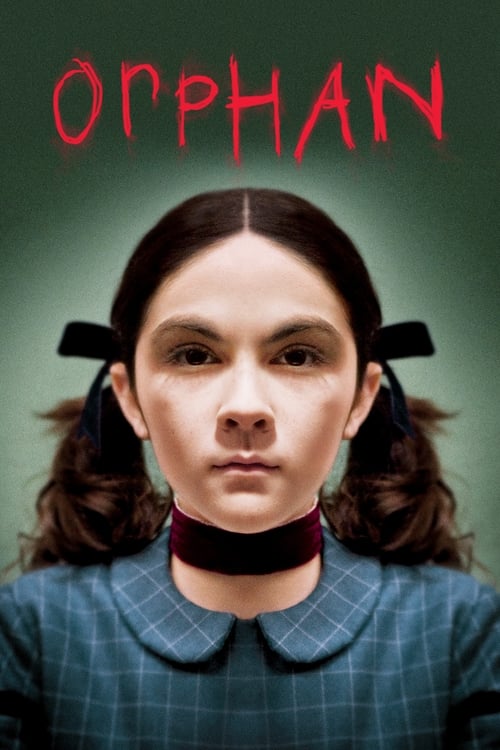
Orphan
2009 · Jaume Collet-Serra
For when you want a real scare with a story under it — a lights-off, don't-check-your-phone thriller that rewards paying attention. Not comfort viewing; it plays rough with family, grief, and trust.
What it's about
Kate and John Coleman, a couple hollowed out by the loss of a baby, try to heal their marriage by adopting nine-year-old Esther — a poised, old-fashioned girl from an orphanage who paints beautifully and speaks with unsettling formality. As accidents and cruelties begin to pile up around the household, Kate becomes convinced something is deeply wrong with their new daughter, while everyone around her insists she's the unstable one. It's a haunted-house story where the haunting arrived through the front door, invited.
The experience
A slow tightening of the screws — dread built from dinner tables, school hallways, and a mother nobody believes — punctuated by shocks that genuinely land. It's nasty, confident, and much smarter than its premise suggests, and its final stretch goes places you will not see coming.
Performances
Isabelle Fuhrman, twelve years old at filming, gives one of the great child-villain performances — controlled, watchful, and genuinely frightening — while Vera Farmiga grounds the film as a grieving mother fighting to be believed.
The craft
Jaume Collet-Serra directs with polish rare in studio horror: elegant domestic compositions that curdle, patient escalation instead of cheap jolts, and a screenplay that hides its cards in plain sight. The cold, wintry look and precise sound design make the Coleman house itself feel hostile — worth watching somewhere dark and quiet.
Why it matters
Its third-act reveal became one of the most talked-about twists in modern horror, earning the film a durable cult following and, over a decade later, a prequel. It also cemented Collet-Serra's reputation as a craftsman of upmarket genre thrillers.
Horror · Psychological horror · Suspense & terror. A grieving couple adopts a poised nine-year-old: slow-tightening domestic dread, nasty shocks, and a mother nobody believes.
Snapshot
Orphan is a domestic-gothic horror thriller that weaponizes the most protected figure in American family melodrama — the adopted child — and turns her into the intruder. A grieving couple, Kate and John Coleman, take in nine-year-old Esther, an unnervingly poised, old-fashioned Russian-speaking orphan whose arrival coincides with escalating violence in the household. The film's now-notorious third-act reversal — that Esther is not a child at all but Leena Klammer, a thirty-three-year-old woman with a rare hormonal disorder (hypopituitarism) that has arrested her physical growth — recodes the entire preceding narrative from "possessed evil child" into something closer to a home-invasion seduction thriller wearing a horror costume. Directed by Jaume Collet-Serra as his second feature, produced under Joel Silver's Dark Castle banner with Leonardo DiCaprio's Appian Way, and released by Warner Bros. in July 2009, the film was received tepidly at first and has since hardened into a durable cult object, eventually generating a 2022 prequel. Its central performance, by twelve-year-old Isabelle Fuhrman, is the reason it endures.
Industry & production
Orphan was a Dark Castle Entertainment production, the horror label founded by Joel Silver and Robert Zemeckis that had made its name in the early 2000s remaking or riffing on William Castle gimmick pictures (House on Haunted Hill, Thir13en Ghosts, and Collet-Serra's own 2005 debut House of Wax). By the late 2000s the company was pivoting from remakes toward original material, and Orphan — from an original screenplay rather than a pre-sold title — sits at that transition. Leonardo DiCaprio's Appian Way Productions co-produced, with Silver, Susan Downey, and Jennifer Davisson among the producing team. Warner Bros. distributed.
The screenplay is credited to David Leslie Johnson (later Johnson-McGoldrick, subsequently a fixture of the Conjuring universe and Aquaman), working from a story by Alex Mace. Production was mounted in Canada, principally in and around Montreal and the Laurentians in Quebec, standing in for a wintry Connecticut exurb — a common cost-driven arrangement for mid-budget genre films of the period, and one that gave the film its snowbound, insulated look.
The most consequential industry event around the film was not commercial but reputational. Its marketing leaned on a line of dialogue — "It must be hard to love an adopted child as much as your own" — that adoption-advocacy organizations condemned as stigmatizing to adoptees and adoptive families. The protest was significant enough that Warner Bros. pulled the offending language from trailers and revised elements of the campaign before release. That controversy is part of the film's permanent record and speaks to the genuine cultural nerve the premise touched. Precise budget and gross figures are outside what can be responsibly cited here; the film is generally understood to have been a modestly budgeted picture that turned a healthy profit, sufficient to keep it commercially alive and, ultimately, to justify a franchise revisit more than a decade later.
Technology
Orphan was made in the last years before digital capture became the horror-genre default, and it carries the grain and tonal depth associated with photochemical origination; the visual evidence is consistent with 35mm photography, though the exact format should be treated as inference rather than documented fact here. What is more clearly legible is the film's technological conservatism as a virtue: it is a practical-effects, location-and-set picture that relies on staging, prosthetic and makeup work, and performance rather than digital augmentation. The one place technology surfaces diegetically and thematically is in the depiction of deafness — the youngest Coleman child, Max, is deaf, and the film integrates sign language and the sound-design consequences of her hearing throughout, culminating in a climax partly structured around what she can and cannot perceive.
Technique
Cinematography
The photography is credited to Jeff Cutter, who would become one of Collet-Serra's recurring collaborators. The film's visual signature is coldness: a desaturated winter palette of whites, grays, and steel blues, with the family's large modern-rustic house rendered as a glass-walled container that promises transparency but delivers exposure and vulnerability. Cutter and Collet-Serra exploit the architecture — large windows, open sightlines, the greenhouse, the frozen pond — so that characters are constantly visible to one another and to the camera, which makes the film's secrets feel as though they are hiding in plain sight. Esther is frequently framed low or at a remove, small in the composition, so that her physical stature reads as childlike right up until the moment the film wants us to feel the wrongness of scale.
Editing
Cut by Timothy Alverson, the film runs long for its genre (roughly two hours) and uses that length deliberately, functioning for much of its duration as a slow-burn domestic thriller rather than a shock-driven horror film. The editing's key structural task is the withholding and then detonation of the central reversal: the picture is built so that a first viewing and a second viewing are almost different films, and the cut has to plant behavioral "tells" — Esther's poise, her painting, her interest in John — that are legible as sinister-child cues on first pass and as adult-woman cues in retrospect.
Mise-en-scène / staging
The production and costume design do enormous narrative work. Esther is dressed in high-collared, old-fashioned, almost Edwardian clothing, and she habitually wears ribbons at her wrists and neck — a detail the film later reveals to be concealment of scarring and, in the neck's case, evidence of her true history. This is mise-en-scène as embedded clue: the character's aesthetic "primness" is retroactively exposed as disguise. The Coleman home, all warm wood and cold glass, embodies the film's central tension between the fantasy of a secure nuclear family and the porousness that lets a predator in.
Sound
John Ottman — better known as Bryan Singer's regular composer and editor — provides the score, and the sound design threads the motif of hearing and its absence through Max's deafness. The film's tensest sequences repeatedly turn on auditory information: what is heard through walls, what a deaf child cannot hear approaching, the linguistic strangeness of Esther's accented, formal speech. Sound is thus not merely atmospheric but a plot instrument.
Performance
The film lives or dies on Isabelle Fuhrman, twelve during production, who had to play a character who presents as a nine-year-old but is a thirty-three-year-old woman — a role requiring her to layer adult calculation, seductiveness, and rage beneath a child's surface without tipping the audience off before the script wants. It is a remarkably controlled piece of child screen acting and the single most-cited reason the film has aged into cult respectability. Vera Farmiga, as Kate, delivers the film's other essential performance: a recovering alcoholic and grieving mother whose credibility is systematically undermined — by Esther, by her husband, by her own history — so that the film also operates as a gaslighting drama in which the one person who sees the truth is the one no one will believe. Peter Sarsgaard plays John as amiably oblivious, and CCH Pounder appears as a suspicious neighbor; Aryana Engineer, a deaf actress, plays Max, grounding the film's use of sign language in lived reality.
Narrative & dramatic mode
Structurally, Orphan is a bait-and-switch. For most of its length it presents as a "bad seed" possession-adjacent horror film — the uncanny child whose malevolence the mother alone perceives — and it invites the audience to read Esther through that generic template. The late revelation that Esther is an adult predator retroactively converts the film into a different mode: a domestic-invasion thriller about a serial manipulator who exploits the social sanctity of childhood as camouflage. The dramatic engine throughout is epistemic — who is believed, and why — which aligns Orphan with the long tradition of gaslight melodrama (a wife driven to seem unstable) grafted onto horror. The mother's alcoholism and the family's prior loss (a stillbirth) are not incidental; they are the mechanisms by which her accurate perception is dismissed as pathology.
Genre & cycle
The film belongs squarely to the "evil child" / enfant terrible lineage — the horror tradition running from The Bad Seed (1956) through Village of the Damned (1960), The Omen (1976), and The Good Son (1993), in which the culturally protected innocence of the child is inverted into menace. But Orphan's twist is precisely a critique or subversion of that cycle: its monster is not a preternaturally evil child at all but an adult exploiting the very sentimentality the sub-genre depends on. It thus also participates in the "cuckoo in the nest" thriller — the intruder who infiltrates the family from within, a cousin to films like The Hand That Rocks the Cradle (1992). Within the horror economy of the late 2000s, it also fits a mini-cycle of comparatively "prestige" horror pictures anchored by respected dramatic actors and adult-thriller pacing rather than teen-slasher rhythms.
Authorship & method
Jaume Collet-Serra, a Spanish-born director who came up through commercials and music videos before House of Wax, uses Orphan as a bridge between horror and the sleek, twist-driven adult thrillers that would define his subsequent career — the Liam Neeson action-mystery cycle (Unknown, Non-Stop, Run All Night) and the survival thriller The Shallows. Seen in that arc, Orphan is recognizably his: a genre exercise organized around a concealed truth and a controlled, escalating reveal, executed with visual polish and a taste for the clean high-concept hook. Key collaborators reinforce the through-line: cinematographer Jeff Cutter became a repeat partner; composer John Ottman brought a classical, suspense-oriented sensibility; editor Timothy Alverson managed the film's careful long-form withholding; and writer David Leslie Johnson supplied a screenplay whose entire architecture is a single, load-bearing reversal. Collet-Serra's method here is less about horror atmospherics than about narrative engineering — building a machine whose payoff reframes everything before it.
Movement / national cinema
Orphan is a Hollywood studio-system product — a Warner Bros./Dark Castle picture — physically produced in Canada and directed by a Spanish filmmaker, which makes it a characteristically transnational late-2000s genre object rather than an expression of any single national cinema. It does draw, glancingly, on European gothic and fairy-tale iconography (the prim, old-world child; the Eastern-European backstory eventually revealed to be Estonian, with the fictional Saarne Institute), lending the American suburban frame an uncanny continental undertone. But it belongs to no film movement in the art-historical sense; its lineage is generic and industrial.
Era / period
The film is a document of American anxieties circa the late 2000s: the sanctity and fragility of the nuclear family, the cultural charge around adoption, and a recessionary-era unease about the security of the domestic sphere. It arrived amid a broader horror landscape still shaped by the "torture" cycle it largely avoids, and it points forward to the character-driven, actor-forward horror that would flourish in the following decade. Its restraint — long stretches of dramatic build, minimal gore until late — marks it as transitional between 2000s shock horror and 2010s "elevated" or prestige horror.
Themes
The film's dominant theme is maternal knowledge and its dismissal — the mother who sees clearly and is disbelieved because of her grief, her history, and her gender. Around it cluster: grief and replacement, the impulse to fill the void of a lost child with an idealized substitute; adoption anxiety, the culturally forbidden fear that the child you take in may be unknowable or dangerous (the very nerve the marketing controversy exposed); the uncanny, in the disturbance of the child/adult boundary; performance and disguise, with Esther's costume and manners as literal concealment; and the predatory exploitation of innocence, since the film's true horror is an adult who hides inside the social armor of childhood. The subplot of Max's deafness adds a theme of perception and its limits — who can hear, see, or be believed becomes the film's moral currency.
Reception, canon & influence
On release, Orphan met divided reviews: some critics dismissed the premise as lurid or the twist as absurd, while others credited its craft, its pacing, and above all Isabelle Fuhrman's performance. The adoption-advocacy protest over its marketing generated as much conversation as the reviews themselves and remains an inseparable part of its reception history. Over time, critical estimation warmed, and the film has become a genuine cult favorite — its once-derided twist re-evaluated as an audacious genre subversion rather than a cheat, precisely because the screenplay plants it fairly.
Looking backward, the film draws on the "evil child" horror canon (The Bad Seed, The Omen, The Good Son), on gaslight-melodrama (the disbelieved wife), and on the domestic-invasion thriller of the early 1990s. Looking forward, its most concrete legacy is Orphan: First Kill (2022), a prequel directed by William Brent Bell that brought Isabelle Fuhrman back to the role a decade older — using forced perspective, body doubles, and staging tricks to re-embody a now-adult actress as the child-presenting Leena, a production conceit that itself became the film's talking point and a testament to how completely the original performance had defined the character. Beyond the franchise, Orphan endures as a reference point in discussions of the killer-child genre and its subversion, and as an early marker of Collet-Serra's signature: the immaculately constructed reveal. The record on its granular production history and finances is thinner in public sources than its cult profile might suggest, and claims about exact budget, grosses, and format should be treated with corresponding caution.
Reception
Dismissed by many critics in 2009 as trashy elevated-pulp, it quietly became one of the decade's most beloved horror rewatches — the twist kept it alive in conversation, and the 2022 prequel *First Kill* confirmed Esther as a full-blown horror franchise icon.
How Orphan was received, from release to now →
How to watch Orphan: what to notice on a first viewing
- Notice the cold, desaturated color of every interior. Jeff Cutter shoots the house in whites, grays, and steel blues, a wintry palette that never warms up even in domestic scenes. The chill in the lighting keeps you from ever feeling fully at ease in this home.
- Notice how much glass the family's house is made of. Large windows and open sightlines let characters see each other constantly, so the house that should feel secure instead leaves everyone exposed. A house built for transparency ends up offering no real privacy or protection at all.
- Watch how unnervingly formal and composed Esther stays. Isabelle Fuhrman plays Esther with an old-fashioned politeness and poise that never slips, even in moments where a child would normally react with mess or panic. The performance keeps you slightly unsettled without ever pointing at exactly why.
- Notice the ribbons Esther always wears at her wrists. Her high-collared, old-fashioned clothing and the ribbons at her wrists and neck never come off, a consistent detail of her wardrobe throughout. The costume makes her look like a girl from another century.
- Watch how often Kate is doubted when she raises alarms. Vera Farmiga plays a mother whose history of grief and alcoholism gets used against her credibility every time she voices a concern about Esther. You watch her be systematically talked out of trusting what she sees.
The whole guide to watching Orphan, with the keys for a rewatch →
Influences: the films it descends from and the films it influenced
- The Bad Seed (1956) — Establishes the child-performer tour-de-force template — Patty McCormack's Rhoda carries a whole film as an angelically-mannered killer whose politeness is the horror, the exact register Fuhrman revives as Esther.
- The Innocents (1961) — Freddie Francis's deep-focus, cold desaturated widescreen frames children as unreadable threats and makes the whole film hinge on an adult's possibly-faulty perception — the misperception-as-structure Orphan inherits.
- Village of the Damned (1960) — Codifies the child staged as predator-in-innocent-guise, with the uncanny reveal metered out inside placid domestic normalcy rather than shock.
- The Omen (1976) — Marries classical orchestral/liturgical suspense scoring to escalating 'is this child evil?' dread — the John Ottman suspense grammar on Orphan descends directly from Goldsmith's approach.
- The Good Son (1993) — Casts a beloved child star against type as a manipulator whose harmlessness is the weapon, using behavior and costume as the audience's only clues — Orphan's costume-as-clue playbook.
- The Hand That Rocks the Cradle (1992) — Supplies the domestic-invasion architecture: an outsider infiltrates the household and the mother who senses the danger is systematically disbelieved by everyone around her.
- Gaslight (1944) — The source grammar for the disbelieved-wife melodrama — a woman's accurate perception reframed as instability — which is the entire load Kate's arc carries.
- Rosemary's Baby (1968) — Perfects maternal-knowledge-dismissed suspense through slow-burn withholding that vindicates the mother only at the final reveal, the same delayed-validation engine Orphan runs.
- Whatever Happened to Baby Jane? (1962) — Weaponizes an adult woman performing arrested girlhood as horror — the precise uncanny Esther's twist (a grown woman passing as a child) inherits and literalizes.
- Unknown (2011) — Collet-Serra reuses the identical load-bearing identity-twist machine — the whole film reverse-engineered from a single concealed truth — carrying Orphan's authorship signature into the Neeson thriller cycle.
- Orphan: First Kill (2022) — Direct franchise extension that re-embodies a now-adult Fuhrman as child-presenting Leena using forced perspective, body doubles, and staging tricks — a production conceit descended from the original performance's completeness.
- Goodnight Mommy (2014) — Cold, symmetrical domestic horror in which children menace a mother and a key identity is withheld until a reframing reveal — the withholding-then-reversal structure applied as art-house minimalism.
- Run (2020) — Inverts the gaslight-melodrama and disability motif into a taut reveal machine where the household is a trap and medical deception is the plot instrument — Orphan's grammar flipped onto the child's side.
- We Need to Talk About Kevin (2011) — Renders the evil-child / disbelieved-mother dyad as fractured prestige art cinema, foregrounding maternal knowledge dismissed as the film's organizing wound.
- Abigail (2024) — Its reveal that the child is really an adult predator, and the performance that plays to the audience over the other characters' heads, are what Abigail's dramatic irony relies on, since its marketing gave away the twist.
- The Others (2001) — A transnational Spanish-helmed prestige horror built entirely around a fair-play final reversal — the 'narrative machine whose payoff reframes everything before it' that Collet-Serra engineers.
- The Orphanage (2007) — Contemporaneous transnational-genre object — Spanish-lineage prestige horror centered on a menacing child, a cold palette, and grief, marking the exact movement Orphan joins.
- Case 39 (2009) — Same-year evil-child thriller in which a caretaker takes in a child who is not what she seems, running a parallel predatory-innocence reveal from the guardian's point of view.
Similar films
- The Orphanage (2007) — influence & lineage
- The Others (2001) — influence & lineage
- The Innocents (1961) — influence & lineage
- The Good Son (1993) — influence & lineage · same viewing thread
- Goodnight Mommy (2015) — same viewing thread
- Bring Her Back (2025) — same viewing thread
- Let the Right One In (2008) — same viewing thread
- The Witch (2016) — same viewing thread
All the films related to Orphan →
Watch it with: curated runs of related films
- Whatever's Wearing That Face — A run of horror-thrillers where the real terror is that you can't trust what a person appears to be — a double, a shapeshifter, a smiling stranger, the one you desire.