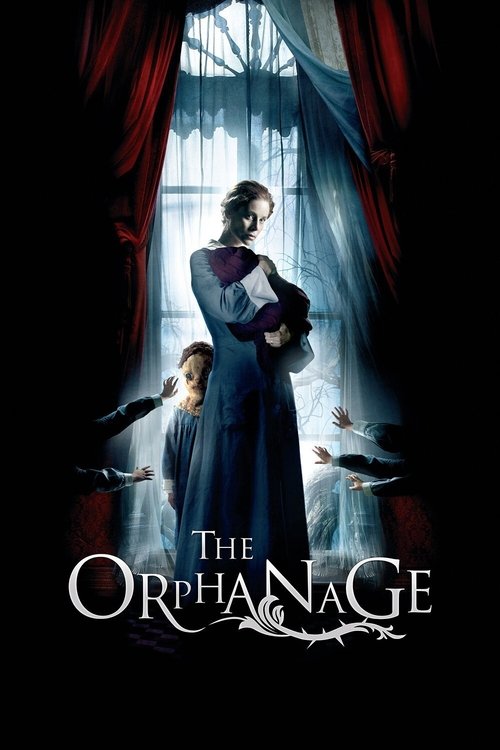
The Orphanage
2007 · J. A. Bayona
For when you want a haunted-house film with a heart — scares in service of a story about love and loss. Reach for it when you want to be frightened and moved in the same evening; keep tissues within reach.
What it's about
A woman returns with her husband and young son to the seaside orphanage where she grew up, planning to reopen it as a home for children with disabilities. Her son starts talking to invisible friends — and then vanishes during a party, turning a mother's search into something that drifts from police procedure toward séances, the house's buried history, and the dead.
The experience
A ghost story that works on you through grief as much as fear — genuinely scary in bursts, but what sustains it is an ache that keeps tightening. It's elegant, emotionally heavy, and builds to a finale that leaves many viewers in tears as much as chills.
Performances
Belén Rueda carries the film with a ferocious, physically committed performance as a mother who will follow her child anywhere — she makes the supernatural feel like an extension of maternal desperation.
The craft
Bayona's debut is classical Gothic filmmaking done with modern precision: patient camerawork through a creaking coastal house, scares earned through staging rather than noise, and one children's game of knock-and-turn that's become a modern genre touchstone. It looks and sounds sumptuous — worth watching big, in the dark.
Why it matters
Released under Guillermo del Toro's banner, it became one of Spain's biggest homegrown hits, won seven Goya Awards, and stands as a cornerstone of the 2000s Spanish genre revival that proved horror could be prestige cinema.
Snapshot
El orfanato is Juan Antonio Bayona's first feature. It is a Spanish ghost story built around grief. Laura (Belén Rueda) grew up in an orphanage on the northern Spanish coast. She returns to the house with her husband Carlos (Fernando Cayo) and their adopted son Simón (Roger Príncep), meaning to reopen it as a home for children with disabilities. Simón starts talking about invisible friends and then disappears during a party. From there the film follows a mother's search that slowly turns from a police matter into a confrontation with the dead.
The film came out under the banner "Guillermo del Toro presents" and premiered at Cannes in 2007. It became one of the biggest Spanish box-office hits of its year and won seven Goya Awards. It is now a central title of the 2000s Spanish genre revival. It also clearly belongs to the line of the classical haunted-house film that runs through The Innocents (1961) and The Others (2001), and it uses that form to tell a story about motherhood, guilt and the wish to stay in childhood. Its reputation rests on control: it is a horror film that gets its strongest effects from suspense, sound and an ending that is tragic and consoling at once.
Industry & production
Sergio G. Sánchez wrote the screenplay. He and Bayona had worked together before on short-form projects, and the script spent several years in development before it was financed. The production company was Rodar y Rodar, the Barcelona outfit run by Joaquín Padró and Mar Targarona, with Telecinco Cinema as co-producer. Telecinco Cinema was the film arm of the broadcaster Telecinco, which under Spanish rules had to invest in national film production. It became one of the most important backers of commercial Spanish film in this period.
Guillermo del Toro's role as presenting and executive producer was decisive. Bayona has often said the two met at the Sitges festival in the 1990s. When The Orphanage was being set up, del Toro was at the peak of his reputation in Spain after The Devil's Backbone (2001) and Pan's Labyrinth (2006). By most accounts his backing increased the budget, gave the project credibility with financiers, and protected the novice director's control over the material. His name sold the film abroad, and the credit "Guillermo del Toro presents" was used heavily in marketing outside Spain. Exact budget figures reported in the trade press vary, so none is given here. It was a medium-sized production by Spanish standards and a modest one by Hollywood's.
The main location was the Palacio de Partarríu, a 19th-century manor near Llanes in Asturias. The coast around it, including the beach, the tide-flooded cave and the lighthouse, gives the film its wet, wind-blown Cantabrian setting. The film premiered in the Critics' Week section at Cannes in May 2007. It opened in Spain in October 2007 to very strong business, and Picturehouse released it in the United States at the end of that year. It was Spain's submission for the Academy Award for Best Foreign Language Film but was not nominated.
Technology
The film was shot on 35mm. Its technical achievement lies in controlled craft rather than new technology. Digital work is used sparingly and mostly invisibly: compositing on the coastal exteriors, an accident scene, and a few moments of supernatural presence. The film avoids the CGI apparitions common in American horror of the time. Its ghosts are made almost entirely with costume (most memorably Tomás's sack-cloth mask), makeup, staging and framing.
One sequence builds technology into the story. A team of parapsychologists, led by a figure played by Edgar Vivar, rigs the house with cameras, microphones and monitors for a séance led by the medium Aurora (Geraldine Chaplin). The scene stages a contest between two ways of seeing. Aurora walks the dark house in a trance, while the investigators watch grainy video feeds and listen through headphones. Electronic recording becomes evidence of the uncanny that the sceptical Carlos then rejects. The scene draws on parapsychology's long fascination with tape and video recording, and looks ahead to the found-footage horror that would dominate the next decade. The Goyas for special effects and for makeup and hairstyles reflect how much of the film's effect depends on practical work.
Technique
Cinematography
Óscar Faura, Bayona's regular cinematographer, gives the film a classical, deliberately old-fashioned look. Interiors are lit in warm amber and dim natural tones. Windows, lamps and the thin grey light of the north coast divide the house into readable areas of safety and threat. The camera is mostly fluid and composed. It favours slow tracking moves through corridors and doorways, and wide frames that leave empty space at the edges, where the audience learns to look for something. Faura and Bayona often hold on what might be in a frame instead of cutting to show it.
Night scenes and the cave sequences use deep darkness and single sources such as torches and lanterns. The flashbacks and spectral scenes keep the same visual style as the rest of the film, so the line between past and present, and between the living and the dead, is never marked by a change in look. That continuity matters to the film's ambiguity.
Editing
Elena Ruiz's editing is patient. It gives scenes room to settle before suspense tightens. The film rations its shocks: there are few jump scares, and each is set up carefully. The most famous is a sudden, violent street accident, cut so abruptly that it breaks the slow rhythm the film has built.
The defining set piece is Laura playing "un, dos, tres, toca la pared" (a version of Grandmother's Footsteps) alone, hoping the ghost children will join in. It works through rhythm. Laura turns to the wall, counts, turns back, and finds the room changed. Each cut back to the space adds another increment of dread. The game is the film's model of horror editing: the audience is made to anticipate change in a repeated frame.
Mise-en-scène / staging
Josep Rosell's production design won a Goya, and the house is the film's main construction. It is a large old building with a blocked-off basement, a garden shed, long corridors, and children's rooms full of toys and furniture. It works as both family home and archive of the institution it once was. Each repeated location (the doors, the stairs, the garden, the shed) gains meaning as the story goes on. The film's terrible final revelation depends on a piece of staging introduced early and then forgotten: Laura moves the iron bars that would have shown her the way to the basement.
The masked figure of Tomás is the film's best-known image. He is a child in a sack mask with crudely painted features. It is a homemade, almost folkloric piece of design, and its strength comes from being plain and childlike. The treasure-hunt motif organises objects into a trail of clues: shells, a doorknob, a doll, keys. This turns the house into a puzzle Laura must solve, and it echoes the children's games around which the plot is built.
Sound
Sound may be the film's most important tool, and it won the Goya for Best Sound. The house is heard before it is seen: knocks inside the walls, footsteps above, breathing, and the creak of wood in the damp. Some of the strongest scenes are built almost entirely in the soundtrack. In the séance, Aurora's trance is answered by children's voices that only the recording equipment and the headphones pick up. The film uses near-silence well, letting room tone and the sea build tension.
Fernando Velázquez's orchestral score is lyrical and melancholy rather than shrill. It is strongest in the elegiac final passage, where the music turns horror into lament. Velázquez went on to score most of Bayona's later features.
Performance
The film rests on Belén Rueda. She was then best known in Spain for television and for her role in Alejandro Amenábar's The Sea Inside (Mar adentro, 2004). Rueda is on screen almost all the time and plays Laura's arc with great precision. She moves from warm, competent motherhood through frantic searching and then a long, obsessive exhaustion, to a final state that the film leaves between madness and grace. She earned a Goya nomination for Best Actress.
Around her are carefully pitched supporting performances. Fernando Cayo's rational, decent Carlos stands for the sceptical viewer. Geraldine Chaplin's medium Aurora is brief and arresting; her casting also recalls her long association with Carlos Saura's films and with Spanish art cinema. Montserrat Carulla plays the sinister old social worker Benigna. Mabel Rivera plays the psychologist who investigates Simón's disappearance. As Simón, Roger Príncep has an unforced naturalness that makes his loss felt.
Narrative & dramatic mode
The film starts as a family drama, becomes a disappearance thriller, and ends as a ghost story. The movement follows Laura's own giving up on reason. The plot works as an investigation: clues, interviews and a slowly recovered history of the orphanage. The children Laura grew up with were poisoned by Benigna, the mother of Tomás, a disfigured boy who drowned in the sea cave after the other children played a cruel trick on him.
The film is built on balanced ambiguity in the tradition of Henry James's The Turn of the Screw and its film adaptation The Innocents. Almost every supernatural event can also be read as Laura's grief and breakdown. The film keeps that double reading open through most of its length, and Carlos's scepticism is never simply proved wrong.
Its dramatic engine is tragic irony. The truth about Simón's death, revealed late, is one of the most devastating twists in modern horror. It shows that the "haunting" has partly been a series of clues pointing back to Laura's own unknowing act. The ending is a deliberately ambiguous act of grace. Laura chooses to die and is reunited with Simón and the ghost orphans, and the film frames this explicitly through J. M. Barrie's Peter Pan, with Laura as Wendy returning to look after the Lost Boys. A short coda shows Carlos at the memorial. The ending can be read as consolation, as the logic of a suicidal fantasy, or as both.
Genre & cycle
The Orphanage belongs to the classical, or "quiet," ghost story: atmosphere and suggestion instead of gore. Its closest models are The Innocents, Peter Medak's The Changeling (1980) and Amenábar's The Others. It shares with The Others a Spanish production, a large isolated house, a mother at the centre, and a reversal of who is haunting whom. It also belongs to the subgenre of the child-centred horror film, and to a specifically Spanish tradition of films about children and institutions: Narciso Ibáñez Serrador's ¿Quién puede matar a un niño? (Who Can Kill a Child?, 1976), Víctor Erice's The Spirit of the Beehive (1973), and del Toro's orphanage ghost story The Devil's Backbone.
Within its cycle it was a central part of the 2000s Spanish fantastic boom. That boom included Amenábar's films, Jaume Balagueró's Darkness (2002) and Fragile (2005), the Filmax "Fantastic Factory" label, and in 2007 alone [REC] and Nacho Vigalondo's Timecrimes. Among these films, The Orphanage stands for the prestige, emotionally led end of the genre, as against the found-footage shock of [REC].
Authorship & method
J. A. Bayona (b. 1975, Barcelona) trained at ESCAC, the Catalan film school, and worked in music videos and commercials before this debut. The Orphanage already shows the concerns of his later career: mothers and children, grief, catastrophe seen through a child's eyes, and a frank love of emotionally direct, Spielbergian popular cinema. Bayona has openly named Spielberg as a formative influence. His later films The Impossible (2012), A Monster Calls (2016), Jurassic World: Fallen Kingdom (2018) and Society of the Snow (2023) all deal with parents, children and survival, and A Monster Calls is almost a companion piece about a child facing a mother's death.
Sergio G. Sánchez wrote the original screenplay and won the Goya for it. He later wrote The Impossible and wrote and directed Marrowbone (2017), another gothic tale of orphaned children in an old house. Óscar Faura (cinematography), Fernando Velázquez (music) and Elena Ruiz (editing) became the core of Bayona's long-term team, much of it from the same Catalan film-school background. Josep Rosell designed the house. Guillermo del Toro's role was mainly that of patron and protector, not co-author. Still, the film's sympathy for ghosts as victims, its attention to children's suffering, and its institutional setting fit closely with del Toro's own Spanish-language films.
Movement / national cinema
The film is a key work of the commercial and artistic revival of Spanish genre cinema around the turn of the millennium. Several factors drove that revival: a generation of directors raised on American and European genre films, film schools such as ESCAC, broadcaster investment rules that brought television money into production, and the international success of Amenábar and del Toro. The Orphanage showed that a Spanish-language horror film could be a domestic blockbuster, a festival success and an export in the same release. It was made in Catalonia with a largely Catalan creative team and filmed in Asturias, and it shows the Barcelona-based production base behind much of the boom.
The film rarely refers directly to Spanish history, unlike The Devil's Backbone or Pan's Labyrinth, which are set in the Civil War and its aftermath. Even so, critics have read its buried children, its religious-institutional past and its theme of crimes that must be dug up in the context of Spain's contemporary arguments over historical memory. That reading is interpretive, not stated in the film, and it should be treated as such.
Era / period
The film was released in 2007, at the height of the international vogue for Spanish-language fantastic cinema that followed Pan's Labyrinth. It is contemporary with the rise of found-footage horror ([REC], Paranormal Activity) and with the American "torture porn" cycle. Against both, its classical restraint was received as a deliberate alternative. The period also saw active remaking and re-export of non-English horror, from J-horror remakes to [REC]'s American version Quarantine (2008). An English-language remake of The Orphanage was announced in the following years but was never produced.
Themes
- Motherhood and guilt. Laura is an adoptive mother who was herself an orphan. The film examines maternal love as devotion and as possessiveness. Its parallel between Laura and Benigna, two mothers each undone by a lost son, is its darkest structural rhyme.
- Childhood as refuge and trap. The Peter Pan framing presents never growing up as a paradise and as death. Laura's return to the orphanage is a return to her own childhood that she cannot escape.
- Grief and the refusal to let go. The haunting can be read as the shape of mourning, and the ending as the fulfilment of a refusal to accept loss.
- Concealment and revelation. Hidden rooms, buried bodies, secrets about Simón's adoption and illness (he is HIV-positive, which his parents have not told him), and the institution's buried crime all drive a plot about what adults hide from children and from themselves.
- Games and rules. Children's games (the treasure hunt and "knock on the wall") are the language the dead use to communicate. They make play into ritual and into the mechanism of suspense.
- Reason versus belief. Carlos's medicine and the investigators' equipment are set against Aurora's mediumship and Laura's faith. The film declines to settle the matter.
Reception, canon & influence
Reception. The film was well received at Cannes and on international release. Critics broadly praised its craft, Rueda's performance, its restraint, and the emotional force of its ending. Some reviewers found it too close to its models, especially The Others. In Spain it was a popular and industry triumph. At the 2008 Goya Awards it received fourteen nominations and won seven, including Best New Director for Bayona and Best Original Screenplay for Sánchez, along with art direction, production supervision, sound, makeup and hairstyles, and special effects. It now appears regularly on lists of the best horror films of the 21st century and of the best ghost stories.
Influences on the film (backward). Its main models are The Innocents and James's The Turn of the Screw; The Changeling; The Others; The Devil's Backbone; Spanish child-centred films from The Spirit of the Beehive to Who Can Kill a Child?; Barrie's Peter Pan as an explicit literary intertext; and Spielberg's family-centred popular cinema, including the suburban haunting of Poltergeist (1982), which del Toro produced and Spielberg co-wrote and produced.
Legacy (forward). The Orphanage launched Bayona's international career, which leads directly to The Impossible (also starring a mother searching for her children, again written by Sánchez) and on to Hollywood franchise work. It established the "Guillermo del Toro presents" model for new genre directors. Del Toro used it again for Guillem Morales's Julia's Eyes (2010), which also starred Belén Rueda, and Andy Muschietti's Mama (2013), another story of ghostly motherhood. Rueda became the leading face of Spanish thriller-horror. More broadly, the film's success helped prove the international market for emotionally serious, grief-centred supernatural films, a mode later taken up by The Babadook (2014) and the wave of "elevated" horror that followed. Its specific influence on those later films is a critical connection, not a documented line of descent.
Influences: the films it descends from and the films it influenced
- The Innocents (1961) — Freddie Francis's deep-focus framing puts ghostly figures far back in otherwise empty spaces, and children are never clearly innocent or possessed; Bayona builds his house and his treatment of Simón on the same negative-space composition and the same doubt.
- The Changeling (1980) — A séance recorded on tape, a hidden room upstairs where a murdered child was kept, and a dead child's toy that comes back on its own: The Orphanage's séance-surveillance scene and its sealed-room reveal follow this pattern closely.
- The Haunting (1963) — Wise made a house terrifying almost entirely through sound, with booming knocks on walls and doors and nothing shown on screen; the pounding behind Laura's walls uses the same acousmatic method.
- Poltergeist (1982) — A middle-class mother searches a haunted house for a child taken into the spirit world, and a small, eccentric female medium leads a team with recording gear; Geraldine Chaplin's Aurora and the paranormal investigators repeat that setup almost exactly.
- The Spirit of the Beehive (1973) — Erice built a Spanish tradition of telling the supernatural from a child's point of view, in long, quiet takes inside a large, isolated house, where believing in a monster becomes a way of making contact. Bayona's child-centred fantastique comes out of this tradition.
- Cria Cuervos (1976) — Geraldine Chaplin plays a dead mother who steps into the present-tense frame with no transition, flashback and haunting merging in continuous space; The Orphanage uses the same unmarked past-present continuity and casts Chaplin as its medium.
- Who Can Kill a Child? (1976) — The founding Spanish film in which children are the source of horror. Its sunlit, coastal setting and children whose games turn into ritual anticipate the masked orphan children and the cruelty of the playground in Bayona's film.
- The Others (2001) — A Spanish-produced gothic in a big house, with a mother protecting her children, scares used sparingly, and a final reversal about who is haunting whom; it gave the Spanish fantastic boom the production model and pacing Bayona works within.
- The Devil's Backbone (2001) — The model for the orphanage ghost story: a murdered child who is a victim and not a monster, an institution hiding a crime, and practical makeup on the child-ghost. These are the del Toro traits that Tomás and his sack mask inherit.
- A Tale of Two Sisters (2003) — A grief-driven, design-led domestic ghost story in which a mother's mourning organizes and motivates the entire haunting.
- Pan's Labyrinth (2006) — Produced and shaped by del Toro, transplanting the Spanish-gothic child/ghost grief structure and slow-build chiaroscuro into his protégé's debut.
- The Sixth Sense (1999) — Carries forward the grief-driven, child-centered quiet ghost story with a delayed revelation that recontextualizes the mother's search — Shyamalan's emotional sincerity over shock.
- Julia's Eyes (2010) — The next 'del Toro presents' film used the same patron model again, cast Belén Rueda once more as a woman investigating alone, and kept a figure whose face is never shown, staged at the edges of the frame and kept out of focus.
- The Impossible (2012) — Bayona and Sergio G. Sánchez, with Faura, Velázquez and Ruiz returning, move the story of a mother searching for her children into disaster cinema, keeping the Spielbergian emotional build and the practical-effects approach.
- Mama (2013) — Another del Toro-sponsored debut built around ghostly motherhood. It takes over The Orphanage's ending, where a mother's ghost and her children reunite, and its long-take games with children played against an unseen presence.
- The Babadook (2014) — It extends the grief-centred, mother-focused supernatural film that The Orphanage proved could sell internationally, with Essie Davis's performance carrying the film the way Rueda's maternal arc does. This is a critical connection, not documented descent.
- A Monster Calls (2016) — Bayona flips his debut's grief story around: a child faces a mother's death, again with Faura's camera, Velázquez's score and Geraldine Chaplin, and a fantastic figure who helps the grieving.
- Marrowbone (2017) — The Orphanage's screenwriter directs his own story about orphaned children hiding in a gothic house, built around a late twist that, like the sealed-room reveal in The Orphanage, makes you reread everything before it.
- Bring Her Back (2025) — A domestic-Gothic of maternal grief and lost children built on patient chamber pacing and tactile practical scares rather than spectacle.
- The Conjuring (2013) — Its 'hide and clap' game-turned-haunting is a direct relative of the grandmother's-footsteps scene: a children's game sets the rhythm of the scare, which comes in a single held, rationed beat.
- Insidious (2010) — It brings back the Poltergeist and Orphanage medium-with-technicians scene: an older female psychic, investigators with monitoring gear, and a parent who has to cross into the spirit world to get a child back.
- The Invisible Guest (2017) — Anchors the Spanish-thriller boom's house style — glossy chilly-interior cinematography and a swelling orchestral score wrapped around a grief-and-guilt reveal — that Paulo inherits.
- Orphan (2009) — Contemporaneous transnational-genre object — Spanish-lineage prestige horror centered on a menacing child, a cold palette, and grief, marking the exact movement Orphan joins.
- Crimson Peak (2015) — Del Toro–produced Spanish Gothic scored by Fernando Velázquez, whose Romantic, grief-swollen orchestral idiom becomes the waltz-driven tragic-romance tone Velázquez brings to Crimson Peak.
Similar films
- The Devil's Backbone (2001) — influence & lineage · same viewing thread
- The Others (2001) — influence & lineage
- The Innocents (1961) — influence & lineage
- The Babadook (2014) — influence & lineage
- Marrowbone (2017) — influence & lineage
- The Spirit of the Beehive (1973) — influence & lineage
- The Conjuring (2013) — influence & lineage
- The Haunting (1963) — influence & lineage
All the films related to The Orphanage →
Watch it with: curated runs of related films
- Where Children Meet the Dead — Watch these together and Coco's candlelit sweetness darkens by degrees into a run of folk fables where the dead won't stay buried and children bargain with mortality under the shadow of war and fascism.