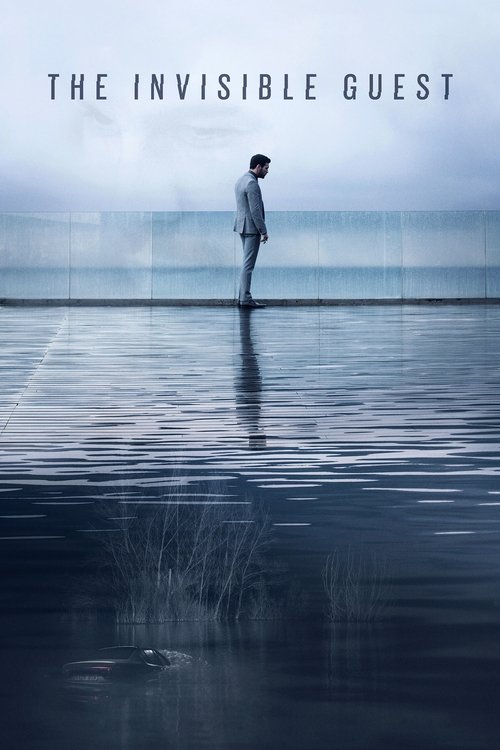
The Invisible Guest
2017 · Oriol Paulo
For when you want to play detective from the couch — a puzzle-box night, ideally with someone to argue with the moment the credits roll. Pure engrossing entertainment, no homework required.
What it's about
A young Barcelona businessman, accused of murdering his lover in a locked hotel room, has one night to prepare his defense with a formidable veteran lawyer before a surprise witness testifies. As she pushes him to tell the story again — and again — the versions stop matching.
The experience
A tightening screw of a thriller: talky on the surface, but every retelling rearranges what you thought you knew, and the film openly dares you to spot the lie. You watch it leaning forward, second-guessing everything.
The craft
Oriol Paulo builds mysteries like a watchmaker: the script is the star, a locked-room puzzle told and retold with each pass through the evidence subtly shifted. Chilly, elegant interiors and Fernando Velázquez's purring score keep the machinery sleek — it's a film about narration you cannot trust, engineered so the pieces click.
Why it matters
A modest performer at home, it became a genuine international phenomenon and one of the most remade and imitated Spanish thrillers of its era, cementing Paulo as Spain's premier puzzle-thriller engineer.
Spanish cinema's post-Orphanage thriller boom found its most exportable engineer in Oriol Paulo, a screenwriter-turned-director who builds mysteries the way watchmakers build escapements. The setup is austere chamber drama: a businessman accused of murder, a formidable veteran lawyer, one night in a Barcelona apartment to construct a defense before a surprise witness testifies. What follows is a locked-room puzzle told and retold, each pass through the evidence subtly rearranged, the film openly delighting in narration you cannot trust. Paulo's models are Hitchcock and Agatha Christie rather than realism — the pleasure is architectural, watching a story audit itself. Mireia Gabilondo's chilly interiors and Fernando Velázquez's score keep the machinery purring. A modest performer at home, it became a genuine world phenomenon in transit: a colossal sleeper hit in Chinese cinemas and one of the most remade thrillers of its decade, spawning official versions in India (Badla, with Amitabh Bachchan), Italy, and beyond — the rare screenplay treated internationally as a proven blueprint.
Reception
A solid-but-unspectacular performer in Spain on release, it exploded abroad — becoming a word-of-mouth phenomenon in China (where it outgrossed its home market) and a streaming-era staple in India, turning a mid-budget Spanish thriller into a global recommendation-thread legend.
How The Invisible Guest was received, from release to now →
Influences: the films it descends from and the films it influenced
- Witness for the Prosecution (1957) — Adapts Agatha Christie's courtroom-confession structure where a final reveal retroactively rewrites every prior testimony — the same lawyer/client interrogation frame Paulo uses to stage his nested lies.
- Rashomon (1950) — Establishes the contradictory-retelling device where the same event is dramatized in mutually exclusive flashback versions, the exact machine Paulo runs when the defense lawyer forces the client to revise his account.
- Stage Fright (1950) — Pioneers the lying flashback — visualizing a character's spoken account as if it were true, then detonating it — the specific betrayal-of-the-image trick Paulo builds his whole confession around.
- Les Diaboliques (1955) — Models the chamber-scale thriller whose final act reveals an impersonation and a staged death engineered by a hidden accomplice, mirroring Paulo's substitution-of-identity endgame.
- Sleuth (1972) — Two-hander confined to interior rooms where power flips through escalating verbal gamesmanship and disguise, the locked-room duel dynamic Paulo compresses into a single hotel-suite interview.
- Dial M for Murder (1954) — Demonstrates architectural plotting — a murder scheme diagrammed like blueprint geometry within one apartment — the meticulous spatial-alibi engineering Paulo's script fetishizes.
- The Usual Suspects (1995) — Perfects the interrogation-frame twist where a narrator spins an elaborate false account and the listener's revealed identity collapses it, the structural rug-pull Paulo copies wholesale.
- Primal Fear (1996) — Legal-thriller whose entire case rests on a client performing a false persona to his own counsel, the lawyer-deceived-by-client reversal at the heart of Paulo's climax.
- The Body (2012) — Paulo's own prior single-night procedural drives its twist-plot through a guilt-ridden interrogation and a staged death, the template of chilly interiors and orchestral misdirection he refines here.
- The Orphanage (2007) — Anchors the Spanish-thriller boom's house style — glossy chilly-interior cinematography and a swelling orchestral score wrapped around a grief-and-guilt reveal — that Paulo inherits.
- The Girl on the Train (2016) — Sibling exercise in unreliable narration where a witness's reconstructed memory of a crime proves self-serving and false, the same testimony-you-can't-trust engine.
- Mystic River (2003) — Sibling in guilt-and-deception plotting where a confession's meaning inverts once identity is clarified, deploying orchestral gravity to sell a moral rug-pull.
Similar films
- Open Your Eyes (1997) — shared sensibility
- Intacto (2001) — shared sensibility
- Forgotten (2017) — shared sensibility
- Memoir of a Murderer (2017) — shared sensibility
- Anatomy of a Fall (2023) — shared sensibility
- The Secret in Their Eyes (2009) — shared sensibility
- Memento (2000) — shared sensibility
- Parasite (2019) — shared sensibility