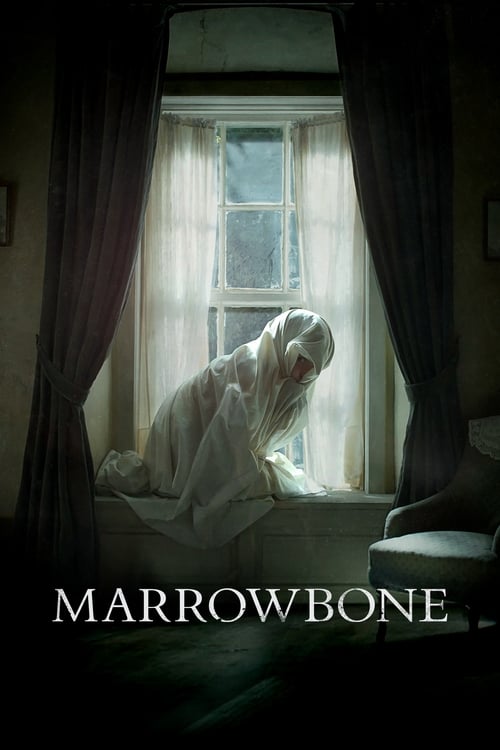
Marrowbone
2017 · Sergio G. Sánchez
For a rainy-night watch when you want atmosphere and a puzzle more than a gorefest — creaky-house chills wrapped around a story with actual heart. Comfort-adjacent horror for people who like to be moved as well as spooked.
What it's about
In 1969, four siblings and their mother flee across the Atlantic to a crumbling inherited house in rural New England, hoping to disappear and start over. When the eldest, Jack, is left to hold the family together, the children seal themselves off from the town — hiding from prying eyes, covering mirrors, and keeping the attic locked — while something in the house makes itself known. Jack's tentative romance with a local librarian is the one thread connecting them to the outside world, and it's fraying.
The experience
A slow-building gothic that trades jump-scare barrages for creeping dread and genuine tenderness — you're as invested in these siblings protecting each other as you are afraid for them. It plays as much like a sad, romantic mystery as a horror film, and it saves its real cards for late.
Performances
George MacKay carries the film as Jack, wound tight with responsibility, and Mia Goth brings a strange, watchful gentleness to Jane; the young ensemble sells the siblings' bond, which is the whole ballgame.
The craft
Written and directed by Sergio G. Sánchez, the screenwriter behind some of Spain's most acclaimed emotional horror, and it shows: the scares are built on structure and secrets rather than shock. Handsome, autumnal photography turns the decaying house and the 1960s New England setting into a storybook gone wrong, with details like Morse code taps and covered mirrors doing quiet work.
Why it matters
A notable entry in the wave of Spanish-produced, English-language gothic horror that put emotion and narrative sleight-of-hand at the center of the genre, and the directorial debut of one of that movement's key writers.
Snapshot
Marrowbone — released in Spain as El secreto de Marrowbone, a title that hands the audience the film's operating principle before the lights go down — is the directorial debut of Sergio G. Sánchez, the screenwriter best known for J.A. Bayona's The Orphanage (El orfanato, 2007) and The Impossible (Lo imposible, 2012). It is a Spanish production shot in Spain with an almost entirely British cast, set in an American nowhere in 1969, and performed in English: a film with no fixed nationality, which is itself the point of the production model it belongs to.
The premise is a gothic setup of great economy. Four siblings — Jack (George MacKay), Billy (Charlie Heaton), Jane (Mia Goth) and small Sam (Matthew Stagg) — arrive with their mother at a decaying inherited house in rural New England, having crossed the Atlantic to escape a father whose crimes have made the family name unusable. They take the mother's maiden name, Marrowbone. She dies. The children conceal the death, because Jack's twenty-first birthday is the date at which he can legally hold the estate and keep them together; until then, any adult who learns the truth can dissolve them into the care system. They live sealed off, mirrors covered, an attic boarded up, something moving behind the boards.
What the film is actually doing with that setup — and the mechanism by which its ghost is generated — is a late reveal that retroactively reorganizes everything before it. It is a twist film in the most structurally committed sense: not a sting in the tail but a load-bearing column. Whether the column holds is the central question of its critical reception.
Industry & production
Marrowbone is a product of the Spanish "international gothic" production model, an export strategy consolidated by Alejandro Amenábar's The Others (2001): Spanish capital and crews, English-language performance, a period setting legible to Anglophone audiences, and a story engine — the haunted house with a secret — that requires no cultural translation. Sánchez had been the writer inside that model for a decade. Having supplied Bayona with two of the most commercially successful Spanish films of the century, he directed here within the same producing circle; Belén Atienza and Sandra Hermida, long-standing producers in the Bayona orbit, are credited on the film, which situates it squarely in that lineage of personnel rather than as an outsider's project.
The screenplay has a longer history than the film's date suggests. By multiple accounts Sánchez had carried the Marrowbone material for years before it was made, which helps explain how closely its concerns rhyme with The Orphanage — this is not a director imitating his own hit but a writer returning to a preoccupation that predates it.
Production was based in northern Spain, where the Cantabrian coast and its interior stand in for the American Northeast: the wide beach, the treeline, the isolated house on a rise. This is the most consequential production decision in the film, and it is invisible only if you don't know to look. The landscape is almost right and never quite, which lends the whole picture a faintly denatured, storybook quality — an America assembled from other films rather than observed. Given that the narrative is finally about a world constructed inside a damaged mind, the mismatch reads less as a compromise than as a resource.
The film opened in Spain in October 2017 and reached the United States the following spring in a limited, specialty-label pattern typical of mid-budget genre imports of the period. Domestically it performed respectably against the standard of Spanish releases that year; internationally it was a modest theatrical presence that found its real audience through home viewing and streaming. I won't attach figures to either claim, since the reliable numbers are not something I can reconstruct with confidence.
Technology
Marrowbone was made at a moment when digital capture had fully absorbed the low-light gothic. The film's interiors are governed by lamp, window, and firelight — the kind of scheme that, on film stock, would have demanded either exposure compromises or lighting units visibly in excess of the sources. Contemporary sensors make available a plausible naturalism at very low levels, and the picture spends much of its running time in a register of underexposed browns, sodium ambers, and pooled darkness that would have looked either muddier or falser fifteen years earlier.
The other technological substrate is the digital intermediate, which is where a film like this is genuinely finished. The consistent tonal grade — desaturated, warm in the highlights, cold in the shadows, with a persistent slight haze — is a grading decision as much as a photographic one, and it does heavy lifting in unifying Spanish locations, built interiors, and period dressing into one continuous place.
Visual effects are used with restraint and mostly in the service of ambiguity: a suggestion behind boards, a hand at a gap in a wall, atmospherics. The film's most important effect is not an effect at all but a piece of production design — the covering of mirrors — and its most important compositing job is arguably in the reveal sequences, where the mechanics of who is and isn't present in a frame have to be handled without tipping the hand. The detailed technical record here is thin in accessible sources; what I've described is read off the images rather than off a published breakdown, and I'd flag it as such.
Technique
Cinematography
Xavi Giménez photographs the film, bringing to it the sculpted, high-contrast gloom he had developed across a career in Spanish genre work — his images for The Machinist (2004) and his large-canvas work on Agora (2009) mark the two poles of his range, and Marrowbone draws on the first. The house is shot as an interior of thresholds: doorframes within doorframes, corridors that recede into unlit depth, staircases photographed from below so the upper landing sits in blackness. Windows are used as the film's only reliable light source and its only reliable image of the outside, which is thematically exact — the children can see the world but not enter it.
Against this, the exteriors are pastoral and over-bright, shot with a lyric softness: the beach, the long grass, the bicycle rides to town. The film alternates the two registers so regularly that the contrast becomes a grammar. Interior equals truth withheld; exterior equals the fantasy of an ordinary adolescence. The device also quietly prepares the reveal, since the exteriors are precisely where the film's most consoling images live.
Mirrors, covered with cloth, are the recurring compositional object — the film keeps placing them in frame while refusing them their function. It is a gothic convention (mourning custom, vampire lore) repurposed as a clue in plain sight.
Editing
The cutting strategy is one of managed withholding, and it operates on two clocks. The first is a suspense clock — the calendar toward Jack's birthday, the encroachment of the solicitor Tom Porter, the noises overhead — cut in conventional, patient thriller rhythms, with a marked preference for holding shots slightly past comfort. The second is the concealment clock: an entire second film is being edited around, and the picture's technique consists largely of what it declines to show and whose point of view it declines to occupy.
The reveal itself arrives as a reprise structure — a return to earlier material re-cut and re-angled so that the same events yield a different account. This is the standard architecture of the twist film since The Sixth Sense (1999), and the Marrowbone version is competent rather than revelatory: it explains thoroughly, arguably past the point of trust in the audience. The most common critical complaint about the film lands here, on the final act's willingness to narrate its own solution.
I've described the cutting rather than credited it; the editorial credit is one of the craft attributions I can't fix with confidence, and I'd rather leave the gap visible than fill it with a guess.
Mise-en-scène / staging
The house is the film's central performance. It is played as a body — the title's marrow and bone are not decorative — with an interior that is warm, cluttered, and childlike at ground level and progressively hostile as it rises: attic as skull, boarded wall as suture, the gap in the boards as wound. The children's domestic arrangements (chores, meals, the fiction of the mother upstairs) are staged with a specificity that earns the film much of its emotional credit; the sibling group is blocked in clusters, physically overlapping, in a way that reads as tenderness before it reads as anything else.
Staging carries the concealment. Characters are grouped so that Jack is habitually the hinge of a scene — the one who speaks to outsiders, the one who occupies the doorway between the family and the world. Retrospectively this is the film's largest formal tell and, on a second viewing, its most satisfying piece of craft.
Sound
Fernando Velázquez's score is the film's most confident element and its clearest inheritance. Velázquez wrote The Orphanage, The Impossible, A Monster Calls and Crimson Peak, and he brings the same late-Romantic idiom: strings in long ascending phrases, piano figures for the children, a lullaby-adjacent theme that carries the sibling material. It is unabashedly emotive scoring in a genre that had, by 2017, largely moved toward drone and texture, and it declares the film's allegiance to the melodramatic ghost story rather than to atmospheric horror.
The effects design is more conventional: house creak, wind, the specific percussive vocabulary of something moving above the ceiling. The film's cleverest sound idea is perspectival — the question of whose ears we have been in, and what has been audible only to one person, is part of the puzzle, and the mix is constructed so that the eventual reframing of the soundtrack is retroactively consistent.
Performance
George MacKay carries the film on a face that must be simultaneously open and sealed. Two years before 1917 made him internationally legible, he plays Jack as a young man performing adulthood — the tightness in the jaw, the over-careful courtesy with strangers — and the performance is calibrated so that its strain can be read as responsibility on first viewing and as something else on second.
Anya Taylor-Joy, arriving off The Witch (2015) and Split (2016) and not yet the fully formed star of the following decade, plays Allie, the girl from town who brings books and warmth; her function is to be the audience's access and the film's only sunlight. Mia Goth and Charlie Heaton — the latter concurrent with Stranger Things, which gives the film an accidental period-nostalgia adjacency — have the harder assignment: playing characters whose ontological status the film is concealing, and doing so without either overplaying or blanking out. Kyle Soller's Porter supplies the film's non-supernatural evil as ordinary provincial appetite, a solicitor with a claim and a hunger, and the performance's deliberate banality is a useful contrast to the gothic machinery.
Narrative & dramatic mode
The film runs two antagonists in parallel, one metaphysical and one bureaucratic. The thing in the attic is the family's inheritance made literal; Porter, with his documents and his leverage, is the adult world arriving to collect. This doubling is the film's structural signature and its dramatic solution to a classic problem of the haunted-house story: a ghost cannot impose a deadline, but a lawyer can.
Its mode is the fairy tale with a legal instrument at its center. The children's pact, the sealed room, the forbidden gaze, the name changed to escape a curse — all of it is folkloric, and the film's diction supports that, with the siblings speaking a slightly formal, storybook English. Against that, the plot mechanism is property law and the age of majority. The collision is productive: the horror is that a bureaucratic date can dissolve a family that a monster could not.
The reveal converts the film from ghost story to case study, and this is where opinion divides. Read generously, the twist is not a trick but a thesis — the picture has been dramatizing, from the inside, the refusal to mourn, and every gothic convention it deployed turns out to have been a symptom rather than a device. Read less generously, the last act's explanatory zeal collapses a rich ambiguity into a diagnosis, and the film spends its final minutes telling the audience what it has just felt.
Genre & cycle
Marrowbone sits in the post-Others cycle of Spanish-financed English-language gothics, and more specifically in the sub-cycle of the sad ghost story, where the supernatural is an expression of grief and the horror resolves into pathos. The Orphanage is the load-bearing precedent; The Devil's Backbone (2001) and Crimson Peak (2015) are the del Toro flank of the same tradition.
It also belongs, more awkwardly, to the twist-horror lineage running from The Sixth Sense through The Others to A Tale of Two Sisters (2003) — the last of which shares its precise conceit of a survivor sustaining lost siblings as present company, and stands as the film's closest structural relative in world cinema.
Its release year places it beside the commercial and critical horror surge of 2017 — Get Out, It, the A24 sensibility — but Marrowbone is not an "elevated horror" film in that idiom. Its sensibility is older and more sentimental: gothic-romantic, Y.A.-adjacent in its handling of first love, more interested in tears than in dread. That mismatch with the prevailing 2017 taste is one plausible reason its reception was cooler than its craft warranted.
Authorship & method
Sánchez's authorial signature, visible across The Orphanage and Marrowbone, is a single figure: a person who constructs a livable fiction around an unbearable loss, and whose love is indistinguishable from denial. The Orphanage ends with a mother choosing to join her fantasy; Marrowbone dramatizes a young man who has already made that choice and doesn't know it. Both films treat the gothic apparatus — sealed rooms, hidden bodies, house as psyche — as the outward form of grief rather than as a threat from outside. Both are unusually kind to their deluded protagonists; neither treats delusion as pathology so much as devotion.
As a first-time director he stages more conservatively than Bayona, with less appetite for the bravura setpiece and more patience for domestic texture. The key collaborators are the ones who make the film feel of a piece with the tradition it comes from: Giménez's chiaroscuro photography and Velázquez's late-Romantic score, both of which are more assured than the direction. Other craft credits — editorial and production design in particular — I can't attribute with confidence, and I'd rather note that than assign them.
Movement / national cinema
The Spanish fantastic of the last quarter-century is one of the more coherent national genre movements in world cinema: Amenábar, Jaume Balagueró, del Toro as patron and producer, Bayona as its biggest commercial success, with Sitges as its festival home and a production infrastructure — Filmax, Rodar y Rodar, Telecinco Cinema and their successors — capable of financing English-language work for export.
That movement's most serious strand is political. The Spirit of the Beehive (1973), The Devil's Backbone, Pan's Labyrinth (2006) all locate their ghosts in the unburied dead of the Civil War and the Franco period; the haunted house is Spain, and the child's inability to name what haunts it is a statement about historical memory. Marrowbone takes the movement's forms and detaches them from that content. Its house is American, its history is a private crime rather than a national one, and its buried body belongs to one family. This is a real cost — the film loses the political resonance that gives its predecessors their weight — and also a legible commercial logic, since the export model rewards stories that carry no local history with them. The film is a clear case study in what the Spanish gothic gains in reach and loses in specificity when it crosses the Atlantic on paper.
Era / period
Two eras are in play. The setting, the late 1960s, is used lightly: no counterculture, no Vietnam, an America of dirt roads, libraries and small-town solicitors that exists mainly to make the children's isolation plausible in a way it could not be after mass communications. Period here is a technology of sealing.
The production era matters more. 2017 was the year mid-budget theatrical genre film was being squeezed between franchise tentpoles and streaming, and Marrowbone is exactly the size of picture that suffered — too handsome for VOD-native economics, too unfranchised for a wide international release. Its afterlife has been a streaming one, which is now the normal fate of the well-made mid-budget import.
It is also, unintentionally, a document of a casting moment. Taylor-Joy, MacKay, Goth and Heaton were all, in 2017, ascendant performers associated with horror and prestige-adjacent genre work; within five years all four had significantly larger profiles. The film has become, in retrospect, a kind of group photograph.
Reception, canon & influence
Critical reception was mixed and has stayed mixed. The recurring praise is for atmosphere, production design, the photography, Velázquez's score, and the ensemble — particularly MacKay and Taylor-Joy. The recurring objection is structural: that the third act over-explains, that the twist is both guessable and over-serviced, and that the film's mechanics are more admired than its meanings. Domestically it did better than abroad, and it has accumulated a modest cult of viewers who find its final movement genuinely moving rather than merely tidy. Its awards profile in Spain was that of a respectable debut rather than a contender; I'd rather not assert specific nominations I can't verify.
Backward. The debts are legible and mostly acknowledged by the form itself. Henry James's The Turn of the Screw by way of The Innocents (1961) supplies the model of a haunting that may be a mind. The Night of the Hunter (1955) supplies children fleeing a murderous father through an America shot as folklore. Poe's The Fall of the House of Usher supplies the house-as-body, the sibling entombed, the structure that cannot survive the truth — and the title's marrow-and-bone is nearly a citation. V.C. Andrews's Flowers in the Attic (1979) supplies the sequestered-siblings gothic in its popular register. Psycho (1960) supplies the concealed corpse and the personality that keeps a dead relative alive. Closer to home: The Others, The Devil's Backbone, and Sánchez's own The Orphanage, whose ending Marrowbone essentially restages from the other side. A Tale of Two Sisters is the closest structural analog, though I'd frame that as kinship rather than documented influence.
Forward. Its influence is real but narrow, and honesty requires saying so: Marrowbone is not a film that changed the grammar of its genre. Its legacy operates in three places. First, as a career node — it consolidated the reputations of a cohort of young performers now central to contemporary genre cinema, and it functions today as an early-career reference point for MacKay, Taylor-Joy and Goth. Second, as evidence in the ongoing argument about twist construction: it is frequently cited in criticism of the period as a case where the reveal is well-built and yet diminishing, a useful negative example for a device that had begun to exhaust itself. Third, as a marker in the Spanish export model — a demonstration that the Orphanage formula could be transferred to a new director within the same production family, and that what transferred most reliably was the craft rather than the emotional detonation.
The film's most durable idea is one it never quite lets itself sit inside: that a story told well enough to survive on can also be the thing preventing you from living. That is the same idea The Orphanage ends on, and Sánchez is one of the few genre filmmakers of his generation to have built an authorship on it.
Reception
Met with a shrug in 2017–18 — middling reviews (49% on Rotten Tomatoes) and a quiet release — it's since been rediscovered as an accidental time capsule: Anya Taylor-Joy, George MacKay, Charlie Heaton and Mia Goth, all cast just before they became huge.
How Marrowbone was received, from release to now →
How to watch Marrowbone: what to notice on a first viewing
- Notice doorframes stacked inside other doorframes throughout the house. Gimenez shoots the house as an interior of thresholds, corridors receding into unlit depth and staircases photographed from below so the upper landing sits in blackness. The house itself keeps drawing boundaries around what these children are and are not allowed to see.
- Watch the swing between gloomy interiors and over-bright outdoor scenes. The film alternates sculpted, high-contrast gloom indoors with lyric, sunlit exteriors so regularly that the contrast becomes its own grammar, truth withheld inside, ordinary adolescence outside. You can tell which kind of scene you're in just from how much light is allowed into it.
- Notice the mirrors kept covered with cloth around the house. The film keeps placing cloth-covered mirrors in frame while refusing to let them do their normal job, an old mourning custom repurposed as a clue sitting in plain sight. A covered mirror is worth noticing every single time this film gives you one.
- Watch how the siblings are grouped together, physically overlapping. The children are blocked in tight, overlapping clusters that read as tenderness first, while Jack is habitually placed at the doorway between the family and outsiders. Where Jack stands, always at the threshold to the world, matters more than it first appears.
The whole guide to watching Marrowbone, with the keys for a rewatch →
Influences: the films it descends from and the films it influenced
- The Night of the Hunter (1955) — Stanley Cortez's folkloric Americana — the pursuing father rendered as a horizon silhouette and the children's flight staged in storybook tableaux — supplies Marrowbone's prologue grammar and its recurring luminous-exterior/gloomed-interior contrast.
- Psycho (1960) — The survivor who keeps a dead parent alive as an internal antagonist, plus an epilogue that re-screens withheld footage to force a re-reading — the concealed body in the sealed room and the explanatory reprise are lifted structurally.
- House of Usher (1960) — Daniel Haller's design of the mansion as a diseased organism whose widening fissure tracks the family's collapse, with the sibling entombed inside it — the house-as-body conceit Marrowbone's marrow-and-bone title nearly cites outright.
- The Innocents (1961) — Freddie Francis's candle- and window-motivated practical sources inside matted-black widescreen, married to a POV regime that never cuts to an objective view of the apparition — the device that keeps Jack's hauntings permanently unadjudicated.
- The Haunting (1963) — Davis Boulton's wide-angle, canted, bulging-door coverage that gives an interior somatic behavior — the direct model for Marrowbone's attic as cranium and its threshold framing of knocking, breathing partitions.
- Flowers in the Attic (1987) — The sequestered-siblings gothic in popular register: eldest child as surrogate parent, attic geography as social confinement, and an inheritance/legal clock as plot engine — Marrowbone's sibling blocking and deadline mechanics come from this template.
- The Sixth Sense (1999) — Built the twist as a mourning device rather than a gotcha, serviced by a closing montage of re-screened earlier shots; Marrowbone's reprise-reveal reproduces both the montage form and its consoling, non-punitive tone.
- The Others (2001) — Javier Aguirresarobe's sealed-house grammar — permanently drawn curtains, banished photographs, a household rulebook that turns out to describe the protagonists — is the cycle-parent for Marrowbone's covered mirrors and perspective inversion.
- The Devil's Backbone (2001) — Guillermo Navarro's amber-interior against bleached-exterior scheme and the ghost figured as an unmourned wound rather than a menace — the Spanish-gothic production-design method Marrowbone inherits nearly intact.
- The Machinist (2004) — Xavi Giménez's own precedent — desaturated, hard-sourced interiors built around a hallucinated antagonist who is the protagonist's guilt made flesh; Marrowbone's palette and its embodied denial are the same DP working the same conceit.
- The Orphanage (2007) — Sánchez's own script and Velázquez's score, with an ending Marrowbone restages from the other side: grief dramatized through sealed rooms and a hidden body, and a protagonist who elects the consoling fiction.
- The Little Stranger (2018) — Extends the device coldly: a decaying manor whose poltergeist is the narrator's own denied desire, disclosed in a final reflection shot — Marrowbone's unreliable-caretaker structure stripped of its consolation.
- A Tale of Two Sisters (2003) — The closest structural analog: a survivor who stages a dead sibling as a living presence, a dual antagonist split between external tormentor and dissociated self, resolved by a reprise that re-blocks earlier two-shots as one-shots.
- Julia's Eyes (2010) — The post-Orphanage export model in action — craft transferred to a new director inside the same production family — with subjective-vision blocking that systematically withholds faces from frame as its formal engine.
- The Awakening (2011) — Runs the Others cycle's debunker-to-participant reversal on period practical lighting, using a doll's-house model of the location as the diegetic key that unlocks the reveal.
- Goodnight Mommy (2014) — Sibling blocking that conceals a head-count: the children are framed and cut so the audience is never permitted to audit whether both are present — the same withholding strategy governing Marrowbone's group staging.
- Crimson Peak (2015) — Velázquez scoring a house that bleeds and breathes; del Toro's literalized house-as-body and the sibling secret sealed on an upper floor is Marrowbone's exact design vocabulary at scale.
- A Monster Calls (2016) — The Bayona/Velázquez/Óscar Faura team on the same thesis — an invented narrative held as a survivable substitute for an unbearable truth, with the whole film engineered to defer one confession scene.
Similar films
- Crimson Peak (2015) — influence & lineage
- The Others (2001) — influence & lineage
- A Tale of Two Sisters (2003) — influence & lineage
- The Innocents (1961) — influence & lineage
- The Devil's Backbone (2001) — influence & lineage
- Hokum (2026) — shared sensibility
- Oddity (2024) — shared sensibility
- The Ritual (2017) — shared sensibility