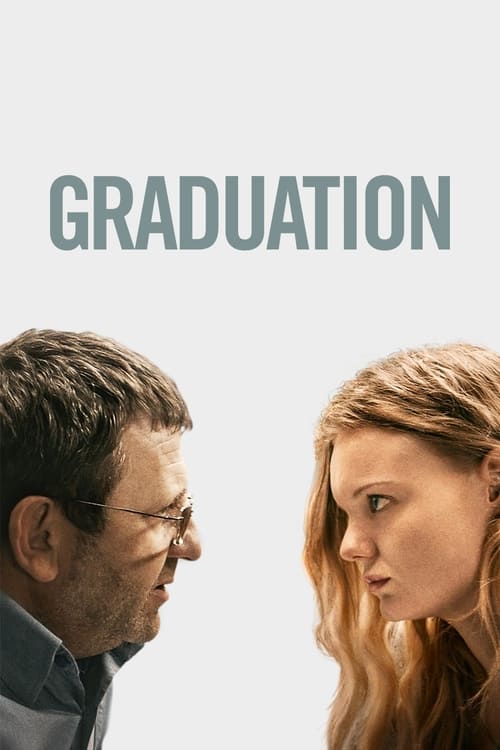
Graduation
2016 · Cristian Mungiu
When you want a film to chew on for days — a serious, adult drama about how good people bend, best watched when you're up for being challenged rather than comforted.
What it's about
A respected doctor in a provincial Romanian town has spent years grooming his daughter for one thing: a scholarship to study in the UK, away from everything he despises about his country. Days before her final exams, she's assaulted, and her chance starts slipping away — so a man who built his identity on integrity begins trading favors in a system where everyone owes everyone, one small compromise at a time.
The experience
Quiet, tense, and morally suffocating in the best way — long unbroken scenes of negotiation and self-justification that tighten around you like a slow knot. It doesn't tell you what to think; it makes you complicit in every choice.
Performances
Adrian Titieni is quietly devastating as the father, playing a decent man's erosion so gradually you can never point to the moment he crossed the line.
The craft
Cristian Mungiu, who won Best Director at Cannes for this film, works in long, patient takes with no score, letting conversations play out in real time until the ethical trap is fully visible. The drab apartment blocks and gray institutional light aren't just backdrop — they're the argument.
Why it matters
It confirmed Mungiu as a standard-bearer of the Romanian New Wave, extending that movement's unflinching study of everyday corruption from institutions into the intimacy of a family.
Snapshot
Graduation (Romanian: Bacalaureat) is Cristian Mungiu's fourth solo feature, a tightly wound moral drama about a provincial Romanian physician who compromises his principles to secure his daughter's escape from the country. Premiering in competition at the 2016 Cannes Film Festival, it won Mungiu the Best Director prize, which he shared that year with Olivier Assayas for Personal Shopper. The film extends the central preoccupation of the Romanian New Wave — the corrosive aftermath of communism, the way an entire society negotiates daily life through small corruptions — and folds it into an intimate study of a father whose love curdles into the very behavior he wishes his child to flee. Where Mungiu's earlier work confronted institutional cruelty head-on (illegal abortion in 4 Months, 3 Weeks and 2 Days, monastic dogma in Beyond the Hills), Graduation turns inward, dramatizing how decent people rationalize complicity. It is a film of waiting rooms and parked cars, of conversations conducted in fixed frames, and its quiet, almost clinical surface conceals one of the most devastating portraits of generational disillusion in contemporary European cinema.
Industry & production
Graduation was produced by Mungiu's own Bucharest-based company, Mobra Films, which he founded and through which he has controlled his output as writer-producer-director. The picture was assembled as a tri-national European co-production, partnering Romania with France's Why Not Productions (Pascal Caucheteux's outfit, long associated with auteur cinema) and Belgium's Les Films du Fleuve, the production house of Jean-Pierre and Luc Dardenne. That last collaboration is telling: Mungiu's observational realism and ethical seriousness share clear kinship with the Dardennes' Belgian social cinema, and the partnership situates Graduation squarely within a pan-European art-house financing model that pools national funds, broadcaster money, and festival prestige to make films that would struggle to recoup in any single domestic market.
Romanian cinema operates on slender resources, and Mungiu's career has been shaped as much by his entrepreneurial control of production as by his directing. After the Palme d'Or for 4 Months, 3 Weeks and 2 Days in 2007 placed Romanian film at the center of world cinema, Mungiu used his standing to keep authorship and final cut firmly in his own hands. Graduation reflects that autonomy: a modestly budgeted drama with no stars in the international sense, no spectacle, and a running time and rhythm dictated entirely by its maker's aesthetic convictions rather than commercial calculation. Its commercial life ran along the familiar art-house circuit — festival launch at Cannes, specialized theatrical distribution across Europe and a limited release in North America (handled in the United States by Sundance Selects/IFC) — where it performed as a critical success rather than a box-office one. I will not cite specific gross figures, as reliable consolidated numbers for so dispersed a release are not something I can verify with confidence.
Technology
Graduation was shot digitally, the prevailing capture mode for low-to-mid-budget European drama by the mid-2010s, and the choice serves the film's aesthetic rather than calling attention to itself. Digital acquisition suits Mungiu's method of long, uninterrupted takes — there is no magazine length to limit a shot, and scenes can run as long as the staging demands. The technology is, in keeping with New Wave practice, deliberately unobtrusive: there is no visual-effects layer, no digital grading toward stylization, no manipulation that would announce itself. The film's "technology," in the meaningful sense, is the discipline of available light, real locations, and a camera that records rather than embellishes. This effacement of technique-as-spectacle is itself a position — a refusal of the gloss that distinguishes the Romanian school from mainstream European prestige drama.
Technique
Cinematography
The cinematography is by Tudor Vladimir Panduru, and it is the film's most immediately legible signature. Panduru works in long takes and largely static or minimally mobile framings, often placing the camera at a slight remove and letting action unfold within a fixed rectangle. The compositions favor doorways, windows, car windscreens, and corridors — frames within frames that hem the characters in and underscore the film's themes of constraint and surveillance. Depth of field is frequently shallow, isolating a face against a softened, anonymous provincial backdrop of gray apartment blocks and institutional interiors. The palette is muted and overcast, a register of winter light and fluorescent hospital glare that refuses any consoling warmth. Crucially, the camera tends to observe rather than dramatize: it does not cut in for emphasis or punctuate dialogue with reaction shots, but holds, forcing the viewer to read the scene whole. This patient, anti-rhetorical visual style is the inheritance of the Romanian New Wave's foundational realism, but Panduru's work here is notably composed and architectural — less handheld and jittery than some of the movement's earlier films, more deliberately framed.
Editing
Edited by Mircea Olteanu, Graduation is built from relatively few cuts. The long-take method means that editing operates primarily at the level of scene-to-scene architecture rather than within scenes; the rhythm is governed by duration and by the patient accumulation of episodes, each a transaction or negotiation in Romeo's widening web of favors. The cutting refuses the tension-building grammar of conventional thrillers even though the plot — an investigation, a coverup, the unraveling of a scheme — could easily have been shaped that way. By withholding accelerated montage, Olteanu and Mungiu keep the film in a register of moral observation rather than suspense, so that the dread accrues from inevitability rather than from manufactured shocks.
Mise-en-scène / staging
Mungiu is a master of staging in depth and of the choreographed long take, and Graduation is among his most controlled work in this respect. Scenes are blocked so that characters move toward and away from the camera within a single frame, entering and exiting through real doorways, conducting overlapping conversations that feel caught rather than performed. The settings — the cramped apartment, the hospital, the school, the police station, the car — are rendered with unfussy authenticity, the texture of a specific post-communist provincial world. A recurring, quietly disturbing motif of broken glass (a stone through a window, a shattered windscreen) punctuates the staging, an external violence intruding on Romeo's attempts to manage his world. The mise-en-scène consistently subordinates the individual to environment and circumstance, framing people as products of a place.
Sound
In strict accordance with Romanian New Wave practice, Graduation has essentially no non-diegetic musical score. The soundtrack is built from the ambient noise of its locations — traffic, hospital machinery, the murmur of bureaucracy, footsteps in stairwells. This absence of score is a defining ethical and aesthetic choice: it denies the audience emotional cueing, refuses to tell us how to feel, and keeps the film tethered to the unglamorous real. Sound design works to deepen the sense of a lived-in, indifferent world; the few instances of music are diegetic, arising from within the scene. The result is a soundscape of mundane realism against which the drama's moral pressure registers all the more sharply.
Performance
The performances are calibrated to the same naturalism. Adrian Titieni anchors the film as Romeo Aldea, the doctor, in a performance of contained desperation — a man whose surface reasonableness barely masks the panic and self-deception driving him. Maria-Victoria Draguș plays his daughter Eliza with a watchful reticence; her stillness becomes the film's moral mirror, registering her growing recognition of what her father is doing in her name. (Draguș had earlier appeared as a child in Michael Haneke's The White Ribbon, another study of a community's buried compromises.) The supporting ensemble — the wife, the mistress, the various officials and intermediaries — performs in the same understated key, avoiding melodrama. Mungiu directs actors to a granular realism in which the drama lives in glances, hesitations, and the things left unsaid across long takes.
Narrative & dramatic mode
Graduation operates in the mode of compressed moral realism, a near-classical tragedy unfolding over a handful of days. The inciting event — the assault on Eliza just before her crucial baccalaureate exams, leaving her injured and shaken — sets in motion a chain of compromises as Romeo seeks to guarantee the grades that will secure her scholarship to a British university and, with it, her departure from a Romania he has given up on. The dramatic engine is the cascade of favors and reciprocal obligations: to fix one thing, Romeo must trade another, and each transaction implicates him further. The structure is causal and tightening, but Mungiu resists genre payoff. There is no clean resolution, no comeuppance staged for catharsis; the film ends on ambiguity and irony rather than closure. The dramatic mode is observational and dialectical — it presents Romeo's reasoning with enough sympathy that the viewer feels the seduction of his logic, then exposes its rot. This refusal to flatter the audience with moral certainty is central to the film's power.
Genre & cycle
On its surface Graduation borrows the architecture of the procedural and the social-problem drama — there is a crime, an investigation, a scheme to defeat the system — but it belongs more properly to the cycle of Romanian New Wave moral dramas that anatomize the texture of post-Ceaușescu society. It sits in dialogue with films like Corneliu Porumboiu's Police, Adjective and Cristi Puiu's The Death of Mr. Lazarescu in its use of mundane bureaucratic process as a lens on ethics. Within Mungiu's own body of work it forms a loose thematic cycle with 4 Months, 3 Weeks and 2 Days and Beyond the Hills: three films about individuals trapped between conscience and a coercive social order. If a genre label must be applied, it is the European art-film as ethical inquiry — the "cinema of moral anxiety," to borrow a phrase from Polish film history that fits the Romanian school remarkably well.
Authorship & method
Graduation is a thoroughgoing auteur work: Mungiu wrote the original screenplay, directed, and produced through Mobra Films, exercising the comprehensive control that has characterized his career. His method is one of meticulous scripting followed by long-take execution, building scenes as sustained behavioral events rather than assemblies of coverage. He has been candid that his films emerge from observed reality and from his concern with the moral compromises of Romanian life; Graduation in particular reads as a generational reckoning, the work of a filmmaker examining what his peers — those who stayed, who built families, who told themselves they could not change the country — have become.
His key collaborators reinforce this signature. Cinematographer Tudor Vladimir Panduru translates Mungiu's compositional precision into the film's architecture of fixed, framed observation. Editor Mircea Olteanu shapes the patient, duration-driven rhythm. The most conspicuous "collaborator," by its absence, is a composer: the decision to forgo a score is itself an authorial statement, aligning the film with the realist ethics of the movement. The lead performances by Adrian Titieni and Maria-Victoria Draguș are extensions of Mungiu's directorial method, performances built to live inside long takes and to reveal character through restraint. The Dardenne brothers' involvement as co-producers is worth noting as an affinity of sensibility rather than direct creative input, situating Mungiu within a broader European tradition of ethically rigorous realism.
Movement / national cinema
Graduation is a flagship work of the Romanian New Wave, the loose movement that emerged in the mid-2000s and announced itself to the world through Puiu's The Death of Mr. Lazarescu (2005) and, decisively, Mungiu's 4 Months, 3 Weeks and 2 Days (2007). The movement is defined by long takes, naturalistic performance, real locations, an absence of non-diegetic music, dark deadpan irony, and an abiding concern with the legacy of the Ceaușescu era and the disordered transition to capitalism. Graduation exemplifies these traits while marking a maturation: a decade after the movement's breakthrough, it turns from the communist past to the disappointed present, asking what the post-1989 generation has made of its freedom. As an artifact of a small national cinema punching far above its weight on the festival circuit, it also illustrates how the Romanian school sustained itself through European co-production and the cultural capital won at Cannes.
Era / period
The film is set firmly in its present — Romania in the mid-2010s, a quarter-century after the 1989 revolution. Its temporal and political horizon is the disillusionment of that anniversary moment: the recognition that the hoped-for transformation has stalled, that corruption merely changed forms, that the system rewards those who learn to manipulate it. Romeo and his wife are of the generation that came of age around the revolution and believed, as he says, that things would change after Ceaușescu fell; the film is suffused with their sense of having been defeated by the country they meant to remake. This is why Eliza's potential emigration carries such weight — it represents the parents' wager that the only honorable future is elsewhere. The period is rendered not through historical markers but through the everyday texture of provincial Romanian life: its hospitals, schools, and police stations, the small humiliations and accommodations of a society its own citizens have learned to distrust.
Themes
The governing theme is moral compromise and its self-justification — the way a fundamentally decent man persuades himself that breaking the rules "just this once," for his child, is not corruption but love. Around this orbit several others: the impossibility of raising children to be honest in a dishonest society (Romeo wants Eliza to leave precisely so she need not become like him, yet to send her away he behaves exactly as he hopes she never will); the failures of the post-communist generation and the betrayal of the revolution's promise; the gap between public morality and private exception; and the question of whether to stay and endure or leave and escape. Surveillance and exposure recur — the broken windows, the anonymous threats, the sense of being watched — externalizing Romeo's guilt. The film is finally a tragedy of inheritance: the parent's compromises become the child's burden, and the very effort to spare the next generation transmits the disease to it.
Reception, canon & influence
Graduation was received as a major work by a filmmaker at the height of his powers. Its Cannes Best Director award (shared with Olivier Assayas) confirmed Mungiu's standing among the foremost living European directors, and critical response broadly praised the film's moral seriousness, its formal control, and Titieni's central performance, while some reviewers found it more measured and less viscerally gripping than the harrowing 4 Months, 3 Weeks and 2 Days. It is now firmly part of the contemporary art-cinema canon and a touchstone in discussions of the Romanian New Wave's second decade.
The influences on the film run backward through the realist tradition: the long-take ethics of the Romanian New Wave's own founders (Puiu, Porumboiu), the social cinema of the Dardenne brothers (here also co-producers), and behind both the lineage of observational European realism reaching to Italian neorealism and to the morally probing cinema of Krzysztof Kieślowski, whose interest in ethical dilemma and the texture of compromised lives Graduation clearly echoes. Its forward influence is best understood as part of the cumulative authority of the Romanian school, which has shaped a generation of festival filmmaking committed to duration, restraint, and ethical inquiry; Mungiu himself continued the project with R.M.N. (2022). Pinning specific later films to Graduation as a singular source would overstate what can be documented — its legacy is most honestly described as its consolidation of a regional style into one of the defining art cinemas of the early twenty-first century, and as a benchmark for the moral drama of compromise.
A Deleuzian reading
A stone comes through the apartment window in the first minutes, and no one sees the hand that threw it.
The full Deleuzian reading of Graduation →
Reception
Premiered in competition at Cannes 2016 to strong reviews and has held steady since — respected as mature, morally knotty Mungiu, though it never sparked the seismic reaction 4 Months, 3 Weeks and 2 Days did.
How Graduation was received, from release to now →
Influences: the films it descends from and the films it influenced
- Bicycle Thieves (1948) — Founds the neorealist template Graduation inherits: location-shot observation of an ordinary, decent man pushed by circumstance into an ethical transgression, with drama built from behavior rather than plot mechanics.
- A Short Film About Killing (1988) — Models the morally-probing study of compromised lives in a corrupt state, including the desaturated, filtered muted palette (Idziak's green-tinged framing) that Graduation's restrained color scheme echoes.
- Dekalog (1989) — Establishes the single-ethical-dilemma chamber drama — one compromise pursued to its consequences — that Mungiu adopts as his narrative engine of moral anxiety.
- The Son (2002) — The Dardennes (here Graduation's co-producers) supply the method of locking onto a morally entangled protagonist with diegetic-only sound, no non-diegetic score, and an ethically suspended final beat.
- The Death of Mr. Lazarescu (2005) — The founding Romanian New Wave work that codifies the long-take, real-time observational ethic and ambient-realist soundscape Mungiu builds on.
- 12:08 East of Bucharest (2006) — Pioneers the deadpan cinema-of-moral-anxiety register in static, fixed-frame long takes that interrogate post-communist self-deception.
- 4 Months, 3 Weeks and 2 Days (2007) — Mungiu's own earlier film perfects his signature — scenes staged as unbroken behavioral long takes (the dinner-table single shot), zero score — that Graduation extends into the register of bureaucratic compromise.
- Beyond the Hills (2012) — Shares the identical authorial method: depth-staged long takes with Panduru-style framing through doorways and windows, restrained naturalist performance, and an institutionally implicated moral catastrophe.
- R.M.N. (2022) — Mungiu continues the project, climaxing in a celebrated single-take town-hall scene that pushes his depth-staging long take to its most ambitious orchestration of a community's moral failure.
- Bad Luck Banging or Loony Porn (2021) — Inherits the RNW's ambient-realist, score-free observation of compromised public morality, then mutates it — proof of the regional style's consolidated authority that Graduation helped cement.
- Collective (2019) — Carries the Romanian moral-anxiety inquiry into observational documentary, tracing institutional corruption through patient fly-on-the-wall long takes and strictly diegetic sound.
- Fjord (2026) — First Mungiu–Tudor Panduru collaboration: the telephoto tether that trails a parent through institutional corridors at a fixed distance, compressing each negotiation into a shallow plane, is the lens grammar Fjord tightens further.
- Police, Adjective (2009) — Extends the same moral-realist duration, dramatizing conscience versus institutional procedure with patient, near-uncut observation and no scoring.
- Tuesday, After Christmas (2010) — A sibling RNW domestic drama built on sustained unbroken takes and shallow-focus naturalism, dissecting a man's compromised choices without judgment or music.
- Child's Pose (2013) — Directly parallel premise and craft — a parent leveraging connections and bribery to shield a child from consequences — rendered in handheld observational realism and post-communist moral-corruption critique.
- Sieranevada (2016) — Deploys the same depth-staging-and-blocking choreography within cramped interiors, orchestrating many bodies in long takes with offscreen action and ambient sound.
- A Separation (2011) — Builds a scrupulously balanced moral drama of escalating compromise with no non-diegetic score, restrained naturalism, and an ending that withholds resolution — the same ethical-ambiguity engineering.
- Winter Sleep (2014) — Shares the long-take moral-conversation aesthetic and depth-staged compositions that let a privileged, self-justifying protagonist indict himself through duration.
Similar films
- 4 Months, 3 Weeks and 2 Days (2007) — influence & lineage
- Beyond the Hills (2012) — influence & lineage
- The Death of Mr. Lazarescu (2005) — influence & lineage
- Fjord (2026) — shared sensibility
- Sound of Falling (2025) — shared sensibility
- Goodbye Julia (2023) — shared sensibility
- La Promesse (1996) — shared sensibility
- Police, Adjective (2010) — shared sensibility
All the films related to Graduation →