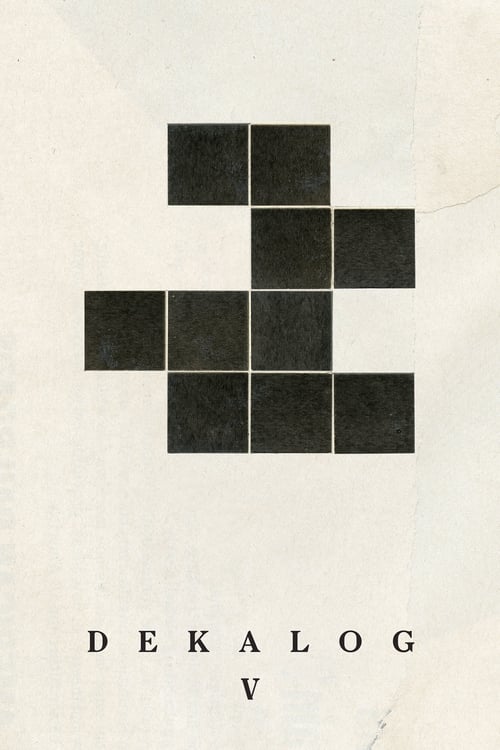
Decalogue V
1989 · Krzysztof Kieślowski
For when you want cinema at its most challenging — a film that takes a position and makes you sit with it. Save it for a night when you're ready to be shaken, not soothed.
What it's about
A restless young drifter wanders Warsaw with violence gathering in him; a taxi driver goes about his rounds; a young lawyer, idealistic and freshly qualified, celebrates passing the bar. Their paths converge around a brutal, motiveless killing — and the film sets that crime against the state's own cold, procedural machinery of punishment, asking whether one killing can ever answer another.
The experience
Grim, gripping, and morally serious in a way few films dare — it's shot through a murky, jaundiced filter that makes the city itself feel sick, and it refuses you any comfortable distance. It's not an easy watch; it's an unforgettable one.
The craft
Kieślowski and his cinematographer drain the world of warmth with sickly green-brown filters and vignetted frames, so every image feels morally contaminated. Part of the ten-film Dekalog cycle made for Polish television, it was expanded into the theatrical feature A Short Film About Killing — either version is among the most rigorous things ever made about violence.
Why it matters
The theatrical version won major prizes at Cannes, brought Kieślowski to international attention, and fed directly into Poland's real debate over the death penalty — a rare case of a film entering a nation's legal conversation.
Snapshot
Decalogue V is the fifth episode of Dekalog, the ten-part cycle Krzysztof Kieślowski made for Polish television between 1988 and 1989, each hour loosely refracting one of the Ten Commandments. Episode Five takes the Fifth Commandment — "Thou shalt not kill" — and stages it twice: first as the drawn-out, motiveless strangling of a Warsaw taxi driver by a drifting young man, Jacek, and then as the equally deliberate judicial hanging of that same young man by the state. Between the two killings stands Piotr, an idealistic novice advocate who has just passed his bar exam and who is assigned Jacek's defense. The episode exists in two closely related forms: the roughly 57-minute television cut, Dekalog: Pięć, and a longer theatrical version, Krótki film o zabijaniu (A Short Film About Killing), which Kieślowski shot simultaneously and which became one of the most decorated European films of 1988. Together they constitute the cycle's harshest and most polemical entry — a work that refuses to let the audience distinguish, morally, between the murder it condemns and the punishment it depicts.
Industry & production
Dekalog was produced for Telewizja Polska (TVP) and made within the state film production structures of the People's Republic of Poland in its final years, under the Tor film unit with which Kieślowski was long associated. The project originated in Kieślowski's collaboration with Krzysztof Piesiewicz, a defense lawyer he had met while making documentary-adjacent work around the Polish courts; Piesiewicz co-wrote all ten films. The scale was unusual — ten hours of television drama shot on modest budgets — and Kieślowski distributed the cinematography across several directors of photography (each episode has a distinct visual signature), while retaining a unified authorial control over script, staging, and tone.
The commercial and international life of the cycle ran largely through the two episodes expanded into features: A Short Film About Killing (from Episode Five) and A Short Film About Love (from Episode Six). These theatrical versions gave the cycle its foothold at festivals and in art-house distribution abroad; the television Dekalog itself circulated more slowly, becoming a canonical object over the following decade. West German television financing is commonly cited as part of the co-production picture for the cycle, reflecting the increasingly transnational funding of late-communist Polish cinema; the precise contractual arrangements are not something I can specify without risk of error. What is firmly established is that Episode Five and its feature twin were shot together, sharing cast, locations, and Sławomir Idziak's photography.
Technology
The films were shot on 35mm color film stock and finished for both television broadcast and, in the theatrical case, cinema projection. The defining technological gesture of Episode Five is not a new tool but the aggressive manipulation of a conventional one: Idziak's use of handmade filters and vignetting devices to darken and discolour the image. Large portions of the frame are masked into shadow or smeared with a bilious green-yellow cast, achieved optically through filtration in front of the lens rather than in post-production (the film predates the digital color grading that would later make such looks routine). This gives the film its sense of a world already half-poisoned, seen through a diseased pane of glass — a technological "primitivism" deployed deliberately against the clean, evenly lit norms of television drama.
Technique
Cinematography
Sławomir Idziak's photography is the most celebrated technical achievement of the episode and one of the signature images of the whole cycle. He works with a palette drained toward jaundiced greens and murky browns, and with graduated and spot filters that plunge the edges and corners of the frame into darkness so that characters seem hemmed in by black, viewed through a keyhole or a soiled lens. Warsaw becomes a gray, degraded, dehumanized space — puddles, waste ground, dim interiors. The camera frequently isolates Jacek within this vignetting, both accusing and pitying. The visual scheme is expressive rather than naturalistic: it externalizes a moral atmosphere, insisting that the environment which produced the murder and the apparatus which will answer it belong to the same rotten continuum.
Editing
The episode's construction is built on a slow accumulation and cross-cutting among three initially unconnected lives — Jacek drifting through the city, the taxi driver going about his day, Piotr passing his exam — before their trajectories converge. Kieślowski withholds connection, letting the parallel montage generate dread precisely because the viewer senses the lines must meet. The two set-piece killings are edited against the prevailing patience of the rest of the film: they are extended, not elided. The murder is protracted to an almost unbearable length, and the execution is given a comparable clinical duration, so that the cutting rhythm itself enforces the film's thesis — that killing, of either kind, is laborious, physical, and ugly, never the swift abstraction cinema usually makes of it. The theatrical version's editor was Ewa Smal.
Mise-en-scène / staging
Kieślowski stages violence to deny catharsis. The murder unfolds across waste ground and the taxi's interior, clumsy and effortful — Jacek uses a rope, a heavy object, a cloth, and the victim does not die cleanly or quickly. The execution, by contrast, is staged with bureaucratic order: the gallows, the trap, the bucket, the officials performing their roles. The visual rhyme between the two — both are killings carried out on a bound, helpless human by another human's hands — is the film's central staging argument. Interiors are cramped and institutional; the physical smallness of the death chamber and the courtroom corridors traps the figures.
Sound
Zbigniew Preisner's score — credited across the cycle under his own name, having earlier worked with the semi-mythical attribution "Van den Budenmayer" that recurs in Kieślowski's films — is used sparingly and gravely, entering to lend weight rather than to underline suspense. Much of the film's tension is carried by ambient sound and near-silence: the labor of the killing, the mechanical noises of the execution apparatus. The restraint of the sound design amplifies the horror of the two extended death sequences, which are among the least musically cushioned in the cycle.
Performance
Mirosław Baka plays Jacek as sullen, blank, and adrift — a performance built on opacity, which the film only partly opens near the end when Jacek speaks of a dead younger sister and the rural life he lost. The refusal to supply a clean psychological "motive" is central; Baka gives just enough to make Jacek human without making him explicable. Krzysztof Globisz plays Piotr, the young advocate, as earnest and increasingly stricken, the film's moral conscience and its surrogate for the audience's helplessness. Jan Tesarz plays the coarse, unlikeable taxi driver, a casting choice that pointedly complicates sympathy without ever justifying his death.
Narrative & dramatic mode
The episode operates as a moral tragedy in a broadly realist register, but its dramaturgy is diagrammatic: three lives cross-cut toward a collision, then a second act in which law and punishment answer the crime. Kieślowski deliberately strips the crime narrative of the machinery of the thriller — there is no mystery of whodunit, no suspense about guilt, no detection. The "why" is muted and finally almost withheld. The dramatic engine is instead ethical and structural: the film sets a private killing beside a public one and forbids the viewer any comfortable asymmetry between them. Piotr's arc — from freshly minted idealist to a man who has watched the state kill his client and can do nothing — supplies the emotional throughline.
Genre & cycle
Nominally the film sits at the crossing of crime drama, courtroom drama, and social-realist tragedy, and it was made as television drama within an anthology cycle. But it consciously subverts each of those genres. As crime film it denies procedural pleasure; as courtroom drama it compresses the trial almost to nothing, since the verdict is never in doubt; as television it violates the medium's conventions of legibility and safe distance. Its true genre is closer to the moral parable, the mode of the entire Dekalog: a contemporary, secular reworking of the Decalogue in which commandment and case study illuminate one another obliquely rather than as illustration.
Authorship & method
Decalogue V is a Kieślowski work in the fullest sense — the culmination of his move from documentary and the politically engaged "cinema of moral anxiety" of 1970s Poland toward the metaphysical, ethically preoccupied fiction of his late career. His method on Dekalog combined tight scripting with Piesiewicz (whose legal background grounds this episode's engagement with the courts and capital punishment) and a strategy of rotating cinematographers to give each hour its own face. Here the decisive collaborator is Sławomir Idziak, whose filtered, vignetted images are inseparable from the film's meaning; Idziak would later work internationally, and his Dekalog V photography remains a touchstone. Zbigniew Preisner's music, sparingly deployed, is the third pillar of Kieślowski's late authorial signature, one that would deepen through The Double Life of Véronique and the Three Colours trilogy. Ewa Smal edited the theatrical version. Across the cycle the near-mythic figure of the silent "witness" — a young man who appears at moments of moral crisis in several episodes — recurs as a Kieślowskian device; his function is contemplative rather than narrative.
Movement / national cinema
The film belongs to Polish cinema at the very end of the communist period, and to the later phase of Kieślowski's own trajectory out of the kino moralnego niepokoju ("cinema of moral anxiety") — the movement of the mid-to-late 1970s, associated with Kieślowski, Zanussi, and others, that used realist drama to probe individual conscience under a compromised political order. By Dekalog, Kieślowski had largely displaced the overtly political frame with a more universal ethical and spiritual inquiry, though Decalogue V's attack on state killing remains pointedly civic. The cycle stands as a summit of Polish television art and a bridge between national cinema and the pan-European art film Kieślowski would make in the 1990s.
Era / period
Made in 1988–89, the film is a document of Poland on the cusp of transformation — shot as the communist system approached collapse and the Round Table negotiations reshaped the country. Its degraded, exhausted vision of Warsaw reads, in retrospect, as a portrait of a society at the end of something. The question of capital punishment it dramatizes was live in exactly this period: Poland carried out its last execution in the late 1980s and moved toward a moratorium, and the film is frequently discussed as part of that public reckoning (the precise causal weight it carried is debated, and I would not overstate it). The film thus belongs both to a specific Polish political moment and to a timeless parable structure.
Themes
The governing theme is the equivalence of killing — that the state's deliberate, sanctioned, procedural taking of a life is not categorically distinct from the individual's brutal one. From this flow the film's other concerns: the death penalty as institutional violence; guilt, punishment, and the inadequacy of the law as a moral instrument; the failure of society to reach the drifting and dispossessed before they become killers. Jacek's late intimations of loss — a dead sister, a ruined rural boyhood — gesture at a social and personal history that neither explains nor excuses him but implicates a world. Piotr's impotence dramatizes the limits of individual conscience against systems. Underlying all of it is the Fifth Commandment read at its most absolute: not "thou shalt not murder" but "thou shalt not kill," with no exemption for the executioner.
Reception, canon & influence
The theatrical expansion, A Short Film About Killing, was the breakthrough: it won the Jury Prize at the 1988 Cannes Film Festival and took the Best Film award at the inaugural European Film Awards (then the "Felix") in 1988, announcing Kieślowski to an international audience and effectively launching the export career of the whole cycle. Critically, the film has been received as one of the most powerful cinematic arguments against capital punishment, praised especially for Idziak's imagery and for the moral seriousness of its refusal to aestheticize death; it is routinely singled out as the strongest, or at least the most viscerally forceful, of the ten episodes.
Influences on the film (backward): it draws on the tradition of Polish moral-realist cinema and Kieślowski's own documentary engagement with institutions and the courts; the collaboration with Piesiewicz roots it in first-hand legal experience. Its ethical framework is the Decalogue itself, secularized into contemporary case study — a lineage of moral-parable filmmaking rather than of the crime genre it superficially inhabits.
Legacy (forward): Dekalog as a whole became a canonical work of world cinema, cited by filmmakers and admired as a high-water mark of the television-length art film and the anthology form; Episode Five and its feature version anchored Kieślowski's reputation and paved the way for his 1990s European productions. The film is frequently invoked in debates over the death penalty and is often credited with contributing to the climate of Polish public opinion that accompanied the end of executions in Poland — a claim best stated with care, since the historical record on direct causation is thin. Its influence on subsequent filmmakers is usually described in terms of Kieślowski's broader impact — on the moral and metaphysical strain of art cinema and on directors who cite the Dekalog as formative — rather than through a documented chain of specific homages traceable to this single episode.
A Deleuzian reading
Nothing in the death chamber has been improvised.
The full Deleuzian reading of Decalogue V →
Reception
Aired as one hour of Polish TV in 1989, but its expanded theatrical twin *A Short Film About Killing* had already stunned Cannes in 1988 (Jury Prize) and won the very first European Film Award — today the whole Decalogue routinely lands on greatest-ever lists, with V and VI singled out as the peaks.
How Decalogue V was received, from release to now →
Influences: the films it descends from and the films it influenced
- L'Argent (1983) — Bresson's 'model' acting — affectless, opaque, drained of psychology — and his refusal to dramatize or aestheticize the axe murder directly template Kieślowski's motiveless killer and the flat, anti-cathartic staging of violence.
- Camouflage (1977) — A founding text of the 'cinema of moral anxiety,' it stages an ethical dilemma as a coldly observed institutional case study — the interrogative, parable-as-argument mode Kieślowski secularizes into the Decalogue.
- Man of Marble (1977) — Wajda's documentary-inflected anatomy of the state and its institutions established the Polish moral-realist grammar — courts, bureaucracy, complicity — that grounds Episode Five's engagement with the machinery of capital punishment.
- In Cold Blood (1967) — Conrad Hall's cold, near-documentary procedural anatomy of a senseless killing and its execution builds an anti-death-penalty argument by depicting the gallows' mechanics — the exact rhetorical move of the film's protracted hanging.
- Blind Chance (1987) — Kieślowski's own branching structure and cross-cut alternate fates prefigure the parallel-montage architecture — killer's day intercut with victim's — that binds the murder and the state execution as moral equivalents.
- Au Hasard Balthazar (1966) — The passive, contemplative witness passing silently through others' cruelty anticipates Kieślowski's recurring mute 'witness' figure, whose function across the cycle is observational and moral rather than narrative.
- Gattaca (1997) — Idziak carried his green-gold in-camera filtration internationally, tinting the entire world a diseased, filtered hue so that palette itself encodes a moral condition — the Dekalog V method transplanted to sci-fi.
- Black Hawk Down (2001) — Idziak's flashed, desaturated, hand-filtered war photography is the same optical toolkit — filters held to the lens, deliberate vignetting — that gave Episode Five its sickly light, now industrialized for a studio production.
- Traffic (2000) — Soderbergh drenches the Mexico strand in a jaundiced yellow-green filtration to color-code moral geography — a direct extension of Idziak's use of a diseased palette as ethical commentary rather than realism.
- The White Ribbon (2009) — A moral parable built on opaque, motiveless cruelty, near-silence, and an austere monochrome palette, extending Kieślowski's refusal to psychologize evil into a study of the conditions that produce it.
- Elephant (2003) — Motiveless killing rendered through protracted duration, drifting long takes, and blank affectless performance — an anti-procedural refusal to explain the murderer that descends directly from the opaque-killer strategy.
- Irréversible (2002) — Noé forces violence into agonizing real-time duration specifically to strip it of catharsis and pleasure, radicalizing the protracted, anti-aestheticized killing that made Episode Five morally punishing.
- A Prophet (2009) — The first murder is staged as clumsy, prolonged, and physically horrifying rather than efficient or thrilling — the anti-cathartic 'killing is hard and ugly' choreography pioneered by the film's central hanging and murder.
- Dead Man Walking (1995) — Robbins builds an anti-capital-punishment argument by depicting the execution's procedure in clinical, de-aestheticized detail and withholding easy absolution — the same rhetorical strategy of dramatizing state killing to indict it.
- The Double Life of Véronique (1991) — Idziak elaborates the same in-camera hand-filter and vignetting method into a golden-green haze, proving the Dekalog V palette a signature technique rather than a one-off, again paired with a Preisner score.
- Three Colours: Blue (1993) — Idziak returns as cinematographer to make a single saturated color carry moral and emotional meaning — the optical-filtration-as-argument principle of the jaundiced green pushed to its purest form, scored again by Preisner.
- Funny Games (1997) — Haneke stages violence to deny catharsis — protracted, ugly, refusing the aestheticization that would let a viewer enjoy it — the same anti-cathartic ethics that make the film's murder and execution unbearable rather than exciting.
Similar films
- The Double Life of Véronique (1991) — influence & lineage
- Funny Games (1997) — influence & lineage
- A Short Film About Killing (1988) — shared sensibility
- Decalogue I (1989) — shared sensibility
- A Short Film About Love (1988) — shared sensibility
- Kanal (1957) — shared sensibility
- The Fifth Seal (1976) — shared sensibility
- Ashes and Diamonds (1958) — shared sensibility