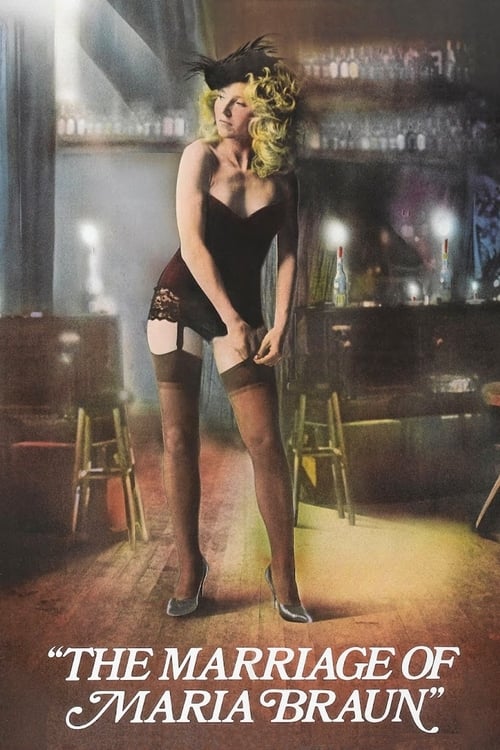
The Marriage of Maria Braun
1979 · Rainer Werner Fassbinder
For when you want a film to chew on for days — a stylish, sharp character study that doubles as a portrait of a whole country. Choose it when you're up for something rich and thought-provoking rather than cozy.
What it's about
Amid falling bombs in the last days of World War II, Maria marries a soldier — and has barely a day with him before he vanishes into the war. Left alone in the rubble of defeated Germany, she sets out to survive and then to prosper: through the black market, a nightclub, a wealthy industrialist's firm, using her beauty, nerve, and ruthless clarity about what things cost. Her rise tracks West Germany's own postwar boom — a marriage kept alive as an idea while everything around it becomes a transaction.
The experience
Elegant, ironic, and quietly devastating — it plays like a lush melodrama but watches its heroine with a cool, unsentimental eye. You're seduced by Maria's wit and drive even as the film makes you uneasy about what her success is built on.
Performances
Hanna Schygulla is unforgettable — glamorous, calculating, and wounded all at once, delivering one of the defining performances of European cinema in a role that made her an international star.
The craft
Fassbinder stages postwar Germany in sumptuous, precise images — mirrors, doorframes, and radio broadcasts layered into the sound so history literally chatters in the background of private life. The period detail is immaculate, and the storytelling is so confident it makes a national allegory feel like intimate gossip.
Why it matters
Fassbinder's biggest commercial success and a landmark of the New German Cinema, it opened international audiences to a generation of filmmakers reckoning with Germany's past — and remains the touchstone portrait of the postwar 'economic miracle.'
Snapshot
A woman marries a German soldier in the final, chaotic days of World War II. He disappears. She survives — through resourcefulness, beauty, calculated self-commodification, and at least one act of lethal violence — and rises into the prosperity of the West German economic miracle, only to be destroyed in the moment of apparent triumph. The Marriage of Maria Braun is Rainer Werner Fassbinder's most commercially successful film, his most sustained political allegory, and one of the landmark works of postwar European cinema. Its title character is not merely a woman navigating history; she is, in Fassbinder's design, West Germany itself — rebuilding on a foundation of suppressed guilt, transactional pragmatism, and deferred reckoning.
Industry & production
The film was produced in 1978 and released in West Germany in early 1979 under Albatros Filmproduktion, with Michael Fengler among its producers. The screenplay was written by Peter Märthesheimer and Pea Fröhlich, developed from an original story idea by Fassbinder. It was made within the infrastructure of the New German Cinema's state-subsidy apparatus, which from the late 1960s onward enabled a generation of auteurs to work outside conventional commercial constraints; Fassbinder, however, had also cultivated a popular audience more assiduously than most of his peers. Maria Braun became his breakthrough into mainstream success: it performed strongly in West Germany and had a notably wide international release, including in the United States, where it reached art-house audiences well beyond the usual festival circuit. Exact box-office figures for its domestic and international run are not reliably documented in sources I can confidently cite, but its commercial reach was by common account exceptional for a Fassbinder production and for West German art cinema generally at the time.
Technology
The film was shot on 35mm, in color, using widescreen framing that allowed Fassbinder and his cinematographer to exploit deep-field staging and compositional entrapment. No documentary record suggests exceptional or experimental use of then-available technology; the film's power derives from the disciplined application of classical craft rather than technical novelty. The postwar settings required detailed period production design, recreating rubble landscapes, black-market economies, and the gradual reappearance of prosperity through set dressing, wardrobe, and prop work.
Technique
Cinematography
Michael Ballhaus served as director of photography, continuing one of the most productive collaborations in New German Cinema. Ballhaus, who would later become known internationally through his work with Martin Scorsese, had already shot numerous Fassbinder films across the 1970s and brought to Maria Braun a precise command of the aesthetics Fassbinder derived from his study of Douglas Sirk: deep-focus compositions in which characters are framed by doorways, windows, mirrors, and architectural elements that visually constrain them even in ostensibly open spaces. The camera does not merely observe Maria; it implicates the viewer in her objectification while simultaneously sustaining enough ironic distance to prevent straightforward identification. Color is used expressively — the palette shifts from the muted grays and ochres of immediate postwar desolation toward the warmer, more saturated tones of the economic miracle years, a visual encoding of Fassbinder's thesis about the seductive surface of prosperity.
Editing
Juliane Lorenz, Fassbinder's long-term editor and companion in his later years, shaped the film's rhythm. The editing is not flashy; it respects the theatrical duration of scenes while knowing precisely when to cut against emotional expectation. The film's pacing is deliberately uneven in a purposeful way — certain scenes sustain longer than comfort requires, pressing on the viewer the weight of Maria's endurance, while others cut away at moments of maximum implication, denying catharsis.
Mise-en-scène / staging
Fassbinder's staging throughout carries the imprint of his theatrical background — he had run the Munich Action Theatre and the anti-theater before turning to film, and his blocking tends toward the tableaux of theatrical composition rather than the kinetic energy of much contemporary European cinema. Characters frequently occupy positions of asymmetrical power within the frame; Maria is often framed at a distance or through intermediary objects, reinforcing the sense that she is being looked at, evaluated, possessed. The opening sequence — a wedding conducted amid bombing, officials shouting and plaster falling — establishes immediately the film's method of juxtaposing private ceremony with public catastrophe.
Sound
Sound in Maria Braun carries an unusual expressive and allegorical burden. Radio broadcasts thread through the film as an ambient historical narrator: news bulletins, denazification proceedings, currency reform announcements, and the film's extraordinary closing device — the radio commentary of West Germany's victory in the 1954 Football World Cup, Helmut Rahn's decisive goal replayed in overlapping fragments, crescendoing as the gas explosion destroys the house. The sound design of this ending is meticulously calculated: the triumph of national resurrection and the explosion of Maria's deferred life arrive simultaneously, indistinguishable, each amplifying the other's horror.
Performance
Hanna Schygulla's performance as Maria Braun is the film's irreducible core. Schygulla had worked with Fassbinder since the late 1960s in his theater and early films; Maria Braun gave her the role through which she became an international figure, and she received the Silver Bear for Best Actress at the Berlin International Film Festival in 1979. Her performance is remarkable for what it withholds: Maria is warmly present in almost every scene, yet Schygulla keeps the character's interiority opaque, allowing the viewer to project feeling onto a face that is perpetually calculating. This ambiguity is the film's moral engine — we are never quite sure how much Maria feels, how much she has suppressed, whether her pragmatism is survival or complicity. Klaus Löwitsch as Hermann brings a bruised, passive quality that contrasts with Maria's relentlessness, and Ivan Desny as the industrialist Oswald embodies the polished corruption of Adenauer-era prosperity.
Narrative & dramatic mode
The film follows a chronological arc from approximately 1945 to 1954, structured in the manner of a classical melodrama but laced throughout with Brechtian irony. Maria's trajectory — from war widow to black-market survivor, from American soldier's companion to industrial consort to nominal inheritor of a fortune — traces the successive compromises required of those who wished to thrive in the Federal Republic. The narrative's decisive turn comes when Hermann unexpectedly returns home to find Maria in bed with Bill, the American GI; Maria kills Bill in the struggle, and Hermann, in an act of ambiguous chivalry, takes responsibility before the court and is imprisoned. From this point Maria works not merely to survive but to hold in trust, she insists, everything she accumulates for Hermann's eventual return. The film's final revelation — that Hermann and Oswald had struck a secret deal, trading Maria's time and body for Oswald's fortune — retrospectively exposes her entire existence as a transaction conducted without her knowledge. Her death in the explosion reads simultaneously as accident, suicide, and structural inevitability.
Genre & cycle
Maria Braun belongs to the women's melodrama tradition while simultaneously deconstructing it. The film is in explicit dialogue with Hollywood melodrama of the 1940s and 1950s — the "women's picture," the soap-operatic narratives of sacrifice and endurance organized around a female protagonist navigating patriarchal social structures. Fassbinder was specifically and deeply indebted to Douglas Sirk (born Hans Detlef Sierck, a German-Danish director who fled the Nazis and made his most celebrated films at Universal in the 1950s), and Maria Braun can be read as a Sirkian melodrama transposed to German soil. It also belongs to a cycle of West German films grappling with the Nazi past and the moral consequences of reconstruction — Heimatfilm inverted, Trümmerfilm legacy reprocessed. Within Fassbinder's own oeuvre it inaugurates the informal BRD Trilogy (Federal Republic of Germany), completed by Lola (1981) and Veronika Voss (1982), a triptych interrogating the costs of the Wirtschaftswunder through female protagonists whose fates allegorize the nation.
Authorship & method
Fassbinder's working method was notoriously compressed: he wrote quickly, shot quickly, edited quickly, and sustained a pace of production — over forty films and television works in roughly thirteen years — that remains almost without parallel in world cinema. His personal life, characterized by intense entanglements with his collaborators, fed directly into his work; the erotics of power, dependency, and exploitation that structure his films were not purely aesthetic positions. On Maria Braun his key collaborators were Ballhaus (camera), Lorenz (editing), and Peer Raben, his long-standing composer, who provided the score. Raben had worked with Fassbinder since the theater years and developed a musical idiom that blended lush, ironic orchestral gesture with the distanced melancholy appropriate to Fassbinder's ironized melodrama. The screenplay's co-authors Märthesheimer and Fröhlich brought structural rigor; Märthesheimer in particular had a background in television drama, and the film's crafted episodic architecture reflects that influence, though the authorial voice throughout is recognizably Fassbinder's.
Movement / national cinema
The Marriage of Maria Braun stands near the apex of the New German Cinema, the movement that emerged from the 1962 Oberhausen Manifesto — signed by a group of young filmmakers declaring the death of the old German film and asserting their right to make an author's cinema — and that received crucial institutional support through the Kuratorium junger deutscher Film and the Film Subsidies Board. By 1979, the New German Cinema had produced internationally recognized work by Wim Wenders, Werner Herzog, Volker Schlöndorff, Alexander Kluge, and Margarethe von Trotta, among others. Fassbinder occupied a singular position within this movement: more prolific than any of his contemporaries, more commercially ambitious, more willing to engage popular genres, and more explicitly confrontational in his treatment of German guilt. Where Herzog sought mythological and spiritual dimensions and Wenders explored alienation through Americanized surfaces, Fassbinder pressed on the specific social machinery of West German complicity.
Era / period
The film's historical setting — the years 1945 to 1954, precisely the period of West Germany's transformation from rubble into the Federal Republic — is inseparable from its meaning. The 1954 World Cup victory, with which it ends, was a real and widely documented moment of West German national pride, the first major assertion of recovered identity on an international stage; Fassbinder uses it as the film's final irony, collapsing national triumph and personal obliteration into a single detonation. The film was made in the late 1970s, a period when West Germans were still debating the extent of national guilt and the adequacy of reckoning with the Nazi past — when the popular television series Holocaust (broadcast in West Germany in January 1979, shortly before Maria Braun's release) catalyzed a mass emotional confrontation that official processes had for decades deferred.
Themes
The film's central theme is the price of survival under conditions that make survival itself a moral compromise. Maria does not simply endure; she thrives, and Fassbinder refuses to let that thriving be innocent. The film examines the gendered economics of postwar reconstruction: the resources available to Maria are her body, her intelligence, and her willingness to treat both as exchangeable commodities. This is presented without sentimentality but also without misogynist contempt — Fassbinder's gaze, mediated through Schygulla's performance, sustains an implication that the social conditions producing Maria's choices are the real object of critique. Alongside this runs the film's sustained allegory: Maria-as-West-Germany, rebuilding on suppressed catastrophe, prospering through transactions whose moral costs are never settled, destroyed precisely when the reconstruction seems complete. The secret deal between Hermann and Oswald — men trading her without her knowledge — retroactively exposes the entire postwar settlement as a bargain made over women's bodies and over the buried dead.
Reception, canon & influence
Critical reception. The Marriage of Maria Braun was received immediately as a major work. Schygulla's Berlin Silver Bear was accompanied by widespread critical recognition of the film's ambition and formal command. International critics — particularly in France, where Fassbinder had a devoted following, and in the United States, where the film received substantial art-house distribution and press — placed it among the significant European films of the decade. It consolidated Fassbinder's international reputation and made him, briefly, a visible presence in discussions of world cinema alongside the French New Wave veterans and the Italian masters.
Influences on the film (backward). The debt to Sirk is the film's most explicit and documented retrospective influence. Fassbinder had written a celebrated essay on Sirk — specifically on All That Heaven Allows and the aesthetics of melodrama as social critique — in 1971, and his films of the 1970s are systematic elaborations of that analysis. Sirk himself (who had retired to Switzerland) knew of Fassbinder's admiration; there is documented contact between them, though the precise nature of their exchanges is not fully on the record. The film also carries clear marks of Brecht: the distanciation effects, the refusal of seamless emotional identification, the insistence that private stories are political structures. Hollywood genre cinema more broadly — particularly the women's pictures of the studio system — supplies the generic framework that Fassbinder ironizes. The influence of Jean-Luc Godard and the French New Wave is present in the self-conscious use of genre and the politicized formal strategy, though less directly than the Sirkian inheritance.
Legacy and forward influence. The BRD Trilogy that Maria Braun inaugurates has become a standard reference point for discussions of memory, gender, and postwar national identity in cinema. The film's model — using a woman's biography as a lens for national history, filtered through the ironic conventions of melodrama — has informed subsequent German films grappling with twentieth-century history. More broadly, it contributed to the rehabilitation of melodrama as a legitimate critical mode in film studies; Laura Mulvey, Mary Ann Doane, and other feminist film theorists writing in the late 1970s and 1980s found in Fassbinder's work — and this film in particular — a productive site for analyzing the gendered structures of cinematic looking and the politics of the "woman's film." Hanna Schygulla's performance remains a touchstone for the possibilities of screen acting under conditions of reflexive, politically aware direction. The film is regularly programd in retrospectives of world cinema and appears on canonical lists assembled by major critical institutions, representing both the New German Cinema at its most achieved and the postwar European art film's engagement with history at its most unflinching.
A Deleuzian reading
Start with the wedding.
The full Deleuzian reading of The Marriage of Maria Braun →
Reception
No flop-to-classic story here — it was Fassbinder's biggest box-office hit on release and his international breakthrough, and it has only solidified since into the consensus cornerstone of New German Cinema.
How The Marriage of Maria Braun was received, from release to now →
Influences: the films it descends from and the films it influenced
- Germany Year Zero (1948) — Rossellini's rubble-film grammar—shooting in the physical ruins of postwar Berlin to stage a child's moral complicity within a devastated nation—establishes the visual and allegorical framework of destroyed Germany-as-protagonist that Maria Braun's opening sequences inherit and then ironize through Brechtian distance.
- Lola Montès (1955) — Ophüls's widescreen staging of a woman's life as spectacular commodification—theatrical-within-cinematic framing that simultaneously implicates the viewer in Lola's objectification and ironizes the male gaze—directly informs the double perspective Ballhaus and Fassbinder hold on Maria: object and agent, spectacle and critique, never resolved into identification.
- All That Heaven Allows (1955) — Sirk's systematic use of architectural deep-focus entrapment—doors, windows, and television screens framing Cary within domestic space to make patriarchal constraint visually legible—is the compositional template Ballhaus deploys throughout Maria Braun, transposed from critique of American bourgeois conformity to West German economic miracle complicity.
- Written on the Wind (1956) — Sirk's Technicolor excess—colors saturated beyond verisimilitude to encode psychological and moral states rather than serve period accuracy—is the precise chromatic methodology Ballhaus employs in tracking Maria's moral trajectory, shifting the palette from postwar gray through the warm, seductive tones of Wirtschaftswunder prosperity.
- Imitation of Life (1959) — Sirk's deployment of the women's picture as a vehicle for systemic social critique—using private catastrophe and spectacular female suffering to expose American racial and class hypocrisy—is the genre model Fassbinder explicitly adapts, substituting West German postwar guilt and transactional complicity for Sirk's American targets.
- Yesterday Girl (1966) — Kluge's use of a female East German refugee navigating West German bureaucracy—with Brechtian intertitles and essay-film reflexivity that prevent emotional immersion and force political reading of personal situations—establishes the New German Cinema mode of female protagonist as historical allegory that Fassbinder adopts and then strategically de-distances into melodrama.
- Fox and His Friends (1975) — Ballhaus's Wirtschaftswunder-era class critique perfected: objects-as-status-markers and reflective framing chart a character consumed by postwar Germany's economic-miracle transactions.
- Mother Küsters Goes to Heaven (1975) — Culminates the melodrama-as-BRD-history method and the female-survivor figure, with Ballhaus's now-mobile camera reading postwar Germany through one woman's exploited endurance.
- The Nasty Girl (1990) — Verhoeven's post-reunification film extends Maria Braun's Brechtian historical mode by giving its female protagonist direct address to camera and deploying mixed-media collage—photographs, archival footage, theatrical sets—to expose West German provincial denial of Nazi complicity, transposing the BRD trilogy's allegorical female protagonist structure into a post-reunification memory-politics context.
- Safe (1995) — Haynes adopts Fassbinder's compositional strategy of architectural entrapment—extreme wide shots in which the female protagonist is engulfed by domestic and institutional space, consistently framed at a distance that forestalls identification—along with a withheld-interiority performance mode for Julianne Moore modeled on Schygulla's method of suppressing emotional legibility in Maria Braun.
- Far from Heaven (2002) — Haynes explicitly reconstructed Sirk through the lens of Fassbinder's methodology—using deep-focus entrapment compositions, the expressive color system in which palette encodes ideological seduction, and the women's picture as a vehicle for systemic social critique—making Far from Heaven a deliberate second-generation transmitter of the craft lineage that Maria Braun both absorbed and exemplified.
- Broadcast News (1987) — Where Michael Ballhaus forged his roving, choreographed tracking camera (the famous encircling moves) before bringing that mobility to Brooks's ensemble-in-motion.
- Suspiria (2018) — New German Cinema template for reading postwar German guilt through a woman's body inside a desaturated, granular 1970s period mise-en-scène.
- Quiz Show (1994) — Ballhaus's fluid, circling camera and European formal classicism, the transatlantic craftsmanship he transplanted into American prestige drama.
- Phoenix (2014) — Codifies the postwar woman as national allegory built through wardrobe and transaction rather than psychology, staged in mirrors, doorframes and glass; Anette Guther's costume work in Phoenix does conceptual duty on exactly this Fassbinderian principle.
- The Bitter Tears of Petra von Kant (1972) — Shot seven years before Maria Braun in the same theatrical mode, Petra von Kant deploys single-set tableau staging and asymmetric power compositions in which spatial position literalizes dominance and submission, while Schygulla's sustained performance of withheld inner states establishes the mise-en-scène vocabulary Maria Braun would mobilize within historical and allegorical space.
- Ali: Fear Eats the Soul (1974) — The most architecturally faithful Sirkian experiment in Fassbinder's oeuvre—Ballhaus's deep-focus doorway framings recreate All That Heaven Allows' entrapment geometry while the women's picture structure is recoded to expose West German xenophobia—making it the immediate formal rehearsal for the more complex political allegory of Maria Braun.
- Effi Briest (1974) — Fassbinder's adaptation uses explicit Brechtian intertitles and theatrical tableau compositions to frame Effi's entrapment within patriarchal social structure, establishing the structural grammar of female constraint that Maria Braun then deploys without the distancing apparatus, forcing the ironic burden onto cinematographic composition and performance register alone.
- Jeanne Dielman, 23 quai du Commerce, 1080 Bruxelles (1975) — Akerman's anti-cathartic editing strategy—sustained real-time duration that forces the viewer to endure domestic routine without release or commentary—establishes a formally cognate but independent parallel to Maria Braun's anti-catharsis rhythm; both films refuse conventional emotional relief to make ideological critique legible in the gap between event and expected feeling.
- Germany Pale Mother (1980) — Released the year after Maria Braun, Sanders-Brahms uses the identical structural conceit—a woman navigating German wartime and postwar society whose trajectory allegorizes national trauma—and deploys radio broadcasts as historical punctuation in the same manner, but shifts the formal register from Brechtian irony to autobiographical elegy, revealing the shared genre template's affective range.
- Lola (1981) — The second BRD trilogy film extends Maria Braun's West Germany allegory with Xaver Schwarzenberger's deliberately lurid, near-fluorescent color palette—a systematic intensification of Ballhaus's expressive color strategy in Maria Braun, pushing the Sirkian chromatic method to the point of grotesque self-exposure.
- Veronika Voss (1982) — The third BRD trilogy film preserves Maria Braun's anti-catharsis editing rhythm and the female body as site of West German moral reckoning, while inverting its chromatic strategy: Schwarzenberger's high-contrast black and white interrogates the same postwar amnesia through visual bleaching rather than the seductive warmth Ballhaus built in the earlier film.
- The Tin Drum (1979) — Same-year New German Cinema reckoning with the national past (Vergangenheitsbewältigung), using one figure's biography as ironic allegory of the German trajectory.
- In a Year with 13 Moons (1978) — Made the same period, it shares the collage soundtrack of layered radio/mediated audio and the melodrama-as-postwar-German-reckoning mode, with Peer Raben's scoring and the anti-teater ensemble.
- I Only Want You to Love Me (1976) — The direct descendant: this television 'workbook' rehearses, in one bricklayer, the love-equals-money argument that Maria Braun elevates into full national allegory as the BRD Trilogy's opening.
Similar films
- Ali: Fear Eats the Soul (1974) — influence & lineage
- The Bitter Tears of Petra von Kant (1972) — influence & lineage
- The Fifth Seal (1976) — same viewing thread
- Hitler: A Film from Germany (1978) — same viewing thread
- Never Look Away (2018) — same viewing thread
- Schindler's List (1993) — same viewing thread
- I Only Want You to Love Me (1976) — shared sensibility
- Mother Küsters Goes to Heaven (1975) — shared sensibility
All the films related to The Marriage of Maria Braun →
Watch it with: curated runs of related films
- In the Shadow of the Reich — A run of films about ordinary people inside the Nazi era — surviving it, resisting it, or trying to reckon with how it happened — that rhyme on conscience, complicity, and who chooses to act.