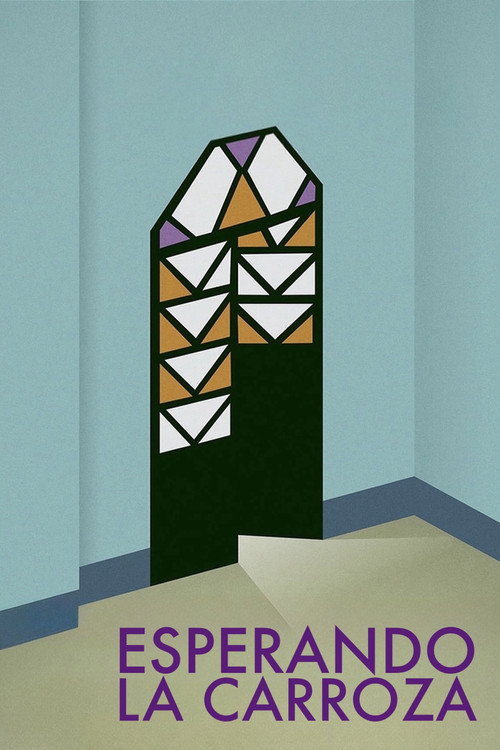
Waiting for the Hearse
1985 · Alejandro Doria
For when you want to laugh at the awfulness of family — sharp, quotable, cathartic comedy, especially if your own clan has ever gone to war over lunch. A challenge wrapped in a crowd-pleaser.
What it's about
Mamá Cora is nearly eighty, and none of her three sons or her daughter wants to be the one to take her in. When the extended family gathers for an anniversary lunch, the question of who cares for her cracks open every grievance, debt and pretension in the room — and the day spirals from bickering into full-blown farce.
The experience
Savage and hilarious in the same breath — a comedy of raised voices, wounded pride and monstrous pettiness where you laugh hard and wince at how true it all rings. It plays like a family fight you can't look away from.
Performances
Antonio Gasalla plays the elderly Mamá Cora in drag and makes her both ridiculous and heartbreaking, while China Zorrilla is ferociously funny as the family's grandest hypocrite.
The craft
Adapted from Jacobo Langsner's stage play, it keeps the pressure-cooker unity of one family and one day, letting overlapping arguments and razor-edged dialogue build to farce. Alejandro Doria stages chaos with precision — every insult lands where it's aimed.
Why it matters
A flop on release that became one of Argentina's most beloved and endlessly quoted films — its lines are national shorthand, recycled in everyday speech and memes decades on.
Snapshot
Esperando la carroza is an Argentine black comedy that failed to make a strong impression on its 1985 release and then, over the following decade, became one of the most beloved and quoted films in the country's history. Adapted from Jacobo Langsner's stage play, it compresses a sprawling working- and lower-middle-class family into a single day of recrimination when the question of who will care for the aging matriarch, Mamá Cora, curdles into a comedy of guilt, poverty and misplaced grief. Its defining conceit — an elderly woman played, in drag, by the comedian Antonio Gasalla, and a family that mistakes a stranger's corpse for hers and stages a wake for a woman who is still alive — sits at the exact seam between farce and cruelty that Argentine popular theater had cultivated for generations. The film is, in the fullest sense, a cult object: its afterlife on television and home video, rather than its box office, made it canonical, and its lines have passed into Argentine everyday speech.
Industry & production
The film was produced in Argentina in 1985, roughly eighteen months after the return to constitutional democracy in December 1983. That timing is not incidental to its texture, even though the film is apolitical on its surface: it belongs to the burst of production and expressive freedom that followed the end of the 1976–1983 military dictatorship, when censorship structures were dismantled and directors who had spent years working carefully in television and theater moved back toward more candid, more abrasive material. Alejandro Doria was one such figure — a director whose reputation had been built substantially in television — and Esperando la carroza bears the marks of an economical, chamber-scaled production: a small principal cast, a largely single-location shoot centered on a modest family house, and a reliance on ensemble performance rather than spectacle.
Precise production financing and budget figures for the film are not something I can attribute with confidence, and I will not invent them. What the historical record establishes clearly is the shape of the film's commercial life: it did not perform as a hit on first release and was, by most accounts, a disappointment relative to expectations. Its status was rebuilt afterward through repeated television broadcasts and video circulation, which is the more reliable and better-documented part of its economic story.
Technology
The film was shot on 35mm color stock, the standard professional format for Argentine theatrical features of the period. Beyond that, I do not have confident, specific attributions for camera equipment, film stock or laboratory processes, and the honest position is that this level of technical detail is thin in the accessible record. What can be said substantively is that the production's technological choices were subordinated to a theatrical logic: this is a film built around interiors, faces and sustained dialogue rather than around any exploitation of the camera or lab as expressive instruments. The relevant "technology" is closer to the technology of the stage — a controlled domestic set, practical interior lighting, and an acoustic environment tuned for overlapping speech — than to any novel cinematographic apparatus.
Technique
Cinematography
The visual strategy is functional and self-effacing, in the service of performance. The film favours the middle distance and the grouped shot that keeps several family members in frame simultaneously, so that the comedy of reaction — the sidelong glance, the withheld comment, the performance of concern — can register within a single composition. Close-ups are deployed for the film's grotesque set-pieces, isolating a face at the moment its social mask slips. The overall look is unglamorous by design, matching the shabby domestic world it depicts. I do not have a confident credit for the director of photography and will not manufacture one; what is analytically clear is that the cinematography's ambition is legibility and proximity to the actors, not visual authorship.
Editing
Cutting follows the rhythm of the ensemble scene rather than an imposed montage design. The film's comic engine is the collision of registers within a room — genuine anxiety, petty vanity, appetite, boredom — and the editing's job is to catch the reaction that lands the joke, then move on before it is over-explained. In its climactic movement, the editing sustains a cruel dramatic irony: it holds the family's mourning and the audience's superior knowledge (that Mamá Cora is not dead) in the same span of time, letting grief and absurdity accumulate together. I cannot confidently name the editor and decline to guess.
Mise-en-scène / staging
This is the film's strongest and most characteristic dimension, and the one where its theatrical origin is most productive. The action is concentrated in a cramped, overcrowded domestic interior, and Doria stages the family as a mass of bodies perpetually in one another's way — an image, in itself, of the film's argument that economic precarity turns kinship into congestion. Props do heavy thematic work: the food, the too-small rooms, the objects of aspiration and their absence. The staging repeatedly organizes the frame around Mamá Cora as the still, uncomprehending center of a swirl of self-interested talk, so that the mise-en-scène literalises the family's problem — she is always there, physically, as the thing no one wants to be responsible for.
Sound
The soundscape is dominated by speech, and specifically by simultaneous, overlapping, competitive speech — the sonic signature of a family that does not listen. Dialogue delivery is broad and highly inflected, closer to stage projection than to naturalistic murmur, which is appropriate to the material's roots. Music is used sparingly and pointedly, chiefly to inflect the film's swerves into pathos; I do not have a confident attribution for the composer and will not fabricate one. The most important "sound" effect is structural: the din of the wake, in which mourning and gossip and appetite are audible in the same breath.
Performance
Performance is the film's true medium. Antonio Gasalla's Mamá Cora — a comedian's turn, in old-age drag, that refuses to become mere caricature — anchors the film by remaining opaque and vulnerable amid the noise. Around her, the ensemble builds a gallery of recognizable social types: the aspirational, status-anxious couple; the harried son and exhausted daughter-in-law with whom Mamá Cora actually lives; the impoverished branch of the family with too many children and too little food. Mónica Villa's beleaguered Emilia and the exchanges around the household's meager food became some of the most quoted material in Argentine popular culture. The performances are pitched at the grotesque register — large, unflattering, emotionally exposed — and the film's achievement is that this bigness reads as truth about how families actually behave under pressure rather than as mere mugging.
Narrative & dramatic mode
The dramatic mode is the unity-of-time-and-place farce inherited from the stage: a single day, essentially one location, a family assembled by an occasion. Onto this classical armature the film grafts a black-comic reversal. The first movement is a comedy of avoidance — the siblings maneuvering so that responsibility for Mamá Cora falls on someone else. The pivot comes when Mamá Cora goes missing and a dead woman is taken for her; the second movement becomes a comedy of premature mourning, in which the family performs grief and guilt for a mother who is not, in fact, dead. The device is dramatically ruthless: it lets the film expose what each character truly feels by staging their reactions to a death that has not happened, and it turns the eventual return of the living Mamá Cora into a punchline that is also an indictment.
Genre & cycle
Formally the film is a comedy, but its genre identity is more precisely located within specifically Argentine popular-theatrical traditions. It is heir to the sainete — the short, populous, working-class comedy of tenement and family life — and, more importantly, to the grotesco criollo, the tragicomic genre associated above all with Armando Discépolo, in which immigrant and working-class families are ground down by money, disappointment and the gap between social pretension and reality, and in which laughter and despair are deliberately fused. Esperando la carroza is one of the clearest cinematic translations of that grotesco sensibility: its subject is economic humiliation inside the family, and its method is to make that humiliation unbearably funny. As part of a cycle, it belongs to a lineage of Argentine domestic tragicomedy and helped renew that lineage for a late-twentieth-century audience.
Authorship & method
The controlling authorship is Alejandro Doria's, working as an adapter and director of actors rather than as a visual stylist. His method — consistent with a career that moved between television and cinema — was to trust the text and the ensemble, to stage densely, and to let the comedy emerge from performance and situation. The foundational creative source is the playwright Jacobo Langsner, whose play Esperando la carroza supplies the structure, the characters and the central conceit; the film is genuinely an adaptation, and its power is inseparable from that theatrical DNA. The decisive casting choice — Antonio Gasalla as Mamá Cora — is itself an authorial act, importing a specific comic persona and the transgressive charge of cross-gender casting into the family drama. On the technical crew — cinematographer, composer, editor — I do not have confident, verifiable credits, and I flag that gap rather than fill it with invention.
Movement / national cinema
The film is a landmark of Argentine national cinema and, more specifically, of the democratic-transition cinema of the mid-1980s. That moment is usually remembered internationally through its solemn, politically explicit face — the reckoning with dictatorship and disappearance exemplified by the year's Academy Award–winning drama. Esperando la carroza represents the other, comic-popular face of the same opening: a film rooted in vernacular theater and national comic tradition that speaks about Argentine society obliquely, through the family and the household economy, rather than through direct political address. Its enduring canonization shows that the period's most durable achievements were not only its prestige dramas but also its popular forms.
Era / period
Made in 1985, the film sits at the beginning of the Alfonsín-era democratic restoration, in a country still marked by economic strain — conditions that would soon culminate in severe inflation. That backdrop of scarcity is legible everywhere in the film's obsession with money, food and who can afford to take on another mouth. The film's aesthetic — theatrical, interior, ensemble-driven, unglamorous — is also of its era: an Argentine cinema working at modest scale, drawing on the country's deep theatrical and television talent pools, and addressing a domestic audience in a shared vernacular.
Themes
The film's governing theme is the collision of family obligation with economic precarity — the way poverty makes love conditional and turns an aging parent into a problem to be allocated. Around this center cluster several linked concerns: hypocrisy and the performance of feeling, dramatized most sharply by a mourning that precedes any actual death; class and aspiration, embodied in the status-anxious relatives who measure themselves against their poorer kin; and the indignity of old age and dependency, focused on Mamá Cora's silent, uncomprehending presence. Underlying all of it is the grotesco's core insight: that the same situation can be simultaneously hilarious and devastating, and that a family's cruelty is often indistinguishable from its exhaustion.
Reception, canon & influence
The most striking fact of the film's reception is its inversion over time. On release it was received tepidly and is generally remembered as a commercial disappointment. Its reputation was built afterward, through repeated television airings and home-video circulation, which turned it into a genuinely popular text — one whose dialogue was memorized, repeated and folded into everyday Argentine speech. By the twenty-first century it had migrated from cult object to consensus classic, routinely cited among the best Argentine films in critics' and public polls, and treated as a touchstone of national comedy.
Looking backward, the influences on the film are clear and theatrical: Langsner's play directly, and behind it the whole tradition of the sainete and the grotesco criollo, with its tragicomic families and its fusion of laughter and ruin. The casting also draws on the established comic and television culture from which its performers came.
Looking forward, the film's legacy is chiefly cultural and linguistic. Its lines and characters became reference points recognizable across generations of Argentines, a rare instance of a "failed" film becoming a shared national vocabulary. It also generated a much later sequel, Esperando la carroza 2 (2009), made after the original had become a classic; I do not have confident directorial and production credits for that follow-up and note that its details should be verified rather than taken from this dossier. The more important influence is diffuse: the film demonstrated, and helped entrench, the idea that Argentine cinema's grotesco tradition — cruel, funny, domestic, unglamorous — could produce work of lasting popular and critical value.
Reception
Met with lukewarm reviews and modest business in 1985, it was slowly resurrected by endless TV reruns until it became arguably Argentina's most beloved comedy — the 'failed' film that turned into a national institution.
How Waiting for the Hearse was received, from release to now →
How to watch Waiting for the Hearse: what to notice on a first viewing
- Watch how crowded every room stays with family members. Doria packs the frame with relatives perpetually in one another's way, bodies crossing paths in rooms too small for this many people. The congestion itself is the argument: too little space, too many obligations.
- Notice Mama Cora sitting still while everyone talks around her. The frame keeps her at the center of the room while the family's scheming and complaining swirl past her, rarely addressed to her directly. She is always physically present as the one thing nobody wants to be responsible for.
- Listen for everyone talking over each other at once. The soundtrack is dominated by simultaneous, competing speech, broad and highly inflected, the sonic signature of a family incapable of listening to itself. The noise itself tells you how this family actually communicates.
- Watch Mama Cora's face stay opaque amid all the noise. Antonio Gasalla plays her in old-age drag without tipping into caricature, keeping her vulnerable and unreadable at the center of everyone else's performance of concern. The quietest performance in the room is also the most exposed one.
- Notice several relatives' reactions caught in the same shot. The camera favors the middle distance and the grouped shot, so a sidelong glance or a withheld comment registers alongside everyone else's face at once. You catch the family lying to each other in real time, in one frame.
The whole guide to watching Waiting for the Hearse, with the keys for a rewatch →
Influences: the films it descends from and the films it influenced
- Los muchachos de antes no usaban gomina (1937) — Transposes the porteño sainete's ensemble of barrio types and its bittersweet stage-to-screen tragicomedy, establishing the theatrical-adaptation practice Doria inherits.
- El ángel exterminador (1962) — Builds a cruel chamber comedy from an ensemble trapped in a single bourgeois interior by social ritual, staging decorum itself as grotesque farce.
- Charley's Aunt (1941) — Codifies the farce convention of a male comic in matronly drag as the ensemble's disruptive engine, prefiguring Gasalla's transgressive Mamá Cora.
- A Wedding (1978) — Runs a large-ensemble family ritual on dense overlapping dialogue and roving satirical observation of relatives' vanities.
- La Grande Bouffe (1973) — Confines an ensemble to one location where bodily appetite and death drive a bourgeois gathering into sustained caricature.
- Amarcord (1973) — Parades caricatured provincial faces in grouped middle-distance tableaux, deriving comedy from the ensemble as a gallery of grotesques.
- Abigail's Party (1977) — Turns a single-room social gathering into class grotesque generated entirely from ensemble performance and excruciating overlapping talk.
- The Loved One (1965) — Makes the funeral industry and mourning itself the target of black comedy, the death-farce register Doria's premature-mourning plot exploits.
- Festen (1998) — Detonates buried family cruelty across a single-location ritual meal, sustained by unity of place and overlapping table talk.
- Death at a Funeral (2007) — The funeral farce proper: a single-day, single-house ensemble in which mourning collapses into escalating comic catastrophe.
- Carnage (2011) — Observes strict unity of time and place as a filmed play in which an ensemble's social masks disintegrate into grotesque combat inside one room.
- August: Osage County (2013) — Adapts a theatrical family reunion around a death into venomous overlapping ensemble acting, the grotesque-domestic register in prestige form.
- El hijo de la novia (2001) — Carries forward Doria's warm-but-grotesque Argentine family register and its reliance on beloved comic ensemble performers.
- Parenti serpenti (1992) — A holiday family reunion in one home where inheritance and death curdle relatives into cruel caricature — the commedia all'italiana twin of the grotesco criollo.
- Relatos salvajes (2014) — Extends the Argentine grotesco's cruel-funny bronca — everyday humiliation escalating to caricatural violence — in a national comic register Doria helped canonize.
- Black Cat, White Cat (1998) — A cacophonous overlapping-dialogue ensemble whose weddings and funerals become nonstop grotesque spectacle, comedy mined from crowded chaos.
Similar films
- Wild Tales (2014) — influence & lineage · same viewing thread
- Son of the Bride (2001) — influence & lineage
- The Celebration (1998) — influence & lineage · same viewing thread
- La Ciénaga (2001) — shared sensibility
- The Skeleton of Mrs. Morales (1960) — shared sensibility
- Divorce Italian Style (1961) — shared sensibility
- Volver (2006) — shared sensibility
- All About My Mother (1999) — shared sensibility
All the films related to Waiting for the Hearse →
Watch it with: curated runs of related films
- When Everyone Finally Snaps — A run of films where an ordinary scene — a birthday dinner, a small town, a quiet house, a man at the end of his patience — gets pushed past its breaking point until the whole social order detonates.