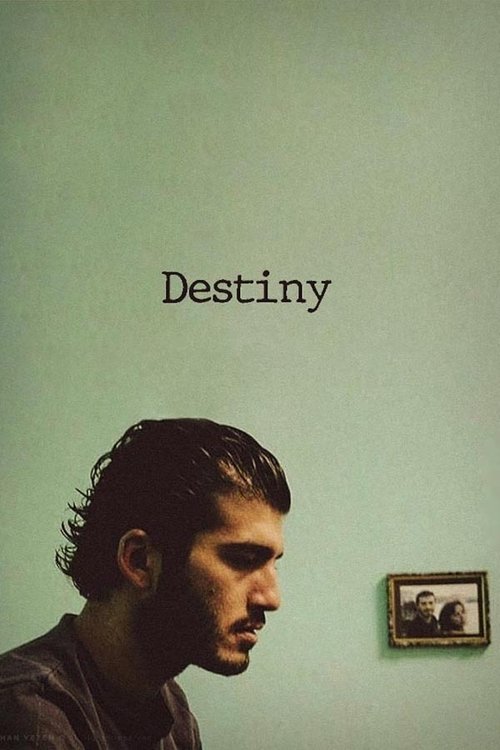
Destiny
2006 · Zeki Demirkubuz
When you're braced for something bleak and true — a film about loving the wrong person past all reason. Strictly a challenge, not a comfort watch; save it for when you want cinema that refuses to flinch.
What it's about
In working-class Istanbul, Bekir is hopelessly in love with Uğur, a young woman who has eyes only for Zagor, a small-time criminal about to get out of jail. The triangle is already unbearable when, on a hot summer night, Zagor kills a man and Uğur vanishes into the city's margins — and Bekir, unable to stop himself, follows her into a years-long spiral neither of them can explain or escape.
The experience
Slow-burning, airless, and pitiless — long takes, cramped rooms, and passions that dismantle people rather than redeem them. It's the kind of film that makes obsession feel physical, like heat you can't get out from under.
The craft
Demirkubuz shoots with clinical detachment: unhurried takes, drab interiors, and a refusal of melodrama that makes the emotional violence hit harder. The restraint is the point — the camera simply watches people ruin themselves, and the accumulating stillness becomes its own kind of intensity.
Why it matters
A key work of the Turkish auteur cinema that rose to international attention in the 2000s, and the film that most fully distills Demirkubuz's fatalist vision of love as self-destruction.
Snapshot
Destiny (Kader, 2006) is the sixth feature film by Turkish auteur Zeki Demirkubuz, and arguably the work that most fully crystallizes his governing preoccupations: unrequited love as a vocation of self-annihilation, fate as an impersonal force that grinds down the willing and unwilling alike, and the lower-class Istanbul milieu as a landscape where hope arrives already defeated. The film follows Bekir, a young man in helpless thrall to Uğur, who herself pines obsessively for Zagor — a small-time criminal awaiting release from prison. When Zagor kills someone and Uğur vanishes into the city's margins, Bekir pursues her through a long spiral of degradation that neither character can explain, arrest, or escape. Shot in Demirkubuz's characteristic register of clinical detachment and long, airless takes, Destiny is simultaneously a character study, a meditation on the Turkish word kader (fate, or divine predestination), and an implicit prequel to his 1997 breakthrough Innocent (Masumiyet) — a structural choice that invites viewers who know that earlier film to read the present one as tragedy already sealed.
Industry & production
Demirkubuz founded and operates Mavi Film (Blue Film), his own independent production house, which has financed and produced his features since the mid-1990s. This vertical integration — writing, directing, and producing under one roof with minimal outside interference — is structurally central to his practice. Destiny was produced within this arrangement on a characteristically modest budget; precise figures are not publicly documented, and the limited-crew, location-heavy production model that defines his filmography makes any approximation speculative.
The film circulated through Turkish theatrical release and international art-house festival channels, consistent with Demirkubuz's previous features. His films are not designed for commercial distribution and have never been positioned as such; their natural habitat is the festival circuit (Rotterdam, Locarno, Istanbul) and the specialty theatrical venues that sustained the "New Turkish Cinema" internationally through the 1990s and 2000s. Specific box-office figures, distributor arrangements, and sales data for Destiny are not part of the reliable scholarly record, and any numbers in circulation should be treated with skepticism.
Technology
Like virtually all of Demirkubuz's work of this period, Destiny was shot on film — 35mm — rather than on the digital video formats that were beginning to attract other low-budget Turkish independents in the mid-2000s. The choice sustains a particular tactile quality in the image: grain present but not foregrounded, tonal depth in shadows, a flatness in overlit interiors that reads less as stylistic statement than as the honest record of how these spaces actually look. Demirkubuz has shown no interest in exploiting digital formats for the aesthetic effects that drew contemporaries like Nuri Bilge Ceylan toward high-resolution landscape photography; his technological choices are instrumental rather than expressive.
Technique
Cinematography
The visual language of Destiny is one of systematic withholding. Demirkubuz and his cinematographer — the director has worked most recurrently with Ali Utku, though specific crew attribution for individual productions in this period is not always clearly documented in accessible sources — favor static or nearly static setups: the camera finds a position and holds it, regarding action without leaning in. Medium shots dominate. Close-ups are used sparingly and therefore carry weight when they arrive. The Istanbul locations — cramped apartments, dust-coated streets, the undifferentiated heat of a Turkish summer — are treated not as picturesque backdrop but as oppressive environment, rendered in a palette of bleached yellows and grays that communicates suffocation without poeticizing it. There is almost no beauty in the frame in any conventional sense, and this is a deliberate ethical stance: to aestheticize this world would be to lie about it.
Editing
Editing in Demirkubuz's films follows the logic of duration rather than drama. Cuts do not arrive at emotionally convenient moments; scenes run past their conventional endpoint, stranding characters in silence or in the aftermath of speech, and the discomfort this creates is functional — it refuses the viewer the rhythmic relief that conventional cutting provides. Destiny exemplifies this: a confrontation does not end with the decisive line, it continues into the embarrassed or enraged or exhausted silence that follows. The editing is, in this sense, anti-expressive, working against the emotionalism that the plot material might otherwise generate.
Mise-en-scène / staging
Demirkubuz stages with a theatrical economy that owes something to Robert Bresson and something to the exigencies of shooting in real locations with small crews. Actors are placed in space with precision but without ostentation; blocking tends toward the functional — characters sit, stand, move through doorways, occupy the foreground or background of a shot without the spatial choreography becoming legible as directorial display. The absence of camera movement reinforces this: the director will not follow a character across a room if doing so would convert observation into identification. The cumulative effect is a cinema that watches its characters as if from across a courtyard, interested but not intimate.
Sound
The sound design in Destiny is naturalistic and spare. Ambient noise — traffic, fans, television from adjacent rooms — grounds scenes in their locations without becoming expressionistic texture. Music, where it appears, is used intermittently and often diegetically; Demirkubuz is not a director who scores emotional beats with non-diegetic music, and the absence of a sustained orchestral or atmospheric soundtrack is itself significant. Silence, or near-silence, is the dominant acoustic condition of his films. This connects his practice to a tradition of European art cinema — Bresson, Haneke, early Tarkovsky — in which sound is treated as something to be earned rather than deployed as continuous atmospheric support.
Performance
Performance in Destiny is calibrated to withhold. The actors — working in a register somewhere between Bresson's conception of the "model" and the flat affect of social-realist performance traditions — do not signal emotion through conventional gestural or facial expressiveness. Bekir's obsession with Uğur is never played as romantic longing; it manifests as a kind of dogged, almost bureaucratic persistence. Uğur's relationship with Zagor is similarly underplayed — desire here is indistinguishable from compulsion, and neither character articulates what they want or why. This approach, consistent across Demirkubuz's filmography, is deliberately alienating: the viewer is given behavior without explanation, action without psychology, which is precisely the formal correlate of the film's thematic claim that people do not understand why they do what they do.
Narrative & dramatic mode
Destiny operates in what might be called a mode of fatalistic observation. The narrative structure is deceptively simple — a chain of one-sided loves that descend in a social and moral register — but Demirkubuz is not interested in psychological motivation, backstory, or the mechanics of how people arrived at their situations. Characters appear already defined by their compulsions. The story advances not through escalating dramatic conflict in a conventional sense but through accumulation: the same situations repeat with slight variations, each repetition confirming that nothing will change and no one will escape.
The film's most significant structural gesture is its relationship to Innocent (1997). Uğur appears in both films, and viewers who know Masumiyet encounter her in Kader already knowing, in rough outline, where she ends up. This creates a dramatic irony that is not comic but tragic in the classical sense: we watch her making choices that we understand, from the earlier film, to be steps toward an already-known destination. The "prequel" logic is not explained or signposted within the film; it is simply there for those who have followed Demirkubuz's body of work, adding a layer of inevitability that sharpens the title's resonance.
Genre & cycle
Destiny is not a genre film in any conventional sense, but it draws on and transforms genre materials: the love triangle, the criminal underworld, the noir heat of a summer night, the woman as object of dangerous fascination. What Demirkubuz does with these materials is characteristic of European art cinema's long relationship with genre — he takes the emotional architecture of melodrama or crime fiction and evacuates it of the satisfactions those modes normally deliver. There is no catharsis, no moral reckoning, no redemption, no decisive act that resolves the situation. The film belongs to a cycle of Turkish films from this period that engaged seriously with social margins and urban poverty not as political documentary but as existential terrain — a tendency that connects Demirkubuz's work to that of Nuri Bilge Ceylan, Derviş Zaim, and Yeşim Ustaoğlu, however differently each director handles the material.
Authorship & method
Demirkubuz writes, directs, and produces his own films, and the degree of authorial control this implies is unusual even within the art-cinema context. He has been consistent about his literary and philosophical influences: Dostoevsky is the most frequently cited, and the Dostoevskian concern with characters who understand their own destruction and proceed anyway is legible throughout his work, including in Destiny. Whether Destiny draws directly on any Dostoevsky text is not clearly established in the record — some of his other films (Envy, for instance, is connected to The Eternal Husband) have more explicit source relationships — but the sensibility is thoroughly Dostoevskian: fate not as external force but as the inner necessity of character.
His method is reportedly one of minimal pre-production in terms of conventional script development; the scripts are lean, the shooting is focused, and the films are made quickly relative to their complexity. Specific details about the production timeline and crew practices for Destiny are not well documented in accessible critical or journalistic sources.
Movement / national cinema
Destiny belongs to the "New Turkish Cinema" (Yeni Türk Sineması), the loose designation applied to a generation of filmmakers who emerged in the 1990s and achieved significant international visibility in the 2000s. This movement — the term is descriptive rather than programmatic; no manifesto, no shared aesthetic orthodoxy — was shaped by the collapse of the old Yeşilçam studio system, the availability of lighter production technologies, the emergence of state and European co-production funding, and the receptiveness of the international festival circuit to non-Western art cinema following the successes of Iranian, Taiwanese, and Chinese directors in the late 1980s and early 1990s.
Demirkubuz is, alongside Nuri Bilge Ceylan, the most internationally recognized figure of this generation, though their aesthetics differ sharply: Ceylan's cinema is contemplative, formally beautiful, and increasingly expansive in its philosophical ambitions; Demirkubuz's is compressed, deliberately unglamorous, and relentlessly focused on the urban underclass. Both positions were reactions, in different registers, against the commercial conventions of domestic Turkish cinema and toward a European art-cinema model. Destiny, made the year after Ceylan's Climates won the FIPRESCI prize at Cannes, appeared at a moment when New Turkish Cinema was at or near its peak of international critical attention.
Era / period
The mid-2000s was a period of significant consolidation for Turkish art cinema internationally. Domestic theatrical conditions for non-commercial films remained difficult, but the festival network provided an alternative distribution system that sustained filmmakers like Demirkubuz. Globally, this was a period in which digital acquisition was beginning to disrupt the economics of arthouse production, but Demirkubuz remained committed to film-based production. The film appeared against a broader backdrop of growing international scholarly and critical attention to non-Western cinemas — Turkish cinema was being written about in academic film studies with increasing seriousness, and retrospectives of Turkish work at major European institutions were more common than they had been a decade earlier.
Themes
Kader — destiny, fate, divine predestination — is the central concept the film interrogates without resolving. The Arabic-derived Turkish word carries theological weight in Islamic thought (the concept of qadar: that God has foreordained all events), and the film's use of it as a title is not casual. But Demirkubuz's treatment is secular and existential rather than religious: the fate his characters endure is not divine plan but the fate of character — the inescapable consequence of who you are and what you cannot stop wanting. Bekir cannot stop pursuing Uğur not because God wills it but because he is the kind of person who cannot stop; Uğur cannot disengage from Zagor for the same structural reason.
Obsession and unrequited love are treated not as romantic afflictions but as modes of existence — ways of being in the world that replace all other purposes. The love triangle, in this reading, is not a plot mechanism but a demonstration of how desire, when it is fully one-directional, becomes a system that serves the person suffering rather than the person pursued. Bekir needs Uğur to need him; Uğur needs Zagor to need her. That neither need is reciprocated is the engine that keeps the system running.
Social class is present but not polemicized: the characters exist in a specific material world — the petty criminality, the cramped apartments, the seasonal labor, the summer heat — that is rendered without condescension or sentimentality. Demirkubuz does not explain these characters through their circumstances; he simply places them in circumstances and observes.
Reception, canon & influence
Backward influences. Robert Bresson is the most frequently invoked precursor for Demirkubuz's method — the flat performance style, the refusal of psychological exposition, the insistence on showing behavior rather than explaining it. Rainer Werner Fassbinder's treatment of obsession, manipulation, and social entrapment in films like The Bitter Tears of Petra von Kant or Fox and His Friends is a plausible reference point for the emotional dynamics, though Demirkubuz works with a fraction of Fassbinder's baroque theatrical energy. Dostoevsky, as noted, is the literary precursor the director himself has consistently cited. Within Turkish cinema, the social-realist tradition and the work of earlier directors like Yılmaz Güney — whose films also dealt with poverty, criminality, and fate in the Turkish context — provide a domestic lineage, though Demirkubuz's formal approach is considerably more influenced by European art cinema than by the Güney tradition.
Critical reception. Destiny was well received within the critical community that follows Turkish art cinema, consolidating Demirkubuz's reputation as one of the most distinctive voices in contemporary world cinema. Specific review sources, quoted assessments, and detailed festival reception records are not within the scope of what can be responsibly cited here without risking fabrication; the broader pattern — substantial critical respect, limited mainstream awareness — is consistent with his entire filmography.
Forward legacy. Demirkubuz's influence on subsequent Turkish cinema is real but difficult to disentangle from the influence of the broader New Turkish Cinema movement. His specific contribution — the Bressonian performance mode applied to Turkish urban social reality, the linked-film universe built around recurring characters and themes, the insistence on fate as character rather than circumstance — has been absorbed by younger Turkish directors to varying degrees, though direct lines of influence are difficult to document with precision. Within his own filmography, Destiny's position as a companion piece to Innocent established a model of intertextual continuity — the shared character universe — that he continued to develop in subsequent work. Internationally, his films are taught in university courses on world cinema and world art cinema, and Innocent in particular has a secure place in discussions of 1990s international cinema; Destiny is generally treated as an essential complement to that film for any serious engagement with his work.
A Deleuzian reading
A man waits.
The full Deleuzian reading of Destiny →
Reception
Swept Turkey's festivals in 2006 — Best Film at Antalya's Golden Orange, plus prizes in Ankara, Istanbul and Nuremberg — but barely traveled abroad; Letterboxd and streaming have since turned it into a fixture of 'greatest Turkish films' lists, with ratings that startle newcomers.
How Destiny was received, from release to now →
Influences: the films it descends from and the films it influenced
- Pickpocket (1959) — Demirkubuz adopts Bresson's 'model' system wholesale: non-actors directed to suppress psychological expression and reduce performance to precise physical behavior, so that meaning accrues through the accumulation of action rather than displayed interiority — the founding device of the Bressonian performance mode the film explicitly inherits.
- L'Argent (1983) — The fatalistic accumulation structure in which a protagonist's destruction follows the inner necessity of their own character rather than external plot mechanics is Bresson's late formal method; Demirkubuz replicates it as the narrative engine of Destiny, where obsession functions as an inescapable internal logic rather than dramatic circumstance.
- Gertrud (1964) — Static tableau staging organized around obsessive unrequited love, with duration-based cutting that refuses dramatic acceleration and anti-expressive performance that denies psychological explanation — a formal prototype for the evacuated melodrama mode in which Destiny operates.
- Fox and His Friends (1975) — The strategy of constructing an obsession-and-entrapment narrative using melodrama's structural chassis while systematically removing its affective release mechanisms — leaving desire and destruction to register as social inevitability rather than individual tragedy — is the evacuated melodrama form Demirkubuz applies to Turkish urban reality.
- Jeanne Dielman, 23 quai du Commerce, 1080 Bruxelles (1975) — Duration-based cutting that assigns equivalent screen time to each action regardless of dramatic weight, combined with static medium-shot framing that refuses close-up emotional punctuation, making temporal accumulation itself the formal argument — the editing and cinematographic grammar Demirkubuz deploys as his baseline.
- Yol (1982) — The domestic Turkish lineage of social-realist fatalism in which fate operates as a structural force on the underclass; Demirkubuz inherits this subject position and national context while replacing Güney's expressionist neo-realism with a Bressonian formal vocabulary drawn from European art cinema.
- Damnation (1988) — Long-duration static-to-slow-panning takes, fatalistic accumulation of incident in the lives of the underclass, and diegetic music as the sole affective signal in an otherwise non-expressive formal system — a precursor that arrives at formally similar results through sustained duration rather than Bressonian performance restraint.
- A City of Sadness (1989) — Static long-take framing with medium-shot dominance, diegetic naturalistic sound as the sole affective carrier, and the practice of allowing personal-historical fate to accumulate through observational duration rather than expressive close-up — formal vocabulary Demirkubuz transposes to the Turkish urban context.
- The Match Factory Girl (1990) — Evacuated melodrama built on non-expressive performance, static medium-shot framing, diegetic music as the only emotional signal, and working-class fatalism in which a character is destroyed by desires she cannot renounce — an almost structurally isomorphic formal approach to Demirkubuz's method applied to Nordic social reality.
- Taste of Cherry (1997) — Parallel formal development of static framing, naturalistic diegetic sound, and non-expressive performance applied to fatalistic subject matter in a neighboring Islamic cultural context; the Iranian New Wave's formal vocabulary constitutes a likely regional influence on Demirkubuz's synthesis of Bressonian method and Middle Eastern social-realist subject matter.
- Egg (2007) — New Turkish Cinema descendant extending the quiet duration-based static-shot minimalism and functional non-expressive performance mode in a linked-trilogy structure that directly mirrors Demirkubuz's own intertextual character-universe architecture, with Demirkubuz's formal precedents absorbed as the normative language for serious Turkish art cinema.
- Uzak (2002) — New Turkish Cinema sibling applying the same static medium-shot framing, long-duration cutting, naturalistic ambient sound, and urban underclass subject matter to Istanbul alienation — a contemporaneous formal parallel within the same national movement, developed without direct derivation from Demirkubuz but in the same aesthetic climate.
- In Vanda's Room (2000) — Static medium-shot framing, functional blocking that refuses to aestheticize poverty, diegetic sound only, and a non-expressive performance mode with non-professional actors applied to the urban underclass — parallel formal development in Portuguese cinema converging on the same anti-expressive observational method.
- L'Humanité (1999) — Non-professional actors deployed in a directly Bressonian mode — flat affect, behavioral precision, zero psychological explanation — with static framing and anti-expressive editing organized around accumulation rather than dramatic architecture; shares the specific Bressonian inheritance and the formal commitment to duration-as-meaning.
- Times and Winds (2006) — New Turkish Cinema contemporaneous work applying static long-take framing and fatalistic accumulation with non-expressive performance to Turkish provincial life, using naturalistic ambient sound and functional staging as Demirkubuz does — a sibling film within the same national movement produced in the same year.
Similar films
- Damnation (1988) — influence & lineage
- Yellow Letters (2026) — shared sensibility
- The Stranger (2025) — shared sensibility
- Crossing (2024) — shared sensibility
- Head-On (2004) — shared sensibility
- Burning (2018) — shared sensibility
- Mustang (2015) — shared sensibility
- Time to Love (1965) — shared sensibility