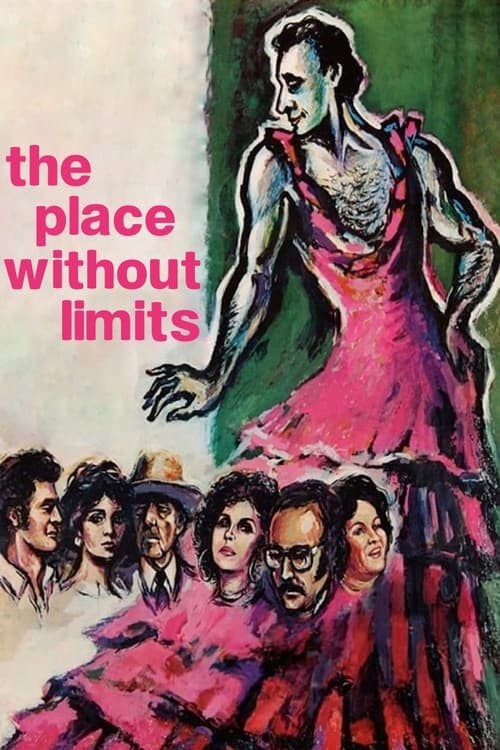
The Place Without Limits
1978 · Arturo Ripstein
For when you want a bruising character tragedy — something bold, queer, and decades ahead of its time — and you're prepared for it to hurt. A film to watch when you want to feel the cost of a world without room for someone.
What it's about
Over roughly a single day in El Olivo, a dying Mexican town, the fates of a decaying brothel's inhabitants come to a head. At the center is La Manuela, an aging gay man who performs as a Spanish dancer and runs the house with his daughter — and whose charged history with Pancho, a young truck driver whose swagger barely covers what he can't admit about himself, comes roaring back when Pancho returns to town. Honor, money, machismo, and desire collide with nowhere left to hide.
The experience
Suffocating and sad, with flashes of defiant glamour — the tension between attraction and threat tightens scene by scene until the air goes out of the room. It's melodrama with a knife's edge, and it lingers.
Performances
Roberto Cobo is extraordinary as La Manuela — flamboyant, funny, wounded, and fearless — in one of the landmark queer performances of Latin American cinema; Gonzalo Vega matches him as Pancho, all menace and self-loathing tangled together.
The craft
Ripstein compresses José Donoso's novel into a near-classical unity of place and time, letting the brothel's peeling walls and the town's dust do half the storytelling. The direction favors long, uncomfortable proximity — you're shut in the room with these people, which is exactly the point.
Why it matters
One of the defining works of 1970s auteur Mexican cinema and a milestone in queer representation on Latin American screens, confronting machismo and homophobia head-on at a time when almost no one did.
Snapshot
El lugar sin límites is Arturo Ripstein's adaptation of the 1966 novel by the Chilean writer José Donoso, and it stands as one of the defining achievements of the auteur-driven Mexican cinema that flourished under state sponsorship in the 1970s. Set over roughly a single day in a dying provincial town called El Olivo, the film concentrates a Latin American tragedy of caste and desire into the space of a decaying rural brothel. Its central figure is La Manuela (Roberto Cobo), an aging homosexual man who performs as a Spanish dancer and runs the brothel with his daughter, La Japonesa Chica; the drama turns on his charged, doomed encounter with Pancho (Gonzalo Vega), a young truck driver whose violent machismo is inseparable from his repressed attraction. The film's title, inherited from Donoso, derives from a line in Marlowe's Doctor Faustus describing hell as a place without limits — a frame that governs the whole work, which treats the town, the brothel, and the trap of machismo as a hell without exit. It is widely regarded as a landmark of queer representation in Latin American cinema and one of Ripstein's key early films.
Industry & production
The film belongs to a specific moment in Mexican film history: the tail end of the reformist state-cinema project associated with the presidency of Luis Echeverría (1970–1976), when federal money and newly restructured production companies gave a generation of ambitious directors room to make serious, socially critical work outside the commercial mainstream. El lugar sin límites was produced through the state apparatus — the record points to Conacite Dos, one of the government production entities of the period — rather than the private industry that dominated Mexican output. It arrived in 1978, just as the incoming administration of José López Portillo was beginning to dismantle and defund that experiment, which lends the film a valedictory quality: it is among the last works of that publicly financed art cinema before the sector's decline and the rise of the crude commercial cine de ficheras sex comedies of the same years.
Ripstein came to the project as a scion of the industry. He is the son of the prominent producer Alfredo Ripstein, and he had apprenticed directly under Luis Buñuel, observing the shooting of The Exterminating Angel (1962). By 1978 he had already directed his debut Tiempo de morir (1965), scripted by Gabriel García Márquez, and a string of subsequent features. El lugar sin límites consolidated his standing as the leading Mexican auteur of his generation. Precise budget and box-office figures for the film are not something I can responsibly cite; the state-financed context means it was never conceived primarily as a commercial proposition.
Technology
The film was made with the standard professional apparatus of late-1970s Mexican feature production: 35mm color photography, sync-sound shooting, and studio-and-location work typical of the period. There is nothing technologically experimental about its means; its distinction lies entirely in how conventional resources are deployed. The color process yields the muted, dust-and-lamplight palette of the brothel interiors and the flat provincial daylight outside, and the film's restrained approach to camera and cutting depends on stable, unshowy technical craft rather than any novel equipment or process.
Technique
Cinematography
The photography builds the film's sense of enclosure. Interiors of the brothel are rendered in warm, sourced light — lamps, doorways, the reflected glow of a dance — against pervasive shadow, so that the house reads as both refuge and trap. Ripstein's compositional instinct, already evident here and central to his later career, is toward staging in depth and holding the frame, letting figures move within an unbroken space rather than fragmenting action into coverage. The camera follows characters through the rooms of the brothel with a controlled fluidity that ties the space together into a single moral geography. Exteriors, by contrast, give us the emptied, sun-bleached town — the fields, the road, the promised electrification that never fully redeems the place — underscoring the town's abandonment by history.
Editing
The film's editing serves its theatrical concentration rather than any montage-based rhythm. Scenes are allowed to play out at length, and the cutting tends to preserve the integrity of the performances and the continuity of the interior spaces rather than accelerate them. A single crucial flashback — the origin of La Manuela's paternity, arising from a wager — is folded into the present-tense action, so that past and present coexist within the film's tight time frame. I do not have reliable confirmation of the editor's identity to attribute the work to an individual, so I will not guess; the discernible editorial strategy, however, is one of restraint and duration in the service of dramatic build.
Mise-en-scène / staging
Mise-en-scène is where the film is richest. The brothel is a fully realized microcosm: worn furnishings, religious kitsch, the accumulated debris of a marginal life, all of it doubling as a portrait of Mexican provincial decay. Ripstein stages the drama almost as chamber theater, choreographing entrances, thresholds, and the crossing of the house's rooms so that social hierarchy and sexual tension are legible in physical arrangement. La Manuela's red Spanish dance dress is the film's central object — the emblem of his fragile, defiant self-fashioning — and its appearance organizes the film's climactic movement. The staging insists throughout on the town's dependence on the landowner Don Alejo, whose power hangs over every interior even when he is offscreen.
Sound
Sound is heavily anchored in the diegetic world of popular Mexican music — ranchera and bolero, the sonic texture of the cantina and the brothel. The casting of Lucha Villa, one of the era's celebrated ranchera singers, in a central role folds that musical culture directly into the drama. Music functions less as an external emotional score than as an element of the milieu and of La Manuela's performance persona. I am not able to verify the credited composer with confidence, so I will not attribute an original score to a named figure; what is certain is that the film's aural world is built substantially from source music and the ambient sound of a dying town.
Performance
Performance is the film's engine, and Roberto Cobo's La Manuela is its centerpiece. Cobo — indelibly remembered as El Jaibo, the delinquent of Buñuel's Los Olvidados (1950) — delivers a portrayal of extraordinary tenderness and bravery, refusing both caricature and sentimentality in playing an aging queer man who insists on his dignity and his dance in a hostile world. Gonzalo Vega's Pancho embodies machismo as a form of self-torture, his aggression legible as the flip side of desire he cannot acknowledge. Lucha Villa brings weight and pathos to La Japonesa, the madam whose history with La Manuela and with Don Alejo underlies the whole situation. The veteran Fernando Soler, near the end of a long career, lends patriarchal authority to Don Alejo. The ensemble sustains the film's difficult tonal balance between melodrama, tragedy, and unsparing social observation.
Narrative & dramatic mode
The narrative is compressed and classically tragic. It observes a near-unity of time and place — a single day, a single house and town — and moves inexorably toward catastrophe. The dramatic mode is melodrama pushed to the edge of tragedy: heightened emotion, a fatal secret from the past, and a reckoning that arrives as violence. Ripstein takes the templates of the Mexican brothel melodrama and the cabaretera tradition and hollows them out, replacing their sentimental resolutions with a bleak determinism. The wager that produced La Manuela's daughter, the debts that bind Pancho to Don Alejo, the town's economic death — all function as a mechanism closing on the characters. The film's structure makes clear from early on that there is no exit, formally enacting the "place without limits" of hell that its title names.
Genre & cycle
Generically the film sits at the intersection of melodrama, social-realist tragedy, and the brothel drama that had a long lineage in Mexican cinema. It belongs to the cycle of serious, state-supported auteur films of the 1970s that took up subjects the commercial industry avoided — poverty, violence, sexuality, the failures of the Mexican Revolution's promises. Against the era's proliferating soft-core ficheras comedies, which also used cantina-and-brothel settings, El lugar sin límites is their grave inverse: it treats the same milieu as the site of genuine tragedy and social indictment. It is also, importantly, an early entry in the still-thin genre of Latin American films that placed a homosexual protagonist at the center with seriousness and empathy.
Authorship & method
The film is centrally Ripstein's, and it exemplifies his method: literary adaptation of a major novel, chamber-scale staging, an unblinking view of cruelty, and an insistence on the dignity of society's outcasts. His formation under Buñuel is visible in the corrosive treatment of provincial hypocrisy and repression, and the casting of Roberto Cobo makes the Buñuelian lineage explicit.
The screenplay adapts Donoso's novel, and the writing credits reflect the literary seriousness of the enterprise: Ripstein worked with the distinguished Mexican poet and writer José Emilio Pacheco on the adaptation. The Argentine novelist Manuel Puig — author of Kiss of the Spider Woman — is widely reported to have contributed to the screenplay as well, a collaboration that resonates strongly with the film's themes of queerness, fantasy, and popular melodrama, though accounts of the exact nature and crediting of his involvement vary and I flag it as such rather than overstate it.
For the cinematography, the photographic work realizing the film's shadowed interiors and emptied exteriors is central to its effect. I am not able to confirm the identities of the composer and editor with the certainty required to make firm authorial attributions, and rather than invent names I note that the documentary record readily available to me is thin on those specific credits. This film predates Ripstein's long, defining collaboration with the screenwriter Paz Alicia Garciadiego, which began in the following decade and shaped his mature period.
Movement / national cinema
El lugar sin límites is a signal work of the movement often called the Nuevo Cine Mexicano — the renewal of Mexican film that emerged from the late 1960s onward and reached fullest institutional support during the Echeverría years. Alongside directors such as Felipe Cazals, Jaime Humberto Hermosillo, Jorge Fons, and Paul Leduc, Ripstein used newly available state funding to make artistically ambitious, socially critical cinema. The film also participates in a broader inter-American literary culture: it draws its source from the Chilean Donoso, its title from Marlowe by way of Donoso's epigraph, and — through Puig's reported involvement — from the Argentine avant-garde of popular forms, making it a node in a continental network of Latin American letters as much as a strictly national product.
Era / period
The film is precisely of its late-1970s moment. It captures a Mexico in which the modernizing promises of the mid-century state — electrification, roads, development — have curdled into abandonment, and it registers, at the level of production history, the closing of a window of cultural liberalization just as censorship pressures and funding cuts returned under a new administration. Its frankness about homosexuality and its critique of machismo were bold for their time and place, and part of what makes the film historically important is that it articulated these themes within, and against, a deeply conservative and Catholic provincial imaginary.
Themes
The film's governing themes are machismo and its violence, homophobia, and the impossibility of desire under a rigid honor code. Pancho's brutality toward La Manuela is shown to originate in his own thwarted attraction, so that machismo is diagnosed as a prison for the men it supposedly empowers. Around this runs a searching account of class and power: Don Alejo's near-feudal control of the town, the economics of debt and dependency, and the death of a community bypassed by progress. Family honor, greed, and paternity thread through the plot's central wager. Performance and self-invention — La Manuela's dance, his dress, his defiant femininity — are held up as acts of dignity and freedom in a world that punishes them. Overarching all of it is the Marlovian conceit of hell as a place without limits: damnation not as a location one enters but as a condition one already inhabits.
Reception, canon & influence
Critically, the film was recognized at home as a major achievement, taking multiple honors at the Ariel Awards, Mexico's national film prizes, including recognition as one of the best pictures of its year; Roberto Cobo's performance in particular has been singled out in the decades since as one of the great portrayals in Mexican cinema. (I cite the Ariel recognition in general terms because I want to avoid misstating the exact slate of categories.) Over time the film's reputation has only grown, and it is now firmly canonical: a fixture in accounts of Ripstein's career, of the Nuevo Cine Mexicano, and — increasingly — of the history of queer cinema in Latin America, where it is treated as a foundational text.
Looking backward, the film's influences are legible and largely acknowledged: Donoso's novel and, through it, the moral universe of the Latin American literary Boom; Buñuel, both directly (Ripstein's apprenticeship, Cobo's presence) and in spirit (the anatomy of provincial repression and hypocrisy); and the deep well of Mexican melodrama, whose conventions the film reworks. Looking forward, its legacy lies in having demonstrated that a homosexual protagonist could anchor a serious, tragic, canonical national film, opening ground that later Mexican and Latin American filmmakers — including Ripstein's own contemporary Jaime Humberto Hermosillo and subsequent generations of queer cinema — would continue to work. Within Ripstein's own body of work it marks the crystallization of the chamber-tragedy mode, the fascination with marginal lives and enclosed spaces, that he would refine across the following decades. It remains one of the essential Mexican films of the 1970s and a touchstone for the study of gender, sexuality, and power in Latin American cinema.
Reception
A prize-winner at San Sebastián in 1978 and a scandal at home for putting queer desire at the center of macho Mexican cinema, it's since been fully canonized — restored, taught, and now routinely called one of the greatest Mexican films ever made.
How The Place Without Limits was received, from release to now →
How to watch The Place Without Limits: what to notice on a first viewing
- Watch characters cross specific thresholds as they enter rooms. Ripstein choreographs every entrance and doorway crossing inside the brothel, so where a person stands, and who lets them in, maps the town's whole hierarchy. Social rank and sexual tension show up in blocking before anyone says a word about either.
- Notice the lamplight in the brothel against deep shadow. Interiors glow from lamps and doorways while everything around them stays dark, so the house reads at once as shelter and as a trap. The lighting itself argues that safety and danger share one address here.
- Look at the empty, sun-bleached streets outside the brothel. Whenever the film steps outside, it finds a town with almost nobody in it, fields and roads baking under a promise of electrification that never quite arrives. The emptiness outside makes the crowded brothel feel like the only place still alive.
- Listen for ranchera and bolero playing through the cantina. Lucha Villa's singing and the popular Mexican songbook run through the film as the sound of the place itself, not as music added over the top. The music belongs to the world on screen, not to a score commenting on it from outside.
- Watch Pancho's aggression whenever he stands near Manuela. Gonzalo Vega plays Pancho's machismo as something closer to torment than swagger, tightening every time he is close to La Manuela. His hostility reads less like hatred than like something he refuses to let himself feel.
The whole guide to watching The Place Without Limits, with the keys for a rewatch →
Influences: the films it descends from and the films it influenced
- Los Olvidados (1950) — Ripstein reactivates Buñuel's discovery Roberto Cobo — El Jaibo's feral, unsentimentalized street-body — as La Manuela, carrying forward the same clinical, pitiless framing of society's discards.
- Él (1953) — Its clinical dissection of pathological machismo and paranoid possessiveness confined within claustrophobic domestic architecture is the template for Pancho and Don Alejo's coercive, jealousy-driven gaze.
- Nazarín (1959) — Ripstein's on-set apprenticeship here trained the deadpan, long-take anatomy of provincial Catholic hypocrisy and repression that governs El lugar's moral universe.
- Aventurera (1950) — The cabaretera-brothel melodrama in which diegetic musical floor-show numbers carry the emotional drama is exactly the convention Ripstein reworks inside La Japonesa's house of ranchera and danzón.
- Allá en el Rancho Grande (1936) — It codified the comedia ranchera's feudal-hacienda patrón and its sourced diegetic ranchera song, a nostalgic order Ripstein inverts into Don Alejo's decaying feudal power.
- A Streetcar Named Desire (1951) — The model of chamber-theater adaptation that preserves unity of place while brute machismo collides with a fragile 'unnatural' figure in one sweltering interior, staged as filmed theater.
- Tiempo de morir (1966) — Ripstein's debut established his fatalist duel structure and rigorous unity of time and place — the narrative armature, scripted from a major literary hand, that El lugar reuses.
- El castillo de la pureza (1972) — His earlier crystallization of the enclosed-house tyranny — staging-in-depth within a single confining dwelling as a chamber of patriarchal control — is refined and perfected here.
- Victims of Sin (1951) — Rebuilds the vertical moral diagram — brothel floor below, balcony and staircase above — as one continuous negotiable space, and gives the climax to a performance number in which dancing in costume is what gets the performer killed.
- El evangelio de las maravillas (1998) — Extends the chamber-tragedy mode — an enclosed community ruled by a corrupt patriarch, shot in staging-in-depth long takes — that El lugar first set as his signature method.
- Principio y fin (1993) — Applies the same method — long-take, staging-in-depth family tragedy adapted from a major novel (Mahfouz) with Garciadiego — that El lugar pioneered with Donoso and Pacheco.
- Profundo carmesí (1996) — The mature refinement of the folie-à-deux chamber tragedy and lurid, sourced-music melodrama whose tone and enclosed staging were mode-set in El lugar.
- Kiss of the Spider Woman (1985) — Adapts Manuel Puig — a reported screenplay contributor here — extending the same fusion of queer dignity, popular-melodrama fantasy, and enclosure into a two-hander confined space.
- Doña Herlinda y su hijo (1985) — Ripstein's Nuevo Cine Mexicano contemporary builds directly on the ground El lugar cleared, anchoring a national film on an openly gay protagonist treated with dignity rather than punishment.
- Fresa y chocolate (1993) — A canonical Latin American film centered on a gay man's dignity and a chamber-scale two-character encounter, extending El lugar's demonstration that a queer protagonist could anchor a serious national cinema.
- The Mysterious Gaze of the Flamingo (2025) — Pioneers the rural-brothel drag performer as a figure of defiant lip-sync spectacle and locus of communal violence, the staging logic behind the film's cabaret-drag numbers and found-family house.
- The Bitter Tears of Petra von Kant (1972) — A single-set chamber theater of queer desire and domination played in theatrical long takes, sharing El lugar's fusion of enclosed staging with melodrama pushed toward tragedy.
- In a Year of 13 Moons (1978) — Contemporaneous tragedy built around a trans/queer protagonist's humiliation and death, elevating popular-melodrama conventions into serious tragic form in the same register.
- Fox and His Friends (1975) — A gay protagonist destroyed by class and money, filmed as melodrama-as-tragedy — the parallel project of anchoring a serious film on a queer figure exploited by feudal-economic power.
Similar films
- Nazarín (1959) — influence & lineage
- The Young and the Damned (1950) — influence & lineage
- Kiss of the Spider Woman (1985) — influence & lineage
- Deep Crimson (1996) — influence & lineage
- Manila in the Claws of Light (1975) — shared sensibility
- Law of Desire (1987) — shared sensibility
- Last Tango in Paris (1972) — shared sensibility
- Victims of Sin (1951) — shared sensibility