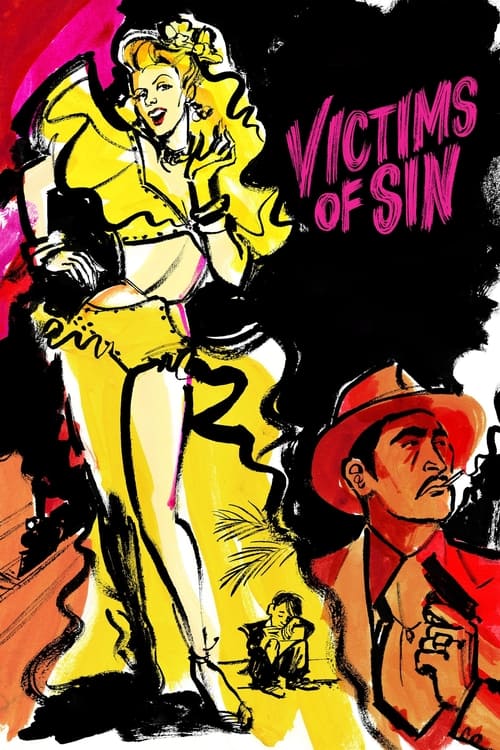
Victims of Sin
1951 · Emilio Fernández
For when you want big feelings and don't want them polite — a night for lurid, gorgeous, all-in melodrama that earns its tears and its dance breaks alike.
What it's about
A nightclub dancer in Mexico City finds a newborn abandoned in a trash can and decides to raise him as her own — a choice that costs her the job, the protection, and what little social standing the cabaret world allowed her. Around her swirl pimps, mambo orchestras, prison, and the city at night, as the film follows her fall and her fight through Mexico's underworld of smoke-filled dance halls.
The experience
Melodrama at full boil — fast, feverish, and shameless in the best way, swinging between electrifying musical numbers and gut-punch cruelty. It plays like a fever dream of maternal sacrifice set to a mambo beat.
The craft
The great Fernández–Figueroa team, famous for stately prestige pictures, throws its full pictorial arsenal at a pulp nightclub story: hurtling crane shots through smoke-filled dance floors, inky expressionist shadows, and real musical royalty — Dámaso Pérez Prado and Rita Montaner — performing onscreen at the height of the mambo boom. The clash between high style and low genre is exactly what makes it sing; see it big and loud if you can.
Why it matters
Now regarded as the crown jewel of the cabaretera cycle — the Mexican nightclub melodrama — and a key rediscovery for international audiences since its restoration, it shows what happened when Mexico's most prestigious filmmaking team embraced its most disreputable genre.
Snapshot
Víctimas del pecado is the great collision of Mexico's two dominant Golden Age idioms: the nationalist-pictorial cinema of Emilio "El Indio" Fernández and Gabriel Figueroa, and the commercial cabaretera — the nightclub melodrama built around a rumba dancer, a pimp, and a fallen woman's serial humiliations. Fernández, whose reputation had been made on indigenista prestige pictures that carried Mexico to Cannes and Venice, here takes a producer's genre assignment and refuses to condescend to it. The result is a film of extraordinary formal density: hurtling crane moves through a smoke-filled dance floor, Afro-Cuban music performed onscreen by Dámaso Pérez Prado and Rita Montaner at the height of the mambo boom, and a maternal-sacrifice plot pushed past realism into something closer to hallucination.
The story is minimal and archetypal. Violeta (Ninón Sevilla), a dancer in a Mexico City cabaret, rescues an infant abandoned in a trash can by a fellow performer at the insistence of the pimp Rodolfo (Tito Junco). Keeping the child costs Violeta her job, her standing, and eventually her body; she works the street, finds refuge and a kind of dignity with Santiago (Rodolfo Acosta) at a dance hall by the railroad yards, and when Rodolfo returns to destroy that life she kills him. Prison, and a long deferral, follow. What is remarkable is not the plot but the pressure Fernández and Figueroa apply to it — every station of the melodrama is staged as a set piece, and the film's argument about who is permitted to be a mother in a modernizing nation is carried as much by camera height and locomotive steam as by dialogue.
Industry & production
The film was produced by the Calderón brothers' company, the Mexico City house most closely identified with the cabaretera cycle — the same production milieu that had made Ninón Sevilla a star with Aventurera (1950). This matters to how the film should be read: Fernández was not developing a personal project but taking a job inside a proven formula, at a moment when his own prestige line had stalled commercially.
The context is Mexican cinema's turn from boom to glut. The Época de Oro had been supercharged by the Second World War, when Hollywood's reduced Spanish-language output and Argentina's political disfavor with Washington left Mexico as the hemisphere's dominant Spanish-language producer. By 1951 the export cushion had deflated, production volume remained high, and the industry's financing — routed heavily through the state's Banco Nacional Cinematográfico — favored fast, formula-driven genre product. The film workers' union (the STPC) operated a closed shop that made it very difficult for new directors to enter, freezing the industry's creative leadership in place and pushing established figures like Fernández into repeat business rather than renewal. The cabaretera was the reliable formula of the moment: cheap to shoot on standing nightclub sets, structurally able to absorb musical numbers that doubled as record-industry promotion, and licensed by its moralizing frame to show far more skin and vice than the material would otherwise permit.
Precise production documentation for the film — schedule, budget, receipts — is thin in the widely available record, as it is for most Mexican studio pictures of the period; specific figures should be treated with caution unless drawn from the industry ledgers or from Emilio García Riera's Historia documental del cine mexicano, the standard reference. What is clear is the shape of the deal: a name director, a bankable Cuban dancer, two internationally famous Cuban musical acts, and a genre audience already in place.
Technology
The film sits at the last moment of the classical Academy-frame studio apparatus: 35mm black-and-white, 1.37:1, single-channel optical soundtrack. CinemaScope was still two years away; magnetic stereo, color, and widescreen would arrive in Mexico shortly after and change the industry's economics substantially. Nothing here is technologically novel — the interest is in how completely the existing toolkit is exploited.
Mexico City's Churubusco studios, built in the mid-1940s with RKO capital, gave the country the most modern soundstages in Latin America: large stages, process facilities, and a sound plant on American lines. That plant is the hidden precondition for the film's style. Deep-focus night interiors — a crowded dance floor rendered sharp from the bandstand to the back wall — required both fast panchromatic negative and very heavy lighting units, and the tonal control Figueroa exercises over black is a laboratory achievement as much as a lighting one. The mobile work depends equally on studio hardware: a camera crane and dolly track through spaces designed with removable walls to accommodate them.
Two other technical conventions govern the film. First, musical numbers were shot to pre-recorded playback, which frees the camera to move violently around performers who would otherwise be tethered to a microphone. Second, Mexican production of the period made routine use of post-synchronized dialogue, which gives the dramatic scenes a slightly forward, close-miked vocal presence quite distinct from the ambient reality of the images — a texture modern viewers sometimes misread as crudeness when it is in fact standard practice.
Technique
Cinematography
Gabriel Figueroa is the most consequential cinematographer in Latin American film history, and Víctimas del pecado is the key document of his urban, nocturnal register. His famous manner — low horizon, towering filtered clouds, figures monumentalized against sky, compositions borrowed from Mexican muralism and from Eduard Tisse's work on Eisenstein's unfinished ¡Que viva México! — is a landscape idiom. Here he transposes its logic indoors and after dark. The sky becomes the cabaret ceiling and the underside of a railway bridge; the monumental low angle now aggrandizes a pimp in a doorway; the diagonal shafts that once fell through cornfields become a searchlight bar of smoke over a dance floor.
The signature effects are chiaroscuro of an almost engraved hardness, wet pavement used as a second light source, and steam and cigarette haze as a volumetric medium that makes light beams legible. The camera is unusually kinetic for Fernández: booms descend from the band into the dancers, lateral tracks follow Violeta through the club's social strata, and the railyard sequences use the locomotives themselves as moving light and shadow generators. Figueroa had photographed Buñuel's Los olvidados the year before — a film on which Buñuel is well documented to have suppressed exactly the picturesque instincts Figueroa is usually celebrated for. Seen against that, Víctimas del pecado reads as Figueroa reclaiming his full rhetoric while accepting a subject Buñuel had made it impossible to sentimentalize.
Editing
Gloria Schoemann, the editor on effectively the whole Fernández–Figueroa corpus, was one of the period's most powerful technicians and one of very few women in a senior craft position anywhere in the industry. Her cutting here does two distinct jobs. In dialogue and melodrama the pace is patient, holding long enough for Figueroa's compositions to be read as pictures — a deliberate slowness that lets the film's images accumulate iconic weight. In the musical numbers the film switches to a percussive, on-beat rhythm that treats the orchestra's attack as the cut point, dissolving narrative time into performance time. The alternation is the film's real structure: suffering, then spectacle, then suffering.
Mise-en-scène / staging
The film's world is built as a vertical moral diagram. The cabaret is a stratified space — bandstand, floor, tables, balconies, back rooms — and Violeta's fortunes are legible entirely from which level she occupies and whether she is looking up or down. Below and outside it lies the street, the alley, the trash can; further out, the railway, an unenclosed zone of noise and transit where the film locates its only durable tenderness. The trash-can scene is the film's compositional thesis: an infant framed among refuse, staged with the same reverent lighting Fernández and Figueroa had spent a decade lavishing on Dolores del Río and on Mexican peasants. Sacralizing the discarded is the picture's entire method.
Sound
Music is not accompaniment here; it is the film's public sphere. Pérez Prado and his orchestra appear onscreen as themselves, and Rita Montaner — a major figure of Cuban musical theater and popular song, and one of the most significant Black performers of the era's Spanish-language cinema — performs within the fiction. Mambo, rumba, danzón, and bolero are diegetic, played by visible musicians in a real acoustic space, which lends the numbers a documentary charge: the mambo craze was cresting in Mexico City precisely then, and the film is partly a record of it. Antonio Díaz Conde, Fernández's regular composer, supplies dramatic scoring that has to negotiate around this diegetic material rather than dominating it. Against the music the film sets a second, harsher sonic layer: locomotive whistles, couplings, and steam, which function as the voice of the industrial city and as a recurring interruption of intimacy.
Performance
Ninón Sevilla's performance is the reason the film survives argument about its plot. Cuban-born and a dancer first, she works in a register the era's respectable Mexican critics found vulgar: eyes and mouth used with silent-film amplitude, dance that is athletic and unpolished rather than balletic, emotion arriving at full volume without transition. Read as naturalism it fails; read as melodrama — where the point is that inner states become visible on the body — it is exact. François Truffaut's admiring notice of Sevilla in Cahiers du cinéma in the mid-1950s remains the most-cited external endorsement, and it is telling that the auteurist critics who would soon canonize Hollywood B-pictures recognized her before most local critics did.
Around her, Tito Junco plays Rodolfo as pure predatory appetite with no interior, and Rodolfo Acosta — who had played the vicious pimp in Fernández's Salón México (1949) — is cast against that memory as the decent, doomed Santiago, an inversion the period's audience would have felt immediately.
Narrative & dramatic mode
The film is melodrama in the strict sense theorized by Peter Brooks and Thomas Elsaesser: a post-sacred moral universe in which virtue is unrecognized and must be proved through suffering, and in which what cannot be spoken is displaced onto music, gesture, and décor. Its plot machinery is the nineteenth-century fallen woman narrative filtered through Mexican naturalism — the lineage of Federico Gamboa's Santa, itself downstream of Zola — spliced to the maternal-sacrifice melodrama familiar from Madame X and Stella Dallas, with the crucial local difference that the child is not biological. Violeta's motherhood is elective, an act of will against every institution around her, which converts the genre's usual conservatism into something more subversive: the film's moral center is a sex worker who constitutes a family by decision.
Structurally the film is episodic and vertical rather than causal — a descent through stations of degradation punctuated by musical set pieces — and it relies openly on coincidence, reversal, and a juridical coda. The dramatic mode is not psychological; characters do not change, they are revealed under pressure.
Genre & cycle
Víctimas del pecado is a late, self-aware entry in the cabaretera / rumbera cycle, which had roots in Santa (1931, the first Mexican sound feature) and La mujer del puerto (1934), and which surged after the war around Cuban-born dancers — Sevilla, María Antonieta Pons, Amalia Aguilar — in vehicles directed by Alberto Gout, Juan Orol, and others. It overlaps with the arrabal film, the slum melodrama that Ismael Rodríguez had turned into a national phenomenon with Nosotros los pobres (1948), and it borrows freely from American film noir: the nocturnal city, the fatalistic architecture, the criminal who is also an economic type.
Fernández had already tested the mode in Salón México, and Víctimas del pecado is best understood as its darker companion. The cycle's descendants are direct: it degrades into the ficheras sex comedies of the 1970s, and it is deliberately exhumed and interrogated by Arturo Ripstein and Paz Alicia Garciadiego in films such as their 1991 La mujer del puerto.
Authorship & method
Fernández built an authorial signature out of a fixed unit — Figueroa on camera, Mauricio Magdaleno as writing partner, Gloria Schoemann cutting, and for years Dolores del Río and Pedro Armendáriz in front of the lens — and out of a totalizing nationalist program: a cinema that would make Mexico legible to itself and to the world through muralist composition, indigenous subjects, and mythic simplicity. María Candelaria, Enamorada, Río Escondido, and La perla carried that program to European festivals in the late 1940s.
The persona was as constructed as the style. "El Indio" cultivated a mythology of authenticity and machismo, and the widely repeated claim that he modeled for the Academy Award statuette is best treated as legend rather than documented fact. On this film the authorial unit is intact behind the camera and entirely replaced in front of it: no del Río, no Armendáriz, but a Cuban rumbera and two Cuban musical stars. That substitution is the most revealing production fact about the film. Fernández's method — pictorial monumentality applied to the humble — does not change; only its object does, and applying an idiom developed for indigenous villagers to a cabaret dancer's body is either an act of solidarity or an act of appropriation, a tension the film never resolves and probably could not.
Movement / national cinema
The film belongs to the Mexican school of the Época de Oro, a national cinema that was for a decade the hemisphere's most influential Spanish-language film culture, exporting throughout Latin America and to Spain. Its aesthetic synthesis is unusual and specific: Soviet montage-era compositional grandeur, the muralist program of Rivera, Orozco, and Siqueiros, Hollywood's narrative grammar, and the popular musical theater and radio culture of the Spanish-speaking Caribbean.
That last strand is what Víctimas del pecado foregrounds. The film is a transnational object as much as a national one: Cuban performers, Cuban and Afro-Cuban musical forms, and a Mexico City that functions as the capital of a Caribbean-Latin American entertainment circuit. It is also one of the era's most sustained onscreen presentations of Black performance in Mexican cinema, and modern scholarship treats it as a central and genuinely ambivalent text on that question — Blackness is granted enormous musical authority and simultaneously confined to the register of sensuality and spectacle.
Era / period
1951 falls at the end of Miguel Alemán's presidency and at the height of the "Mexican Miracle": import-substitution industrialization, rapid capital accumulation, and a torrential migration from the countryside into a Mexico City that could not house it. The film is a direct report from the underside of that boom. Its railway yards are the infrastructure of the miracle; its cabaret is where rural migrants' labor is converted into urban leisure; its abandoned child is the demographic surplus the boom produced and did not absorb.
The comparison that fixes the year is Buñuel's Los olvidados (1950), photographed by the same cinematographer, on the same city's margins, and arriving at the opposite conclusion — cruelty without redemption where Fernández offers redemption through suffering. Between them they define the two available Mexican answers to alemanista modernity. Meanwhile the industry itself was entering the decline that would define the 1950s, and Fernández's own international prestige was fading; the film is simultaneously a peak of craft and a symptom of exhaustion.
Themes
The film's governing theme is elective motherhood as an act of civil disobedience. Violeta's crime, in the eyes of every institution she meets — the cabaret, the police, the courts, the orphanage — is not prostitution but insisting on a child she has no legal or biological claim to. Around this cluster the film's other concerns: the commodification of women's bodies and the pimp as an ordinary businessman rather than a monster; the sacralization of the discarded, which Figueroa's lighting performs shot by shot; the city as machine, with trains as its indifferent circulatory system; improvised kinship set against state and church custodial power; and the racialized division of pleasure, in which Afro-Cuban music supplies the film's vitality while the Black performers who make it remain framed as spectacle.
Underneath runs a specifically melodramatic theology: virtue is real but invisible, and only extremity — violence, imprisonment, time — can force the world to acknowledge it.
Reception, canon & influence
Backward. The film draws on Gamboa's Santa and its screen adaptations for its narrative template; on the Hollywood maternal melodrama for its structure of sacrifice; on American noir for its nocturnal iconography; on Eisenstein and Tisse and Mexican muralism, via Figueroa, for its compositional language; on Fernández's own Salón México for its subject; and on the live musical culture of Havana and Mexico City for everything that makes it move.
Contemporary reception. The record here should be stated carefully. Mexican critical opinion of the period generally regarded the cabaretera cycle as commercial debasement, and the standard historiography — García Riera's above all — has tended to treat Fernández's 1950s output as a decline from his indigenista peak. Detailed contemporaneous reviews and box-office figures are not well represented in the accessible English-language record, and precise claims about the film's initial commercial performance should be sourced rather than assumed. What is documented is the early French enthusiasm for Sevilla, Truffaut's notice included, which arrived from outside the Mexican critical consensus and anticipated the auteurist revaluation of popular genre cinema by several years.
Forward. The film's afterlife has been long and increasingly serious. Carlos Monsiváis's essays on melodrama, camp, and the rumberas did more than anything else to move the cycle from embarrassment to national self-knowledge, and subsequent scholarship — on Mexican melodrama, on gender and sexuality in Mexican film, on Blackness and Afro-Cuban performance in Latin American cinema — has made Víctimas del pecado a standard primary text. Its genre line runs through the ficheras films of the 1970s and, at a much higher level of self-consciousness, into Ripstein and Garciadiego's revisionist melodramas; more broadly it belongs to the tradition of unashamed, formally exalted melodrama that connects Douglas Sirk to Rainer Werner Fassbinder to Pedro Almodóvar, whose fondness for Latin American bolero and melodramatic excess descends from this same reservoir.
The most consequential recent development is material rather than critical: a new restoration returned the film to North American theatrical screens and home video in 2024 under the English title Victims of Sin, distributed by Janus Films and the Criterion Collection. That release has given the film its first substantial general audience outside Spanish-speaking territories and has repositioned it — accurately — not as a curiosity from the tail end of a great director's career, but as one of the essential films about what modernity costs the people who build it.
A Deleuzian reading
A baby lies in a trash can in an alley behind a Mexico City nightclub, and the light falling on him is the light Emilio Fernández and Gabriel Figueroa had spent ten years reserving for peasants and for Dolores del Río.
The full Deleuzian reading of Victims of Sin →
Reception
In its day it was filed under the cabaretera cycle — popular, lurid nightclub melodrama, a notch below Fernández's 'respectable' prestige pictures like María Candelaria. A 4K restoration and a 2023 Criterion release flipped that completely: it's now routinely called one of the crown jewels of Mexican Golden Age cinema.
How Victims of Sin was received, from release to now →
How to watch Victims of Sin: what to notice on a first viewing
- Notice which level of the club Violeta stands on. The cabaret is built as bandstand, floor, tables, balconies, and back rooms, and her fortunes are legible from which level she occupies and whether she looks up or down. You can read her whole social standing off her position in the room before anyone says a word.
- Watch the baby in the trash can lit like a painting. Fernández and Figueroa use the same soft, reverent key light on the infant among the garbage that they once reserved for peasants and for Dolores del Río. The light alone tells you this discarded child is being treated as sacred, before the story argues it.
- Watch the camera boom down from the band into the dancers. Crane shots descend from the bandstand into the dance floor and lateral tracks follow Violeta through the club's different social levels, unusually kinetic camerawork for Fernández. One unbroken camera move can cross the entire moral diagram the club is built on.
- Notice the editing speed up whenever the music starts. Dialogue scenes are cut patiently, holding long enough for a composition to be read like a picture, then the musical numbers switch to a hammering, on-beat rhythm. Suffering and spectacle alternate at two entirely different speeds, and the switch is the film's real structure.
- Listen for the orchestra playing live inside the story itself. Pérez Prado and his orchestra appear on screen as themselves, and the mambo, rumba, and bolero are performed by visible musicians in a real acoustic space. The music is not commentary on the story; it is a real event the film is also recording.
The whole guide to watching Victims of Sin, with the keys for a rewatch →
Influences: the films it descends from and the films it influenced
- Santa (1932) — Supplies the episodic-descent template Fernández reuses beat for beat — provincial seduction, the brothel, the cabaret floor as workplace, the destroyed body — along with the convention of a fixed house musician who functions as the fallen woman's moral witness inside the number.
- La mujer del puerto (1934) — Fixes the Mexican port-cabaret nocturne — raking lamplight through cigarette smoke, the woman framed in a lit doorway above the men below — and the device of the sung lament as an interruption that states the film's thesis instead of advancing plot.
- ¡Que viva México! (1932) — Tisse's filtered sky-heavy frames and low-angle monumentalizing of peasant faces against cloud banks are the direct source of Figueroa's low-angle monumentalism, here redirected from the indigenous laborer onto a dancer's body and a rail-yard trash lot.
- Redes (1936) — Paul Strand's deep-focus, stills-photographer staging of fishermen as sculptural masses under enormous skies gave Mexican cinema the grammar of conferring dignity by composition rather than by dialogue — the exact operation Fernández performs on a cabaretera.
- María Candelaria (1943) — The same production unit (Figueroa, Magdaleno, Schoemann) codifies the pictorial-monumentality method — haloed close-ups, processional staging, the martyr framed from below — which Victims of Sin transposes intact from the indigenous village to the nightclub.
- Distinto amanecer (1943) — Figueroa's own prototype for the urban nocturne: long tracking moves through a cabaret, wet asphalt and arc light, deep-focus staircases and arcades organized as a moral geography of nighttime Mexico City.
- Salón México (1949) — The immediate rehearsal — identical unit, danzón-hall setting, and the structure of a dancer selling her body to finance someone else's innocence, with the live band's number timed to carry the scene's rhythm rather than merely decorate it.
- Stella Dallas (1937) — The maternal-sacrifice architecture — the mother renounces her claim so the child can rise, then watches the outcome from outside a barrier that excludes her — is the structural skeleton beneath Violeta's surrender of Juanito.
- Blonde Venus (1932) — Welds the floor-show number to maternal prostitution (the performing body literally earns the child's survival) and pioneers the smoke, gauze and veils that make nightclub light visible as a substance — the technique Figueroa hardens into full volumetric haze.
- La Bête humaine (1938) — Treats the rail yard as a sound-first dramatic space, cueing whistles, couplings and venting steam as emotional punctuation rather than ambience — the same use of locomotive noise as a fate motif on which Fernández builds his foundling scene and finale.
- Bellas de noche (1975) — The ficheras cycle industrializes the cabaretera's component parts — floor show, vecindad comedy, the woman's episodic fall — while discarding the muralist framing and crane work that made Fernández's version monumental rather than merely salacious.
- El lugar sin límites (1978) — Rebuilds the vertical moral diagram — brothel floor below, balcony and staircase above — as one continuous negotiable space, and gives the climax to a performance number in which dancing in costume is what gets the performer killed.
- Danzón (1991) — Cuts to the dance step and the orchestra's phrase rather than to dialogue, and restages the salon as a rule-bound moral geography where a woman's body is publicly legible — an affectionate revision of the Fernández dance hall from inside the dancer's point of view.
- High Heels (1991) — Runs a maternal melodrama on Latin American bolero: the mother's staged number is the film's confession scene, using the same device by which Fernández makes the cabaret performance carry moral weight the dialogue is forbidden to state.
- Profundo carmesí (1996) — Keeps the bolero-saturated soundtrack and long-take chiaroscuro interiors of the classic melodrama while inverting its engine — here the child is disposed of rather than saved, a deliberate counter-reading of the maternal-sacrifice convention.
- Roma (2018) — Monumentalizes a domestic worker through deep-focus monochrome, low-angle framing and slow lateral pans in the muralist manner, opening on sacralized refuse in a driveway and using off-screen street and vehicle noise as the fate motif Fernández assigned to the locomotive.
- Aventurera (1950) — The rival Ninón Sevilla vehicle of the same season: Alex Phillips shoots the mambo numbers to be cut hard on the downbeat, making the dance sequence the character's argument with the audience rather than an interlude — on-the-beat musical cutting as narration.
- Los olvidados (1950) — Figueroa in the same year applying the same deep-focus, low-angle monumentality to Mexico City's vacant lots and rubbish heaps — the sacralized refuse of Fernández's trash-can foundling, filmed as the place where the city deposits its children.
Similar films
- The Place Without Limits (1978) — influence & lineage
- The Young and the Damned (1950) — influence & lineage
- Deep Crimson (1996) — influence & lineage
- Sing, Lola, Sing! (2023) — shared sensibility
- Nights of Cabiria (1957) — shared sensibility
- Gilda (1946) — shared sensibility
- Amores Perros (2000) — shared sensibility
- The Blue Angel (1930) — shared sensibility