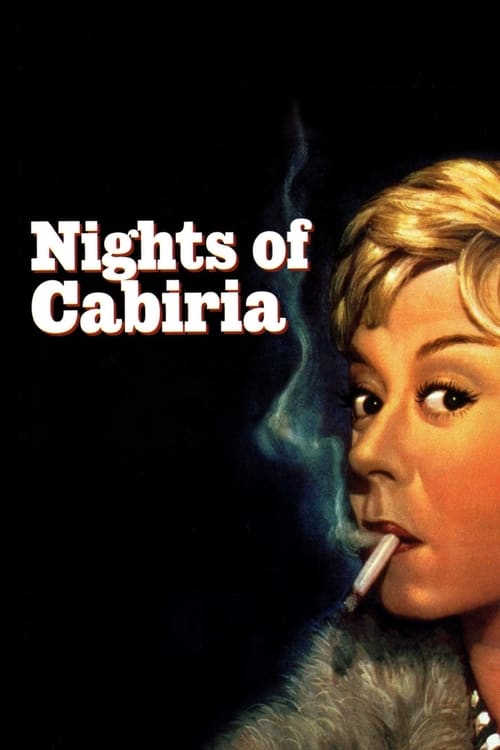
Nights of Cabiria
1957 · Federico Fellini
When you want to feel something all the way through — a good cry that somehow leaves you more hopeful than before. Comfort and heartbreak at once; ideal for a quiet, open-hearted evening.
What it's about
Cabiria is a small, fierce, endlessly hopeful prostitute working the margins of 1950s Rome, robbed and betrayed in the film's opening minutes and undeterred anyway. Across a string of nights — a movie star's villa, a religious pilgrimage, a hypnotist's stage — she keeps hunting for the love and dignity the world seems determined to deny her. It follows one woman's stubborn heart through a city that treats her as disposable.
The experience
It swings between street-level comedy and heartbreak with startling ease — funny, tender, and then suddenly devastating. You spend the film bracing for Cabiria to be hurt and rooting for her not to be, and the final minutes land like almost nothing else in movies.
Performances
Giulietta Masina is the whole reason the film is immortal — a clownish, Chaplinesque physical performance with a raw, wounded soul underneath, and it won her Best Actress at Cannes. Her face in the last shot is one of the most famous images in cinema.
The craft
Fellini structures the film as a chain of nighttime episodes, each one a small fable, shot with a warmth and looseness that lets Rome's streets and shrines feel both real and enchanted. The Nino Rota score threads carnival melancholy through everything.
Why it matters
It won the Oscar for Best Foreign Language Film, marked Fellini's bridge from neorealism toward his dreamlike later style, and was later reborn as the Broadway musical Sweet Charity.
Snapshot
Le notti di Cabiria is a tragicomic portrait of Cabiria, a small, tenacious prostitute navigating the margins of postwar Rome. Across a series of episodes that move from riverbank to movie-star villa to pilgrimage road to a village theater stage, Fellini charts the collision of innocence and exploitation with the precision of a moralist and the tenderness of a fabulist. The film culminates in one of cinema's most cited endings: Cabiria, stripped of her savings, her house, and her hope by a false suitor, rises from a roadside ditch and, surrounded by a carnival procession of young people, turns to face the camera with a tear-streaked smile that refuses extinction. Giulietta Masina's performance won the Best Actress prize at Cannes in 1957, and the film took the Academy Award for Best Foreign Language Film. It served as the source for Bob Fosse's Broadway musical Sweet Charity (1966) and its 1969 film adaptation, carrying Cabiria into American popular culture. The film stands as one of the decisive works in Fellini's transition from neorealist apprentice to the fully realized mythmaker of La dolce vita and 8½.
Industry & production
The character of Cabiria made an early appearance as a minor figure—a young prostitute glimpsed briefly—in Fellini's Il bidone (1955). Struck by the character's potential, Fellini returned to her and constructed an entire film around her life. The project was produced by Dino De Laurentiis, who had backed La strada (1954), and was shot in and around Rome in 1956.
A formative element of the film's development is the involvement of Pier Paolo Pasolini, then a young novelist and Roman dialect poet who had recently arrived from Friuli. Pasolini is credited with dialogue collaboration, specifically for scenes set in the borgata—the working-class peripheral settlements of Rome—where his intimate knowledge of street vernacular gave the exterior sequences their linguistic authenticity. The collaboration was a meeting of opposed sensibilities: Fellini's Catholic-inflected mysticism and Pasolini's Marxist materialism both leave traces in the finished film, most legibly in the tension between Cabiria's spiritual yearning and the social determinism of her circumstances.
Giulietta Masina, Fellini's wife, had already given the performance that made him internationally famous in La strada as the waif Gelsomina. The two roles are companion pieces in his imagination of female endurance, but where Gelsomina is mute suffering, Cabiria is voluble, combative, and streaked with willed self-deception. The production remained relatively close-knit, with non-professional actors drawn from the neighborhoods being filmed populating the street scenes, consistent with the neorealist casting practice Fellini had inherited and was in the process of transforming.
Technology
The film was shot on 35mm in black and white, standard for Italian art productions of the period. Italian cinema of this era relied almost universally on post-synchronization: actors delivered dialogue on location with little concern for ambient sound, and all speech was re-recorded in a studio in post-production. This practice, often criticized by foreign commentators, gave filmmakers unusual freedom in location selection and allowed Fellini to reshape performances in the dubbing room—a latitude entirely consistent with his improvisatory method. Nino Rota's score was composed and recorded after the shoot, integrated with dubbed dialogue and selective ambient sound.
The film's editor, Leo Catozzo, was a longtime Fellini collaborator whose name is associated with a practical contribution to editing technology: the Catozzo splicer, a transparent-tape-based splicing tool that replaced the earlier cement-join method, allowing more fluid and reversible editorial work. The consequence for Fellini was greater flexibility in the cutting room, consistent with his habit of determining final structure after rather than before the shoot.
Technique
Cinematography
The cinematography was handled by Aldo Tonti, working in a mode that mediates between neorealist location naturalism and something more atmospherically charged. Tonti shoots the arterial road on Rome's southern periphery—where Cabiria and her colleagues solicit—with a raw and unglamorous eye: harsh automobile headlights cutting through darkness, faces caught in unflattering sweeps of light. The pilgrimage sequence at the Madonna del Divino Amore shrine is handled with a different quality of attention—a crowd moving in processional waves, candlelight, collective devotion rendered with documentary density. The final road scene achieves a limpid, almost bleached quality that suits its emotional register. The camera approaches Masina in close-up with frequency and confidence; at its core the film is an extended study of one face.
Editing
Catozzo's editing honors Fellini's episodic construction without forcing artificial transitions between the film's distinct movements. The cuts are largely functional rather than rhetorical; the film's formal charge comes from accumulation rather than montage. The notable exception is the variety-theater hypnotism sequence, where the editing builds a sustained, discomfiting tension—Cabiria on stage, vulnerable in a way she cannot perceive, Oscar's face watching from the darkened audience—through precise control of eyeline matches and the duration of held close-ups.
Mise-en-scène / staging
Fellini's staging is consistently theatrical: he populates the frame with eccentric secondary figures, uses costume and makeup to fix social type rapidly, and moves the camera less than many contemporaries. The scene inside the movie star Alberto Lazzari's villa (played by Amedeo Nazzari) is a set-piece of class juxtaposition—Cabiria, rough and direct, navigating the lush, languid disorder of celebrity wealth. The pilgrimage sequence is a sustained study in collective longing, the crowd's ecstatic prayers thrown into relief by Cabiria's quiet desolation when no transformation comes for her. The hypnotism sequence at the variety theater depends on a clear spatial geometry—audience, stage, performer, dreaming face—that maps precisely the nature of Cabiria's exposure.
Sound
Post-synchronized throughout, as was universal in Italian production. Nino Rota's score is among his most emotionally direct: the main theme for Cabiria is a brief, modal melody—deceptively simple, with a minor-key undertow beneath a music-box surface—that recurs with variations across the film, neither sentimental nor ironic but somehow sustaining both registers simultaneously. The theme became inseparable from the character and is among the most immediately identifiable cues in Rota's extensive catalog.
Performance
Masina's performance is the film's primary text. The comparison most frequently invoked is Charlie Chaplin—her tragicomic physicality, her resilient waif-figure, the combination of pathos and comic deflation are in evident dialogue with the Tramp—but the comparison, though apt as far as it goes, can obscure the specificity of what she does here. Cabiria is not Gelsomina; she is aggressive, loud, easily affronted, and radiates a willed self-confidence that keeps collapsing and reconstituting itself. Her physical comedy—the walk, the gestures, the mimicry of what she imagines middle-class romance looks like—is extremely precise. The defining achievement is the hypnotism sequence, in which Masina makes Cabiria simultaneously ridiculous and devastating without collapsing either mode. The final close-up—tear-streaked, uncertain, then barely smiling, the gaze turned directly at the lens—has been analyzed extensively and resists exhaustive interpretation. It is among the most cited single images in postwar European cinema.
Narrative & dramatic mode
The film is episodic in structure, organized as a picaresque in which the protagonist moves through a series of social encounters, each testing and reconfiguring her image of herself and the world. The governing narrative logic is repetition with variation: Cabiria is stripped of something—money, dignity, hope—recovers, and is stripped again. This rhythm of victimization and recovery is not presented as tragedy in the classical sense—there is no hubris, no inexorable fate—but as the structural condition of existence at the economic and social margin.
The film's dramatic mode is tragicomedy, but Fellini refuses clean generic assignment. Scenes begin in one register and slide into another: the pilgrimage sequence begins as social observation, moves toward collective ritual, and ends in quiet personal desolation. The hypnotism scene is comedy that becomes exposure. The final sequence is catastrophe that resolves into something irreducible and generically unstable. The film also carries a faint allegory of Christian endurance—Cabiria is not redeemed in any orthodox sense, but she continues—filtered through the secularizing pressure of mid-century Italian culture.
Genre & cycle
Nights of Cabiria belongs to a cycle of Italian films of the 1950s that placed working-class women at the center of narratives about postwar moral and economic survival, alongside Bitter Rice (Riso amaro, 1949) and related works in the Italian social melodrama tradition. Its attention to the borgata connects it to an emerging cycle of films and literature about Rome's peripheral communities—a cycle in which Pasolini, as both a contributor here and as the director of Accattone (1961), is a central figure; Accattone can be read in part as a systematic expansion of the social geography Pasolini helped map in these scenes.
The film also belongs to the broader European art cinema cycle of the 1950s—alongside Bergman, Bresson, and the films that would shortly constitute the French New Wave—in which the feature film was being renegotiated as a space for personal auteurist expression rather than genre production.
Authorship & method
Federico Fellini co-wrote the screenplay with his regular collaborators Ennio Flaiano and Tullio Pinelli—Flaiano a sharp satirist of Italian bourgeois life, Pinelli a structural dramatist—with Pasolini contributing the vernacular texture of the street sequences. The combination is characteristic of Fellini's scriptwriting method: a stable structural core shaped by collaborators who bring distinct registers.
The director of photography, Aldo Tonti, had replaced Otello Martelli (who shot La strada and other early Fellini films) on this production. The transition does not mark a dramatic stylistic rupture; Tonti worked within the visual grammar Fellini had established rather than imposing an independent signature.
Nino Rota had begun his collaboration with Fellini on Lo sceicco bianco (1952) and would continue through the 1970s; their partnership is one of the most consequential director-composer relationships in postwar cinema. Rota's ability to give Fellini's films their peculiar tonal ambiguity—melancholy and circus, wistfulness and vulgarity held in simultaneous suspension—was constitutive of the Fellini style rather than supplementary to it.
Fellini's working method is extensively documented. He frequently withheld the full script from actors, working scene by scene; he sometimes had Masina perform to pre-recorded music on set to achieve a specific emotional register; he routinely cast non-professional actors for peripheral and crowd roles. The episodic logic of the finished film reflects a practice of determining final structure in the editing room rather than the script stage.
Movement / national cinema
The film occupies a transitional position in Italian cinema between neorealism and auteurist art cinema. The neorealist inheritance is palpable: location shooting in the actual streets and periphery of Rome, attention to working-class life, social observation, a protagonist at the economic margin. But the film departs from neorealist orthodoxy in its theatricality, its subjective distortion of social reality around the protagonist's consciousness, and its emphasis on spiritual and existential questions that the neorealist program tended to subordinate to the material and historical.
By the time Fellini made La dolce vita (1960) and 8½ (1963), the move from neorealism to something more formally inventive and autobiographically inflected was complete. Nights of Cabiria is one of the legible stations of that journey—still tethered to the social, but already reaching toward the mythological and carnivalesque.
Era / period
Italy in 1957 was in the early phase of the miracolo economico, the rapid industrialization and consumer expansion that would transform Italian society through the late 1950s and 1960s. The film is set in this transitional moment: Cabiria's world is one of pre-boom marginality—her little house on the urban periphery, bought with painstakingly saved earnings, represents aspiration at the threshold of economic transformation—while the movie star's villa and the variety theater speak to the emerging consumer and entertainment culture beginning to redefine what Italian life might look like. The film captures a social landscape in active transition, the borgata already being absorbed into an expanding city.
The pilgrimage to the Madonna del Divino Amore situates the film in a popular religious culture that coexisted uneasily with the secularizing pressures of modernization, a coexistence Fellini would continue to examine across his career.
Themes
Innocence and exploitation. Cabiria's defining quality is a structural inability to abandon the expectation of goodness in others despite repeated betrayal. Fellini declines to pathologize this as naivety; the film treats it as a form of grace, though not one that protects her from harm.
The gap between desire and fulfillment. The pilgrimage sequence is the film's most concentrated expression of this theme: Cabiria prays with genuine intensity, transformation appears to come for others, but she leaves unchanged. Her desire for transcendence—for love, for a different life—finds no answer except in the film's final, unresolved gesture.
The spiritual at the social margin. Fellini here, as across his work, is interested in sacred experience at a remove from institutional religion. The church pilgrimage, the theatrical stage as a space of trance and involuntary revelation, the final road and its carnival of strangers: these are secular-sacred spaces in which something approximating grace is both approached and withheld.
Female resilience and its cost. The film refuses both sentimentality and voyeuristic exploitation in its treatment of Cabiria's profession and victimization. She is neither moralized over nor idealized; her tenacity is presented with admiration and simultaneously as an ongoing wound.
Class and the social margin. Through Pasolini's contribution and Fellini's location choices, the film is grounded in a precise sociology of postwar Rome. The encounter with the movie star is among the film's most exact explorations of class distance: Lazzari is not cruel, only oblivious—which is its own kind of cruelty.
Reception, canon & influence
Critical reception. Shown in competition at Cannes in May 1957, the film earned Giulietta Masina the Best Actress award. It subsequently won the Academy Award for Best Foreign Language Film at the 1958 ceremony. French critical reception was strong, consistent with the esteem in which Italian art cinema was held by the Cahiers du Cinéma generation; Italian reviewers placed it alongside La strada in the first rank of Fellini's achievement. Subsequent critical history has at times subordinated it to the more formally ambitious 8½ and La dolce vita, but it has retained a secure canonical position and its final sequence remains a touchstone in discussions of performance, the close-up, and the limits of genre.
Influences on the film (backward). The most consistently noted antecedent is Charlie Chaplin; both Fellini and Masina acknowledged the influence, and the film's tragicomic tonal method—comedy used to approach suffering indirectly, the resilient figure undone and reconstituted—is in direct dialogue with the Tramp. Italian neorealism is the immediate formal inheritance: the location practice, the casting of non-professionals, the social attention of Roberto Rossellini's Roma città aperta (1945) and Vittorio De Sica and Cesare Zavattini's Bicycle Thieves (1948) and Umberto D. (1952) are the generative texts. The theatrical tradition of the variety stage—a space in which truth is revealed through performance, the music hall as secular confessional—connects the hypnotism sequence to a broader European tradition that includes Bergman's Sawdust and Tinsel (1953). Pasolini's borgata novels, particularly Ragazzi di vita (1955), provided a literary map of the social territory the film inhabits.
Legacy and influence (forward). The most direct and extensively documented influence is Sweet Charity (1966), the Broadway musical with book by Neil Simon, music by Cy Coleman, and lyrics by Dorothy Fields, directed and choreographed by Bob Fosse, which transposes Cabiria to New York as a dance-hall hostess. Fosse's 1969 film adaptation, starring Shirley MacLaine, is a significant point of transmission between Italian art cinema and American popular entertainment; Fosse's characteristic combination of bitter irony and structural sentimentality reads in part as a sustained interpretation of Fellini's tonal method.
The final shot—Masina's direct gaze at the camera, the protagonist's appeal from the screen's edge—has been widely discussed as an influence on the tradition of fourth-wall address in European art cinema. François Truffaut's The 400 Blows (1959), released two years later, closes with a comparably celebrated and structurally similar device; the specific lines of influence between the two endings are debated rather than settled in the critical literature.
Fellini's conception of the female protagonist as a site of spiritual and social meaning—resilient, repeatedly victimized, finally irreducible—became legible in subsequent European art cinema concerned with women at the margin, though the specific transmissions are difficult to establish with precision. The film's standing as a bridge between the neorealist 1950s and the auteurist 1960s remains its most settled historical claim: it distills the themes—spiritual longing, the gap between performance and authentic self, the resilience of ordinary consciousness against an indifferent world—that Fellini would expand and formalize in the decade to come.
A Deleuzian reading
You remember the smile before you remember anything else.
The full Deleuzian reading of Nights of Cabiria →
Reception
A hit from the start — it won Fellini his second consecutive Foreign Language Oscar and Giulietta Masina Best Actress at Cannes — but it spent decades in the shadow of La Strada and 8½ until the 1998 restoration re-release, after which a growing chorus started calling it Fellini's most moving film.
How Nights of Cabiria was received, from release to now →
Influences: the films it descends from and the films it influenced
- City Lights (1931) — Cabiria's tragicomic tonal architecture—comedy as an oblique approach to suffering, the resilient clown-figure undone and reconstituted—derives from the Tramp's structural sentimentality, a debt Fellini and Masina explicitly acknowledged.
- Roma città aperta (1945) — Rossellini's practice of shooting on location in Rome's streets while mixing professional and non-professional performers established the location-naturalism and social-documentary texture that Cabiria inherits as its default cinematographic register.
- Bicycle Thieves (1948) — De Sica and Zavattini's episodic-picaresque structure—a marginal Roman figure moving through the city's social geography in a series of failed transactions, each episode accumulating without resolving—is the direct narrative model for Cabiria's formal architecture.
- Umberto D. (1952) — De Sica's sustained close-up portraiture of a dispossessed Roman figure—the camera holding on a face registering humiliation in real time—and the episodic accumulation of small defeats toward a devastating finale is the immediate cinematographic and editorial model Cabiria refines.
- Sawdust and Tinsel (1953) — Bergman's staging of the circus and variety performance as a space where authentic feeling is publicly exposed and humiliated prefigures Cabiria's hypnotism sequence, in which the theatrical stage becomes a site of involuntary self-revelation before an audience.
- La Strada (1954) — Fellini's immediately preceding film established Masina's tragicomic clown-body performance—mime technique grafted onto neorealist social space—and the picaresque episodic structure that Cabiria directly inherits and sharpens into a more formally disciplined single-protagonist portrait.
- The Flowers of St. Francis (1950) — Centers a naive, radiant innocent whose simplicity reads as grace, the holy-fool protagonist Fellini first developed writing Francis's Juniper.
- The 400 Blows (1959) — Truffaut's closing direct-camera freeze-frame—the protagonist's gaze turning outward to fix the viewer in an irresolvable appeal—is widely debated as formally descended from Cabiria's final shot, which deploys the same device to convert personal devastation into audience implication.
- Accattone (1961) — Pasolini, who co-wrote Cabiria's borgata street sequences to supply vernacular social texture, applied the same location-naturalism and post-synchronization practice to Rome's underworld in his debut feature, sustaining Cabiria's grammar of social attention through non-professional performance.
- 8½ (1963) — 8½ inherits Cabiria's episodic-accumulation editing structure and theatrical framing—staging that positions characters as performers in their own drama—while Nino Rota's leitmotif scoring, developed through Cabiria, becomes the organizing logic of the film's associative architecture.
- Giulietta degli spiriti (1965) — Fellini applies Masina's close-up tragicomic expressivity from Cabiria to color cinematography, with the episodic intrusion of fantasy into domestic realism structurally inheriting Cabiria's repetition-with-variation: each episode returns the protagonist to the same constrained position under new pressure.
- Sweet Charity (1969) — Fosse's film directly transposes Cabiria's episodic structure and tonal oscillation—bitter irony and structural sentimentality held in suspension—into the American musical idiom, with Shirley MacLaine's physicality constituting a sustained performance-reading of Masina's tragicomic method.
- Jeanne Dielman, 23 quai du Commerce, 1080 Bruxelles (1975) — Akerman radicalizes Cabiria's repetition-with-variation structure—episodes returning the female protagonist to the same constrained social position with accumulating variation—stripping it to durational precision and making the episodic-accumulation principle the film's sole formal logic.
- Dancer in the Dark (2000) — Von Trier adopts Cabiria's structural counterpoint—theatrical performance sequences offering interior escape from naturalist social suffering—and applies it to a female protagonist whose irreducible consciousness organizes episodic accumulation toward a devastating finale she cannot avoid.
- La Dolce Vita (1960) — The final pre-La Dolce Vita consolidation of the Fellini–Rota–doppiaggio triumvirate; Giulietta Masina's performance of archetypal spiritual grace amid corruption directly prefigures Ekberg's Sylvia as embodied mythological figure, establishing the template of the female protagonist functioning as an unreachable standard against which the passive male protagonist measures his own vacancy.
- Poor Things (2023) — Fellini's picaresque grammar — a female protagonist moves through a succession of social environments that each promise integration and deliver exploitation, while her irreducible vitality resists narrative defeat — is the structural template for Bella's episodic odyssey that refuses tragic resolution.
- Anora (2024) — Establishes the Cinderella-inversion template Baker explicitly inherits: a sex worker's sincere romantic aspiration is methodically exploited by a man she trusts, ending in devastated persistence rather than rescue or moral resolution — the structural blueprint for Anora's refusal of consolation.
- Vivre Sa Vie (1962) — Builds a dignifying portrait of a streetwalker out of discrete episodic encounters rather than continuous plot, prefiguring the tableau scaffolding.
- There's Still Tomorrow (2023) — Blueprint for the resilient female lead whose face carries abrupt tonal pivots from comedy to devastation, and whose final act reclaims hope through a single expressive gesture toward the camera.
- Rocco and His Brothers (1960) — Visconti's explicitly chapter-divided episodic accumulation of a family chronicle, combining location naturalism in Milan's working-class margins with post-synchronization sound and non-professional supporting performers, represents a parallel Italian art cinema elaboration of the same neorealist inheritance.
- Mouchette (1967) — Bresson's sustained close-up tracking of a female adolescent's resistant consciousness through episodic social humiliation—without redemptive arc, the portrait building through accretion alone—is the most formally rigorous parallel development of the neorealist female-protagonist method.
Similar films
- La Strada (1954) — influence & lineage
- Juliet of the Spirits (1965) — influence & lineage
- 8½ (1963) — influence & lineage
- Bicycle Thieves (1948) — influence & lineage
- Rome, Open City (1945) — influence & lineage
- Accattone (1961) — influence & lineage
- City Lights (1931) — influence & lineage
- Umberto D. (1952) — influence & lineage
All the films related to Nights of Cabiria →