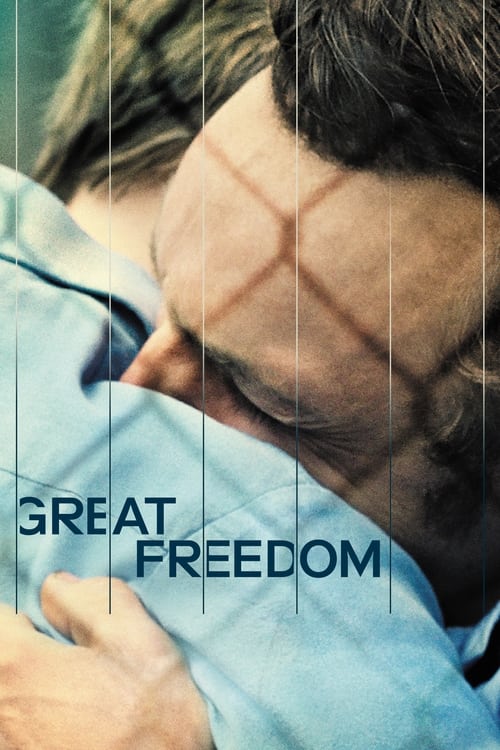
Great Freedom
2021 · Sebastian Meise
For when you want a serious, deeply humane drama and you're ready to be moved slowly rather than swept up — a film to chew on, not to unwind with. Bring your full attention; it pays it back.
What it's about
In post-war West Germany, liberation from the Nazis doesn't extend to Hans Hoffmann: he's jailed again and again under Paragraph 175, the law criminalizing sex between men. The film moves between three of his imprisonments — 1945, 1957, and 1968 — tracing the decades-long bond that forms between Hans and Viktor, a convicted murderer and hardened lifer who starts out despising him. It's a love story told almost entirely inside prison walls, about a man who refuses to let the state define what his life means.
The experience
Spare, patient, and devastating in a hushed way — long silences, small gestures, and tenderness found in the least tender place imaginable. It builds to an ending that lands like a quiet gut-punch and stays with you for days.
Performances
Franz Rogowski gives one of the great screen performances of recent years as Hans — wordless yearning, stubborn dignity, a whole life carried in his posture — and Georg Friedrich is his equal as Viktor, charting a transformation from contempt to devotion with almost no speeches.
The craft
Sebastian Meise braids three time periods into one flowing account, letting haircuts, light, and film texture mark the years instead of title-card hand-holding. Shot largely in cells and corridors, it turns darkness itself into a motif — some of its most intimate moments happen in near-total black, which rewards a dark room and good screen.
Why it matters
Winner of the Un Certain Regard Jury Prize at Cannes 2021 and Austria's Oscar submission, it became a touchstone in the reckoning with Paragraph 175 — the persecution of gay men that continued in Germany long after the war ended.
Snapshot
Great Freedom (Große Freiheit) is an Austrian-German prison drama that follows Hans Hoffmann, a gay man repeatedly incarcerated in West Germany under Paragraph 175, the statute that criminalized male homosexuality. Directed by Sebastian Meise from a screenplay he wrote with his longtime collaborator Thomas Reider, the film braids three periods of imprisonment — 1945, 1957, and 1968 — into a single, non-chronological account of a life spent largely behind bars. Its emotional center is the decades-long bond between Hans (Franz Rogowski) and Viktor (Georg Friedrich), a convicted murderer and career prisoner who begins as a homophobe and becomes, over the years, Hans's closest intimate. The film premiered in the Un Certain Regard section at the 2021 Cannes Film Festival, where it won the section's Jury Prize, and was subsequently selected as Austria's entry for the Academy Award for Best International Feature Film. It is at once a love story, a study of institutional cruelty, and an argument about the continuity of state persecution across the supposed rupture of 1945.
Industry & production
Great Freedom is a co-production between Austria and Germany, produced by the Vienna company FreibeuterFilm — which Meise co-founded — together with the German outfit Rohfilm Productions. It belongs to a well-established European art-cinema financing model, drawing on national and regional film funds, public broadcasters, and pan-European support structures rather than commercial studio money; this is the funding ecology that underwrites most Austrian auteur cinema. The picture arrived after a long development period following Meise's 2011 debut feature Stilleben (Still Life), and the historical subject required substantial research into the postwar administration of Paragraph 175 and the lived experience of men convicted under it.
Commercially, the film performed as a festival-driven art-house title rather than a wide release: it circulated through the international festival circuit and specialty distributors after Cannes, earning strong reviews and prizes rather than significant box office. I do not have reliable specific gross figures and will not invent them. Its most consequential industrial outcome was awards recognition — the Cannes prize, a slate of Austrian and European nominations and wins, and the Oscar submission — which is the currency in which films of this scale trade. It advanced to the shortlist stage of the Best International Feature race for the 94th Academy Awards but was not among the final five nominees.
Technology
The film is technically modest in its means and deliberately so. Much of it unfolds in cramped cells, corridors, and — crucially — in the near-total darkness of solitary confinement, so the production's central technical problem was rendering very low light legibly and expressively. The cinematography exploits deep shadow, hard single-source key lighting, and the glow of small practical sources (cell bulbs, matches, a cigarette's ember) as narrative instruments. Whether the film was originated on celluloid or a digital sensor I cannot confirm from memory, so I will not assert a capture format; what is unmistakable on screen is a controlled, grain-friendly, low-key image that treats darkness as a subject rather than a limitation. The period reconstruction — three eras spanning a quarter century — is achieved less through spectacle than through the disciplined dressing of a confined set and careful attention to changing textures of uniform, grooming, and institutional wear.
Technique
Cinematography
The photography is by Crystel Fournier, a French cinematographer best known internationally for her collaborations with Céline Sciamma (Water Lilies, Tomboy, Girlhood). Her work here is austere and sculptural. The prison is shot largely in enclosed, symmetrical, or boxed-in frames that press the men against walls and bars; the palette is desaturated, dominated by grays, prison browns, and the sickly institutional greens and blues of fluorescent and incandescent light. The film's most discussed visual strategy is its embrace of darkness: the solitary-confinement passages plunge into black, so that touch, sound, and the flare of a single flame become the only means of contact and orientation. This is not merely atmospheric; it converts the punitive dark cell into the film's most intimate space, a place where surveillance fails and tenderness becomes possible.
Editing
The editing, by Joana Scrinzi, carries the film's boldest formal decision. Rather than tell Hans's story chronologically, the film cross-cuts among 1945, 1957, and 1968, withholding at first the logic that connects the strands. Because Hans is imprisoned in the same institution across all three periods — often in near-identical cells and clothing, with Rogowski's appearance only subtly aged — the cuts between eras can be momentarily disorienting, and the film uses that disorientation deliberately. The structure enacts its theme: time collapses into a single recurring condition of confinement, so that decades of a man's life read as one continuous sentence. The reveal of how the timelines interlock — particularly the meaning of the 1945 material — functions as the film's key structural turn.
Mise-en-scène / staging
Meise's staging is spare and rigorous, in keeping with the Austrian art-cinema temper. The mise-en-scène is organized around confinement: doorways, bars, bunks, and the geometry of cells structure nearly every composition, and bodies are repeatedly framed by thresholds. Blocking emphasizes proximity and its denial — how close two men may stand, what a shared cigarette or a passed note permits, how a guard's presence reorganizes a room. The production design accumulates period detail without fetishizing it, so that the institution itself, rather than any single set piece, becomes the film's dominant character. Physical intimacy is staged frankly but without sensationalism; the erotic and the tender are treated as ordinary human facts criminalized by the state.
Sound
The soundscape is dominated by the diegetic acoustics of the prison — clanging metal, echoing corridors, the muffled sounds of bodies in close quarters, the near-silence of the dark cell. The film is very sparing with non-diegetic music, and long stretches play with no score at all, which intensifies the sense of enclosure and makes moments of contact land with unusual force. Silence and darkness operate together as the film's expressive extremes. (I am not certain of the specific composer credited for what limited original music the film uses, and will not attribute it falsely.)
Performance
The film rests on two performances of exceptional physical intelligence. Franz Rogowski plays Hans across roughly twenty-five years with minimal aging makeup, communicating the passage of time through posture, weariness, and a hardening watchfulness rather than cosmetics; his Hans is stubborn, self-possessed, and unwilling to be shamed, a man who refuses to treat his desire as a pathology even as the state insists it is a crime. Rogowski, already an emblem of contemporary German-language cinema through his work with Christian Petzold (Transit, Undine), brings his characteristic quality of contained, slightly opaque interiority. Georg Friedrich, one of Austria's most distinctive character actors, plays Viktor as a gruff, damaged lifer whose slow movement from disgust to devotion supplies the film's emotional arc. The relationship between the two men — often communicated through gesture, proximity, and withheld speech rather than declaration — is the axis on which the film turns.
Narrative & dramatic mode
The dramatic mode is realist and observational, but organized by a modernist, elliptical structure. There is no conventional escalation toward a single climax; instead the film accretes meaning through repetition and variation, returning Hans to the same cells across decades until the pattern itself becomes the tragedy. The three timelines are withheld and then gradually clarified, so that the audience must actively reconstruct the chronology and the causal links — a demand that mirrors the way memory and a life sentence flatten time. The 1945 strand carries a devastating historical charge: Hans is transferred not into freedom at the war's end but from a Nazi camp directly into an Allied-administered prison, because his Paragraph 175 conviction is deemed to carry over — the "liberation" of Germany does not extend to him. The ending, set against the 1969 reform of Paragraph 175, delivers a bitter irony about what "freedom" means for a man institutionalized so long that the outside no longer holds a place for him.
Genre & cycle
Great Freedom sits at the intersection of several genres: the prison film, the historical drama, and queer cinema. As a prison film it draws on a long lineage of incarceration narratives concerned with confinement, solidarity, and the negotiation of power between prisoners and guards, but it inverts the genre's usual escape logic — the drama is not about getting out but about the impossibility of ever truly being out. As queer cinema it belongs to a cycle of twenty-first-century films reckoning with the criminalization and persecution of gay men in the twentieth century, and specifically with the German memory of Paragraph 175, a history that films and documentaries have increasingly foregrounded. Its combination of an art-cinema formal register with an explicitly political-historical subject aligns it with a broader European tendency to treat past state persecution through rigorous, non-sentimental dramatization.
Authorship & method
Sebastian Meise is an Austrian filmmaker whose earlier feature Stilleben also confronted transgressive sexuality and social taboo, and whose method is marked by careful research, formal restraint, and a refusal of easy moralizing. Great Freedom was written with Thomas Reider, his regular writing partner, and the screenplay's central conceit — folding a life into three interlocking imprisonments — is itself the film's principal authorial signature. Meise's approach is broadly consonant with the Austrian art-cinema sensibility: patient, austere, attentive to institutions and the bodies caught inside them, and willing to trust the audience with structural ambiguity.
The key collaborators shape the film decisively. Cinematographer Crystel Fournier supplies the film's language of darkness and enclosure. Editor Joana Scrinzi realizes the tri-temporal structure that is the film's defining formal gamble. Co-writer Thomas Reider shares authorship of the narrative architecture. And the two lead actors, Franz Rogowski and Georg Friedrich, are effectively co-authors of the film's meaning, since so much of it is carried in performance rather than dialogue. Regarding the specific composer of any original music, I do not have a reliable credit and decline to invent one.
Movement / national cinema
The film is a product of contemporary Austrian cinema in dialogue with the German industry. Austrian art film of recent decades — associated with figures such as Michael Haneke, Ulrich Seidl, and Jessica Hausner — is known for formal severity, moral seriousness, and an unflinching interest in social and institutional cruelty, and Great Freedom clearly descends from that temper even as its subject is a specifically German legal history. The casting deepens the transnational character of the work: Rogowski is a leading figure of the German-language auteur scene, Friedrich a fixture of Austrian cinema, and Fournier a French cinematographer formed in another national tradition. The result is a film that is Austrian in production and sensibility, German in historical subject, and European in its financing and circulation.
Era / period
The film is set across the postwar decades of West Germany — 1945, 1957, and 1968 — a span that traces the persistence of Paragraph 175 from the immediate aftermath of the Third Reich through the Adenauer years and up to the eve of the 1969 reform that finally decriminalized homosexual acts between adult men in the Federal Republic. This period framing is the film's core historical intervention. It insists that the young democracy retained, essentially unaltered, a Nazi-era expansion of the anti-homosexuality statute, and that men convicted under it continued to be imprisoned by a state that presented itself as a break from fascism. The 1968–69 setting of the final movement places the story precisely at the threshold of reform, allowing the film to interrogate what liberation actually delivers to those it comes too late to save.
Themes
The film's governing paradox is announced by its title: Great Freedom asks where, and whether, freedom can exist for a man the law forbids to love. Its central themes include the criminalization of desire and the violence of the state's reach into private life; the continuity of persecution across the 1945 divide, which refuses any comfortable narrative of postwar rupture; and the discovery of intimacy in the most unfree of spaces — the recurring irony that the darkest, most punitive corner of the prison, solitary confinement, becomes the one place Hans and Viktor can truly meet. Related motifs run throughout: dignity and the refusal of shame, as Hans declines to treat his sexuality as sickness; institutionalization and the way a life sentence remakes a person until the outside world becomes uninhabitable; and love as endurance rather than romance, built across decades from small, repeated acts of care. The film ultimately reframes freedom not as a legal status conferred from above but as something forged between two people against the grain of the law.
Reception, canon & influence
Great Freedom was warmly received on the festival circuit and by critics, who singled out Rogowski's and Friedrich's performances, Fournier's photography, and the daring of the film's temporal structure and its argument about postwar persecution. Its Un Certain Regard Jury Prize at Cannes 2021 gave it significant international visibility, and its selection as Austria's Oscar submission — advancing to the shortlist stage of the Best International Feature race — confirmed its standing as a major European film of its year. I do not have exhaustive award tallies to cite and will not fabricate them, but the critical consensus positioned it among the more acclaimed art films of 2021.
Looking backward, the film's influences are legible. It stands in the tradition of austere prison cinema — the moral and formal rigor associated with Bresson's A Man Escaped is a plausible touchstone for its confined, disciplined aesthetic — and in the lineage of queer prison imagery that reaches back to Jean Genet's Un Chant d'Amour, whose vision of eroticism and tenderness inside the cell the film clearly echoes. It also draws on the contemporary German-language art cinema exemplified by Rogowski's Petzold collaborations, and on the Austrian school's institutional pessimism. Its historical grounding connects it to the growing body of German cultural work reckoning with Paragraph 175 and the persecution of gay men.
Looking forward, the film's legacy is best understood as part of the ongoing recuperation, in European cinema and public memory, of the Paragraph 175 history and of gay men as victims of both Nazi and postwar state violence. As a recent work its downstream influence is still forming, so any claim about specific films it has shaped would be speculative; what can be said with confidence is that it consolidated Franz Rogowski's international reputation, affirmed Sebastian Meise as a filmmaker of serious ambition, and offered a formally rigorous model for dramatizing the continuity of persecution across the twentieth century's supposed political ruptures.
Reception
Acclaimed straight out of the gate — Jury Prize in Un Certain Regard at Cannes 2021, then Austria's Oscar entry that made the shortlist but missed the final five, a snub cinephiles still grumble about. It hasn't needed reappraisal; it went almost directly from festival darling to modern queer-canon fixture.
How Great Freedom was received, from release to now →
How to watch Great Freedom: what to notice on a first viewing
- Notice the film jumps between three different years. The story cross-cuts among 1945, 1957, and 1968 without announcing which year you're in, often using the same cells and near-identical clothing. You have to actively work out when you are, the way memory itself refuses to stay in order.
- Watch how often bars and doorways box in the frame. Fournier shoots the prison in enclosed, symmetrical, boxed-in compositions that press the men against walls and bars in nearly every scene. The frame itself keeps closing in on them, long before any guard actually does.
- Notice how completely dark the solitary cell scenes go. The palette runs desaturated grays and institutional greens, then the solitary-confinement passages plunge into near-total black, lit only by a match or a cigarette's ember. In the dark, you have to rely on sound as much as sight.
- Listen for how little music this film actually uses. The soundscape leans on clanging metal, echoing corridors, and near-silence, with long stretches playing no score at all. The quiet makes every small moment of real contact land with unusual force.
- Watch Rogowski's posture rather than his face for age. He plays Hans across roughly twenty-five years with almost no aging makeup, carrying the decades instead through posture, weariness, and a hardening watchfulness. Time shows up in how he carries himself, not in anything done to his face.
The whole guide to watching Great Freedom, with the keys for a rewatch →
Influences: the films it descends from and the films it influenced
- A Man Escaped (1956) — Establishes the diegetic-prison-acoustic grammar Meise adopts — screech of keys, scrape of doors, footfalls in stone corridors carrying dramatic weight while the frame stays boxed on cell surfaces and hands.
- Un Chant d'Amour (1950) — Direct source for the film's queer prison eroticism rendered as gestural intimacy across barriers — tenderness passed through cell walls (Genet's smoke shared through a straw prefigures Meise's cigarette and touch exchanges).
- Pickpocket (1959) — Model for performance carried by hands and small physical acts rather than dialogue, and for elliptical modernist cutting that omits connective scenes and trusts the viewer to bridge gaps.
- Querelle (1982) — A West German Genet adaptation that stages homosexual desire inside a sealed, stylized institutional space with saturated low-key lighting, precedent for confinement-as-erotic-theater.
- In a Year with 13 Moons (1978) — Sets the template of the suffering queer body as the film's primary text and the Austro-German art cinema's institutional pessimism about how the state grinds down criminalized desire.
- Victim (1961) — Foundational dramatization of the criminalization-of-desire theme, structuring narrative around a sodomy statute (Britain's parallel to Paragraph 175) that turns love into leverage for blackmail and arrest.
- Fox and His Friends (1975) — Blueprint for reading gay life through class and confinement, with restrained framing that isolates the protagonist within social architecture rather than dramatizing him through melodrama.
- Stilleben (2011) — Meise's own earlier feature that establishes his authorial method — researched confrontation with sexual taboo through formal restraint and refusal of moralizing — carried directly into Great Freedom.
- Passages (2023) — Carries forward Rogowski's post-Great Freedom persona of physically charged queer desire, foregrounding touch, weight, and bodily negotiation over verbal exposition.
- Water Lilies (2007) — Shot by Crystel Fournier, whose naturalist single-source key light and patient attention to bodies in enclosed rooms is the exact photographic method she brings to Great Freedom (the film's sciamma-collaborator lineage).
- Girlhood (2014) — Fournier's cinematography here perfects the low-key darkness with figures emerging from shadow via a single practical source — the visual signature she transposes to the prison cell.
- Tomboy (2011) — Another Fournier collaboration whose close, unhurried observation of embodied identity and gesture over expository dialogue directly informs Great Freedom's performance-first mode.
- A Prophet (2009) — Contemporary prison-film craft of the institution as a total sensory world and the ellipsis of years within incarceration, sharing the temporal-collapse device that folds a long sentence into fragments.
- Transit (2018) — Rogowski collaboration establishing his method of minimalist, interior-facing performance and temporal dislocation across historical periods that Great Freedom's tri-temporal structure exploits.
- Undine (2020) — Extends the Rogowski/Petzold register of gestural intimacy and held stillness, the restrained embodied-aging vocabulary Meise builds his decades-spanning performance around.
- 120 BPM (2017) — Parallel project of recuperating gay history as political memory, using elliptical structure and collective bodily presence to argue continuity of persecution and resistance across time.
- Blue Jean (2023) — Uses restrained, observational compartmentalised framing (the prison cell) to dramatize criminalised, surveilled desire, a sibling study in containment as form.
- Fireworks (2023) — Dramatizes the literal criminalization of same-sex love under a punitive statute, foregrounding how the state and the ordinary citizen enforce persecution — the same historical-witness impulse.
Similar films
- Fox and His Friends (1975) — influence & lineage
- A Man Escaped (1956) — influence & lineage
- A Hidden Life (2019) — shared sensibility
- Fatherland (2026) — shared sensibility
- The Fifth Seal (1976) — shared sensibility
- The Zone of Interest (2023) — shared sensibility
- It Was Just an Accident (2025) — shared sensibility
- The Lives of Others (2006) — shared sensibility