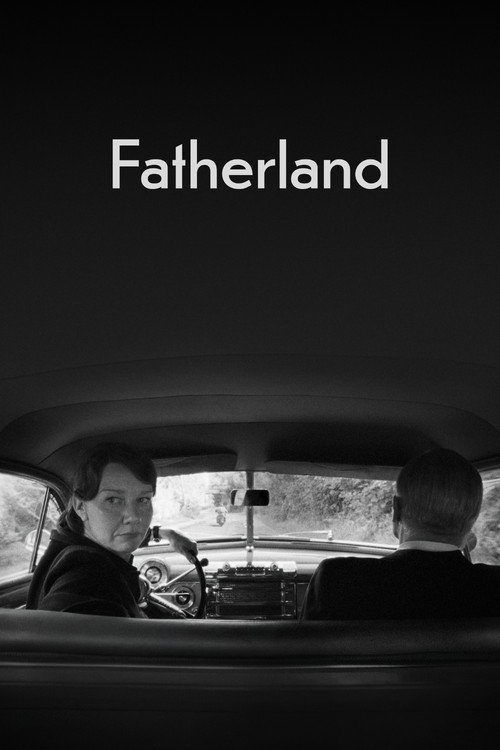
Fatherland
2026 · Paweł Pawlikowski
For a contemplative evening when you want something short, serious, and beautiful — a film to sit with rather than escape into. Choose it when history, ideas, and a thorny family relationship sound more inviting than plot.
What it's about
In the summer of 1949, Thomas Mann returns to a Germany he hasn't seen in sixteen years of exile, traveling by road from American-run Frankfurt to Soviet-run Weimar with his daughter Erika. Both halves of the splitting country want to give him a Goethe prize — it's the Goethe bicentenary, and each emerging state is competing to claim the national culture he embodies. The trip becomes a reckoning: with a homeland in ruins, with the people who stayed, and with a prickly father-daughter bond tested at close quarters.
The experience
Spare, quiet, and charged — the drama lives in glances, pauses, and barbed conversation rather than big scenes. At 82 minutes it moves like a long exhale, melancholy but laced with dry wit, and it leaves you turning over questions about guilt, belonging, and what a writer owes his country.
Performances
Sandra Hüller brings sharp, restless energy to Erika Mann opposite Hanns Zischler's guarded, formal Thomas — the friction between her bluntness and his reserve carries the film.
The craft
Pawlikowski shoots in his signature luminous black and white, composing ruined cities and open roads with a stillness that makes every frame feel considered. The script, written with Hendrik Handloegten, folds a whole Cold War moment into a two-hander on wheels, and the imagery genuinely rewards a big, dark screen.
Why it matters
It premiered in Competition at Cannes 2026 and is widely seen as the closing panel of Pawlikowski's loose historical trilogy about Europe's twentieth century, cementing his standing as a master of compressed period filmmaking.
Snapshot
Fatherland is an 82-minute black-and-white chamber drama. It follows Thomas Mann (Hanns Zischler), the Nobel laureate who has spent sixteen years in exile, and his daughter Erika (Sandra Hüller) through Germany in the summer of 1949, as the country is being split in two. Mann returns from American exile to receive honors in Frankfurt and in Weimar — one from each of the emerging German states, in the bicentenary year of Goethe's birth, when both halves of the country were competing to claim the national heritage that Mann stands for. Pawlikowski wrote the script with Hendrik Handloegten, and critics received the film as the completion of a loose trilogy about Europe after the Second World War, following Ida (2013) and Cold War (2018); Donald Clarke in the Irish Times called the trilogy remarkable. The film premiered in Competition at the 79th Cannes Film Festival on May 14, 2026, where Pawlikowski won Best Director, in a tie with the directors of La bola negra. It was his second Cannes directing prize, after Cold War.
The film rests on one central historical liberty. In 1949 Mann made this journey with his wife, Katia, not with Erika. Pawlikowski made the substitution deliberately — he has said Erika was simply the more dramatically interesting companion — and added other invented presences to the journey, including Wagner's grandsons. Critics noted the change and largely treated it as a productive one, turning a documented episode of postwar cultural politics into a family drama about grief, duty, and public life.
Industry & production
Fatherland is a four-country co-production between Poland, Germany, Italy, and France. Principal photography took 38 days, finishing in mid-December 2025. Although the film is set in Germany, it was shot mostly in Poland — in Legnica, Bielsko-Biała, Wałbrzych, Warsaw, and Wrocław — with brief filming in Weimar itself. Several of those Lower Silesian locations were German territory until 1945, so the production's "Germany" is partly a landscape that changed nations in the same postwar settlement the film depicts. The budget was about €10 million.
After the Cannes premiere, the film opened in Poland on June 19, 2026 (Kino Świat), in Germany on September 3 (Neue Visionen), and in Italy on October 16, with a limited American release on October 23, an Australian release on November 12, and a French release (Pathé) on December 2. Mubi handles distribution across a wide set of territories, including Italy, North America, Latin America, the United Kingdom and Ireland, Spain, Turkey, Australia, and India. Worldwide grosses stood at $5.5 million in the months after release — a modest figure against the budget, though not an unusual one for a black-and-white European art film still rolling out territory by territory.
Technology
Like Ida and Cold War, Fatherland is in black and white and the near-square Academy ratio (1.37:1). Neither is a nostalgic novelty here; both belong to the director's established visual system. Nicolas Rapold in Sight and Sound described Łukasz Żal's monochrome as subtly textured, avoiding the sharp digital clarity that makes some period filmmaking look too clean. Clarke wrote of the light as if chiseled. The film continues the trilogy's position against high-definition literalism, aiming instead for the tonal density of 1940s photography.
Technique
Cinematography
Żal, who shared the cinematography on Ida and shot Cold War (both Oscar-nominated), shapes the film around the dim interiors of hotels, reception halls, and official cars — spaces Rapold read as the sealed bubble of the Manns' exile, moving through a ruined country without quite touching it. Steve Pond in TheWrap described the signature trilogy framing intact: characters placed in the lower half of the Academy frame with space hanging overhead, an effect he found grand in some settings and oppressive in gray, Soviet-decorated Weimar. Rapold drew out a structural contrast between the stolid elegance of the West German hotels and the intimidating emptiness of the East German spaces; the second half of the journey mirrors and inverts the first, so that the film's political critique arrives through adjacency rather than commentary. David Mouriquand of Euronews found a haunted beauty in the meticulously composed frames and claustrophobic long takes. Pawlikowski has said his touchstone for composition is a good, strong still photograph, and he described designing even the interior of Mann's Buick around that instinct, likening it to a rounded space capsule.
Editing
Pawlikowski edited the film himself with Piotr Wójcik. As in his earlier features, the cutting is elliptical: scenes end early, transitions skip connective material, and the story of several days is compressed into 82 minutes. Clarke observed that a great deal is crammed into a short film in which, on the surface, not much happens, and praised its economy; Peter Bradshaw in The Guardian called it an impossibly elegant, poised historical vignette whose brevity and control can hardly contain its characters' pain. The compression also drew the reviews' main reservations. Luke Hicks of The Film Stage warned that the density of Mann-family and philosophical reference may lose general viewers as early as the first Frankfurt press conference, and Stephen Dalton of The Film Verdict found the screenplay sometimes too sparse. Pawlikowski is unrepentant: he has spoken of wanting every scene to carry weight rather than explain, of the thrill of going against the grain with an 82-minute film — and of a contract that technically required at least 90.
Mise-en-scène / staging
The film is built as a series of ceremonies: press conferences, receptions, and official honors in which Mann is placed, photographed, and claimed — first by the Western establishment in Frankfurt, then in the East, where Johannes R. Becher (Devid Striesow), the future East German culture minister, waits to enlist him. Erika sees the game plainly; her observation that both sides need her father as an ornament became one of the film's most quoted lines. Against these public set pieces the film places sudden private ruptures, most memorably Erika's confrontation with Gustaf Gründgens, the actor who flourished under the Nazis — a scene Clarke singled out for Hüller's cold fury. The invented presence of Wagner's grandsons extends the theme of culture under new management. Production design by Marcel Sławiński and Katarzyna Sobańska and costumes by Aleksandra Staszko keep the period detail sparse and functional.
Sound
The score is credited to Marcin Masecki, but the soundtrack is built largely from chosen source music, in line with Pawlikowski's habit. Rapold noted the carefully handpicked music, including soldiers singing in chorus; Pond mapped the same idea geographically, a big band in the West set against children's choirs and military choruses in the East, so that the incoming order is characterized by what it sings. Joanna Kulig, the star of Cold War, appears in a singing cameo, connecting the two films through musical performance, as the trilogy has repeatedly used music to express what its characters cannot say.
Performance
Critics singled out both leads, with Hüller as the headline. Pond called her quietly dazzling, grief and political disgust breaking through a composed surface; Alex Denney in AnOther Magazine and David Jenkins in Little White Lies both wondered aloud whether she is the best actor working anywhere right now. Pawlikowski's own account matches the performance's register: she doesn't emote or signal, he has said, but has an extra gear in which things simply happen. Zischler's Mann is a portrait of reserve as both defense and moral limitation; Clarke credited him with conveying the writer's stony integrity, and Jenkins found both leads superb. The casting carries its own history: Zischler was a key actor of the New German Cinema, above all in Wim Wenders's Kings of the Road (1976), a road film along the inner-German border, so his presence connects Fatherland to an earlier cinema about divided Germany. August Diehl plays Klaus Mann, Erika's brother; Dalton's reservation was that the film keeps him a shadowy specter at its edges. The cast also includes Joachim Meyerhoff, Anna Madeley as the journalist Betty Knox, and David Menkin.
Narrative & dramatic mode
The film takes the form of a road movie made of formal stops: a journey of about five days, running from Frankfurt in the West to Weimar in the East, in which an exiled writer is honored by two systems that each want him as proof of legitimacy. Pawlikowski has been emphatic that it is not a biopic — he has said he has no interest in the form — but a road movie in the manner of Ida, abstracted down to a handful of characters and a single charged moment. Pond described the result as a chamber piece, a snapshot of a few days in which people grapple with personal loss and with artistic and political divides at once. Clarke located the key theme in our uncertain understanding of what home means. The film's main fictional change — Erika in place of Katia — turns the public itinerary into a study of a father's emotional reticence seen through a daughter who is both his manager and his conscience. Pawlikowski was given Colm Tóibín's novel The Magician (2021), a fictional life of Mann that includes the 1949 return, but declined to adapt it, preferring to imagine the historical journey directly; he has described the bond between Mann, Erika, and Klaus as a symbiotic triangle of loyalty and resentment.
Genre & cycle
Fatherland sits where several forms meet: the European historical art film, the literary film-about-a-writer, the road movie, and the postwar "rubble" film. It has an obvious affinity with the Trümmerfilme of 1946–49, such as Wolfgang Staudte's The Murderers Are Among Us (1946) and Roberto Rossellini's Germany, Year Zero (1948), and with outsiders' views of occupied Germany such as Billy Wilder's A Foreign Affair (1948). It belongs to a recent cycle of European films about mid-century political memory in which Hüller herself has been central, notably Jonathan Glazer's The Zone of Interest (2023), also shot by Żal. And it joins the small group of screen treatments of Thomas Mann and his family, alongside Heinrich Breloer's docudrama The Manns (2001) and the many adaptations of Mann's fiction, from Visconti's Death in Venice (1971) onward.
Authorship & method
Paweł Pawlikowski (b. 1957, Warsaw) left Poland as a teenager and built his career in Britain. He first made documentaries for the BBC, among them road and travel essays such as From Moscow to Pietushki (1990) and Tripping with Zhirinovsky (1995), then British features: Last Resort (2000), My Summer of Love (2004), and The Woman in the Fifth (2011). He returned to Poland for Ida, which won the Academy Award for Best Foreign Language Film, and then made Cold War. His method is by now recognizable — monochrome, near-square framing, extreme concision, strong ellipsis, chosen music, stories drawn from Central European history — and he edits his own films. His own account of Fatherland fits the pattern: he has said that feeling lost in the present is precisely why he made a period film, and that he came to Mann's prose reluctantly, finding it dry at first and only later valuing its precision in describing the world.
Hendrik Handloegten, co-writer, is a German screenwriter-director best known as a co-creator of Babylon Berlin, a background that gives the script its detailed grasp of German twentieth-century politics and culture. Łukasz Żal is among the most celebrated cinematographers in Europe. Marcin Masecki is a Polish pianist and composer from the jazz and contemporary scene, suited to Pawlikowski's preference for diegetic music. Piotr Wójcik co-edited with the director.
Movement / national cinema
The film is a Polish–German–Italian–French co-production, made by a Polish director about German history and largely shot in formerly German Silesia. It exemplifies pan-European co-production cinema, with Mubi's multi-territory distribution marking how far curated streaming platforms now reach into European auteur film. It also stands within the Polish art-cinema revival that Ida brought to international attention, and it can be read as an outsider's addition to German Vergangenheitsbewältigung cinema — the cinema of coming to terms with the past — seen from the east. Like Cold War, it is about a Europe dividing into blocs, but this time from inside the German question.
Era / period
Fatherland is set in the summer of 1949, the founding year of both German states, and the Goethe bicentenary, when Frankfurt (Goethe's birthplace) and Weimar (his later home) competed to honor him and to claim Mann, his most prominent modern heir. Historically, Mann's two appearances drew attacks from both sides: in the West he was criticized for leaving in 1933 and for his wartime broadcasts, while American anti-communists attacked his visit to the Soviet zone. The film compresses these pressures into its few days. Released amid live European debates over memory politics and the return of bloc thinking, it struck several critics as pointed: Enina Rothe found the 1949 setting disturbingly contemporary, and a World Socialist Web Site essay read the film as a warning against nationalist narratives. The film itself never gestures at the present directly.
Themes
- Exile and return: what it means to come back to a "fatherland" that persecuted you and that you condemned from abroad. Clarke identified the film's key theme as our uncertain understanding of what home means; the title ties the nation to paternal authority.
- The political use of culture: Goethe and Mann are claimed by competing ideologies, and Jenkins argued the film is really about artists co-opted as puppets and mouthpieces by politically noxious regimes. The Wagner grandsons extend the point.
- Fathers and children: Mann's reticence toward his children, and Erika's double role as devoted manager and suffering daughter — the symbiotic triangle of loyalty and resentment Pawlikowski has described. Hicks's summary was blunt: everyone in the film is hurting.
- Complicity and continuity: the confrontation with Gründgens, the actor who prospered under Nazism, insists that what followed 1945 was not a clean break.
- Grief and decorum: whether private feeling can survive inside public ceremony — the tension Pond saw in Hüller's performance, grief and disgust pressing against a composed surface.
Reception, canon & influence
Critical reception. Fatherland was among the most acclaimed titles of the Cannes 2026 Competition and holds 97% on Rotten Tomatoes, with a critics' consensus praising its father-daughter dynamic and the intelligence and refinement of Pawlikowski's continuing engagement with post-WWII Europe. Clarke gave it five stars; Bradshaw admired its elegance and control; Dalton called it a visually exquisite, minimalist masterpiece and a poem of a film about national identity and private and public tragedy; Hicks found Pawlikowski in immaculate form; Denney called it a moving family drama and a timely inquisition into the uneasy relationship between art and politics. The reservations were mild and mostly comparative: Pond judged it less revelatory and wrenching than Ida and smaller than Cold War, Hicks flagged its demands on viewers who do not know the Mann story, and Dalton wished the screenplay were less sparse.
Backward influences. Pawlikowski's own Ida and Cold War are the clearest models — he has himself cited Ida as the template for the road-movie structure, and Kulig's cameo makes the kinship explicit. The film's world draws on the rubble films of 1946–49 and on Rossellini's Germany, Year Zero; its road structure recalls both Pawlikowski's documentary travelogues and Wenders's Kings of the Road, the latter reinforced by Zischler's casting. The story of an elderly laureate traveling to collect an honor in the company of a grown child, and being measured as a parent along the way, has a structural likeness to Bergman's Wild Strawberries (1957) — an affinity, not a documented source, since Pawlikowski has named no filmmakers as influences for this film. On the literary side, Tóibín's The Magician was the offered source he declined, choosing to dramatize the historical episode directly; Breloer's The Manns remains the most substantial earlier screen treatment of the family.
Forward legacy. Months into release, the film's influence is still ahead of it. What can be said is that it completes the Pawlikowski–Żal monochrome trilogy, which already shapes how European historical art films are photographed and paced, and that its 82 minutes — made, by the director's cheerful admission, against the grain and under a contract that asked for more — have become a fixture in the critical argument against the swelling runtimes of prestige cinema. Its awards-season run and its afterlife with audiences will settle its place in the canon.
A Deleuzian reading
Start inside the car.
The full Deleuzian reading of Fatherland →
Reception
Premiered in competition at Cannes on May 14, 2026, where Pawlikowski took a shared Best Director prize, and the notices have stayed near unanimous: 97 percent on Rotten Tomatoes. It has been rolling out country by country since a June opening in Poland, taking around $5.5 million on a 10 million euro budget ahead of its October 23 US limited release.
How Fatherland was received, from release to now →
How to watch Fatherland: what to notice on a first viewing
- Watch how much empty air sits above every head. Żal shoots in near-square black and white and keeps the figures in the lower half of the frame, with space hanging over them. In the Frankfurt hotels that space reads as grand; in gray, Soviet-decorated Weimar it presses down. The frame measures the people against the rooms that want to claim them.
- Watch who places Mann at each press conference and reception. The film is built as a series of ceremonies. Officials stand Mann in front of cameras, hand him honors and seat him beside the right people, first in Frankfurt and then in Weimar, where Becher (Striesow) waits to enlist him. Mann is the object of each scene's action rather than its author; both sides arrange him as proof.
- Listen for who is singing in each city. Pawlikowski builds the track from chosen source music rather than a written score. A big band plays in the Western scenes. In the East you hear children's choirs and soldiers singing in chorus. Each new order announces itself by what it sings, before anyone states a position.
- Watch Hüller's face while Erika stays polite. Hüller does not emote or signal. Erika keeps a composed surface through receptions and press conferences, and grief and political disgust break through it in small movements. Pawlikowski says she has an extra gear where things simply happen. The feeling the film will not speak aloud shows up on her face in tiny shifts.
- Notice how early each scene ends. Pawlikowski cut the film himself with Wójcik. Scenes stop before they resolve, transitions skip the connecting material, and about five days fit into 82 minutes, under a contract that asked for ninety. The film refuses to explain what the cut left out, so you supply the links yourself.
The whole guide to watching Fatherland, with the keys for a rewatch →
Influences: the films it descends from and the films it influenced
- Ida (2013) — It established the trilogy's grammar: 1.37:1 digital monochrome (Żal with Ryszard Lenczewski), static frames that put the figures at the very bottom of the image under a large field of empty headroom, and a closing Bach chorale ("Ich ruf zu dir, Herr Jesu Christ") that Fatherland's organ finale picks up again.
- Cold War (2018) — Its fade-to-black ellipses jump years and countries between scenes, and its music is almost all diegetic, performed on screen. Fatherland's elliptical compression and source-music design come directly from it, and Joanna Kulig's cameo makes the link explicit.
- Germany, Year Zero (1948) — Rossellini shot on location in the real ruins of Berlin and let the rubble carry the moral argument, without exposition. This is the source for how Fatherland treats a devastated Germany as a landscape to move through rather than a backdrop.
- The Murderers Are Among Us (1946) — This founding DEFA Trümmerfilm uses expressionist low-key monochrome over actual bomb sites to frame questions of German guilt. It is the genre template behind Fatherland's Trümmerfilm affinity.
- Kings of the Road (1976) — A black-and-white road movie built from formal stops at small-town cinemas along the inner-German border, shot by Robby Müller. Fatherland's structure as a road movie of formal stops follows it, and casting Hanns Zischler, who co-starred, makes the inheritance visible.
- Alice in the Cities (1974) — Robby Müller's Academy-ratio 16mm monochrome follows a mismatched adult–child pair through transit spaces. It is the New German Cinema precedent for the near-square, grainy look of a journey film about family obligation.
- Wild Strawberries (1957) — An elderly laureate drives to receive an honor with a grown child, and each stop on the way forces a reckoning with his failures as a parent. No citation is documented, so this is a structural affinity rather than a confirmed source, but Fatherland's itinerary follows the same armature.
- From Moscow to Pietushki (1990) — Pawlikowski's BBC documentary travelogue turns a train route into a sequence of encounters at stations and stops. It is the documentary origin of the episodic, vignette-by-stop logic of Fatherland's journey through contested territory.
- Heimat (1984) — Gernot Roll's mainly black-and-white photography of German twentieth-century history is told through domestic vignettes rather than great-man biography. This is the West German model for Fatherland's choice of historical vignette over biopic.
- Germany Pale Mother (1980) — A mother and daughter walk across a ruined Germany in a stark episodic trek, a road film made of Trümmer landscapes from the New German Cinema generation of Vergangenheitsbewältigung. It is an early example of the post-catastrophe journey that Fatherland revisits from an Eastern European vantage.
- Last Resort (2000) — Pawlikowski's first feature carries over his documentary method: scenes are improvised, then pared down, and he edits them himself, cutting so hard that the narrative glue is left out. That editing practice later hardened into Fatherland's 82-minute compression.
- Nebraska (2013) — A monochrome road trip in which an adult son drives his ageing father to collect a 'prize', with each stop on the way bringing family failures to the surface. It is a close structural sibling to the laureate-and-child itinerary, done in American deadpan.
- The White Ribbon (2009) — Christian Berger shot in color and graded to a severe, textured monochrome, staging German village life as rigid ceremonial tableaux of church, school and manor. It is the closest pan-European precedent for Fatherland's digital monochrome that deliberately avoids an HD look, and for its ritualised group compositions.
- The Zone of Interest (2023) — Łukasz Żal and Sandra Hüller again: the camera keeps a detached, observational distance from a German domestic household that is complicit in history. Fatherland's handling of Hüller and its coolly withheld point of view draw on the same partnership.
- Phoenix (2014) — Set in postwar rubble Germany, it builds to a single diegetic performance ('Speak Low') that resolves the drama without dialogue. Fatherland reaches the same kind of music-as-verdict climax with its Bach organ finale.
- Transit (2018) — An exile narrative of German émigrés, shaped as a string of bureaucratic way-stations and consulate stops. It shares Fatherland's interest in the geography of German exile and its stop-by-stop dramaturgy, which suits the Mann family's émigré history.
Similar films
- Cold War (2018) — influence & lineage
- Ida (2013) — influence & lineage
- Nebraska (2013) — influence & lineage
- The White Ribbon (2009) — influence & lineage
- Sound of Falling (2025) — shared sensibility
- Rose (2026) — shared sensibility
- All That's Left of You (2025) — shared sensibility
- Foreign Land (1996) — shared sensibility