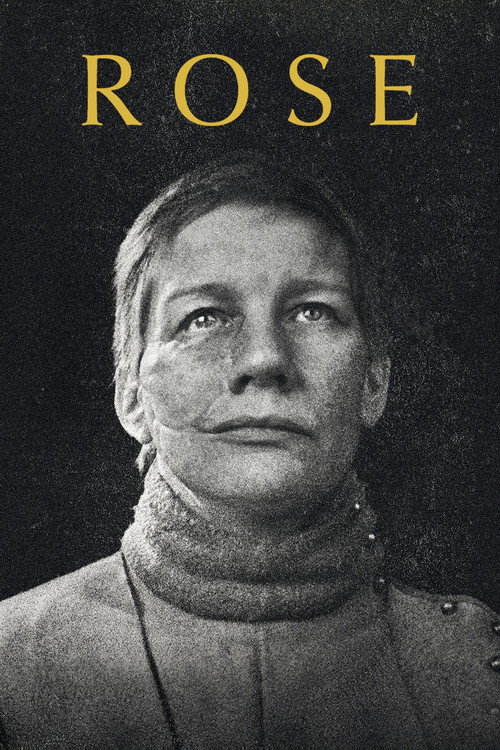
Rose
2026 · Markus Schleinzer
For when you want a serious, absorbing period drama that rewards patience — a film to sit with and chew on, not comfort viewing. Reach for it when you're drawn to stories of hidden identity and quiet defiance.
What it's about
In the chaos of the Thirty Years' War, a soldier walks into an isolated Protestant village in Germany and claims an abandoned farmstead as inheritance, carrying a dead comrade's name. The soldier is Rose, a woman who has survived a decade of war by living as a man, and who now wants the one thing the identity can buy: land, a household, a life. She works hard, earns the village's trust, and marries a farmer's daughter to secure the farm — but in a small, watchful community, trust and suspicion grow side by side.
The experience
Slow-burning and quietly nerve-racking — every neighborly glance carries the weight of a possible unmasking. It's austere and hushed rather than action-driven, the tension of a secret held in a place where nothing stays private for long, with unexpected tenderness at its center.
Performances
Sandra Hüller, one of the most acclaimed European actors of her generation, plays Rose with the kind of controlled, physically exact work the role demands — a performance of posture, silence, and watchfulness. Newcomer Caro Braun holds her own opposite her as Suzanna.
The craft
Shot in stark black and white, which strips the 17th-century setting of costume-drama prettiness and gives the village a hard, elemental look — this one rewards a dark room and a big screen. Markus Schleinzer directs with rigorous restraint, letting faces and routines of farm labor carry the story rather than dialogue.
Why it matters
The third feature from Austrian director Markus Schleinzer, a filmmaker known for severe, exacting dramas, and a major showcase for Sandra Hüller at the height of her international standing.
Snapshot
Rose is the third feature by the Austrian director Markus Schleinzer. It is a German-language Austrian–German co-production, shot in black and white, about a woman living as a man in the wake of the Thirty Years' War. Sandra Hüller plays the title character, a former soldier who arrives in a remote Protestant village and, under a dead comrade's identity, claims an abandoned farmstead. Rose works hard, earns the community's respect, and takes on the full social role of a man of property; a marriage to Suzanna (Caro Braun, in her first major screen role), a farmer's daughter, follows, and complications around marriage and identity grow from there. An off-screen narrator, voiced by Marisa Growaldt, tells the story throughout in an authoritative voice that sits apart from the image. Schleinzer wrote the script with Alexander Brom, his co-writer on Angelo (2018). The film premiered in competition at the 76th Berlin International Film Festival on February 15, 2026, where Hüller won the Silver Bear for Best Leading Performance, twenty years after her first Silver Bear for Requiem (2006). Austria later selected it as its submission for Best International Feature Film at the 2027 Academy Awards. A compact, formally severe chamber piece, it extends Schleinzer's long-running interest in outsiders whom a community absorbs, uses and then judges.
Industry & production
The film was produced by Schubert (Austria) with ROW Pictures and Walker & Worm Film (Germany), a characteristic German-speaking art-house co-production aimed first at a top-tier festival. Principal photography ran from May 7 to December 13, 2024 — a long window that let the shoot follow the seasons and the agricultural year — in the Glasebach Valley in Saxony-Anhalt and in Lower Austria, with German regional funding that included support from Hamburg and Schleswig-Holstein.
After the Berlin premiere, where it competed for the Golden Bear and was a Teddy Award nominee, the film went on a sustained festival run. It won the Firebird Award at Hong Kong in April 2026, screenplay prizes at Istanbul and at the Diagonale in Graz, Best Film Score at the Diagonale, and a Jury Prize at Brussels in September 2026; it also played the Melbourne International Film Festival. Filmladen released it in Austria on April 17, 2026, and Piffl Medien in Germany on April 30, 2026. Mubi took rights for North America, the UK, Latin America, Australia, New Zealand, Italy and Turkey, with a limited US release set for December 11, 2026, timed for awards season. A reported worldwide gross of $681,546 before the US opening is modest but normal for a black-and-white German-language period drama at this stage of its release.
Technology
What matters technically in Rose is the choice of monochrome, and Schleinzer has been explicit about why he made it. He describes black and white as a medium that bundles and concentrates attention, stripping the image down to what he considers the essentials: the story, the staging, the acting, and the audience's own imagination. The visual research behind the film reached back to Dutch Golden Age painting; Schleinzer studied and photographed museum canvases of ordinary citizens, and he has observed how that European visual culture later fed the iconography of the American Western. On screen, the grayscale removes period decoration rather than adding it: mud, timber, linen and skin reduce to graded tones, and critics responded to the result — Time Out's Stephen A Russell admired the crystalline quality of the black-and-white images, while John Bleasdale in Sight and Sound found that Gerald Kerkletz's photography recalls Michael Haneke's The White Ribbon. The war itself is kept off the screen, present only in the narrator's account and in Rose's body and manner, and the film extends that discretion to violence generally, which is held off-screen or obscured.
Technique
Cinematography
Kerkletz has shot all of Schleinzer's features (Michael, Angelo, Rose), and their shared grammar — careful, largely fixed framing, extended takes, little camera movement — is the foundation of the film's style. Wendy Ide in Screen Daily noted how the long takes refuse visual distraction, keeping the eye on behavior rather than incident; Bleasdale described the framing as holding the characters at an implacable distance. That distance is functional: the frontal, patient compositions place figures within architecture and landscape and let the audience watch the village watching Rose. Critics reached for a range of touchstones — Bleasdale for Haneke's Protestant village in The White Ribbon, Grant Watson for Ingmar Bergman, Rory O'Connor at The Film Stage for the monochrome historical worlds of Radu Jude and Aleksei German — and the lighting gives Hüller's scarred face and guarded posture a sculptural presence that several reviewers read as the visual center of the film.
Editing
The editor is Hansjörg Weißbrich, a senior figure in German art cinema and the longtime editor of Hans-Christian Schmid, including Requiem, the film that earned Hüller her first Silver Bear. The cutting serves the long takes: scenes run their full length, edits are spaced out, and the rhythm comes from blocks of time rather than montage. Ben Croll in TheWrap caught the effect precisely, finding the film academically paced yet never slow, unfolding with the same measured deliberation as its protagonist. Martin Kudlac at ScreenAnarchy registered the flat, linear trajectory of the storytelling; Russell, more admiringly, heard the film singing with thoughtful silence and enriching stillness, and likened its deliberate restraint to the Japanese idea of ma associated with Miyazaki.
Mise-en-scène / staging
Olivier Meidinger's production design, with costumes by Doris Bartelt, aims for sparseness rather than reconstruction: farmhouses, fields, a church, the unglamorous textures of peasant life, which Ide singled out as deliberately austere. Kudlac found the whole film carrying a measured, almost fable-like quality, the visual restraint mirroring the carefulness with which Rose manages her identity. Schleinzer stages within the frame, keeping actors at a distance and letting group compositions express communal pressure; the village works as a collective body that observes, gossips, accepts and judges. Equally important is what the staging withholds. Olivia Popp at Purple Hour observed that violence and undressing are kept off-screen or obscured, and Russell called the decision about what not to show the director's wisest one.
Sound
Tara Nome Doyle, a Berlin-based singer-songwriter who comes from her own recordings rather than conventional film scoring, wrote the music, which won Best Film Score at the Diagonale. Russell described the score as built on breathy vocal textures, and Popp heard a whistling soundscape that seems to rise out of the land itself — anachronistic, bodily sounds that keep the past from settling into museum stillness. The defining feature of the soundtrack, though, is Growaldt's narration. It uses quasi-poetic, period-inflected language, in Ide's account, and maintains an ironic storytelling distance that Bleasdale compared to the narrator of Barry Lyndon. Popp noted a telling detail: the narrator shifts between he and she when speaking of Rose, making the instability of the character's social identity audible. Bleasdale registered the one real reservation in the film's reception here, finding the omniscient voice's moralistic tone toward Rose's deception in tension with the character's own quiet struggle.
Performance
Hüller's performance is the film's center and its most praised element. She plays Rose without signaling disguise to the camera: Bleasdale called it a performance of a performance, built from gait and restraint, with the character's scarred face standing as a mark of transformation. O'Connor stressed how heavily the role relies on her gifts as a physical performer, and the Hollywood Reporter found the part so exactly fitted to her flinty manner, conviction and economy of means that no other actor seemed imaginable in it. Popp noted that Hüller refuses over-the-top masculinization; Kudlac observed that the performance extends into patriarchal behavior itself — managing farmhands, negotiating with neighboring farmers — so that the audience, like the villagers, reads Rose entirely through conduct. O'Connor also caught the emotional discipline underneath: when something resembling happiness enters the story, the restraint with which Hüller lets Rose's heart thaw is itself remarkable. The Berlin jury's Silver Bear ratified the consensus. Caro Braun, as Suzanna, was an understated surprise in Watson's account and gives the film its emotional counterweight. The supporting cast includes Godehard Giese as a large-scale farmer, Robert Gwisdek as the bailiff, and Maria Dragus as the farmer's wife; the ensemble carries flashes of sparse, matter-of-fact comedy, most memorably, for Ide, in Rose's bewildered reaction to the prospect of fatherhood.
Narrative & dramatic mode
The film is a historical chamber drama given the shape of a chronicle or told tale by its narrator — closer to a ballad or moral exemplum than to conventional psychological realism. It begins as an impostor story: a soldier returns from the war, claims an identity and a property, and is accepted. Watson read it directly as a gender-flipped version of the Martin Guerre case, though he also found the film chained a little too closely to its inspirations. The drama then becomes one of integration. Rose settles into village life and prospers, and Nicholas Bell at ioncinema traced the turn of the plot to the character's own ambition: the desire to expand the farm leads to an arranged marriage, and Rose becomes the catalyst of her own entanglement. The pacing mirrors the protagonist — measured, deliberate, watchful — and Croll found the film intellectually as gripping as it gets precisely because its questions about identity and tolerance are carried by this slow accumulation of ordinary life.
Genre & cycle
Rose belongs to the European art-house historical drama, specifically the strand that treats the early modern past as a laboratory for current questions of identity, gender and belonging. Its close relatives include:
- Impostor or returned-identity narratives: Le Retour de Martin Guerre (Daniel Vigne, 1982) and its American remake Sommersby (1993) — a comparison critics made directly.
- Austere films about Protestant communities and their rigid moral codes: Carl Theodor Dreyer's Day of Wrath (1943) in the longer lineage, and, in German-language cinema, Haneke's The White Ribbon (2009). Schleinzer worked on The White Ribbon as casting director, and reviewers found Kerkletz's monochrome village explicitly reminiscent of it.
- Recent Austrian historical films about people crushed by early modern social order: Veronika Franz and Severin Fiala's The Devil's Bath (2024) is a contemporary parallel.
- Films about historical gender nonconformity: the film's Teddy Award nomination at Berlin placed it within queer festival cinema.
Authorship & method
Markus Schleinzer (born 1971, Vienna) came to directing from a long career as a casting director, notably for Haneke and Jessica Hausner. His debut Michael (2011), which competed at Cannes, is a deliberately flat, procedural portrait of a man holding a boy captive, and it established his signatures: emotional restraint, fixed framing, and a refusal to explain his subjects psychologically. Angelo (2018) moved into history with the story of Angelo Soliman, an African-born man made into an exhibit of the Viennese Enlightenment court. Rose completes a loose trilogy about outsiders whom a society takes in on its own terms, uses, and judges — and reviewers found it warmer, funnier and more accessible than its predecessors without any loss of rigor; Ide saw genuine arthouse-breakout potential in it, a first for this director.
The project began when a historian friend, reading an old crime file, told Schleinzer about a documented case of a woman who had lived as a man in early modern Germany. Rather than dramatize a single biography, Schleinzer and Brom built Rose as a composite of hundreds of researched accounts of women who lived as men. Schleinzer has described research as immersion that can also become a trap, and he says he does not believe in heroes; the title, he notes, evokes his grandmother and a cut flower. He wrote the part for Hüller — studying her entire filmography with what he jokes was a stalker's thoroughness — but never told her the role had been written for her.
Key collaborators:
- Alexander Brom, co-writer, also co-wrote Angelo; the screenplay won prizes at Istanbul and the Diagonale.
- Gerald Kerkletz has shot all three Schleinzer features; their shared fixed-frame grammar is the basis of the director's style.
- Hansjörg Weißbrich, editor, brings a long history in German auteur cinema.
- Tara Nome Doyle, composer, comes from songwriting rather than conventional scoring, which helps explain the soundtrack's modern, vocal textures.
- Sandra Hüller is by 2026 one of Europe's best-known actors (Toni Erdmann, Anatomy of a Fall, The Zone of Interest); her casting gave the film international visibility as well as its performance center.
Movement / national cinema
Rose sits within contemporary Austrian cinema and its tradition of formal severity and moral unease, a lineage often traced through Haneke, Ulrich Seidl and Hausner; Schleinzer worked directly inside that tradition as a casting director before directing. As a co-production with German companies, a German cast and a German setting, it also belongs to the wider German-language festival cinema, and its distance from conventional costume drama — behavior over psychology, observation over incident — links it to the Berlin School generation. Its run of prizes, capped by Austria's Oscar submission, confirms Schleinzer's move from respected niche figure to a leading Austrian director.
Era / period
The film is set in the aftermath of the Thirty Years' War (1618–1648), which devastated the German lands, emptied villages and left farms ownerless — the condition that makes Rose's claim plausible. Military service offered one of the few routes out of fixed gender roles, and the court records Schleinzer's research drew on document many cases of women who served and lived as men. Made in 2024–26, the film belongs to a moment when European art cinema repeatedly returns to the early modern period to examine gender identity, queer existence and communal violence, and its reception split productively on how to read that return: Russell and Bleasdale saw a direct rebuke to present-day policing of gender, while Croll argued that Schleinzer pointedly resists contemporary framing, using the seventeenth century as an austere, alien lens rather than a mirror.
Themes
- Identity as performance and labor: Rose becomes a man by doing a man's work and taking a man's legal and social place; Bleasdale's formulation — a performance of a performance — captures how the film collapses the distinction between an assumed identity and a lived one. Rose's own stated creed, quoted admiringly by several critics, is that life is freer in trousers.
- Property, inheritance and patriarchal law: the land claim drives the plot. For a woman, owning property requires the fiction of manhood, and marriage is the legal mechanism for holding and expanding it; Bell read Rose's ambition for the farm as the engine of the drama.
- Community as witness and judge: the village accepts Rose as long as its categories hold — a pattern of absorption and judgment that runs through all three of Schleinzer's features.
- Love inside a false structure: the marriage to Suzanna begins as a convenience and becomes the film's emotional core, the queer dimension its Teddy nomination recognized without anachronistic labels.
- Freedom against constraint: Bell identified the connective theme as people trying to restore equanimity to their lives by defying cultural constraints — Rose sacrificing pleasure and comfort for control.
- Who writes history: the narrating voice raises the question of who gets to record a life; Bleasdale read the film as a tragedy about history's losers, the people who do not get to tell their own story.
- War and its afterlives: the war stays off-screen but shapes the depopulated landscape and Rose's taciturn, capable manner.
Reception, canon & influence
Critical reception. Reviews were very strong from the Berlin premiere onward. The film holds 97% approval on Rotten Tomatoes from 33 reviews and a Metacritic score of 88 from 13 critics, in the universal-acclaim band. Time Out gave it five stars, ioncinema four of five. The praise converged on Hüller's physically precise performance, Braun's breakthrough, Kerkletz's black-and-white photography, the arch narration and the discipline of what the film declines to show. Dissent was mild and concerned originality rather than quality: Watson felt the film stays too close to its Bergman and Haneke inspirations, Kudlac found the trajectory linear, and Bleasdale questioned the narrator's moralizing tone. Besides the Silver Bear, the film was a Golden Bear and Teddy nominee and won the festival prizes listed above.
Influences on the film.
- The documented court cases of women who lived as men in early modern Germany, synthesized into a composite protagonist — the film's actual source base.
- Dutch Golden Age painting, Schleinzer's stated visual research for the look of ordinary seventeenth-century life.
- The Martin Guerre story and its film versions, for the impostor-heir premise, here gender-flipped.
- Haneke's The White Ribbon as the clearest German-language precedent — a black-and-white Protestant village with a retrospective narrator — a comparison critics drew repeatedly, alongside Bergman, Jude, German and, for the narration, Barry Lyndon.
- Schleinzer's own earlier films, especially Angelo, for the historical treatment of an outsider absorbed by an institution.
Legacy. Rose confirms Hüller's international standing, launches Caro Braun, and establishes Schleinzer as a major Austrian auteur. It joins the current European wave of historical films that use the early modern past to explore gender and belonging, and it carries Austria's hopes at the 2027 Academy Awards, with Mubi's US release of December 11, 2026 positioned squarely in awards season.
Sources: Wikipedia: Rose (2026 film)) · Sight and Sound review · Screen International review · Time Out review · The Film Stage review · MOIN Filmförderung feature · Screen Daily: Austria's Oscar submission
Reception
Rose premiered at the 2026 Berlinale, where Sandra Hüller won the Silver Bear for Best Leading Performance, then opened in Austria and Germany in April and went on to pick up festival prizes in Hong Kong, Istanbul, and Brussels; it sits at 97% on Rotten Tomatoes and 88 on Metacritic, with a limited US release through MUBI set for December 11. Its theatrical take so far stands at $681,546, with the American opening still to come.
How Rose was received, from release to now →
How to watch Rose: what to notice on a first viewing
- Notice how rarely the camera moves. Kerkletz, who has shot all three Schleinzer films, holds fixed frames in long takes. Figures sit frontally inside farmhouse rooms and open fields, kept at a distance, with nothing to pull the eye away from behavior. You watch the village the way the village watches Rose: patiently, from outside, judging by conduct.
- Listen for whether the narrator says he or she. Growaldt's off-screen voice tells the story throughout in quasi-poetic, period-inflected language, at an ironic distance Bleasdale compared to Barry Lyndon. Popp noticed that the pronoun for Rose shifts between he and she. The instability of Rose's social place is audible before anyone on screen doubts it.
- Watch how Hüller walks and stands. Hüller plays Rose without signaling disguise to the camera. Bleasdale called it a performance of a performance, built from gait and restraint, and Popp noted she refuses over-the-top masculinization. Rose manages farmhands and bargains with neighbors as a man would. The villagers read Rose entirely through conduct, and so do you; the body is the whole argument.
- Watch who is looking at Rose in group scenes. Schleinzer stages within the frame and lets group compositions carry the pressure. The village works as a collective body that observes, gossips, accepts and judges, and the frame keeps that body around Rose. Nothing stays private here for long; acceptance and suspicion are the same gaze.
- Listen for the breath and whistling in the score. Tara Nome Doyle, a Berlin singer-songwriter, built the score on breathy vocal textures and a whistling soundscape that Popp heard rising out of the land itself. The sounds are bodily and anachronistic. The modern voices keep the seventeenth century from settling into museum stillness.
The whole guide to watching Rose, with the keys for a rewatch →
Influences: the films it descends from and the films it influenced
- Day of Wrath (1943) — Dreyer's slow, frontal compositions in Protestant interiors, where a woman faces a community that judges her collectively, are the model for Schleinzer's fixed frames and his village as tribunal.
- The Passion of Joan of Arc (1928) — It sets the template of a woman in male dress questioned by an all-male institution, with the staging built around how the tribunal looks at her body and clothing rather than at her inner life.
- Ordet (1955) — Its long, barely cut takes in a Protestant farmhouse set the slow block-by-block pacing that Rose uses in its domestic and agricultural middle section.
- The Return of Martin Guerre (1982) — It is the screen source for the impostor-heir structure: village witnesses and a court decide whose identity is real, and the outcome is about who inherits property. Rose reverses this structure.
- Barry Lyndon (1975) — Its omniscient narrator undercuts the hero and gives away outcomes in advance over static, painterly wide shots. Rose's arch narration uses the same split between voice and image.
- Days of Heaven (1978) — Linda Manz's offhand, partly uncomprehending female narration runs against the tragedy on screen. This is the main precedent for an ironic female voice reporting events from the side.
- Dogville (2003) — A storybook-style chapter structure and a sardonic narrator turn a whole small town into one judging body that first takes in an outsider and then disciplines her.
- The White Ribbon (2009) — Christian Berger shot in color and converted to sharp digital black-and-white, and the story is told by an older narrator looking back on a Protestant village. This is the closest German-language model for Rose's look and narrative frame.
- Michael (2011) — Schleinzer and cinematographer Gerald Kerkletz first set out their fixed-frame, procedural grammar here: daily routines are shown in flat mid-wide shots with no psychological explanation.
- Angelo (2018) — With co-writer Alexander Brom and Kerkletz, Schleinzer moved the same grammar into historical tableaux and stylized period dialogue, telling the story of an outsider a society absorbs and then turns into an object.
- Amour Fou (2014) — Hausner (whose films Schleinzer cast) uses symmetrical, static period tableaux and deadpan delivery to show social codes as stiff choreography. Rose's dry, comic historical register comes from this Austrian deadpan.
- Orlando (1992) — Swinton's knowing looks to camera and the ironic framing of gender as a performance learned over centuries anticipate Rose's view of masculinity as observable behavior.
- Ida (2013) — Its locked-off digital black-and-white frames, which push figures to the edge under heavy headroom, show the kind of severe digital monochrome that Kerkletz's photography draws on.
- Hagazussa (2017) — This Austrian film set in the early modern Alps uses long, slow takes to show a single woman being shunned by a rural community, staging a folk-tale world with severe formal control.
- Corsage (2022) — This Austrian period film undercuts its imperial setting with modern songs on the soundtrack (Camille), the same use of an anachronistic score to question period gender roles that Tara Nome Doyle's music does in Rose.
- The Zone of Interest (2023) — Also starring Hüller, it uses fixed, distant frames that refuse close-ups and an anachronistic, abstract score by Mica Levi. Like Rose, it presents a household governed by property through flat behavioral observation.
- The Devil's Bath (2024) — This Austrian historical film is built on an archival account of an early modern woman. It uses severe, distanced compositions to show how village religious and marital law closes in on her.
- The Girl with the Needle (2024) — It combines high-contrast digital black-and-white with Frederikke Hoffmeier's anachronistic electronic score and an abstract, fairytale-like treatment of a historical woman's bid to survive.
Similar films
- The Girl with the Needle (2024) — influence & lineage · same viewing thread
- The White Ribbon (2009) — influence & lineage
- The Zone of Interest (2023) — influence & lineage
- Dogville (2003) — influence & lineage · same viewing thread
- Ida (2013) — influence & lineage · same viewing thread
- Nosferatu (2024) — often watched together
- Fatherland (2026) — shared sensibility
- A Hidden Life (2019) — shared sensibility
All the films related to Rose →
Watch it with: curated runs of related films
- The World Against Her — A run of women worn down or driven to extremity by a merciless community, marriage, or economy — watch them near each other and the sacrifice, the drift, and the violence start to rhyme.