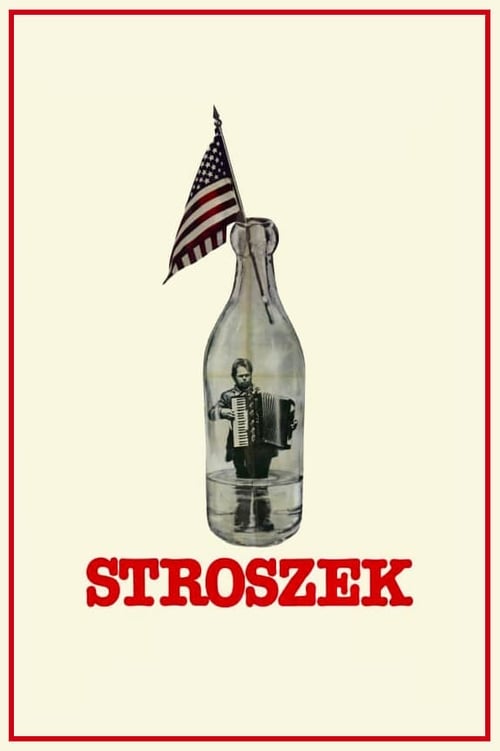
Stroszek
1977 · Werner Herzog
For when you want to feel something real about outsiders and bad luck — melancholy with a crooked smile. Not a pick-me-up, but the kind of sad that's good company.
What it's about
Bruno, a gentle Berlin street musician fresh out of prison and told to stay off the bottle, teams up with Eva, a prostitute trying to escape her violent pimps, and his elderly oddball neighbor Scheitz. Together the three leave Germany for rural Wisconsin, chasing the American Dream with an accordion, a glockenspiel, and no idea what's waiting — which turns out to be a mobile home, a bank loan, and a very different kind of cold.
The experience
Tender, deadpan-funny, and quietly heartbreaking — it drifts like a road movie but keeps landing observations so strange they must be true. The final stretch is one of the most haunting endings ever filmed; you'll be describing it to people for years.
Performances
Bruno S., a street performer with no acting training and a genuinely hard life behind him, gives one of cinema's great non-professional performances — every halting line feels lived rather than written.
The craft
Herzog shot across two continents with a cast of non-actors and eccentrics, letting fiction and documentary blur until you can't tell staged from found. The images of wintry Wisconsin — auction chants, frozen fields, a dancing chicken — have a plainspoken strangeness no set could fake.
Why it matters
A touchstone of the New German Cinema's American pilgrimage and one of Herzog's most beloved films — its ending alone has passed into legend among filmmakers and musicians.
Snapshot
A tragicomic road movie and social elegy, Stroszek follows three misfits—a street musician, a prostitute, and an elderly eccentric—as they flee the miseries of West Berlin for the promised land of rural Wisconsin, only to discover that the American Dream has no room for people like them. Shot across two continents with a cast mixing non-actors and eccentrics, the film operates somewhere between fiction and documentary, between fable and social critique. Its final images—a dancing chicken on a hot plate, a ski lift circling without a passenger, a truck revolving in a mechanical loop—constitute one of cinema's most devastating and inexplicable endings, defying resolution with the persistence of absurdity itself.
Industry & production
Stroszek was produced by Werner Herzog Filmproduktion, Herzog's own company, which gave him the autonomy to pursue projects no studio system would sanction. The film grew directly out of his working relationship with Bruno Schleinstein (known in the credits as Bruno S.), whom Herzog had cast as the title character in The Enigma of Kaspar Hauser (1974). When Herzog learned that Bruno S. was facing renewed difficulties—harassment by the same pimps depicted in the film's Berlin scenes was reportedly a real danger—he resolved to write a vehicle that would draw on Bruno's actual biography and present circumstances. By his own account, Herzog wrote the screenplay in four days. The script is openly tailored to Bruno's life: the street musician background, the history of institutionalization, the accordion and glockenspiel, even some of the supporting figures, are drawn from reality.
The American sequences involved a level of logistical improvisation that is characteristic of Herzog's method. Clemens Scheitz, the actor playing the neighbor who emigrates, had a genuine nephew living in Wisconsin; Herzog essentially used that real family connection as both narrative scaffolding and production infrastructure, filming in and around the nephew's actual property and community. The famous roadside attraction sequence—the dancing chicken, the rabbit playing a piano—was filmed at a real tourist trap in the American South, though the precise location is sometimes listed inconsistently in secondary sources. The production budget was modest by any standard, sustained by West German public television subsidy structures that were central to the New German Cinema's existence.
Technology
The film was shot on 16mm film stock, allowing the small crew the mobility and unobtrusiveness that the observational approach demanded—particularly in the Berlin sequences, where the camera follows Bruno S. through streets, bars, and institutions with the casualness of a documentary unit. The footage was later blown up to 35mm for theatrical exhibition, giving both the Berlin and Wisconsin sections a grain structure that suits the material's refusal of polish. The use of lightweight, handheld-capable equipment meant that staging could respond to environment rather than control it; Herzog has consistently described his fiction films of this period as an extension of documentary practice, and Stroszek's texture makes that claim credible. There is no elaborate color design or studio-controlled lighting in the conventional sense: the film takes its palette from available conditions, from the gray-yellow of Berlin winter streets to the flat, muted daylight of a Wisconsin trailer park.
Technique
Cinematography
The principal cinematographer was Thomas Mauch, who had collaborated with Herzog on several key earlier films including Aguirre, the Wrath of God (1972) and The Enigma of Kaspar Hauser. Mauch's approach is deliberately unshowy—he avoids the kind of compositional grandeur Herzog would deploy elsewhere (most visibly in Fitzcarraldo) in favor of an almost clinical attention to social space. The Berlin frames are cramped and dim, full of the textures of poverty: institutional walls, bar interiors, the reflective surfaces of a winter city that offers no warmth. The Wisconsin frames invert this claustrophobia into a different despair: wide, flat, depressingly open. Strip malls, parking lots, and mobile home developments occupy the center of the frame without irony or beautification. Ed Lachman, who later became one of American cinema's most celebrated cinematographers, contributed camera work on the American sequences—his presence registers in the particular quality of attention paid to American vernacular spaces. The documentary instinct running through both sections means that the camera rarely aestheticizes what it sees; it simply stays and looks.
Editing
Beate Mainka-Jellinghaus, who edited the majority of Herzog's fiction films throughout the 1970s and into the 1980s, cut Stroszek. Her editorial approach is consistent with Herzog's narrative philosophy: scenes are given enough duration to breathe, to become uncomfortable, to outlast easy interpretation. The pacing is episodic rather than propulsive—sequences can feel like they are ending before they do, or continuing past the point where conventional drama would have cut away. This rhythm allows the film's comedy and its sadness to occupy the same register simultaneously, which is essential to how the film works emotionally. The famous final sequence—the chicken, the ski lift, the truck—is edited as a sustained loop rather than a climactic montage, its repetition the point.
Mise-en-scène / staging
The staging throughout is organized around Bruno S.'s physical reality rather than dramatic convention. Herzog does not direct Bruno in any traditional sense; he creates conditions in which Bruno can be himself, and films the result. The bar scenes in Berlin, in which Bruno plays his glockenspiel while the indifferent city moves around him, have the quality of documentation rather than staging. The Wisconsin sequences extend this method into a new setting: the trailer park that Bruno, Eva, and Scheitz move into is itself a kind of character, a space that encodes broken promises—new appliances purchased on credit, modular domesticity without community, the spatial logic of American consumer aspiration stripped of any animating social fabric. Herzog's attention to this environment is unsparing. A TV flickering in an empty room, a bank officer explaining loan terms to people who do not speak English: these scenes are staged with a kind of anthropological patience.
Sound
Stroszek is notable for its use of found or licensed music in place of a commissioned score. Chet Atkins' guitar instrumentals appear at key moments—most memorably over the American road sequences—where their cheerful precision creates an ironic counterpoint to the images of dislocation and failure. Blues harmonica music by Sonny Terry is also used. The music never illustrates emotion in the conventional scoring sense; it runs alongside the action at a slight angle, creating the discrepancy between official narrative (America as opportunity, migration as hope) and experiential reality that is one of the film's organizing tensions. Bruno's own musical performances—his accordion and glockenspiel playing in the streets and bars of Berlin—function as both character revelation and social document: this is what it costs to persist, and this is what the world offers in return.
Performance
Bruno S. is the film's central fact and its most enduring argument. Werner Herzog has been explicit that Bruno S.'s performances are not acting in any conventional sense: Bruno S. had no formal training, and Herzog did not ask him to learn lines or inhabit a character in the Stanislavski tradition. Instead, he placed Bruno in situations—many of them drawn from Bruno's actual life—and filmed his authentic responses. The result is a screen presence of disquieting power. Bruno S.'s face carries a history the camera cannot invent; his musicianship is genuine; his bewilderment at institutional procedures and consumer society is real. Eva Mattes, a trained actress who appeared in several Fassbinder films and had a substantial career in German cinema, plays Eva with a combination of professional craft and open vulnerability; the interplay between her technique and Bruno's non-technique creates its own texture. Clemens Scheitz, who plays the neighbor Scheitz, was himself an outsider figure—a former guard at a Berlin museum—and brings a quality of dignified, batty conviction to the role.
Narrative & dramatic mode
The narrative is structured in three geographical movements: Berlin, the journey, Wisconsin. Each segment has its own tonality. Berlin is grimy, intimate, and occasionally violent—a city that has already chewed Bruno up once and will do so again. The middle passage—the decision to emigrate, the departure—is handled with remarkable swiftness, as though Herzog is unwilling to grant the moment of hope more weight than it deserves. Wisconsin arrives as anticlimax, its bleakness at once comic and devastating. The dramatic mode is tragicomic throughout, but Stroszek resists the comforts of either register: it is too sad to sustain comedy, too absurd to sustain pathos. The plot—such as it is—concerns the progressive stripping away of what little Bruno and Eva have: financial independence, domestic stability, each other. Eva's departure is not melodramatic; it simply happens, as things simply happen to people without resources to prevent them. The robbery that Scheitz initiates—an attempt to steal around thirty dollars from a barber's shop—has the quality of a bad dream about agency: the action is so inadequate to the need that it collapses into farce, and the film cannot recover, which is precisely the point.
Genre & cycle
Stroszek belongs to the road movie tradition while systematically refusing its conventions. The genre had been revitalized in American cinema by Easy Rider (1969) and elaborated through the 1970s as a vehicle for counterculture mobility and existential freedom; Wim Wenders, Herzog's New German Cinema contemporary, was simultaneously exploring it in Kings of the Road (1976). Herzog's version evacuates the genre of its romance. There is no open road as liberation; there is only the flat, unwelcoming expanse of a Midwest that has no use for immigrants without capital. The film also belongs to Herzog's informal cycle of films organized around what he has called "holy fools" or naïve innocents—figures who encounter the world without the protective armor of socialization: The Enigma of Kaspar Hauser, Stroszek, Woyzeck (1979). These films share a structural logic: an undefended consciousness placed within a system that cannot accommodate it, with consequences that are simultaneously absurd and tragic.
Authorship & method
Herzog's authorial method in the 1970s was shaped by a conviction that fiction film and documentary are not essentially different activities—that the camera's relationship to reality is always, at some level, a documentary relationship. Stroszek is perhaps his clearest demonstration of this position. The film does not hide what is real about its materials: the locations are real, the supporting figures are often themselves, and the protagonist is a man playing, to a significant degree, his own life. Herzog's role is curatorial and directorial in the deepest sense: he selects, juxtaposes, and provides conditions for revelation. His collaborators in this period—Mauch behind the camera, Mainka-Jellinghaus in the editing room—were attuned to this philosophy. The film also reflects Herzog's interest in extremity not for its own sake but as a means of seeing clearly: he consistently seeks situations or figures that exist at the edge of what social normality can absorb, because he believes those edges are more truthful than the center.
Movement / national cinema
Stroszek is a product of the New German Cinema (Neues Deutsches Kino), the movement that emerged in the late 1960s following the generational rebellion announced by the Oberhausen Manifesto of 1962, in which a group of young West German filmmakers declared the old cinema dead and claimed the right to a new one. The movement was sustained by a combination of public television subsidy (particularly through ZDF and the Filmförderungsanstalt) and a shared sense of urgency about West German cultural identity in the shadow of National Socialism and the postwar economic miracle. Herzog's relationship to the movement was always somewhat tangential: he shared its independence and its subsidy structures but not its political orientation. Where Fassbinder anatomized postwar West Germany's social repressions with Brechtian precision, and Schlöndorff adapted literary prestige, Herzog pursued myths, outcasts, and obsessive individuals. Stroszek's critique of the Federal Republic is implicit rather than explicit—the Berlin the film depicts is a place that has no use for people like Bruno—but the film's gaze at America is the gaze of a German director for whom the postwar order, in both its German and American manifestations, remains deeply suspicious.
Era / period
1977 sits at a particular moment in West German history. The year of Stroszek's release was also the year of the German Autumn (Deutscher Herbst)—the culmination of the Red Army Faction's campaign of political violence and the West German state's counter-response, a crisis that saturated the cultural atmosphere and produced one of the landmark collective films of New German Cinema, Germany in Autumn (1978). Herzog did not participate in that collective project, but Stroszek's portrait of Berlin as a city of institutional violence, petty criminality, and social abandonment is continuous with the broader cultural mood. More broadly, the film belongs to the mid-to-late 1970s moment of disillusionment with the postwar settlements—in West Germany, in America—that had promised prosperity and delivered, for many, only new forms of alienation.
Themes
The American Dream and its failure is the film's organizing subject, rendered not through polemic but through accumulation of material detail. The trailer park, the bank loan, the repossession of appliances—these are not symbols; they are the actual mechanics of how the dream destroys people who believed in it. Immigration and displacement run throughout: Bruno, Eva, and Scheitz are not equipped, linguistically or culturally, to negotiate the systems they encounter in Wisconsin, and the film is unflinching about the violence of that incapacity. The absurdity of modern consumer capitalism—its reduction of human aspiration to credit scores and monthly payments—is treated with a kind of exhausted black humor. At a deeper level, the film is concerned with what it means to persist in a world that has no structure of meaning adequate to genuine human need: Bruno's musicianship, his capacity for loyalty, his bewildered dignity—none of these are rewarded or even recognized. The final sequence with the dancing chicken proposes that the world's indifference to suffering is mechanical and absolute: the chicken dances because it has been trained to dance on a hot plate, the truck circles because its steering wheel is jammed, and the world continues because that is what worlds do.
Reception, canon & influence
On its initial release, Stroszek received serious critical attention in West Germany and at international film festivals, where Herzog's reputation following Aguirre and Kaspar Hauser meant that any new work commanded notice. It was not a commercial event, and the film's resistance to easy catharsis limited its popular reach. Over the subsequent decades, it has grown steadily in critical standing, now considered among the essential works of 1970s world cinema and one of Herzog's most fully realized achievements.
The film's most documented instance of extra-cinematic influence concerns Ian Curtis, the lead singer of Joy Division. On the night of 17–18 May 1980—the eve of what would have been Joy Division's first American tour—Curtis watched Stroszek and subsequently died by suicide. The connection between the film's imagery of failed emigration, its portrait of an isolated individual ground down by systems beyond his control, and Curtis's own circumstances has been noted by multiple biographers, most carefully in Deborah Curtis's memoir Touching from a Distance (1995). The anecdote has entered the mythology surrounding both the film and Joy Division, and while its implications should not be overstated, it speaks to the film's capacity to make legible a particular kind of existential despair.
Stroszek draws on a lineage that includes the picaresque fiction of the German literary tradition, the social realism of Italian neorealism (particularly in its use of non-actors and location shooting), and the American documentary tradition that Herzog had absorbed during his early visits to the United States. The influence of Robert Flaherty and Frederick Wiseman on Herzog's documentary instincts has been discussed by critics, though Herzog's relationship to documentary ethics is more contested than either of those forebears.
Looking forward, the film's influence is harder to trace precisely but can be felt in a tradition of films about the failure of the American Dream as seen from outside: works that refuse to sentimentalize migration or to treat American consumer culture as a neutral backdrop. Its non-actor methodology anticipates practices that would become more widely theorized in subsequent decades. And its ending—unresolved, circular, absurd—remains a touchstone for filmmakers and critics interested in how cinema might refuse the consolations it is usually expected to provide.
A Deleuzian reading
Start with the chicken.
The full Deleuzian reading of Stroszek →
Reception
Admired on release as one of the peaks of New German Cinema, it has only climbed since — now routinely named among Herzog's very best and a fixture of 'greatest films about America by outsiders' conversations, its deadpan Wisconsin bleakness feeling more prophetic every decade.
How Stroszek was received, from release to now →
Influences: the films it descends from and the films it influenced
- Rome, Open City (1945) — Casting a genuine Resistance figure (Aldo Fabrizi) alongside non-actors from the actual neighborhoods to perform a fictionalized version of recent events establishes the fiction/documentary blur that Stroszek extends by grounding its narrative in Bruno S.'s real institutional biography rather than scripted character.
- La Strada (1954) — Gelsomina as 'holy fool' protagonist—an innocent exploited by a coarser world whose unguarded simplicity reads as moral authority—is the structural and ethical template Stroszek translates directly into Bruno S., including the device of casting a performer whose off-screen fragility is continuous with the role.
- Umberto D. (1952) — Casting Carlo Battisti, a non-actor professor, as the protagonist establishes the Italian neorealist precedent for Herzog's method: a non-professional lead whose lack of technique produces an unguarded presence that extended-duration shots can exploit without the actor collapsing under the camera's scrutiny.
- McCabe & Mrs. Miller (1971) — Vilmos Zsigmond's 16mm origination flash-fogged and blown to 35mm to produce deliberate grain and available-light texture, combined with Leonard Cohen's pre-recorded folk songs deployed as ironic counterpoint against a narrative of frontier defeat, provides Stroszek with both its cinematographic register and its folk-music-against-futility device.
- The Emigrants (1971) — Troell shot his Swedish-emigration-to-America epic himself on 16mm and blew up to 35mm for theatrical release, embedding documentary texture within a tripartite geographic movement—homeland, sea crossing, American arrival—that is the direct structural precedent for Stroszek's Berlin–Wisconsin–Cherokee arc.
- Badlands (1973) — Malick's use of Carl Orff's 'Gassenhauer'—skipping children's music—as ironic counterpoint during acts of killing establishes the American indie practice of weaponizing incongruous source music against the emotional grain of the image that Stroszek inherits for its Cherokee ceremonial and 'Aloha He' sequences against Bruno's dissolution.
- Grey Gardens (1975) — The Maysles shoot in available-light handheld 16mm in a way that activates subjects' performative self-presentation—Edith Beale staging herself knowingly for the camera—which is the observational method Herzog adopts curatorially with Bruno S.: not directing performance but creating conditions in which a personality reveals itself under sustained documentary attention.
- The Enigma of Kaspar Hauser (1974) — Direct continuation of the Kaspar Hauser method: Bruno S. again plays a marginal outsider whose personal history of institutionalization the episodic case-study form contains, now tracing the failure of social assimilation in a contemporary rather than historical setting.
- Even Dwarfs Started Small (1971) — Editor Beate Mainka-Jellinghaus — whose willingness to hold images past audience comfort was constitutive of Even Dwarfs — shapes Stroszek's anti-narrative entropy, while casting Bruno S. as himself continues Even Dwarfs' method of using non-professional performers as instruments of their own authentic endurance.
- Stranger Than Paradise (1984) — Jarmusch directly inherits Stroszek's tripartite geographic structure—New York to Cleveland to Florida mirrors Berlin to Wisconsin to Cherokee—and the European-misfits-in-American-consumer-culture premise, adding Robby Müller's 16mm black-and-white flat lighting as the formal equivalent of Stroszek's available-light grain.
- Paris, Texas (1984) — Wenders returns to the Stroszek configuration with a larger budget: a German director deploying Robby Müller's available-light wide-angle photography to critique the American Dream, with Ry Cooder's slide guitar as diegetic folk counterpoint and a male protagonist whose psychological and geographic dislocation are structurally inseparable.
- Down by Law (1986) — Tom Waits performs his own original songs in character as a diegetic folk musician—the direct extension of Stroszek's folk-performance device—while the film's loop structure (escape that terminates not in freedom but in arbitrary dispersal into Louisiana swamp) echoes Stroszek's ski-lift finale as an image of systemic entrapment with no available exit.
- Wendy and Lucy (2008) — Michelle Williams suppresses trained technique to approach non-actor transparency in available-light 16mm-equivalent texture; American consumer society is witnessed from its underside (parking lots, chain stores), and the ending refuses both rescue and tragedy—the ethical and formal inheritance of Stroszek's American passage, applied to a woman rather than an immigrant man.
- The Florida Project (2017) — Baker casts non-professional actors (Brooklynn Prince, Bria Vinaite) alongside one professional (Willem Dafoe) in Stroszek's exact mixed-cast configuration, shoots in available light at American consumer culture's literal shadow (the motel strip below Disney World), and adopts the holy-fool perspective—a child who cannot fully interpret her social devastation—that Stroszek established as a mode of ideological critique.
- Nomadland (2020) — Zhao casts actual nomadic van-dwellers playing themselves alongside Frances McDormand performing in non-actor register—Stroszek's exact fiction/documentary configuration—and structures the film as a tripartite geographic movement through the American West that accumulates no resolution, inheriting both Stroszek's formal refusal of catharsis and its critique of the American Dream from the system's discards.
- Gummo (1997) — Herzog's casting of genuine outsiders and ecstatic-grotesque vision of marginal Americana — and his public championing of the bacon-on-the-wall image — confirm the humane-grotesquerie debt.
- Control (2007) — Cited inside the film itself — Herzog's flat, unpitying observation of a doomed outsider plays on the Curtis television during his last hours, importing an entire aesthetic position as a diegetic object rather than as homage.
- Kings of the Road (1976) — Immediate New German Cinema co-text: an extended-duration road movie that refuses narrative resolution, shoots West German borderlands with Robby Müller's available-light handheld camera, and uses American rock and pop music on the soundtrack as a symptom of cultural colonization—the same ironic relationship to Americanization that Stroszek pursues by relocating its protagonist to the actual heartland.
- Lightning Over Water (1980) — Ed Lachman, who worked on Stroszek as additional camera, shoots in available-light 16mm; more critically, the film enacts fiction/documentary blur as its formal subject—filming Nicholas Ray scripting scenes about his dying while actually dying—pushing into self-reflexive extremity the same method Stroszek practices through Bruno S.'s performed-yet-real biography.
Similar films
- Paris, Texas (1984) — influence & lineage
- Stranger Than Paradise (1984) — influence & lineage
- The Enigma of Kaspar Hauser (1974) — shared sensibility
- Woyzeck (1979) — shared sensibility
- Wild Strawberries (1957) — shared sensibility
- Land of Silence and Darkness (1971) — shared sensibility
- The American Friend (1977) — shared sensibility
- Even Dwarfs Started Small (1971) — shared sensibility
All the films related to Stroszek →
Watch it with: curated runs of related films
- Grief with Nowhere to Land — Watch these together when you can sit with loss — widows, addicts, and lost children drifting through worlds that refuse to hold still.