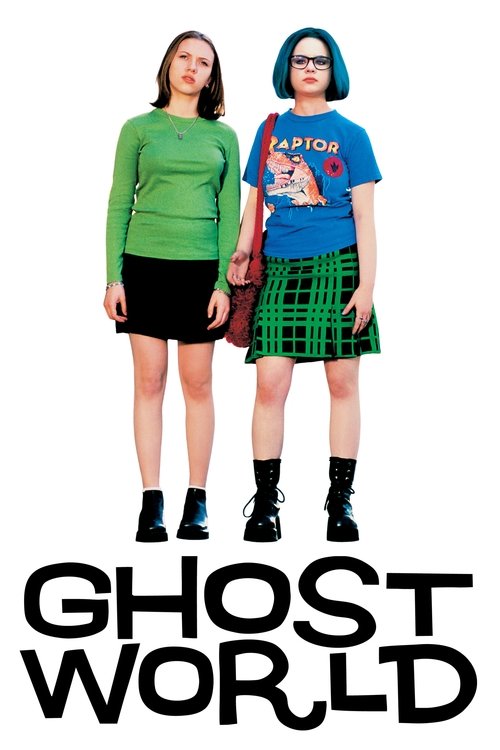
Ghost World
2001 · Terry Zwigoff
For when you're feeling out of step with everyone around you and want a film that gets it — a melancholy hang-out movie for misfits, best watched alone or with the one friend who shares your sense of humor.
What it's about
Enid and Rebecca are best friends who've just graduated high school with no plan except their shared contempt for the strip-mall world around them. A prank on a lonely middle-aged record collector named Seymour backfires when Enid actually starts to like him, and the odd friendship that forms begins to pull the two girls apart. It's about that first post-school summer when the future arrives and your old jokes stop working.
The experience
Deadpan funny and quietly devastating in about equal measure — the sarcasm keeps you laughing while a real loneliness seeps in underneath. It ends up feeling less like a teen comedy than a long, wry goodbye.
Performances
Thora Birch makes Enid's armor of irony visibly heavy, Steve Buscemi turns Seymour into one of the great sad-sack characters — prickly, tender, fully human — and a very young Scarlett Johansson gives Rebecca a groundedness that makes the drift between the girls hurt.
The craft
Adapted by Daniel Clowes from his own comic, it keeps the comic's flat colors and dry panel-like framing while filling the margins with perfect details — novelty diners, garage-sale vinyl, art-class absurdity. The blues records on the soundtrack aren't decoration; they carry the film's whole argument about authenticity.
Why it matters
It became a defining cult film for a generation of outsiders and one of the best comic-book adaptations ever made from a non-superhero source, earning an Oscar nomination for its screenplay.
Snapshot
Ghost World is a comedy of dissolution disguised as a teen movie. Adapted by Terry Zwigoff and Daniel Clowes from Clowes's serialized comic, it follows Enid (Thora Birch) and Rebecca (Scarlett Johansson) through the summer after high school graduation, as the ironic two-person subculture they have built against a world of strip malls and franchise nostalgia quietly comes apart. A prank phone call to a lonely record collector, Seymour (Steve Buscemi), pulls Enid into an attachment she cannot classify — mentorship, mockery, projection, something like love — and the cost is the friendship that defined her. Released in the last weeks before September 2001, it arrived as the culminating statement of a decade of American ironic detachment and, almost immediately, as its elegy. The film was nominated for the Academy Award for Best Adapted Screenplay, made little money, and has since become one of the most durable American independent films of its era: a source text for two decades of alienated-adolescent cinema, and a rare adaptation that alt-comics readers regard as faithful rather than betrayed.
Industry & production
The film emerged from Mr. Mudd, the production company founded by John Malkovich with Lianne Halfon and Russell Smith — a shop that specialized in literary and comics-derived material with awkward commercial profiles, and that would later produce Juno (2007) and The Perks of Being a Wallflower (2012). Financing was assembled as an international co-production with British and German partners, a common structure for mid-budget American independents at the time, and the film was released in the United States through United Artists, then operating as MGM's specialty label.
Zwigoff came to it from documentary. Louie Bluie (1985) and Crumb (1994) had established him as a chronicler of American obsessives — string-band musicians, underground cartoonists, collectors of things nobody else wanted — and Crumb in particular had been an unexpected art-house success. That success bought him a narrative feature, but not an easy one. Zwigoff has described the development period as protracted and adversarial, with pressure toward a more conventionally uplifting shape for the material; the finished film's refusal of resolution is the residue of that fight. Principal photography took place in and around Los Angeles, whose San Fernando Valley arterials, minimalls, and stucco apartment blocks were dressed to produce a deliberately unplaceable American suburb — a city rendered as anywhere.
Commercially it performed as an art-house title: a limited release that expanded modestly on strong reviews without ever crossing into the wider market. Precise grosses are best consulted in the trade record rather than asserted here, but the shape is not in dispute — the film was a critical event and a box-office footnote, and its afterlife on DVD and repertory screens vastly exceeded its theatrical life.
Technology
Ghost World is a photochemical film made at the last moment when that was simply the default. Shot on 35mm and composed for 1.85:1, it predates the normalization of the digital intermediate — the color grading is optical and conservative, and the film's distinctive palette is achieved through production design, costume, and lighting rather than post-production manipulation. There are effectively no visual effects.
The more interesting technological argument is the film's subject. Ghost World is organized around obsolete and obsolescent media: Seymour's 78rpm shellac discs, which require their own player and their own patience; the record convention as a physical marketplace for scarcity; the strip-mall multiplex where Enid briefly works, selling concessions in front of a screen showing product she despises. The film was made and released across 2000–2001, precisely as file-sharing was dismantling the economics of recorded music and the idea of the collection as a form of knowledge. Seymour's expertise — the ability to know what is rare, and to have physically found it — was on the verge of becoming worthless as information and precious only as fetish. The film does not name this transition, but it is the ground under the whole Seymour plot, and it is a large part of why the film has aged into a document rather than a period piece.
Technique
Cinematography
Affonso Beato — the Brazilian cinematographer of Glauber Rocha's Antonio das Mortes (1969) and later of Pedro Almodóvar's The Flower of My Secret (1995), Live Flesh (1997), and All About My Mother (1999) — brings an unexpected pedigree to a film about American suburban anomie, and the effect is a quiet formal rigor. The compositional strategy is frontal and planimetric: characters are placed square to the lens against flat backgrounds — a diner booth, a bus-stop bench, a garage wall of record shelves — with the camera largely static and the horizon parallel to the frame edge. This is comics grammar translated rather than imitated. Rather than mimic panel borders with iris effects or split screens, the film borrows the comic's habit of holding a fixed vantage while the figures inside it change.
Color is used as social diagnosis. The public world of chain restaurants and franchise signage is rendered in aggressive, slightly sour saturation — the greens and yellows of illuminated plastic — while interiors of refuge (Seymour's crowded rooms, Enid's bedroom) run warmer and more cluttered. Clowes's serialized pages were famously printed in black plus a pale blue-green wash; the film does not reproduce that duotone literally, but its cool-cast exteriors are legible as an homage.
The opening sequence establishes the method: a lateral move past the windows of an apartment block, each frame a small tableau of someone alone, arriving finally at Enid dancing ecstatically to "Jaan Pehechaan Ho," the Shankar–Jaikishan number performed by Mohammed Rafi in the Bollywood thriller Gumnaam (1965), playing on her television. The camera treats loneliness as a repeating architectural unit and Enid as the one window with joy in it.
Editing
Cut by Carole Kravetz and Michael R. Miller, the film keeps the comic's episodic construction. Scenes are vignettes with hard entrances and unfussy exits; there is little conventional connective tissue and almost no montage. Transitions frequently land on a beat of silence after a joke has failed to land — the film's characteristic rhythm is the pause in which someone realizes their irony has not been received.
The structural argument is in the pacing curve. The first act cuts briskly between the two girls' shared campaigns of mockery, the tempo of a double act. As Rebecca acquires a job, an apartment, and an interest in coffee-table furniture, and as Enid's involvement with Seymour deepens, the cutting slows and the scenes lengthen. By the final movement the film has become almost becalmed, holding on Enid alone. The edit performs the friendship's dissolution before the dialogue admits it.
Mise-en-scène / staging
Production designer Edward T. McAvoy and costume designer Mary Zophres — the Coen brothers' longtime costumer — built the film's world out of accumulated junk with strict internal logic. Every set is a statement about how its occupant relates to the past. Seymour's rooms are an archive: cataloged, alphabetized, dust-free, and dead. Enid's bedroom is a collage: masks, dolls, records, thrift finds, arranged by association rather than system. Rebecca's new apartment is the horror at the center of the film — clean, sourced from a catalog, indistinguishable from anyone's.
Enid's costume is the film's most-copied element: the sequence of thrift-store personae, culminating in the green hair she adopts as "original 1977 punk rock," instantly deflated by a nunchuck-wielding convenience-store regular who identifies it as exactly that. Zophres dresses Enid in quotations, which is precisely the character's problem — an identity assembled entirely from citations of other people's authenticity.
The exteriors are staged as an inventory of American placelessness: the Sidewinder-style convenience store, the retro-themed diner selling manufactured nostalgia, the "Cook's Chicken" franchise whose corporate history conceals its origin as a real category of American racist restaurant iconography. And recurring throughout, the graffiti tag GHOST WORLD — a phrase Clowes took from actual graffiti — appearing on walls as an unexplained annotation on the landscape.
Sound
The soundtrack is Zwigoff's collection, and it functions as characterization rather than atmosphere. The decisive instance is Skip James's "Devil Got My Woman" (1931), which Seymour plays for Enid and which stops the film dead. It is the moment Enid encounters something that is not a joke — a piece of art with no ironic distance available to her — and the film treats her stricken silence as the closest thing to a religious experience it will offer.
Against this, the film stages its sharpest satire in Blueshammer, a fictional white blues-rock bar band whose hollering appropriation of the very tradition Seymour venerates plays to a delighted crowd while he sits in agony. The scene indicts both the appropriators and, more painfully, Seymour's powerlessness as a connoisseur.
David Kitay — who had scored Clueless (1995), the sunlit teen comedy that Ghost World stands as the negative image of — provides an unusually restrained original score, ceding most of the film's musical real estate to source cues.
Performance
The register is deadpan, and the film's comedy depends on actors refusing to signal. Thora Birch, arriving from American Beauty (1999), plays Enid with a flat, unhurried delivery that makes cruelty and vulnerability sound identical — a performance that requires the audience to do interpretive work the character will not do for them. Scarlett Johansson, roughly sixteen at the time, gives Rebecca a watchful pragmatism that makes her drift toward normalcy read as growth rather than betrayal; it is a genuinely difficult part, since the script's sympathies visibly lie with Enid.
Steve Buscemi's Seymour is the film's pivot and the performance that most changed a career, moving him from a definitive character player to a leading man capable of carrying pathos without pleading for it. He plays Seymour's self-knowledge as the cruelest thing about him: the man knows exactly what he is and can do nothing with the information. Illeana Douglas's art teacher Roberta is a precise satire of institutional avant-gardism, Bob Balaban's affectless father a study in benign absence, and Teri Garr's Maxine a portrait of aggressive, wounding normalcy.
Narrative & dramatic mode
The comic Ghost World — serialized in Clowes's Eightball across the mid-1990s and collected by Fantagraphics in 1997 — is a set of loosely linked vignettes with no strong causal spine. The adaptation's central structural decision was to build two: Enid's remedial summer art class, which supplies deadline and consequence, and the Seymour relationship, which supplies the emotional arc. Seymour is largely a film invention, expanded from a peripheral figure in the comic's personal-ad prank; Clowes has acknowledged that the character owes a good deal to Zwigoff himself, which gives the film's autobiographical current its particular double edge — the director watching a young woman romanticize, then wound, a version of him.
The dramatic mode is picaresque comedy sliding into character tragedy without ever changing tone. There is no crisis scene, no confrontation that resolves the friendship; Rebecca and Enid simply stop being able to talk. The art-class subplot delivers the film's hardest turn, when Enid submits a vintage Coon Chicken Inn poster — an authentic artifact of American racist advertising, salvaged from the franchise's own suppressed history — as found art. The gesture is simultaneously the most serious thing she does and an unforgivable use of other people's history as an aesthetic provocation, and the film declines to arbitrate.
The ending is one of American independent cinema's great ambiguities. Throughout, a man waits at a bus stop on a route everyone insists is discontinued; a bus eventually comes, and he takes it. In the final scene Enid sits at the same stop and boards the same bus. Read as escape, transcendence, suicide, or fantasy, the image withholds its meaning by design. Zwigoff has consistently declined to fix it.
Genre & cycle
Formally, Ghost World belongs to the post-Sundance American independent comedy of manners — the lineage of Hal Hartley's affectless suburbanites, Whit Stillman's over-articulate young people, and Alexander Payne's Midwestern satire. Culturally, it positions itself against the concurrent studio teen-movie boom, the cycle running from Clueless (1995) through 10 Things I Hate About You (1999) and American Pie (1999). Ghost World observes those films' conventions — graduation, summer, the friendship pair, the first romance — and answers each with the opposite outcome. Nobody transforms, nobody is validated, the romance is a catastrophe, and the friendship ends.
It is also a pivotal entry in the adaptation of literary comics. Coming after Zwigoff's own Crumb, it demonstrated that alternative comics could be filmed with fidelity to voice rather than plot, and it directly precedes American Splendor (2003), the Harvey Pekar film that took the lesson further formally. Zwigoff and Clowes reunited for Art School Confidential (2006), also derived from an Eightball story, to considerably less acclaim.
Authorship & method
The film is a genuine two-author work. Clowes brought the material, the dialogue rhythm, and the moral coldness; Zwigoff brought the documentarian's patience with real eccentrics and a lifetime inside the specific subculture the film depicts. Zwigoff is himself a serious collector of pre-war 78s and played with R. Crumb and His Cheap Suit Serenaders — the film's record-collecting milieu is not researched but inhabited, which is why its details (the sleeve conditions, the convention-table etiquette, the exact quality of disappointment) are exact.
That documentary background also explains the film's ethical posture. Zwigoff's earlier subjects were men whose devotion to disappearing culture had cost them ordinary life; Ghost World fictionalizes that figure and then asks what happens when a young person mistakes it for an available future. The key collaborators reinforce the approach: Beato's compositional discipline, Zophres's semiotically loaded costuming, Kitay's willingness to disappear, and an edit that trusts the silence after a scene ends.
Movement / national cinema
The film is a product of the American specialty-division system at its height — the period roughly from the mid-1990s to the mid-2000s when Sony Pictures Classics, Fox Searchlight, USA Films, Miramax, and MGM's United Artists competed for exactly this kind of picture: modest budget, adult audience, awards-season leverage. That infrastructure made Ghost World possible and its economics survivable; its contraction after 2008 is a large part of why a comparable film would struggle to be financed at the same scale today.
Nationally, it belongs to a strain of American cinema preoccupied with the built environment of the suburb as a spiritual condition — a line that runs through The Last Picture Show (1971), River's Edge (1986), Slacker (1990), and Safe (1995), and forward into American Beauty (1999), from which Birch had just come. Ghost World's contribution is to locate the malaise not in repression but in retail: a landscape where every available identity is purchasable and therefore counterfeit.
Era / period
Released in the summer of 2001, weeks before September 11, the film is a terminal document of the long American 1990s — the decade in which irony functioned as a default epistemology for educated young people. Within months, commentators were publicly announcing the "end of irony," and Ghost World was retroactively reframed as its last full expression and its most searching critique. The film had already made the argument the culture would make clumsily: that irony is a survival mechanism with no exit, and that Enid's inability to admit sincerity is not sophistication but a trap.
It is also an artifact of the moment just before the internet reorganized subcultural belonging. Enid and Rebecca must physically find their world — in thrift shops, at record conventions, in the diner. Within a few years, that search would be replaced by a feed, and Ghost World's specific loneliness — being weird in a place with no one else weird in it — would become a historical condition rather than a universal one. Much of the film's continuing resonance with younger audiences comes from that gap.
Reception, canon & influence
Critical reception was strong and disproportionate to the film's commercial reach. Reviewers singled out the writing's refusal to flatter its heroine and Buscemi's performance, which was widely honored in year-end critics' awards; Roger Ebert was among the film's most prominent champions. The screenplay's Academy Award nomination for Best Adapted Screenplay was the film's sole Oscar recognition and a genuine surprise for a small comics adaptation. The Criterion Collection's restored 2017 edition confirmed the canonical status the repertory circuit had already granted it.
Backward, the film's inheritances are legible. From Clowes's own comics come the vernacular and the misanthropy; from Zwigoff's Crumb come the collector-as-tragic-figure and the moral seriousness about vernacular American art. Behind both stands the deadpan American independent tradition of Jarmusch, Hartley, and Linklater, and — in the film's attention to the suburb as an existential setting — Bogdanovich and Tim Hunter's River's Edge. The Bollywood prologue, meanwhile, announces a magpie relationship to global pop culture that anticipates how a generation of viewers would assemble taste.
Forward, its influence is broad enough to be nearly invisible. The 2000s cycle of stylized outsider comedies — Napoleon Dynamite (2004), Juno (2007), the Wes Anderson–adjacent aesthetic — inherited its permission to make deadpan alienation commercially legible, though most inheritors softened the ending. More substantively, Ghost World set the template for a subsequent generation of films about young women whose interior lives are treated as difficult rather than charming: The Diary of a Teenage Girl (2015), Lady Bird (2017), Eighth Grade (2018), and Booksmart (2019) all work variations on its central structure of a female friendship dyad fracturing under the pressure of divergent futures. It launched Johansson's adult career and permanently expanded Buscemi's range.
Its reputation has also complicated productively over time. The Coon Chicken Inn subplot, once read as a satire of art-world hypocrisy, is now more often discussed as a study in the appropriation of Black historical trauma as white provocation — a reading the film arguably supports but does not foreground. And Enid, once a figure of subcultural aspiration, is increasingly read as a warning: a portrait of taste as a defense against connection. That the film sustains both readings, twenty-odd years on, without resolving into either, is the best evidence of what Zwigoff and Clowes actually built.
A Deleuzian reading
The camera moves sideways along an apartment block at night, past window after window, each one a lit box holding a small tableau of someone alone.
The full Deleuzian reading of Ghost World →
Reception
A modest indie in 2001 — critics loved it, it earned an Oscar nomination for its screenplay, but barely registered at the box office. Two decades later it's one of the defining cult films of its era, adopted wholesale by a Letterboxd generation that treats Enid as a personality type.
How Ghost World was received, from release to now →
How to watch Ghost World: what to notice on a first viewing
- Notice how square to the camera everyone sits. Affonso Beato puts characters flat against a wall, a diner booth, a bench, with the camera still and the horizon parallel to the frame edge. The opening tracks sideways past apartment windows, one lit box after another. Every frame is a sealed box with people inside it, and the film lines them up so you can see how little passes between them.
- Look at the sour greens and yellows of the signage. The public world of chain restaurants and franchise plastic is pushed into aggressive, slightly off saturation. The rooms people hide in, Seymour's and Enid's, come back warmer and more cluttered. Color sorts the film into places that sell you something and places where somebody actually lives.
- Look at the strip malls and franchise signs they walk past. The Valley was dressed into a suburb that could be anywhere: stucco blocks, minimall arterials, a chicken franchise selling its own buried history back as heritage. The words GHOST WORLD keep appearing as graffiti and nobody in the film mentions it. These are surfaces rather than places, and the tag on the wall is the one thing that breaks the habit and asks to be read.
- Track what Enid is wearing scene to scene. Mary Zophres puts her through a run of thrift-store personae. The green hair she adopts as original 1977 punk rock gets identified as exactly that, immediately, by a regular at the convenience store. Her identity is assembled out of quotations of other people's authenticity, and the film keeps catching her at it.
- Listen for the silence after a joke does not land. Kravetz and Miller cut the film as vignettes with hard entrances and flat exits, and they keep holding a beat after a line lands flat. Almost no montage, almost no connective tissue. The film's rhythm is the pause where someone realizes their irony has not been received by anyone in the room.
The whole guide to watching Ghost World, with the keys for a rewatch →
Influences: the films it descends from and the films it influenced
- Gumnaam (1965) — Its 'Jaan Pehechan Ho' number is embedded whole as Ghost World's pre-title sequence, establishing the film's method of using a found source cue as a character's interior life before a word of dialogue — Enid's dancing answers the clip in a lateral track past windows that turns the musical number into a survey of suburban isolation.
- The Graduate (1967) — The template for the post-graduation drift film that closes on a held shot of the protagonist on public transit with the reaction unreadable — Ghost World's final bus is a deliberate rhyme, stripped of the second passenger so the ambiguity has nowhere to resolve.
- The Last Picture Show (1971) — Supplies the structure of a friendship dyad that fractures as its members' futures diverge, staged against local institutions (theater, diner, storefront) shot as an index of a dying vernacular America — Ghost World transposes the closing movie house to the closing Angels-in-America bus stop and the ejected repertory theater.
- Harold and Maude (1971) — Establishes the intergenerational misfit dyad played in deadpan black comedy, with a curated song catalog functioning as the older character's transmitted worldview — Seymour's 78s do exactly what Maude's banjo and Cat Stevens cues do, except the transmission is shown to be unlivable.
- Stranger Than Paradise (1984) — The blackout-separated vignette architecture and frontal, near-static compositions of placeless American interiors — Zwigoff inherits the trust in the dead air after a scene's last line, which becomes the film's decelerating pacing curve.
- Crumb (1994) — Zwigoff's own documentary method carried directly into fiction: the collector of disappearing vernacular art filmed with patient, unhurried framing that lets self-incrimination arrive on its own, plus the 78-collecting milieu whose sleeve conditions and convention-table etiquette Ghost World reproduces from lived knowledge rather than research.
- River's Edge (1986) — Treats the anonymous American suburb as an existential setting rather than a backdrop, with flat teenage affect photographed in sour, desaturated-then-oversaturated exteriors — the tonal precedent for Beato's queasy strip-mall palette.
- Trust (1990) — The performance protocol for delivering hyper-written, epigrammatic dialogue at flat affect and metronomic tempo, which is precisely how Birch and Buscemi speak Clowes's lines — the comedy lands because no one signals that it is comedy.
- Welcome to the Dollhouse (1995) — The anti-teen-movie contract: a heroine the camera refuses to flatter, shot in frontal, symmetrical suburban tableaux, with cruelty played at the same register as everything else and no redemption arc offered at the end.
- Rushmore (1998) — Planimetric frontality and chaptered vignette pacing wed to costume-as-fixed-persona — the blazer is Max's thesis statement the way Enid's dyed hair and thrift-store cat-eye glasses are hers — and the same precocious-outsider/depressive-older-man dyad that curdles when the younger party outgrows it.
- 10 Things I Hate About You (1999) — Extends the ferocious-wounded, riot-grrrl-adjacent outsider heroine — Enid's caustic anti-conformist stance is the Kat Stratford mode pushed toward deadpan alienation.
- American Splendor (2003) — Documentarians adapting an autobiographical comic about a vernacular-obsessed misanthrope and record collector, solving the same problem Ghost World solved — inventing a dramatic spine for a strip that has none — while keeping the panel-derived deadpan and the source's moral coldness intact.
- Napoleon Dynamite (2004) — Takes the planimetric frontality and thrift-store costume semiotics wholesale, but converts Ghost World's sour palette into a cheerful one and its unlivable irony into affectionate quirk — the clearest case of an inheritor keeping the framing and discarding the ending.
- Art School Confidential (2006) — The second Zwigoff–Clowes coauthorship, extending the Coon Chicken Inn subplot's argument into a whole film: art-world provocation as a credentialing game, staged again in flat frontal compositions with a satirically overqualified older mentor figure.
- Juno (2007) — Inherits the hyper-articulate outsider girl whose taste is her armor, and the use of obscure-catalog needle drops as characterization — the vinyl-and-hamburger-phone signifiers are Enid's bedroom system with the misanthropy sanded off.
- The Diary of a Teenage Girl (2015) — Another comics adaptation that keeps the source's graphic vernacular and its refusal to make the heroine's sexuality or self-loathing charming, sustaining Ghost World's contract that a young woman's interior life be treated as difficult rather than winsome.
- Lady Bird (2017) — Runs Ghost World's central structure exactly — a female friendship dyad fracturing under divergent post-graduation futures, told in short elliptical vignettes — and closes on a transit departure, though it grants the reconciliation Zwigoff withholds.
- Booksmart (2019) — The dyad-fracture-at-graduation structure with the taste-superiority defense made explicit, and the same use of costume as a self-authored persona; the difference is that its heroines' contempt is diagnosed and cured within the runtime rather than left standing at the bus stop.
- Humanist Vampire Seeking Consenting Suicidal Person (2023) — Codifies the deadpan teenage-girl outsider whose mordant flatness masks depression and a refusal to perform the world's expected roles.
- All About My Mother (1999) — Affonso Beato's immediately prior work, demonstrating the same discipline he brings to Ghost World: color-blocked interiors composed frontally so that a room's saturation and clutter read as a character dossier before the occupant speaks.
- Igby Goes Down (2002) — Parallel portrait of an ironic adolescent waging deadpan war on phoniness and adult hypocrisy — the Salinger-descended alienation rendered as caustic comedy.
- Dinner in America (2020) — Two misfits bonded by shared disgust for a phony mainstream, their deadpan alienation softened by an offbeat record-collector romanticism — the outsider-pair chemistry and music-as-identity that Dinner in America mirrors.
- Speak (2004) — Shares the deadpan, sardonic teenage-girl outsider voice and the aesthetic of interiorized alienation-as-armor against a hostile peer world.
- Bottle Rocket (1996) — Shoots eccentrics in flat, frontal, near-static frames and holds shots several beats past the joke so discomfort accumulates — the same trust in unbroken performer conviction over cutting rhythm that Bottle Rocket uses on Dignan.
Similar films
- Lady Bird (2017) — influence & lineage
- Juno (2007) — influence & lineage
- I Saw the TV Glow (2024) — shared sensibility
- All of Us Strangers (2023) — shared sensibility
- Jojo Rabbit (2019) — shared sensibility
- Under the Skin (2014) — shared sensibility
- The Worst Person in the World (2021) — shared sensibility
- The Craft (1996) — shared sensibility