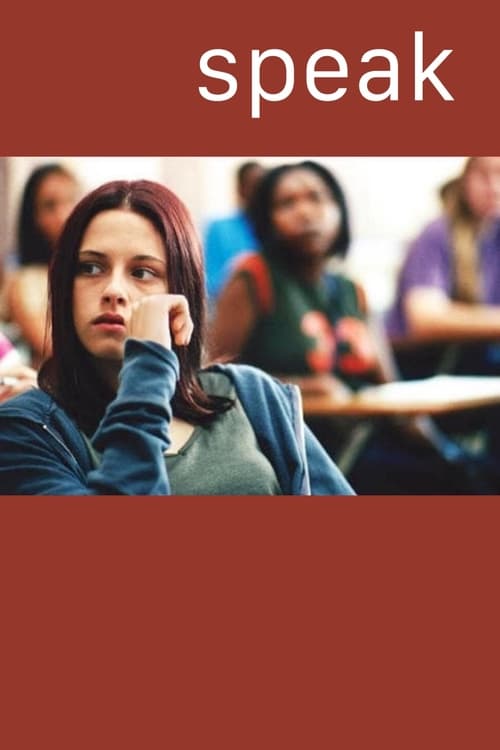
Speak
2004 · Jessica Sharzer
For when you want a small, sincere film that takes a teenager's pain seriously — comforting in its honesty, though the subject matter asks something of you. Good for a reflective night, not a light one.
What it's about
A high-school freshman named Melinda has stopped speaking. Her old friends have frozen her out for calling the cops on a summer party, her parents are too distracted to look closely, and no one knows what she's carrying: a senior assaulted her that night. She drifts through freshman year nearly mute, until an art class — and a teacher who asks her to actually express something — gives her a place to begin.
The experience
Quiet, close, and heavy in the way real adolescence can be, with flashes of dry, sardonic humor in Melinda's inner voice. It builds not through plot twists but through the slow pressure of a secret, and it earns its emotion honestly rather than milking it.
Performances
A thirteen-year-old Kristen Stewart, in her first leading role, carries the film almost without dialogue — the performance lives in her posture, her flinches, her guarded eyes, and it's startling how much she communicates while saying so little.
The craft
Jessica Sharzer's debut adapts Laurie Halse Anderson's landmark young-adult novel with a light, precise hand, trusting silence and voiceover instead of speeches. It's intimate, small-scale filmmaking where the craft is restraint: the camera stays with one girl's face and lets the school around her feel both ordinary and hostile.
Why it matters
A touchstone adaptation of one of the most influential young-adult novels ever written about sexual assault, it found a huge audience through television and classrooms and is now remembered as the film that introduced Kristen Stewart.
Snapshot
Speak is a small, precisely made American independent drama adapted from Laurie Halse Anderson's landmark 1999 young-adult novel. It follows Melinda Sordino, a high-school freshman who has stopped speaking after being raped by a senior at a summer party; her silence — read by classmates as the treachery of the girl who called the police and broke up the party — is the film's central formal and thematic problem. Directed by Jessica Sharzer in her feature debut from a screenplay she co-wrote with Annie Young Frisbie, the film is now best known as the first leading role for a thirteen-year-old Kristen Stewart, whose interiorized, near-wordless performance anchors the picture. It premiered out of competition at the 2004 Sundance Film Festival and reached its audience primarily through television, in a widely noted Showtime/Lifetime simulcast. Its significance is threefold: as an early, unusually faithful screen treatment of adolescent sexual trauma pitched to a teen readership's sensibility; as a launchpad for Stewart; and as an example of how a literary voice built almost entirely on first-person interiority can be translated into image and sound.
Industry & production
Speak belongs to the early-2000s ecosystem in which independent features and premium-cable/television financing had begun to overlap. The film was produced by Fred Berner and Matthew Myers, with Jerry Offsay — a longtime Showtime programming executive — credited as executive producer, and Frisbie and Sharzer as co-producers. That configuration signals the project's route to market: rather than a theatrical platform release, Speak was positioned as a prestige television event. It screened at Sundance in January 2004 and was then broadcast on Showtime, later reaching a broader audience through a Labor Day simulcast across Showtime and Lifetime Television — an arrangement the networks promoted as an unusual cross-channel event, appropriate to the film's public-service dimension around teen sexual assault.
This is a modestly budgeted production; the exact figures are not part of the well-documented public record, and I will not guess at them. What the film's scale makes visible is a deliberate economy: contained locations (a high school, the Sordino home, a wintry small-town exterior world), a compact ensemble, and a running time built for a television hour-plus format. The source novel's status — a bestseller and a fixture of school reading lists, though also a recurring target of challenges and banning attempts — gave the adaptation a built-in constituency among educators, librarians, and teen readers, which aligns with the television-forward release strategy.
Technology
Speak is a product of the early digital-transition years, but it does not foreground technology as a subject or a style. The relevant technical fact is its finishing and exhibition context: a film made for premium-cable and broadcast delivery, where the image had to read cleanly on the television screens of the mid-2000s. Beyond that, the specifics of camera format and post pipeline are not prominent in the documented record, and I won't fabricate them. What matters more than any capture technology is the film's use of the era's ordinary tools — voiceover, dissolves, seasonal exterior shooting — to externalize an interior state, a task the production solves through technique rather than through any novel apparatus.
Technique
Cinematography
The film was shot by Andrij Parekh, then an emerging cinematographer who would shortly become one of the defining lens stylists of American independent cinema (Half Nelson, Blue Valentine) before moving into television directing. His work here is restrained and observational, favoring a naturalistic palette that tracks the calendar: the story is organized by the school year, and the imagery moves from the muted, closed-in tones of autumn and winter toward light as Melinda begins to recover. The camera tends to hold on Stewart's face, trusting small shifts of expression to carry meaning that dialogue withholds, and it frames Melinda within the architecture of the school — lockers, corridors, classrooms — to register her isolation inside a crowded social space.
Editing
Peter C. Frank edited the film. The cutting's principal job is to reconcile two registers: the external, roughly chronological progression of the school year, and Melinda's fragmented inner life, including the withheld memory of the assault that surfaces only gradually. The film parcels out that trauma rather than presenting it up front, so the editing manages a slow disclosure — flashback fragments and associative cuts that let the audience understand before Melinda can say. This structural withholding is the film's chief suspense mechanism and its ethical strategy, keeping the event's weight present without sensationalizing it.
Mise-en-scène / staging
The staging literalizes silence and enclosure. Melinda's bedroom closet becomes a refuge she claims and decorates — a private space against a home where her parents are preoccupied and distant. The high school is staged as a hostile social machine: cliques, cafeteria geographies, hallway snubs. Against these, the art room is composed as sanctuary, an open and permissive space presided over by Mr. Freeman. Running through the mise-en-scène is the film's central visual motif, carried from the novel: the year-long art assignment to render a tree, which recurs as object and image and becomes the barometer of Melinda's capacity to make something true. The tree, and Melinda's repeated failed and finally successful attempts at it, gives the film a concrete symbolic through-line to set against the abstraction of her interior monologue.
Sound
Sound is where the adaptation faces its hardest problem and its clearest solution. Anderson's novel is a first-person voice — sardonic, wounded, funny — and the film preserves it through Melinda's voiceover narration, which supplies the running commentary her spoken silence denies the other characters. The irony is structural: the audience hears the girl who will not speak. Around that voice, the film keeps its sound design quiet and unforced. The score is credited to Christopher Libertino; it works in a supporting, unobtrusive register rather than underlining emotion, leaving space for the silences that are the film's whole subject.
Performance
The film is, finally, a performance vehicle, and its reputation rests on Kristen Stewart. Cast at thirteen and leading a feature for the first time, Stewart builds Melinda almost entirely out of withholding — flat affect, downcast eyes, a physical retreat into hunched postures and hooded clothing — so that the smallest opening (a flicker of interest in the art room, a wary near-friendship) reads as a major event. It is a performance that anticipates the interior, minimalist quality critics would later identify across her career. The surrounding ensemble is well used: Steve Zahn as the encouraging art teacher Mr. Freeman gives the film its warmth without tipping into the inspirational-teacher cliché; Elizabeth Perkins and D. B. Sweeney play the inattentive parents; Michael Angarano is the earnest lab partner Dave Petrakis; Robert John Burke appears among the faculty; and Eric Lively plays Andy Evans, the senior whose predatory charm makes the threat legible without being lurid.
Narrative & dramatic mode
The dramatic mode is confessional realism organized as a recovery arc, and its defining device is the gap between voice and speech. Melinda narrates fluently to us while going mute to everyone around her, which makes dramatic irony the engine of the whole film: we possess the knowledge that would exonerate her socially and explain her behavior, and we watch her carry it alone. The plot withholds the rape itself, revealing it in fragments so that the film's climax is less a physical confrontation than an act of articulation — Melinda finding a way to name what happened, first through her art and then, at last, in words. The structure is a school-year calendar, seasonal and cyclical, which lends the recovery a natural, organic shape rather than a melodramatic one. The register mixes bleakness with the caustic teenage humor of the narration, a tonal balance inherited directly from the novel.
Genre & cycle
Speak sits at the intersection of the coming-of-age drama and the "issue" film, and specifically within the lineage of young-adult literary adaptation. It is a high-school film that inverts the genre's usual social comedy: the cafeteria taxonomies and clique politics are present, but they are instruments of cruelty rather than sources of humor. As a trauma narrative aimed substantially at a teenage audience, it belongs to a cycle of sexual-assault stories that treat the subject from the survivor's interior rather than as procedural or spectacle. Its television-forward release aligns it with the socially conscious TV-movie tradition even as its Sundance premiere and indie craft mark it as an art-house-adjacent work — a hybrid position typical of early-2000s cable-financed features.
Authorship & method
The controlling authorship is Jessica Sharzer's. Speak was her feature debut as director and, with Annie Young Frisbie, co-writer, and it demonstrates the instincts she would carry into a prominent television career — she went on to write and produce on American Horror Story and wrote the screenplay for Nerve (2016). Her method here is fidelity through translation: rather than opening the novel out, she keeps its claustrophobia and its first-person voice, using voiceover as the load-bearing device and trusting a young lead to carry silence. Her key collaborators shape that method concretely. Cinematographer Andrij Parekh supplies the naturalistic, face-attentive image-making that a performance-driven film requires — and his subsequent stature lends the film retrospective interest as early evidence of a major visual sensibility. Editor Peter C. Frank governs the disclosure of trauma through the film's fragmented temporal structure. Composer Christopher Libertino keeps the music deferential to the silences. And Frisbie, as co-writer, shares responsibility for the screenplay's central achievement: preserving Anderson's voice on screen. Anderson herself, as the novel's author, is the film's originating creative source, and the adaptation's reputation for faithfulness is part of its identity.
Movement / national cinema
The film is a work of American independent cinema in its early-2000s cable-financed variant. It does not belong to a formal movement, but it participates in a recognizable American current: literary-adaptation indies made at modest scale, driven by performance and script, and routed to audiences through festivals and premium/broadcast television rather than wide theatrical release. Its concerns — American high-school social hierarchy, suburban family inattention, the institutions of school and art class — are nationally specific, rooted in the American YA tradition from which the source novel comes.
Era / period
Speak is very much of 2004: a moment when Sundance and premium cable had become a viable pipeline for small dramas, and just before the cultural shifts that would reframe its subject. The film treats sexual assault seriously and from the survivor's point of view more than a decade before the #MeToo movement made such centering a mainstream expectation, which is part of why later commentary often reads it as ahead of its moment. It also sits at the front edge of Kristen Stewart's career, several years before Twilight (2008) made her a global star — a temporal fact that has strongly shaped the film's later visibility, as audiences returned to it to find her first leading performance.
Themes
The film's governing theme is silence — its causes, its costs, and the labor of breaking it. Melinda's muteness is at once symptom, self-protection, and social punishment, and the drama is the slow conversion of that silence into voice. Braided through it are the themes of trauma and shame, and specifically the isolation of the survivor who is disbelieved or blamed; the failures of the adult world, where parents are too distracted and most teachers too rote to see a child in distress; and the redemptive function of art, embodied in the tree assignment and in Mr. Freeman's studio as the one place where honest expression is permitted and rewarded. The recurring tree image ties these together: growth, seasons, damage, and renewal made visible in a single symbol. The film also examines adolescent social cruelty — the way a group closes ranks against the one who broke the code — as the mechanism that enforces Melinda's silence.
Reception, canon & influence
Critical reception concentrated, then and since, on Kristen Stewart's performance, widely singled out as a remarkably controlled and mature turn from a young actor and frequently cited as the film's principal achievement; the adaptation was also credited with unusual faithfulness to Anderson's admired novel. I don't have a reliable record of its specific awards or precise critical tallies to cite, and I won't invent them. What is clear is that the film's cultural footprint grew over time rather than at release: its television-first distribution kept it out of the theatrical conversation, but Stewart's later fame turned it into a frequently revisited "first leading role," and the enduring, contested prominence of the novel on school reading lists kept the story in circulation among younger audiences.
Looking backward, the film's influences are literary before they are cinematic: it descends most directly from Laurie Halse Anderson's novel and, through it, from the first-person confessional tradition of American young-adult fiction, as well as from the broader lineage of high-school and coming-of-age drama whose social geographies it inherits and darkens. Looking forward, its clearest legacy is as a career origin point — for Stewart, whose interiorized minimalism is visible here in embryo, and, in a quieter way, for the below-the-line talent, with cinematographer Andrij Parekh going on to major independent films and television directing. As a survivor-centered account of sexual assault made for and about teenagers, Speak also reads in hindsight as a forerunner of the more prominent adolescent-trauma narratives that followed in the 2010s, though tracing a direct line of influence would overstate what the record supports. Its most durable role, finally, may be pedagogical: paired with the novel it faithfully serves, the film has functioned as a text through which young audiences encounter a difficult subject rendered with restraint and empathy.
Reception
Barely seen on release — a Sundance 2004 premiere that ended up airing on cable rather than in theaters — it's since been rediscovered as the proof that Kristen Stewart could always act, years before Twilight made her a punchline and the arthouse made her a critics' darling.
How Speak was received, from release to now →
Influences: the films it descends from and the films it influenced
- Persona (1966) — Establishes elective mutism as a psychological device and the sustained, near-clinical close-up on a woman's face as the primary carrier of unspoken interior states — the exact silence-and-visage grammar Speak leans on.
- The 400 Blows (1959) — Model for the naturalistic, face-attentive observation of an alienated adolescent whose inner life is withheld from adults and delivered instead through the held gaze on a young performer.
- Ordinary People (1980) — Template for withheld trauma disclosed through fragmented flashback shards timed to a survivor's slow recovery, releasing the repressed precipitating event only in the final act.
- Welcome to the Dollhouse (1995) — Maps the cruel social geography of the American middle/high school — cafeteria castes, hallway humiliation — onto an unsentimental outsider-girl protagonist, the darkened coming-of-age terrain Speak inherits.
- My So-Called Life (1994) — Codifies the confessional first-person teen-girl voiceover as the load-bearing narrative device, letting interior monologue reframe naturalistically shot high-school scenes from a single adolescent's POV.
- The Virgin Suicides (1999) — Uses retrospective voiceover over suburban adolescent trauma as the structuring voice, and organizes teen malaise through a seasonal, calendar-like passage of time.
- An Angel at My Table (1990) — Precedent for pairing an interiorized, withdrawn young woman with redemptive art-making as the route out of silence, filmed with patient attention to the unspeaking face.
- Half Nelson (2006) — Carries forward cinematographer Andrij Parekh's naturalistic, available-light, face-attentive handheld image-making first exercised on Speak.
- Blue Valentine (2010) — Extends Parekh's intimate, skin-close naturalism married to a fragmented temporal structure, the disclosure-through-editing logic Speak built around its lead's face.
- Precious (2009) — Continues the abused-teen first-person voiceover — interior narration and escape-fantasy interruptions — with redemptive writing/art as the survivor's path toward speech.
- Short Term 12 (2013) — Inherits the gradual, editing-governed disclosure of adolescents' withheld trauma and the belief in expressive art as the mechanism that finally voices it.
- The Diary of a Teenage Girl (2015) — Sustains the load-bearing first-person adolescent-girl voiceover paired with drawing/art as the medium through which a young woman processes and narrates her own experience.
- 13 Reasons Why (2017) — Most direct legacy: a survivor-of-sexual-assault narrative built for a teen audience, dramatic irony and withheld trauma released through fragmented, non-linear disclosure on television-finished delivery.
- Ghost World (2001) — Shares the deadpan, sardonic teenage-girl outsider voice and the aesthetic of interiorized alienation-as-armor against a hostile peer world.
- Thirteen (2003) — Contemporary issue-film companion: raw, naturalistic, face-attentive handheld portraiture of a teenage girl's private crisis rendered without moralizing distance.
- Elephant (2003) — Parallel naturalistic rendering of the high-school ecosystem, using roaming, observational attention to ordinary corridors and cliques rather than dramatized plot beats.
- Mysterious Skin (2004) — Same-year twin in method: buried childhood sexual assault surfaced through fragmented flashback disclosure and first-person voiceover, the trauma withheld until memory reassembles it.
Similar films
- Short Term 12 (2013) — influence & lineage
- Twilight (2008) — shared sensibility
- Clouds of Sils Maria (2014) — shared sensibility
- The Breakfast Club (1985) — shared sensibility
- Girl with a Pearl Earring (2003) — shared sensibility
- The Perks of Being a Wallflower (2012) — shared sensibility
- Boys Don't Cry (1999) — shared sensibility
- Certain Women (2016) — shared sensibility