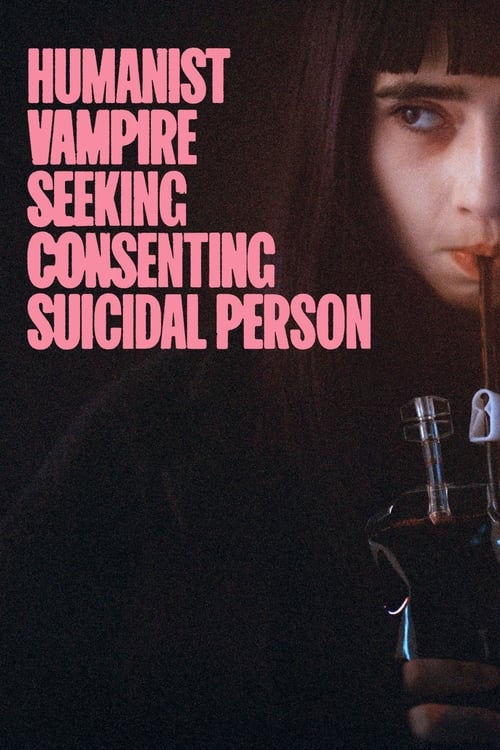
Humanist Vampire Seeking Consenting Suicidal Person
2023 · Ariane Louis-Seize
For a night when you want something sweet and strange at the same time — a love story with fangs that comforts more than it bites. Perfect when standard rom-coms feel too sugary but you still want to feel your heart move.
What it's about
Sasha is a teenage vampire in Montreal with a fatal flaw: she's too empathetic to bite anyone. When her fed-up parents cut off her blood supply to force her hand, she crosses paths with Paul, a bullied kid who's stopped wanting to live — and who offers her a deal that solves both their problems. First, though, he has last wishes, and they have until sunrise.
The experience
Deadpan and gentle at once — a comedy about death that keeps making you smile through the ache. It moves at the unhurried pace of a long night out, wry on the surface, quietly devastating underneath, and it ends up being far more romantic than its morbid setup suggests.
Performances
Sara Montpetit plays Sasha with a wide-eyed, mournful stillness that makes the absurd premise feel completely sincere — she gets laughs and heartbreak out of simply refusing to blink.
The craft
Ariane Louis-Seize's debut commits totally to its tone: every joke delivered straight-faced, the vampire mythology worn lightly, Montreal at night rendered in warm pools of neon and lamplight. The writing pulls off the hardest trick in comedy — treating suicide and hunger seriously while staying genuinely funny — and the nocturnal look rewards watching with the lights off.
Why it matters
A prize-winner at Venice's Giornate degli Autori that announced Louis-Seize as a major new voice, and one of the films that proved the vampire movie still had somewhere tender left to go.
Ariane Louis-Seize's feature debut, which took the top prize in Venice's Giornate degli Autori sidebar, does exactly what its deadpan title promises: a matchmaking of two problems. Sasha is a teenage vampire whose fangs refuse to descend because she feels too much for her food; Paul is a bullied boy who has stopped wanting to live. Their arrangement — his life for hers, but first a night of last wishes — becomes one of the tenderest screen romances of its decade, played entirely straight-faced. The film sits squarely in Québécois cinema's gift for droll melancholy, closer in spirit to Kaurismäki than to any Hollywood vampire property, and it quietly repurposes the genre as a study of adolescent depression, consent, and inherited family expectation without ever announcing the metaphor. Sara Montpetit, pale and saucer-eyed, gives Sasha the gravity of a silent-film heroine; the suburban Montreal nights are shot in deep autumnal blues and neon smears, scored to vintage torch songs. Louis-Seize honed the tone across a decade of shorts, and it shows: not a single scene raises its voice.
Reception
It premiered quietly in Venice's indie sidebar in 2023 — where it took the top Giornate degli Autori prize — and has since traveled almost entirely on word of mouth, going from festival-circuit curio to a fixture of 'hidden gems you need to watch' lists.
How Humanist Vampire Seeking Consenting Suicidal Person was received, from release to now →
Influences: the films it descends from and the films it influenced
- The Match Factory Girl (1990) — The named Kaurismäki debt: static frontal compositions, near-affectless line readings, and a working-class solitude milked for deadpan pathos supply the film's whole tonal grammar.
- Shadows in Paradise (1986) — A romance between two lonely, undemonstrative souls conducted in neon-lit bars over jukebox torch songs — the exact 'nocturnal-neon plus torch-song' courtship the film reprises.
- Nosferatu, eine Symphonie des Grauens (1922) — The silent-film facet borrows Murnau's pantomimic gesture and shadow-staging, letting the mournful set-pieces play wordlessly on faces and light rather than dialogue.
- Martin (1977) — Establishes the self-doubting adolescent vampire who agonizes over the ethics of feeding, demystifying the monster into a depressed, reluctant killer.
- Harold and Maude (1971) — The template for dark romantic comedy built on suicide and mortality: a death-fixated youth finds the will to live through an improbable, tender pairing.
- Let the Right One In (2008) — Blueprint for the melancholy vampire love story — muted wintry palette, restrained off-screen violence, and the monster reframed as a lonely outsider seeking one gentle protector.
- Léolo (1992) — Québécois adolescent-melancholy surrealism: a depressed dreamer-child narrates his way out of a suffocating family, the movement's signature register the film inherits.
- C.R.A.Z.Y. (2005) — Québécois coming-of-age about a child who cannot meet a parent's fixed template, structured around pop needle-drops and the ache of inherited family expectation.
- Ghost World (2001) — Codifies the deadpan teenage-girl outsider whose mordant flatness masks depression and a refusal to perform the world's expected roles.
- Lisa Frankenstein (2024) — Extends the death-positive teen-girl-and-undead romance played deadpan, pairing a depressed adolescent outsider with a corpse-suitor in mordant comedy.
- Only Lovers Left Alive (2013) — Recasts vampirism as languid, deadpan, world-weary temperament soaked in nocturnal music, prizing mood and ennui over horror mechanics.
- A Girl Walks Home Alone at Night (2014) — Deadpan vampire romance staged as pure genre-mood: lonely neon nightscapes, needle-drop scoring, and long wordless glances doing the emotional work.
- Thirst (2009) — A vampire paralyzed by conscience who parses who 'deserves' to be fed on — the same consent-and-ethics-of-killing dilemma driving the seed's premise.
- Byzantium (2012) — Frames vampirism as an inherited family code with a maternal rulebook, and dramatizes a young female vampire refusing the predatory expectation handed down to her.
- Falcon Lake (2022) — Québécois autumnal adolescent romance shadowed by death and starring the same lead, Sara Montpetit — the muted blues and ghostly deadpan tenderness are a direct performance kinship.
- Bones and All (2022) — Tender monster-lovers negotiate the ethics of feeding, building romance on a shared appetite that horrifies its owners — consent-of-the-victim as love language.
- Nadja (1994) — Arthouse deadpan vampire romance in high-contrast nocturnal photography that treats vampirism as melancholic affect and downtown ennui rather than menace.
Similar films
- Falcon Lake (2022) — influence & lineage
- Only Lovers Left Alive (2013) — influence & lineage
- Bones and All (2022) — influence & lineage
- Sorry, Baby (2025) — same viewing thread
- Blue Heron (2026) — same viewing thread
- The Worst Person in the World (2021) — same viewing thread
- Cha Cha Real Smooth (2022) — same viewing thread
- I Want to Eat Your Pancreas (2018) — shared sensibility
All the films related to Humanist Vampire Seeking Consenting Suicidal Person →
Watch it with: curated runs of related films
- Funny Because It Aches — A run of tender, deadpan dramedies where love, grief, and the panic of becoming yourself all get metabolized through jokes — watch these when you want to laugh and cry in the same scene.