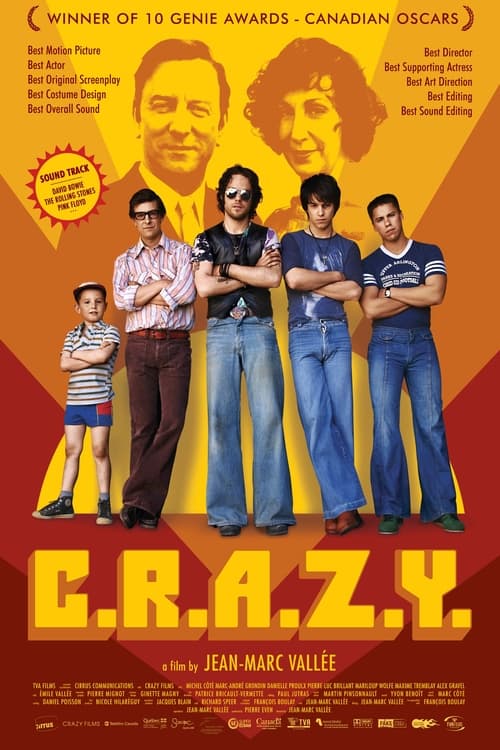
C.R.A.Z.Y.
2005 · Jean-Marc Vallée
For when you want a coming-of-age story that earns its tears — equal parts family warmth and family wound. Bring it to a night when you're ready to feel something real about parents and the people they can't quite see.
What it's about
Zachary is the fourth of five sons in a working-class Catholic family in 1960s and '70s Quebec, born on Christmas Day and adored by a father whose love comes with fixed ideas about what a son should be. As Zac grows up, his emerging sense of his own sexuality collides with everything his father cherishes, and the film follows fifteen years of rebellion, denial, and longing for approval inside one loud, close-knit household.
The experience
Tender, funny, and quietly devastating by turns — it moves with the rhythm of the era's pop and rock records and lands its emotional blows through small domestic moments rather than big speeches. You come out aching for both father and son.
Performances
Marc-André Grondin makes Zac's guardedness magnetic, and Michel Côté is extraordinary as the father — a man whose affection and rigidity come from the same place, so you can never simply write him off.
The craft
Jean-Marc Vallée braids autobiography, a wall-to-wall period soundtrack, and flashes of magical realism into something that feels both intimate and epic. The needle drops aren't decoration — songs carry the family's whole emotional language, so good speakers pay off.
Why it matters
A critical and popular sensation that became one of the defining Québécois films of the 2000s, it launched Vallée toward an international career and remains a touchstone of queer coming-of-age cinema.
Snapshot
C.R.A.Z.Y. is a Québécois coming-of-age drama that follows Zachary Beaulieu — the fourth of five sons in a working-class Catholic family — from his Christmas Day birth in 1960 through the mid-1970s, as he struggles to reconcile a dawning sense of his own homosexuality with the fierce, tender, and finally suffocating expectations of his father, Gervais. The title is a double signature: it spells out the initials of the five brothers (Christian, Raymond, Antoine, Zachary, Yvan) while nodding to the Patsy Cline standard "Crazy" that the father cherishes. Directed by Jean-Marc Vallée from a screenplay he wrote with François Boulay, the film braids autobiography, period pop music, and flashes of magical realism into an intimate family epic. It became one of the defining Québécois films of the 2000s — a critical and popular sensation at home, a Genie- and Jutra-sweeping awards juggernaut, and the launchpad for Vallée's subsequent international career. It endures as a touchstone of queer coming-of-age cinema and of Quebec's Quiet-Revolution-era self-portraiture.
Industry & production
C.R.A.Z.Y. was produced within Quebec's robust, subsidy-supported feature ecosystem, backed by Telefilm Canada and SODEC (Quebec's provincial funding body) and produced through Cirrus Communications with a dedicated production entity built around the film; Pierre Even is among the credited producers. It was a comparatively large undertaking by Québécois standards, and the screenplay had a long gestation — Boulay's semi-autobiographical material reportedly circulated for years before Vallée brought it to the screen, and Vallée has spoken of a lengthy development period. Exact budget figures reported in the trade press vary, and I will not assign a precise number; what is well established is that the production was ambitious for its national context, requiring period reconstruction of 1960s–70s suburban Montreal across a decade-and-a-half of story time.
The film's most consequential — and most frequently discussed — production fact is its music. The soundtrack leans on expensive, marquee catalog recordings (David Bowie, Pink Floyd, the Rolling Stones, Patsy Cline, and more), and clearing those masters consumed an unusually large share of the budget. This had a direct industrial consequence: international distribution was delayed, in part because the rights secured for the domestic release did not straightforwardly extend to foreign territories, and re-clearing them was costly. The film premiered at the Toronto International Film Festival in September 2005, where it won the award for Best Canadian Feature Film, opened strongly in Quebec, and only reached the United States in a limited release the following year. It was selected as Canada's official submission for the Academy Award for Best Foreign Language Film for that cycle, though it did not receive a nomination.
Technology
C.R.A.Z.Y. is a photochemical film shot and finished in the mid-2000s, on the cusp of but firmly before the digital-capture turn that would reshape the industry over the following decade. Its texture — grain, the warmth of period-appropriate color, the tactility of practical light sources — belongs to celluloid. The film uses digital tools mainly in service of period illusion and its handful of fantastical flourishes (dream and vision sequences), but it is not a technology-forward production in the sense of visual-effects spectacle; its innovations are aesthetic and musical rather than technical. The genuinely distinctive "technology" of the film is arguably its jukebox: the licensed master recordings function as a production resource as central as any camera or lens, and the film's identity is inseparable from the specific sound of those records.
Technique
Cinematography
Photographed by Pierre Mignot — a veteran cinematographer known internationally for his long collaboration with Robert Altman — the film moves fluidly between registers. It favors an intimate, mobile camera for the crowded domestic interiors of the Beaulieu home, catching the choreography of a family of seven in tight kitchen and living-room spaces, and it opens up for its lyrical set pieces. Mignot's lighting carries the period warmth of the era's décor and Christmas-lit interiors, and the palette shifts subtly as the film ages from the early-1960s into the harder, more saturated textures of the glam-rock 1970s. The camera is expressive rather than merely observational: it swoons and floats in the fantasy passages, then tightens into the charged silences between father and son.
Editing
The editing is one of the film's signature achievements — a propulsive, music-driven cutting style that compresses fifteen years into a fluid emotional continuum. Montage sequences set to pop records advance time, sketch family rhythms, and dramatize Zac's inner life, and the film repeatedly lets a song carry a scene's meaning across a jump in years. The cutting also negotiates the film's tonal range, moving between broad domestic comedy, tender intimacy, and near-surreal reverie without rupture. Reported credits for the below-the-line editorial team vary in the readily available record, so I will not assign a name I cannot confirm; the achievement, however, is unmistakably a montage sensibility that would recur throughout Vallée's later work.
Mise-en-scène / staging
Vallée and his team stage the Beaulieu household as a dense, lived-in world: period furnishings, religious iconography, the ritual geography of Catholic Quebec (Midnight Mass, the crèche, the family table). The five-brother ensemble is blocked to convey a pecking order and shifting alliances, and the father's domain — his prized car, his record player, his chair — is spatially coded as the seat of an authority Zac both craves and resists. Costume and hair track the passage from clean-cut early-'60s conformity to the long-haired, flared, androgynous fashions of the glam era, externalizing Zac's self-fashioning.
Sound
Sound is the film's beating heart. Rather than lean on an orchestral score, C.R.A.Z.Y. builds its sonic identity almost entirely from licensed pop and rock recordings that double as period markers, character notes, and emotional subtext — Patsy Cline's "Crazy" as the father's talisman, Bowie's "Space Oddity" and "Ziggy Stardust"-era glam as Zac's liberation, Pink Floyd and the Rolling Stones threading through key sequences. The music is diegetically and non-diegetically porous: songs bleed between the world of the film and its interior life. Because the film foregrounds needle-drops over a traditional composed score, I will not attribute an original-score credit I cannot verify; the point is precisely that the "score" here is a curated archive of the era's records.
Performance
The performances anchor the film's tonal ambition. Marc-André Grondin, as the teenage and young-adult Zac, gives a breakout turn of watchful vulnerability, carrying long passages on expression alone. Michel Côté — a beloved Québécois actor — plays Gervais, the father, as a man whose love and intolerance are inextricable, and the film's power depends on his refusal to make Gervais either a villain or a saint. Danielle Proulx plays the mother, a quieter locus of unconditional acceptance and folk faith. The child and adolescent performers who portray Zac and his brothers across the years sustain the illusion of a single family aging together. The father–son relationship is the film's dramatic spine, and it works because both actors keep it specific and unsentimental.
Narrative & dramatic mode
The film is a first-person memory narrative, filtered through Zac's consciousness and shaped by retrospection, with voice-over and subjective flourishes that mark it as a remembered childhood rather than a neutral chronicle. Structurally it is an episodic Bildungsroman organized around recurring rituals — successive Christmases, birthdays, family gatherings — that let the film measure change against constancy. Its dramatic mode blends naturalist family drama with comedy and with strands of magical realism: Zac's Christmas birthday aligns him with Christ, a motif the film literalizes in vision sequences (levitation during Mass, an ambiguous gift of healing), and a mystical thread runs through the mother's belief that Zac has a special power. This willingness to let the sacred and the surreal intrude on kitchen-sink realism distinguishes the film from a purely social-realist coming-out story.
Genre & cycle
C.R.A.Z.Y. sits at the intersection of the coming-of-age film, the queer coming-out narrative, and the family melodrama, all inflected by the period-nostalgia jukebox mode that flourished in the 1990s–2000s. It belongs to a lineage of pop-scored memory films about growing up under a difficult father, and to the international cycle of queer adolescence dramas — but it distinguishes itself by embedding the coming-out story inside a broad, affectionate, ensemble family portrait rather than isolating it. Within Québécois cinema it participates in a strong regional tradition of films that reckon with Catholicism, patriarchal authority, and the legacy of the Quiet Revolution through the lens of family.
Authorship & method
Jean-Marc Vallée (1963–2021) directed and co-wrote the film, and it is the clear hinge of his career. A Montreal-born filmmaker who had debuted with the Quebec thriller Liste noire (1995) before a period of journeyman work, Vallée found in C.R.A.Z.Y. the fusion of pop-music montage, handheld intimacy, and emotionally raw performance that would become his authorial signature — carried forward into The Young Victoria (2009), Dallas Buyers Club (2013), Wild (2014), and his acclaimed HBO limited series Big Little Lies and Sharp Objects. His method favored music as narrative engine and actor-forward, unfussy realism punctuated by lyrical rupture. The screenplay was written with François Boulay, and the story draws on autobiographical material; the intimacy of the father–son conflict owes much to that personal grounding. Key collaborators include cinematographer Pierre Mignot, whose expressive-yet-grounded camera shapes the film's look, and the ensemble cast led by Michel Côté and Marc-André Grondin. On the sonic side, the defining creative "authorship" is the music supervision and licensing that assembled the film's catalog soundtrack. There is a poignant biographical coda: Vallée died on December 25, 2021 — Christmas Day, the very date that anchors his protagonist's identity in this film.
Movement / national cinema
The film is a landmark of contemporary Québécois cinema, a national cinema with its own funding structures, star system, and thematic preoccupations distinct from Anglophone Canadian film. It arrived in a strong period for Quebec features and became one of the era's flagship domestic successes. Its concerns — the grip of the Catholic Church, patriarchal family authority, and the social transformations of the 1960s–70s — engage directly with the memory of the Quiet Revolution, the period in which Quebec rapidly secularized and modernized. The film's popularity at home reflected its resonance as a shared generational self-portrait, and its international travel positioned Québécois cinema on the festival circuit.
Era / period
Though made in 2005, the film is set across roughly 1960 to the mid-1970s, and period is central to its meaning. It charts the loosening of Catholic Quebec, the arrival of counterculture, and the sexual and stylistic revolutions embodied in glam rock — Bowie above all — as both liberation and provocation within a conservative household. The music functions as a historical index, each record dating a moment and marking the widening gap between the father's world and the son's. The film's nostalgia is affectionate but not uncritical: it renders the warmth of the era's family life while tracing the real costs of its rigid gender and religious norms.
Themes
The central theme is the reconciliation of identity and love under conditions of intolerance — Zac's need to be himself against his need for his father's approval. Around this cluster the film's other concerns: faith and doubt (the Christ-motif, the mother's mysticism, the waning authority of the Church); masculinity and its inheritance across five brothers and a father; conformity versus self-expression, dramatized through music and dress; family as both refuge and prison; and memory itself as the medium through which a life is understood. The film insists that acceptance and cruelty can share a single face, and it refuses easy resolution even as it moves toward reconciliation.
Reception, canon & influence
C.R.A.Z.Y. was received as a major achievement. It won Best Canadian Feature Film at TIFF 2005 and went on to dominate Canada's and Quebec's awards seasons, sweeping the Genie Awards (including Best Motion Picture) and the Jutra Awards; it stands among the most decorated Québécois films of its decade. It was also a substantial commercial success at home, ranking among the highest-grossing Quebec films of its era (exact figures reported in the press vary, so I cite the standing rather than a number). Critical reception was warm both in Canada and, once distribution hurdles were cleared, abroad, with particular praise for the performances, the music, and Vallée's control of tone.
Looking backward, the film draws on the pop-scored memory film and the family melodrama, on Quebec's own tradition of Church-and-family reckoning, and on the glam-rock iconography of Bowie as a cultural text within the story. Looking forward, its influence runs first through Vallée's own career: the montage-driven, music-forward, performance-centered style he refined here became his calling card in Dallas Buyers Club, Wild, and Big Little Lies. More broadly, the film became a canonical entry in queer coming-of-age cinema and a reference point for Québécois filmmakers of the following generation, and it is frequently cited in surveys and retrospective polls of the best Canadian films. Its reputation has if anything deepened since Vallée's death, as audiences reread the Christmas-Day framing through the loss of its author.
Reception
A phenomenon in Quebec in 2005 — the year's biggest homegrown hit, a Genie Awards sweep, TIFF's Best Canadian Feature — yet Americans legally couldn't watch it for 17 years because the music rights were never cleared for the US. It finally got its first American release in 2022, months after Vallée's sudden death, arriving pre-canonised.
How C.R.A.Z.Y. was received, from release to now →
Influences: the films it descends from and the films it influenced
- American Graffiti (1973) — Establishes the wall-to-wall licensed-jukebox architecture where a continuous catalog of period pop songs functions as the film's ongoing score and time-anchor — the structural template for C.R.A.Z.Y.'s soundtrack-as-narrative-engine.
- Mean Streets (1973) — Pioneers dropping rock records over Catholic guilt and family/neighborhood ritual, letting pop needle-drops carry religious conscience — the pop-scored Catholic melodrama Vallée directly inherits.
- GoodFellas (1990) — Models the music-driven montage that sweeps years of a life via period-specific pop cues used as emotional counterpoint and chronological markers, the editing grammar Vallée adopts.
- The 400 Blows (1959) — The autobiographical boyhood bildungsroman of a son at war with his father, shot with roving handheld intimacy and closing on a held, memory-freighted image.
- Amarcord (1973) — The comic-nostalgic memory film that punctures period-Catholic family realism with magical-realist fantasy ruptures — the lyrical-rupture device C.R.A.Z.Y. uses for Zac's levitation and church visions.
- Mon oncle Antoine (1971) — The foundational Québécois coming-of-age inside a Catholic community, the Church-and-family reckoning tradition C.R.A.Z.Y. extends — and whose director names the Jutra Award it swept.
- Léolo (1992) — Québécois magical-realist bildungsroman narrated in memory-voiceover, a boy fantasizing escape from a working-class family — the direct Quebec precursor to C.R.A.Z.Y.'s voiceover-plus-magical-realism.
- Velvet Goldmine (1998) — Deploys Bowie/glam-rock iconography as a text of queer self-invention, staging pop stardom as coming-out mythology — the lineage behind Zac's 'Space Oddity' bedroom fantasy.
- My Own Private Idaho (1991) — The queer coming-of-age that breaks naturalism with surreal/lyrical rupture and fragmented memory imagery, licensing C.R.A.Z.Y.'s departures from realism.
- Dallas Buyers Club (2013) — Vallée carries forward the actor-forward, unfussy handheld realism and music-forward method refined here, stripping coverage to raw performance.
- Wild (2014) — Scales up C.R.A.Z.Y.'s associative memory-montage, where needle-drop fragments and voiceover trigger nonlinear recollection rather than linear flashback.
- Big Little Lies (2017) — Extends the porous diegetic-nondiegetic technique so characters' own songs bleed into the score, music becoming the narrative's emotional grammar.
- Sharp Objects (2018) — Fuses the protagonist's diegetic playlist (Led Zeppelin on headphones) with fragmentary flash-cut memory editing — C.R.A.Z.Y.'s music-and-memory device in its most dissolved form.
- Mommy (2014) — Next-generation Québécois family melodrama built on needle-drop pop montage and lyrical rupture (the widescreen 'Wonderwall' expansion), the heir Vallée's music-forward style enabled.
- Humanist Vampire Seeking Consenting Suicidal Person (2023) — Québécois coming-of-age about a child who cannot meet a parent's fixed template, structured around pop needle-drops and the ache of inherited family expectation.
- Billy Elliot (2000) — Stages a working-class father-son rupture over a son's nonconformity and releases it through glam-rock (T. Rex) music-and-movement set pieces, the same fusion of pop cue and emotional catharsis.
- Sing Street (2016) — Coming-of-age in which period pop/new-wave becomes the literal engine of identity formation and family escape, treating song as the primary narrative device the way C.R.A.Z.Y. does.
Similar films
- Mommy (2014) — influence & lineage
- The 400 Blows (1959) — influence & lineage
- Take It All (1963) — shared sensibility
- Murmur of the Heart (1971) — shared sensibility
- Caché (2005) — shared sensibility
- Y Tu Mamá También (2001) — shared sensibility
- Au Revoir les Enfants (1987) — shared sensibility
- Summer of 85 (2020) — shared sensibility