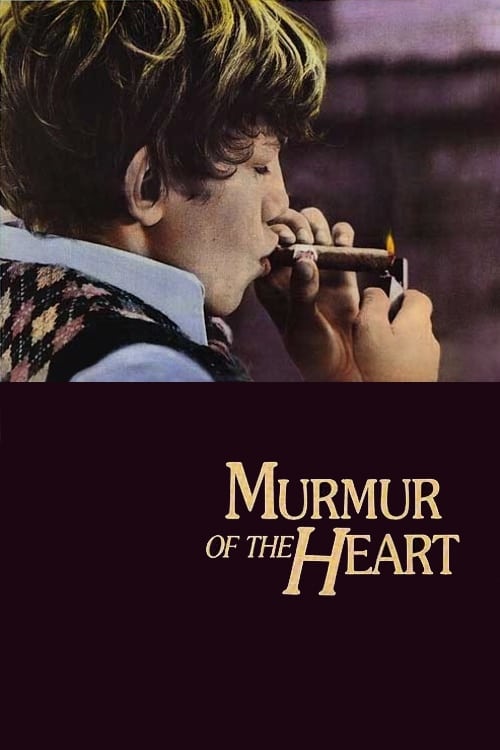
Murmur of the Heart
1971 · Louis Malle
For when you want a coming-of-age film with real nerve — charming and alive on the surface, provocative underneath. Expect to be disarmed, then challenged; this is not a safe nostalgia piece.
What it's about
Dijon, 1954. Laurent is fifteen, the youngest son of a comfortable doctor's family — precocious, jazz-mad, fumbling through Catholic school, older brothers' pranks, and his first clumsy encounters with sex. When scarlet fever leaves him with a heart murmur, he's sent to a spa town to convalesce in the company of his beautiful, restless, Italian-born mother, and the film follows their unusually close, complicated bond through one charged summer.
The experience
Warm, funny, and startlingly frank — it has the loose, sunlit rhythm of remembered adolescence, all Charlie Parker records and family chaos, then steers calmly into genuinely taboo territory without ever raising its voice. What unsettles most is how tender and unjudging it stays.
Performances
Lea Massari is extraordinary as the mother — vivacious, unhappy, and impossible to reduce to either victim or villain — and Benoît Ferreux makes Laurent's awkwardness feel caught rather than acted.
The craft
Louis Malle, writing alone for once, builds the film from loose, lived-in episodes rather than plot, trusting texture — the jazz, the dinner-table warfare, the spa-town rituals — to carry it. The refusal to moralize or punish is the boldest formal choice in the film, and everything is staged to keep judgment out of the frame.
Why it matters
One of the defining scandals and triumphs of 1970s European cinema, it cemented Malle's reputation as the French director most willing to walk into forbidden territory with a light step, and it remains a touchstone for how far a coming-of-age story can go.
Snapshot
Le Souffle au cœur is the film in which Louis Malle discovered that the most transgressive thing a director could do with a taboo was to decline to punish it. Set in Dijon in 1954, it follows Laurent Chevalier, fifteen, third son of a comfortable provincial medical family, through a season of Charlie Parker records, Catholic school, an older brothers' idea of a favour at a brothel, a groping confessor, scarlet fever, and finally a convalescent stay at a thermal spa with his beautiful, unhappy, Italian-born mother — a stay that ends in a night neither of them will repeat and neither of them will regret. The last shot of the film is a family laughing.
That refusal of tragedy is the whole design. Malle's screenplay — written alone, unusually for a director who habitually worked with collaborators — treats a mother-son incest as a comic incident inside a comedy of manners rather than as a rupture that shatters a world. The film's title supplies its governing figure: a heart murmur is a permanent irregularity that is nonetheless benign, a flaw you carry without being killed by it. The film earned Malle an Academy Award nomination for Best Original Screenplay and a permanent, slightly uneasy place in the canon of European adolescence pictures. Fifty years on it remains genuinely difficult to place, which is roughly what Malle wanted.
Industry & production
Malle came to Murmur of the Heart from three years in India. Between 1968 and 1969 he shot the material that became the feature Calcutta and the seven-part television series L'Inde fantôme (Phantom India), an immersion in observational documentary that broke his working habits open and, by his own account, sent him back to fiction wanting something looser, closer to lived texture, less engineered. Murmur is the first fiction feature after that break, and the documentary residue is everywhere in it — in the overlapping family talk, the unemphatic camera, the willingness to let scenes run past their dramatic function.
By 1971 Malle was in the enviable position of being able to finance a difficult subject on the strength of a commercial track record. He had produced through his own company, Nouvelles Éditions de Films, since the early sixties; Murmur was mounted as a French–Italian–West German co-production, the standard European financing architecture of the period, which spread risk across territories and gave a director with Malle's reputation room to make a film whose central event no single national market would have underwritten alone.
The censorship question was not hypothetical for him. His second feature, Les Amants (1958), had become the object of an American obscenity prosecution that reached the Supreme Court in Jacobellis v. Ohio (1964) — the case that produced Justice Potter Stewart's "I know it when I see it." Malle therefore knew exactly what he was taking on, and the incest sequence duly generated classification disputes and moralizing press in several territories on release. What is notable in retrospect is how little the film was actually suppressed: it opened, it was reviewed seriously, it was nominated for an Oscar. The post-1968 loosening of French censorship, and the parallel collapse of the American Production Code into the ratings system, had shifted the ground underneath the taboo faster than most people had registered.
Technology
Conventionally made, by design. 35mm color negative, in the 1.66:1 frame that was the house shape of French features of the period — narrow enough to hold a face and a doorway in the same composition, wide enough to keep a family in the frame together. No optical showmanship, no zoom-driven television grammar, none of the handheld reportage aesthetic that Malle had just spent three years practicing in India, though the attitude of that reportage is retained.
The most consequential technical decision is one of omission: there is no composed score. Malle built the film's music entirely from records — Charlie Parker above all, with Sidney Bechet and other jazz of the period — which means the soundtrack is not an authorial commentary layered over the image but an object inside the fiction, a thing Laurent owns, plays, and defends. The technology at issue is the domestic record player, and the film understands it as the first instrument of adolescent privacy: the device that lets a boy build a culture his parents cannot enter.
Technique
Cinematography
Ricardo Aronovich shot the film. Argentine-born, trained partly in the Brazilian Cinema Novo orbit — he photographed Ruy Guerra's Os Fuzis (1964) — Aronovich went on to a distinguished European career including Alain Resnais's Providence (1977) and Costa-Gavras's Missing (1982). His work here is a study in tactical plainness. Interiors are lit as though by their own lamps and windows; the palette runs to the browns, ochres and dull golds of a heavy bourgeois household, opening into cooler greens and whites when the film moves to the spa. Camera movement is functional and unhurried, following bodies through rooms rather than pointing at meanings.
The restraint is strategic. Because the image never dramatizes, the film can approach its most explosive material without visual warning — the bedroom sequence is shot in the same unemphatic register as a lunch, which is precisely what makes it unnerving. Aronovich also finds a specific quality for the spa: bright, enervated, a little too much light for people with nothing to do, a convalescent world where time has been suspended and ordinary rules have gone soft.
Editing
Suzanne Baron cut the film — an editor whose credits run from Jacques Tati's Mon Oncle (1958) through much of Malle's mature work and on to Volker Schlöndorff's The Tin Drum (1979). Her contribution is structural. Murmur is deliberately "loosely plotted," to borrow the synopsis's phrase, but its looseness is engineered: the film accumulates episodes rather than building acts, and Baron's cutting keeps each episode slightly longer than plot economy would allow, so that the comedy of family life registers as duration rather than as gag. Scenes end on afterthoughts. Nothing is stinger-cut.
The one place the editing tightens is the ending, which lands its laugh with sudden precision after two hours of drift — a structural joke that only works because the preceding rhythm has been so patient.
Mise-en-scène / staging
The Chevalier household is staged as a system of noise. Malle keeps three brothers, two parents, servants and visitors circulating through the same rooms, talking across each other, and he composes for the group rather than the individual, so that Laurent is constantly visible as the smallest and least-consulted element of a crowd. The two older brothers are a single organism of adolescent cruelty and affection; the father is a background authority, a doctor absorbed in his practice; the mother, Clara, is the only other person in the house who does not belong to it.
The period is built from the middle distance rather than declaimed: 1954 arrives through newspaper headlines about Indochina, a scout troop, a Catholic school's rituals, radio, cars, clothes. Malle's key staging idea is the ironic counterpoint of scale — the fall of Dien Bien Phu and the end of French Indochina play out in the background of a film whose foreground crisis is a boy's virginity. The film's first substantial gag has Laurent and his brother collecting money ostensibly for the war's wounded and spending it on a jazz record. Empire ends; adolescence continues.
Sound
The soundtrack is dominated by overlapping speech — a family that talks constantly and listens rarely. Against that, jazz functions as a second voice, always source music, always chosen by someone on screen. Because there is no orchestral underscore to instruct the audience how to feel, emotional cues have to be read off behavior, and the film's most transgressive passages arrive without any sonic signal that something momentous is occurring. The absence is the design.
Performance
Benoît Ferreux plays Laurent with an unshowy watchfulness that is the film's anchor: sullen, funny, precociously literate, physically unfinished. Lea Massari's Clara is the performance the film lives on. Massari carried a particular art-cinema charge — she is the woman who vanishes in Antonioni's L'Avventura (1960) — and she uses it here in reverse, playing a woman who is entirely, embarrassingly present. Her Clara is Italian in a French provincial house, married up and never quite naturalized, conducting an affair with a candor that scandalises her sons and amuses her, and treating Laurent less as a child than as her only ally. Massari plays her without a trace of predation or pathology, which is what makes the film's final act legible as something other than abuse — and what has kept the film arguable ever since.
Daniel Gélin, a fixture of French cinema since Ophüls's La Ronde (1950) and known internationally from Hitchcock's The Man Who Knew Too Much (1956), plays the father as a man of settled, distracted decency, present enough to be an authority and absent enough not to be an obstacle.
Narrative & dramatic mode
The mode is picaresque comedy with a first-person center. Events accrete — school, scouts, records, the brothel, the confessor, the illness, the spa — without the causal chaining of conventional dramaturgy, and the film's crisis is not a crisis in the ordinary sense because it produces no catastrophe. The morning after, mother and son agree that the night will be a memory neither will speak of nor repeat, and the film honors that agreement: no punishment, no revelation scene, no ruin.
This is the film's true formal transgression and the source of most of the argument about it. Classical narrative treats incest as the engine of tragedy, from Sophocles forward; Murmur of the Heart declines the engine. The final sequence — the family arriving to find Laurent with a girl, and everyone collapsing into laughter — converts the entire preceding structure into farce retrospectively, and leaves the audience holding a response it did not choose.
Genre & cycle
It sits in the French adolescence film, a line running from Jean Vigo's Zéro de conduite (1933) through Truffaut's Les Quatre Cents Coups (1959) — films that take a boy's interiority as a subject worthy of a feature and treat institutions (school, church, family) as the antagonists. Malle inflects the cycle in two ways: his boy is bourgeois rather than dispossessed, so the film becomes a comedy of class rather than a drama of neglect; and his adolescent's problem is not escape but appetite.
It also belongs, more awkwardly, to the early-seventies European cycle of sexual candor that followed the collapse of the old censorship regimes — the same permission that produced Last Tango in Paris the following year. And its 1954 setting places it at the front edge of what would become the French mode rétro, the mid-seventies reopening of the national past, of which Malle's own Lacombe, Lucien (1974) is a defining and far more incendiary example.
Authorship & method
Malle is the least classifiable of the major French directors of his generation because he never belonged to a group. He trained at IDHEC rather than at Cahiers du cinéma; he began as co-director and cameraman on Jacques-Yves Cousteau's Le Monde du silence (1956) and as an assistant to Robert Bresson; his Ascenseur pour l'échafaud (1958), with its improvised Miles Davis score, preceded the New Wave's breakthrough year without being of it. Across a career he moved restlessly between documentary and fiction, France and America, and between subjects chosen apparently to prevent him from developing a signature.
His method on Murmur is the documentarist's applied to invention: build a milieu with obsessive specificity, then let a story happen inside it. Malle was open about the autobiographical texture — a wealthy provincial Catholic family, Jesuit schooling, the particular suffocations of that class — while consistently maintaining that the film's central event was invented. The distinction matters: the film's authority comes from the accuracy of the world, not from a confession.
Key collaborators: Aronovich's photography, Baron's editing, and the found jazz score are the three technical pillars. The sole-screenwriter credit is the outlier — Malle worked with Jean-Claude Carrière on Viva Maria! (1965) and would write Lacombe, Lucien with the novelist Patrick Modiano — and it shows in the film's unusual intimacy of address.
Movement / national cinema
French, and adjacent to the New Wave without being a product of it. By 1971 the New Wave as a movement had dispersed, and Malle occupied a distinctive position: an independent producer-director with international financing, commercial credibility, and no critical faction to answer to. The film's Italian and German co-production money, and its Italian lead, are typical of a French industry that by the early seventies was substantially pan-European in its economics while remaining resolutely national in its subject matter.
Era / period
Two eras are in play. The depicted one is 1954 — the last months of French Indochina, a Catholic bourgeoisie still fully intact, an economy climbing into the Trente Glorieuses, jazz arriving as the sound of an elsewhere. The producing one is 1971 — three years after May '68, with censorship in retreat, the family under sustained ideological attack, and France beginning to reopen questions about its own recent past that the Gaullist consensus had closed. Marcel Ophüls's Le Chagrin et la pitié, which dismantled the myth of a nation of resisters, reached French cinemas around the same moment and was kept off French television for years.
Murmur belongs to that second moment while being set in the first. Its 1954 is observed by a 1971 sensibility that finds the whole apparatus — Church, army, patriarchy, the sanctity of the family — less monstrous than absurd.
Themes
Adolescence as appetite rather than innocence. Laurent is not corrupted by the adult world; he is impatient with how slowly it lets him in.
The benign defect. The heart murmur is the film's central metaphor: an irregularity that will never resolve and will never kill you. The incest is offered as the same kind of thing — a permanent private irregularity, absorbed rather than expiated.
Institutions as comedy. School, Church and army are treated not as engines of trauma but as sources of hypocrisy the boy sees through. The predatory priest is played for squirming farce; the war is background noise.
Class and the outsider mother. Clara's foreignness and her lower origins make her the household's other adolescent, allied with Laurent against a decorum neither of them believes in.
Memory without guilt. The film's most radical proposition is that an experience can be transgressive and formative and still not require repentance — a proposition it advances not by argument but by ending on a laugh.
Reception, canon & influence
Backward. The film's inheritance is legible: Vigo and Truffaut for the adolescent subject; Renoir for the comic treatment of a bourgeoisie observed with affection and no illusions; Bresson, in whose orbit Malle briefly trained, as the discipline against which Malle's looseness defines itself. The documentary years in India are the immediate formal antecedent — the observational patience of Phantom India transposed onto a French dining room. The jazz is a genuine influence rather than decoration: Malle had built Ascenseur pour l'échafaud around Miles Davis's improvisation, and Parker's presence here continues a career-long conviction that jazz was the twentieth century's native emotional grammar.
Contemporary reception. Critical reception, in France and especially in the United States, was substantially admiring — enough to carry the film to an Academy Award nomination for Malle's screenplay, a striking outcome for a European picture whose plot summary alone would have disqualified most contenders. The praise consistently attached to the same qualities: the accuracy of the family portraiture, Massari's performance, and the film's tonal nerve. The dissent, then and since, attaches to the ending's comic absolution — the charge that Malle uses charm to make an unexaminable act unexaminable. That argument has not been settled and is arguably the reason the film has stayed alive.
Forward. The most direct line runs through Malle's own filmography: Lacombe, Lucien (1974) applies the same refusal of moral instruction to French collaboration, and Pretty Baby (1978), his first American film, returns to the sexuality of the very young with far more contested results. Beyond Malle, Murmur stands as the reference point for any film that stages adolescent sexual awakening as comedy rather than trauma. Bertolucci's La Luna (1979) takes up mother-son desire in an explicitly operatic register that reads as the anti-Murmur. In France, the line of unsentimental adolescence pictures continues through Diane Kurys's Diabolo menthe (1977) and, most closely, André Téchiné's Les Roseaux sauvages (1994), which repeats Malle's core structure almost exactly — sexual coming-of-age in the provinces against the background noise of a colonial war. Its international descendants include the strand of coming-of-age film, Alfonso Cuarón's Y tu mamá también (2001) prominent among them, that treats sex as ordinary, funny and consequential without treating it as damage.
The film's canonical position is secure — it circulates in restored form as part of the standard Malle repertory, grouped with Lacombe, Lucien and Au revoir les enfants as his central French trilogy — while its argument remains open. That combination is rare. Most films that scandalise are either absorbed or forgotten; Murmur of the Heart has been absorbed without being defused.
A Deleuzian reading
Two boys rattle a collection tin for the wounded of Indochina, then spend the take on a Charlie Parker record.
The full Deleuzian reading of Murmur of the Heart →
Reception
In 1971 it was a genuine scandal — a coming-of-age comedy that strolls up to cinema's biggest taboo with a shrug — yet critics largely embraced it anyway. Today it's Criterion-canonised as one of the great French films about adolescence, though its final act startles first-time viewers just as much as it did then.
How Murmur of the Heart was received, from release to now →
How to watch Murmur of the Heart: what to notice on a first viewing
- Listen for how many people are talking at once. The Chevalier house runs on overlapping speech, three brothers and two parents talking across each other while jazz records play as the only chosen, deliberate sound. This is a family that talks constantly and listens rarely, and the sound mix tells you so before any scene does.
- Watch how small Laurent looks in his own crowded house. Malle composes for the whole family circulating through shared rooms rather than for Laurent alone, so he stays visible as the youngest and least-consulted body in the group. He is not the hero of his own household, which is exactly the position the film wants you to feel.
- Watch a scene end a beat after the joke has landed. Suzanne Baron holds nearly every episode past the point plot economy would allow, letting family comedy register as duration rather than as a punchline you're rushed past. The extra beat is where the film's affection for these people actually lives.
- Notice the war arriving only through headlines and radio. The fall of Dien Bien Phu plays out entirely offscreen, mixed into scout troops and school rituals, never staged as an event the characters actually witness. An empire can end in the background of a story about a boy's summer, and the film treats both as equally real.
- Watch Laurent watch everyone else in the room. Benoît Ferreux plays him sullen, funny, and precociously literate, mostly registering what happens around him rather than driving it. His watchfulness is the film's actual point of view, even inside a crowded ensemble.
The whole guide to watching Murmur of the Heart, with the keys for a rewatch →
Influences: the films it descends from and the films it influenced
- Zéro de conduite (1933) — Establishes the boarding-school film as a series of loosely linked comic insurrections performed by non-actor boys rather than a plotted drama, the sketch-unit construction Malle borrows for the Jesuit-school and scout-camp passages.
- The Rules of the Game (1939) — Deep-staged group compositions in which family, guests and servants all speak at once in one frame, so the bourgeois household is characterized by traffic and overlapping talk rather than by dialogue scenes — the exact method of Murmur's dinner tables and stairwells.
- A Man Escaped (1956) — Malle worked as Bresson's assistant here and absorbed a soundtrack built almost wholly from diegetic noise with music admitted only as a found object; Murmur's records-only score is that principle kept while the ascetic framing is abandoned.
- Mon Oncle (1958) — Editor Suzanne Baron's training ground: cutting comic ensemble blocking so the shot holds past the gag and releases on a stray gesture — the afterthought-endings that close nearly every scene in Murmur.
- Elevator to the Gallows (1958) — Malle's first use of jazz as improvised emotional commentary rather than scoring (Miles Davis blowing to projected rushes); Murmur completes the argument by demoting the jazz to records the characters actually own and play.
- The 400 Blows (1959) — The template for directing an untrained adolescent to behave rather than perform, and for withholding the moral verdict at the cut — Malle takes the method and swaps the punitive ending for absolution.
- I Vitelloni (1953) — Picaresque provincial drift with no plot engine: episodes accumulate around a group of idle young men, and scale-irony comes from staging private humiliations against civic pageantry — Murmur's structure and its band-and-banquet counterpoints.
- L'Avventura (1960) — Where Lea Massari built her technique of playing a woman whose interiority is deliberately withheld from the camera; Clara's unreadability in Murmur is that same performance grammar transposed to comedy.
- Zazie dans le métro (1960) — Malle's earlier experiment in filming a child's-eye picaresque of gags in which adult sexuality is treated as absurd comic material rather than as scandal.
- Phantom India (1969) — The immediate formal antecedent: available-light handheld observation that lets an event finish before the camera reacts to it, a documentary patience carried directly into the fiction of a French dining room.
- Lacombe, Lucien (1974) — Applies the same refusal to instruct the audience — non-professional adolescent lead, unemphatic camera, no score to signal judgment — to the far more incendiary subject of collaboration.
- Diabolo menthe (1977) — Builds a school year out of discrete comic incidents with period pop songs used only as source music, taking Malle's episodic-with-afterthoughts construction into a girls' lycée.
- Pretty Baby (1978) — Returns to underage sexuality with the same tonal refusal of alarm, again scored only by music played within the frame (the brothel's ragtime piano), with Nykvist's available-light interiors extending Aronovich's approach.
- La Luna (1979) — The deliberate inversion: mother-son desire staged with operatic camera movement, Verdi on the score and expressionist lighting — a demonstration of what Malle's unemphatic camera and source-only sound were suppressing.
- Au revoir les enfants (1987) — Returns to the Catholic boarding school with the same ensemble blocking of boys in dormitories and refectories and music restricted to what is performed on-screen, now with the comic absolution withdrawn.
- Les Roseaux sauvages (1994) — Repeats Malle's architecture almost point for point: provincial adolescent sexual awakening staged in loose episodes with a colonial war audible only as radio and adult chatter in the background of the frame.
- Y tu mamá también (2001) — Extends the picaresque-episodic road structure and the treatment of sex as ordinary, funny and consequential rather than damaging, with an unemphatic long-take camera that drifts off the principals onto the surrounding world.
- Damage (1992) — Codifies Malle's refusal of moral commentary — a level, unhurried camera that declines the judging reaction shot at exactly the moment the culture expects one — which is the operative method of Damage's entire treatment of Stephen and Anna.
- L'Enfance nue (1968) — Parallel French method of casting a non-professional child and shooting domestic scenes in real interiors under available light, letting exposition arrive through incidental talk rather than through scripted set-ups.
Similar films
- Au Revoir les Enfants (1987) — influence & lineage
- The 400 Blows (1959) — influence & lineage
- The Chorus (2004) — shared sensibility
- The Strange Ones (1950) — shared sensibility
- Damage (1992) — shared sensibility
- Little Amélie or the Character of Rain (2025) — shared sensibility
- I Killed My Mother (2009) — shared sensibility
- Tomboy (2011) — shared sensibility