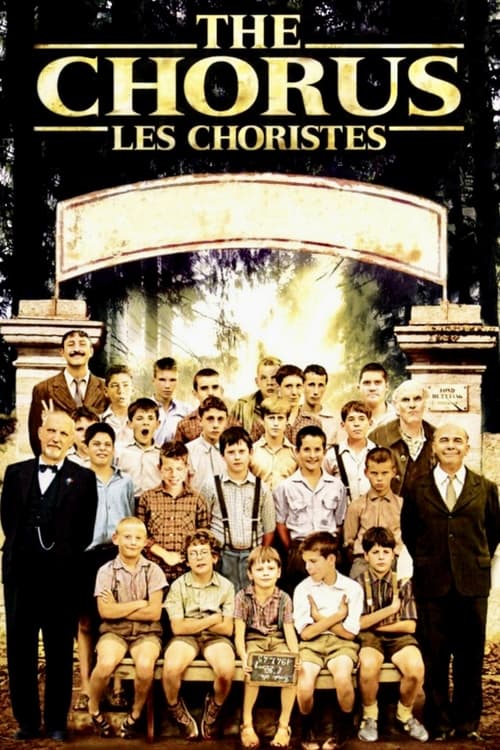
The Chorus
2004 · Christophe Barratier
For when you need a good cry of the uplifting kind — a teacher-changes-lives story to restore your faith in patient kindness. Pure comfort viewing; bring tissues, not skepticism.
What it's about
Postwar France, the late 1940s. Clément Mathieu, a gentle, out-of-work musician, takes a job as supervisor at a grim boarding school for 'difficult' boys, where the headmaster's answer to everything is punishment. Quietly defying the regime, Mathieu starts teaching the boys to sing — and the choir he builds begins to change them, especially one troubled boy with a startling voice.
The experience
Warm, sentimental, and completely unembarrassed about it — a gentle film that builds toward moments where the music simply takes over and gets you. It moves at an unhurried, old-fashioned pace and aims straight for the heart.
Performances
Gérard Jugnot is quietly wonderful as Mathieu — a modest, rumpled man whose decency never tips into sainthood — and the boys' choir performances, led by a genuinely remarkable young soprano voice, carry the film's biggest moments.
The craft
The choral score is the engine of the whole film — its songs became a phenomenon in France in their own right — and the muted, nostalgic period reconstruction of the 1940s school gives the music something austere to shine against. Worth watching with good speakers purely for the voices.
Why it matters
One of the defining popular successes of French cinema in the 2000s, a debut feature that became a national event, sent its soundtrack up the charts, and earned Oscar attention — the modern flagship of French heritage cinema.
Snapshot
Les Choristes is a French period drama about Clément Mathieu, an unemployed musician who takes a post as a supervisor at a bleak boarding school for difficult boys in postwar France and, against the grain of the institution's punitive regime, forms a choir that transforms the children and, briefly, himself. It was the feature debut of Christophe Barratier, and it became one of the defining popular successes of French cinema in the 2000s — a film that reached an audience far larger than the arthouse or festival circuit and lodged itself in the national imagination largely through its music. Warmly sentimental, unashamedly humanist, and formally conservative, the film is a modern flagship of what French critics call cinéma du patrimoine or heritage cinema: a nostalgic, meticulously appointed reconstruction of a mid-century past that trades on collective memory as much as on story. It earned two Academy Award nominations (Best Foreign Language Film and Best Original Song) and turned its boy soprano and its composer into household names in France.
Industry & production
The film was produced by Jacques Perrin's Galatée Films, in a configuration that is central to understanding the project. Perrin — the actor-producer behind the international nature spectacles Microcosmos (1996) and Winged Migration (2001) — is Christophe Barratier's uncle, and Barratier had worked within Galatée's orbit before stepping up to direct. Les Choristes was thus a family-and-house production in the most literal sense, with Perrin lending both his production apparatus and, on screen, his presence: he plays the adult Pierre Morhange, the celebrated conductor whose memory frames the narrative. The production was mounted as a mid-budget period piece, with the co-production support typical of French heritage filmmaking of the era (French financing supplemented by regional and pan-European partners; I would not want to assert exact budget figures without the record in front of me).
The commercial outcome is the film's most striking industrial fact. Released in France in 2004, Les Choristes became a genuine cultural phenomenon, drawing an enormous domestic audience — it stands among the biggest French box-office successes of the decade in terms of admissions — and it traveled unusually well for a French-language film, finding distribution across Europe, in Asia (where it performed strongly), and in the United States through Miramax. The soundtrack album was itself a major commercial success and a significant part of the film's revenue and afterlife. This combination — a first-time director, a modest heritage subject, and blockbuster-scale returns — made the film a talking point in France about the health and direction of popular national cinema.
Technology
Technologically, Les Choristes is unremarkable by design, and that is the point: it was made on 35mm film with conventional tools at a moment when French mainstream production had not yet moved to digital capture. Its "technology," in the sense that matters to the film, is acoustic and musical rather than photographic. The production's most consequential technical decision was the recording and integration of live choral performance — the boys' voices had to be captured, mixed, and married to the image with enough fidelity to carry the film's emotional weight, and the sound work was recognized as among the film's genuine achievements (it won the César for Best Sound). The rest of the craft is analog period reconstruction: sets, costumes, and locations dressed to evoke 1949 rather than any digital augmentation of it. I am not aware of the film employing significant visual-effects or novel imaging technology, and I would rather note that plainly than invent a technical story the film does not have.
Technique
Cinematography
The photography (credited to Carlo Varini and Dominique Gentil) is keyed to the heritage register: warm, softened, and nostalgic, with an autumnal palette of browns, grays, and amber interiors that renders the harsh school — the aptly named "Fond de l'Étang," the Bottom of the Pond — as simultaneously oppressive and, in memory, burnished. The camera is restrained and classical, favoring stable framings and legible compositions over expressive movement. Light is used thematically: the dim, institutional gloom of the dormitories and stone corridors is repeatedly set against the light that enters when the choir sings, a straightforward but effective visual grammar in which music is figured as illumination. This is cinematography in service of clarity and feeling rather than of authorship or spectacle.
Editing
Yves Deschamps's editing organizes the film around a memory frame: the film opens in the present with the aged Morhange, and the body of the narrative unfolds as flashback prompted by Mathieu's rediscovered diary. The cutting within the school story is unobtrusive and continuity-based, structured to build the choir incrementally — audition by audition, rehearsal by rehearsal — so that the emotional payoff of the full-voiced performances is earned through accumulation. The editing's most conspicuous work is musical: the sequences in which the choir sings are built to let performance play at length, trusting the music to carry duration in a way the rest of the film's brisker scene-work does not.
Mise-en-scène / staging
The film's world is tightly bounded — a single institution of stone walls, iron gates, a courtyard, dormitories, and a headmaster's office — and Barratier stages the drama as a set of confinements and small liberations within it. The recurring spatial motif is enclosure versus release: boys marshalled in rows, punished in isolation, set against the choir arranged in loose, upturned-faced formations. Production design leans into period verisimilitude and a certain storybook legibility; the school is a moral geography as much as a place, with the headmaster's regime of "action–reaction" punishment embodied in its architecture of corridors and locked rooms.
Sound
Sound is where Les Choristes is most ambitious and most successful. Bruno Coulais's score and the choral arrangements — performed by Les Petits Chanteurs de Saint-Marc, the Lyon boys' choir — are not decorative but structural; the film essentially argues that sound can redeem, and it stakes its whole emotional case on the listener's response to unaccompanied and lightly accompanied young voices. Pieces such as "Vois sur ton chemin" and "Caresse sur l'océan" function as the film's true set pieces. The recognition of the film's sound design and score at the Césars confirms that this was understood, at the time, as the picture's central craft achievement.
Performance
The film rests on a contrast of adult performances. Gérard Jugnot — a comic actor of the café-théâtre Splendid generation — plays Mathieu with a deliberate ordinariness, a balding, gentle, unglamorous decency that grounds the film's sentiment and keeps it from tipping fully into fable. François Berléand plays the headmaster Rachin as a study in institutional cruelty and self-interest, the necessary antagonist. Among the children, Jean-Baptiste Maunier, cast as Pierre Morhange for his genuine singing voice, gives the film its emblematic figure: the sullen, gifted boy whose "angel face" and soprano become the story's redemptive center. The child performances are naturalistic in the tradition of French films about children, though the film's frame ultimately treats Morhange less as a character than as a vessel for the music.
Narrative & dramatic mode
The dramatic mode is the redemptive teacher-melodrama, told in the elegiac register of remembered childhood. The framing device — the famous conductor receiving, through an old schoolmate (Pépinot) and his late mother's effects, the diary of the teacher who changed his life — casts the entire story as an act of retrieval and homage, so that even before the drama begins the viewer knows it will end in loss and gratitude. Within the flashback, the structure is classical and legible: arrival of the outsider, encounter with a corrupt order, the founding of the choir as a counter-institution, incremental transformation of the boys, escalating conflict with authority, and a bittersweet resolution in which the teacher is dismissed but vindicated. The mode is frankly sentimental and morally unambiguous; its power lies not in complexity but in the precision with which it delivers familiar emotional beats.
Genre & cycle
Les Choristes belongs to the durable international cycle of the inspirational-teacher film — the lineage that runs through To Sir, with Love, Dead Poets Society, and Mr. Holland's Opus, all of which it openly recalls. It crosses that template with the French tradition of films about childhood and schooling, from Jean Vigo's Zéro de conduite (an obvious antecedent in its rebellious boys and tyrannical school, though Vigo's anarchic radicalism is the opposite of Barratier's warmth) to Truffaut's child-centered cinema. Its genre listing as drama-comedy-music is accurate: the comedy is gentle and character-based, the music is not incidental but generic — this is, in a real sense, a choral film. Crucially, it also sits inside the specifically French cycle of nostalgic heritage cinema, films that reconstruct a mid-twentieth-century France for an audience predisposed to remember it fondly.
Authorship & method
As a directorial debut, Les Choristes is best understood as a producer-and-composer film as much as a director's. Barratier — himself musically trained — brought the musical sensibility and the personal investment, and he co-wrote the screenplay with Philippe Lopes-Curval, adapting Jean Dréville's 1945 film La Cage aux rossignols (A Cage of Nightingales), which supplies the film's core situation of a supervisor forming a choir in a school for difficult boys. Jacques Perrin's role as producer and on-screen presence gives the project its institutional backbone and its framing conceit. The single most decisive creative collaborator is composer Bruno Coulais, whose score is the film's argument; his partnership with the Saint-Marc choir is inseparable from the film's identity and success. The cinematography (Varini and Gentil) and editing (Deschamps) serve a house style of transparent classicism rather than personal signature. In authorship terms, then, this is a work of coordinated craft in a popular idiom — its "method" is the careful subordination of every element to a clear emotional design centered on music.
Movement / national cinema
The film is a central specimen of early-2000s French popular cinema and, more specifically, of cinéma du patrimoine / heritage cinema — the strain of well-mounted, accessible period filmmaking that flourished in France as a counterweight to both the auteurist arthouse and Hollywood imports. It arrived in the same broad moment as Le Fabuleux Destin d'Amélie Poulain (2001) and other feel-good exports, and like Amélie it demonstrated that a distinctly French, nostalgic sensibility could travel internationally. Within France, its commercial success fed a recurring debate about the value of consensual, sentimental popular cinema versus more challenging work — a debate crystallized at the 2005 Césars, where Les Choristes, despite its box-office dominance, lost the top awards to Abdellatif Kechiche's tougher, contemporary L'Esquive, while taking the music and sound prizes.
Era / period
The story is set around 1949, in a France still marked by the aftermath of the Second World War — a period of orphans, hardship, and rigid institutions, the "Fond de l'Étang" standing in for a whole order of postwar discipline. The film's treatment of the era is nostalgic rather than critical: it uses the period's austerity as a backdrop against which the humanist gesture of the choir shines all the brighter, and it filters the whole through the golden haze of an old man's memory. Made and released in 2004, the film also belongs firmly to its own era of production — a moment when French cinema was actively seeking popular, exportable successes, and when heritage nostalgia had proven commercial appeal.
Themes
The governing theme is redemption through art — the conviction that music can reach and civilize where punishment fails. Around it cluster several familiar humanist concerns: the opposition between compassionate and authoritarian pedagogy (Mathieu's patient attention against Rachin's doctrine of collective punishment); the recovery of dignity in the discarded and the "difficult"; the transmission of influence across a lifetime, embodied in the frame's grateful conductor; and memory itself as a moral act, the diary and the recollection preserving a good man the world overlooked. There is also a quieter theme of unfulfilled vocation — Mathieu, the failed composer who pours his gift into others rather than himself, and who leaves the school unrewarded, is the emotional heart of the film's melancholy. The film does not complicate these themes so much as render them with unusual clarity and warmth.
Reception, canon & influence
Critical reception was divided in a characteristic way. Popular and general audiences embraced the film wholeheartedly, and much mainstream criticism praised its warmth, its performances, and above all its music. A significant strand of critical opinion, particularly among more demanding French and international critics, found it manipulative, conservative, and overly sentimental — a well-crafted machine for producing tears. Both responses acknowledge the same object: a highly effective, emotionally direct film with no interest in ambiguity. Its awards profile reflects the split — Academy Award nominations for Best Foreign Language Film and Best Original Song ("Look to Your Path" / "Vois sur ton chemin"), and César wins in music and sound rather than in the major categories.
Looking backward, the film's influences are explicit: the direct source is Dréville's La Cage aux rossignols (1945); the genre model is the Anglo-American inspirational-teacher film; and the deeper French antecedent is the tradition of school-and-childhood cinema descending from Vigo. Looking forward, the film's most tangible legacy is musical and cultural rather than stylistic: it launched Jean-Baptiste Maunier and the Petits Chanteurs de Saint-Marc to fame, made Bruno Coulais's melodies genuinely popular, and its songs entered the choral repertoire performed by children's choirs well beyond France — an unusually durable afterlife for a film's music. It also stands, alongside Amélie, as a reference point in ongoing discussions of French heritage cinema and of the international market for a certain kind of exportable French nostalgia. Its influence on subsequent filmmakers is modest — it did not found a school or a style — but as a demonstration of the enduring commercial and emotional power of the redemptive-teacher formula, executed with real musical conviction, it remains a touchstone of 2000s popular French cinema.
A Deleuzian reading
A stone room, cold light, boys standing in loose rows with their chins lifted.
The full Deleuzian reading of The Chorus →
Reception
A colossal popular hit in France in 2004 — the year's biggest domestic box-office draw and a double Oscar nominee — even as French critics sniffed at it as retrograde, nostalgic 'cinéma de papa'. Two decades on, the crowd has clearly won: it's settled in as a beloved comfort classic.
How The Chorus was received, from release to now →
How to watch The Chorus: what to notice on a first viewing
- Notice how the boys are arranged: rows, then loose half-circles. Barratier stages the school as marshaled lines and locked rooms, then breaks that geometry open whenever the choir gathers to sing. You can read the school's whole politics just from how the boys are lined up.
- Listen to how long a song is allowed to play. Coulais's choral pieces run uninterrupted for minutes at a time, while the rest of the film's scenes move along much more briskly. The film trusts the music itself to carry feeling that dialogue is not asked to carry.
- Notice light entering the room whenever the choir sings. The dormitories and stone corridors stay dim and gray, and the photography repeatedly sets that gloom against brightness the moment the boys start singing. Music is being shown to you as literal illumination, scene after scene.
- Watch how unremarkable and balding Mathieu is meant to look. Jugnot plays him with a deliberate lack of glamour, gentle and plain rather than heroic, which keeps the sentiment grounded. An ordinary-looking man is doing something the film treats as genuinely important.
- Notice the film open with an old man receiving a diary. Barratier frames the entire school story as something already past, recovered from a schoolmate's mother's belongings and a rediscovered notebook. You know from the first minute that this story is being remembered, not simply happening.
The whole guide to watching The Chorus, with the keys for a rewatch →
Influences: the films it descends from and the films it influenced
- Barking at the Stars (1998) — Deploys the same retrospective flashback framing device over a boys'-institution ensemble, leaning on a swelling nostalgic orchestral score to convert remembered youth into consoling emotion.
- La Cage aux rossignols (1945) — Direct source text Barratier remakes — supplies the exact narrative machine of a mild supervisor who disciplines a reform school of difficult boys by organizing them into a choir, plus the arriving-outsider structure.
- Zéro de conduite (1933) — Founds the French boarding-school-as-prison grammar Barratier inherits — the enclosure-versus-release staging of a repressive institution photographed against the pockets of childhood anarchy that escape it.
- The 400 Blows (1959) — Bequeaths the observational, non-condescending framing of a boy processed through punitive institutions, and the reform-school milieu (Mondy the incorrigible echoes Doinel) that the film restages sentimentally.
- Goodbye, Mr. Chips (1939) — Template for the memory-frame flashback and the teacher-legacy tearjerker — an aged figure's recollection organizes the whole film, valuing a modest educator's life by the pupils he touched.
- To Sir, with Love (1967) — Codifies the Anglo inspirational-teacher formula Barratier borrows wholesale: an unglamorous outsider wins over a class written off as unteachable, with a signature song ('To Sir'/'Vois sur ton chemin') as emotional emblem.
- Dead Poets Society (1989) — Model for the compassionate-mentor-versus-authoritarian-headmaster axis inside an all-boys institution, where the teacher's method is to unlock individual expression against a system built to suppress it.
- Au revoir les enfants (1987) — Sibling in postwar-French boys'-boarding-school memory cinema — shares the autumnal heritage palette, the enclosed dormitory world, and the adult-remembering-boyhood frame, though Malle refuses the consolation Barratier delivers.
- The Sound of Music (1965) — Ancestor of the redemptive-choirmaster set piece — an outsider transforms a regimented household of children into a singing ensemble, staging musical numbers whose live vocal performance carries the film's emotional argument.
- Mr. Holland's Opus (1995) — Immediate template for redemption-through-music-teaching measured across a career, where a score composed by the protagonist becomes the film's summit and legacy — the 'opus' logic Barratier folds into Morhange's operatic future.
- Sister Act 2: Back in the Habit (1993) — Sibling deployment of the identical formula — a reluctant leader molds a chorus of at-risk, defiant kids and the choir's blossoming voice literally scores their salvation and the film's climax.
- Music of the Heart (1999) — Sibling music-teacher-redemption film built on the same crescendo — a dedicated teacher drills difficult children toward a public performance that functions as the narrative's cathartic payoff.
- Amélie (2001) — Contemporary sibling in exportable French heritage-nostalgia — pairs a warm-toned recreated past with an instantly popular, melody-forward composer score (Tiersen there, Coulais here) engineered for international emotional appeal.
Similar films
- Au Revoir les Enfants (1987) — influence & lineage
- The Sound of Music (1965) — influence & lineage
- The 400 Blows (1959) — influence & lineage
- To Be and to Have (2002) — influence & lineage
- The Umbrellas of Cherbourg (1964) — shared sensibility
- The Teacher Who Promised the Sea (2023) — shared sensibility
- Murmur of the Heart (1971) — shared sensibility
- Mouchette (1967) — shared sensibility