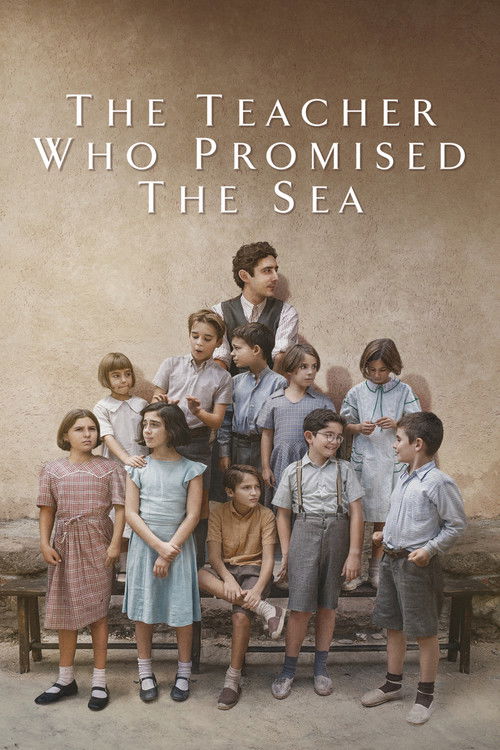
The Teacher Who Promised the Sea
2023 · Patricia Font
For when you need a good cry with a purpose — a film about kindness, memory, and why the past still needs unearthing. Emotionally demanding but ultimately restorative.
What it's about
In present-day Spain, a woman joins volunteers exhuming Civil War mass graves in search of a lost relative — and uncovers the story of Antoni Benaiges, a real young teacher who arrived in a stony hamlet in rural Burgos in the mid-1930s. His radical method let children write their own texts and print them on a classroom press, small booklets of their words and wishes — including his promise to one day show them the sea.
The experience
Warm and luminous in the classroom scenes, sobering in the present-day dig — the two timelines pull against each other so the joy always carries a shadow. It builds to real emotional weight; keep tissues nearby.
Performances
Enric Auquer plays the teacher with a lightness that makes the character's idealism feel lived-in rather than saintly — you understand why the children adore him.
The craft
Patricia Font, adapting Francesc Escribano's book, cross-cuts between the 1930s and today with a clean, classical touch, letting the children's printing press become the film's beating heart. The rural Spanish landscapes and period detail are handsomely mounted, and the emotional architecture is built with patience.
Why it matters
It belongs to Spain's ongoing reckoning with the unquiet dead of Francoism, bringing the country's historical-memory movement — and a real forgotten educator — to a wide popular audience.
Patricia Font's drama moves between two Spains: a present in which a woman joins the volunteers exhuming Civil War mass graves, and the mid-1930s, when Antoni Benaiges, a young Catalan schoolmaster from Tarragona, arrives in a stony hamlet in rural Burgos. Benaiges was real, and so was his method — the Freinet system, imported from France, in which children composed their own texts and set them in type on a classroom printing press, publishing little booklets of their words and wishes. Font, working from Francesc Escribano's book, frames his story within Spain's memoria histórica movement, the ongoing national reckoning with the unquiet dead of Francoism that cinema — from Guillermo del Toro's gothic fables to a wave of recent documentaries — keeps circling. Enric Auquer plays the teacher with a lightness that makes the gathering dread land harder. The pamphlets his pupils printed survive in archives today; one of them was titled 'The Sea,' a thing none of those inland children had ever seen.
Reception
It opened quietly in Spain in November 2023 on barely 80 screens, then did the rarest thing in modern box office: grew week over week on pure word of mouth, outlasting the Hollywood tentpoles around it and landing five Goya nominations. Its second act came on Netflix, where it found a far bigger international audience than its theatrical run ever suggested.
How The Teacher Who Promised the Sea was received, from release to now →
Influences: the films it descends from and the films it influenced
- La lengua de las mariposas (1999) — Establishes the exact narrative template Font inherits — a Republican teacher applying progressive, anti-clerical pedagogy who bonds with a working-class pupil, the idyll snapped shut by a Francoist denunciation delivered as a single devastating word/act.
- El espíritu de la colmena (1973) — Bequeaths the child's-eye grammar of a hushed post-war Castilian schoolroom, honeycomb-window light and long silences carrying the political weight the dialogue withholds.
- Zéro de conduite (1933) — The founding text of anti-authoritarian classroom cinema from Freinet's own French moment — liberatory play staged against institutional repression, the pedagogical formal register Font's Freinet-method scenes revive.
- L'enfant sauvage (1970) — Models the teacher-as-protagonist procedural, dramatizing method itself — the patient, documented experiment of instruction — as the engine of scenes rather than backdrop.
- Los santos inocentes (1984) — Sets the model for the literary-adaptation prestige rural drama built on the isolated Spanish hamlet as a site of class oppression, its landscape framed as a moral indictment.
- Soldados de Salamina (2003) — Prototypes the dual-timeline memoria-histórica structure in which a present-day researcher reconstructs a buried Civil War life from documents and testimony, the investigation itself becoming the film's spine.
- El laberinto del fauno (2006) — Refracts Francoist brutality through a child's world in a remote rural setting, calibrating the collision of innocence and repression that Font's classroom idyll depends on.
- The Silence of Others (2018) — Carries the memoria-histórica project into the register of exhumation and recovery of the disappeared, the present-day unearthing of Francoist crimes that Font's frame-story of locating a teacher's remains mirrors.
- Être et avoir (2002) — Shares the observational grammar of the single-room rural school, letting the daily teacher-pupil rhythm and the printing/writing tasks become the drama.
- Pa negre (2010) — Extends the post-war rural childhood seen from below into gothic-tinged period craft, prestige art direction and Catalan setting rendering historical trauma through a boy's discoveries.
- Mar adentro (2004) — Builds an entire Spanish drama on the sea as governing metaphor of longing and liberation — the same symbolic device Font organizes around a teacher's unkept promise.
- Machuca (2004) — Fuses progressive schoolroom pedagogy with looming political catastrophe, using the cross-class teacher-pupil bond as the lens on an approaching state violence.
- Entre les murs (2008) — Makes the classroom itself the dramatic engine through naturalistic process-cinema, the pedagogical exchange — not events outside — generating the tension.
- Mientras dure la guerra (2019) — Centers an educator (Unamuno) as the moral conscience destroyed by Francoist ascendancy, the intellectual-versus-fascism confrontation staged as intimate period drama.
- La trinchera infinita (2019) — Dramatizes Francoist repression at domestic, individual scale over the long aftermath, the same intimate-history approach that resists battlefield spectacle.
- Las 13 rosas (2007) — Dramatizes real Francoist executions of ordinary Republicans as based-on-true-story prestige memory cinema, martyrdom rendered through named, documented victims as Font does with Benaiges.
Similar films
- The Sea Inside (2004) — influence & lineage
- The Spirit of the Beehive (1973) — influence & lineage
- Radical (2023) — same viewing thread
- The Chorus (2004) — shared sensibility
- Twenty-Four Eyes (1954) — shared sensibility
- Close Your Eyes (2023) — shared sensibility
- All That's Left of You (2025) — shared sensibility
- Romería (2025) — shared sensibility
All the films related to The Teacher Who Promised the Sea →
Watch it with: curated runs of related films
- True Stories of Quiet Defiance — A run of recent fact-based dramas to watch when you want one person's stubborn dignity set against a system built to grind it down — a teacher, a student, a boy, a woman, each refusing the verdict handed to them.